Who has a METAS movement that is losing time?

Posts
234
Likes
153
Interesting how after a few months the movement starts going in the minus direction. Have you been wearing daily?


My SMP 8800 loses about -0.5 to -1sec/day. It’s about 2 months old. Started with +2 sec/day. Randomly, it may gain a second here and there. Not sure if I should send it to Omega now because in the grand scheme of things, -1 sec/day is crazy accurate. Maybe when it goes way off spec or before the warranty runs out I might go ahead and send it in.
 
Posts
89
Likes
180
It's amazing to me that a mechanical device, with intricate and often delicate parts, and such tight tolerances, can be so accurate. Especially considering it is strapped to someone's wrist where it undergoes constant and unpredictable movement, and some extreme acceleration (and sometimes deceleration off a door... ).

Even if the variation between the worst positions during METAS certification is 15s per day, that's only off by 0.017%!
 
Posts
32
Likes
10
It splits the week with a SubC Date, so about 50% of the time. I’m trying out the dial down trick to see how the movement reacts.

Interesting how after a few months the movement starts going in the minus direction. Have you been wearing daily?
 
Posts
32
Likes
10
So true! I just think that the whole “tolerance” of 0 to +5 sec/day throws a lot of people off. If they were to have certified it to say a superlative chronometer of -2 to +2 sec/day, this thread wouldn’t exist haha.

It's amazing to me that a mechanical device, with intricate and often delicate parts, and such tight tolerances, can be so accurate. Especially considering it is strapped to someone's wrist where it undergoes constant and unpredictable movement, and some extreme acceleration (and sometimes deceleration off a door... ).

Even if the variation between the worst positions during METAS certification is 15s per day, that's only off by 0.017%!
 
Posts
3
Likes
0
Except that neither POinNY or I's watches have demonstrated that supposed average... and if this is indeed normal behavior, then it just seems misleading to say that the METAS calibers are "tested with precision criteria of 0/+5 seconds per day". Doesn't that seem to indicate that your watch should run within those specs?

As I mentioned earlier, I'd totally rather my watch gain 4 or 5 seconds per day rather than lose just half a second. The fact that the real world performance of the watch is outside of what it is supposed to be certified for is quite frustrating, especially given the additional premium for a METAS/Master Chronometer watch.

And I found this thread because I bought a new Aqua Terra. I've had it 3 weeks now. It consistently loses 2spd regardless of what I do - wear it all night, put it on a winder, lay it down crown up, crown down, on its face . . ..

It is pretty disappointing to me because I bought an Omega specifically because its alleged accuracy. I thought I was going to buy a JLC, but as I researched, I was taken in by the technology.

Adding insult to injury, I was given the wrong box from an Omega Boutique and don't have access to the original testing report for the watch.

Is 2 seconds a day critical to my existence? Absolutely not. But the dashed expectations are what hurts. If I thought I was buying a watch that was +_ 2 sec I'd be fine with it. But that is not what I thought I was buying.
 
Posts
261
Likes
201
And I found this thread because I bought a new Aqua Terra. I've had it 3 weeks now. It consistently loses 2spd regardless of what I do - wear it all night, put it on a winder, lay it down crown up, crown down, on its face . . ..

It is pretty disappointing to me because I bought an Omega specifically because its alleged accuracy. I thought I was going to buy a JLC, but as I researched, I was taken in by the technology.

Adding insult to injury, I was given the wrong box from an Omega Boutique and don't have access to the original testing report for the watch.
You don’t have the METAS card or warranty card either? I’d go back to the OB
 
Posts
7,678
Likes
14,202
And I found this thread because I bought a new Aqua Terra. I've had it 3 weeks now. It consistently loses 2spd regardless of what I do - wear it all night, put it on a winder, lay it down crown up, crown down, on its face . . ..

It is pretty disappointing to me because I bought an Omega specifically because its alleged accuracy. I thought I was going to buy a JLC, but as I researched, I was taken in by the technology.

Adding insult to injury, I was given the wrong box from an Omega Boutique and don't have access to the original testing report for the watch.

Is 2 seconds a day critical to my existence? Absolutely not. But the dashed expectations are what hurts. If I thought I was buying a watch that was +_ 2 sec I'd be fine with it. But that is not what I thought I was buying.
I wouldn't be upset with a -2 sec/day rate if it is consistent. People get funny if the rate is negative, but -2 is the same accuracy as +2.

Didn't you get the three red cards with your watch.....Warranty, Pictograms and METAS? I'd insist the dealer supply those.
 
Posts
3
Likes
0
I have cards, just for the wrong watch! They are purportedly taking care of it.🤬

Again, the problem is the creation of expectations.
 
Posts
261
Likes
201
I have cards, just for the wrong watch! They are purportedly taking care of it.🤬
They’ll take care of it. And if the -2 bothers you then send it in. But expect 4-8 weeks to get it back.
 
Posts
32
Likes
26
I’m looking for some feedback from those who have PO 8900s/8800s and SMP 8800s and notice their watches losing time over 24 hour periods.
I've had a total of 3 Planet Ocean 8900s: two of them were -0.5 and -1 sec per day and one was +1 sec per day. All were bought new. Because two of these lost time after 24 hours, I'm chalking it up those two having much tighter tolerances than the other one that gained. When I registered these watches on the Omega website and looked at the individual performance results, the two watches that lost time over a 24hr period always had an average that was closer to 0, while the one that gained had an average of 4.6 sec per day in a range of 0-5 seconds.

I'm think the loss might be normal because my first PO 8900 that lost time, I sent it over to Omega for diagnostics and testing. They had it for a week and reported that it was within METAS specs, but on my wrist that was never the case. I've seen numerous other people here and watchuseek.com with METAS movements post about how their watches lose time in a 24 hour period, usually ranging from -2 to -0.5. I find it odd because theoretically a METAS movement should never lose time. But I also know that if the watch spends most of its time in a slow position, that will skew the accuracy.

With my latest PO 8900 purchased only a week ago, I notice it'll lose 1.5 seconds over 15 hours of wrist time. When I set it at night, crown up, it'll gain 0.5 seconds back so the total loss over 24 hours is 1 second. I think crown up is the "fast" position for this particular watch, but the only issue is that it doesn't make up for what it lost fast enough. I'm hopeful this will improve since it's still a new watch, but I've been reading that "settling in" and "break in" periods for mechanical watches are just myths.

Is there anyone else with a METAS movement noticing a loss over 24 hours?
 
Posts
32
Likes
26
I’m looking for some feedback from those who have PO 8900s/8800s and SMP 8800s and notice their watches losing time over 24 hour periods.
I've had a total of 3 Planet Ocean 8900s: two of them were -0.5 and -1 sec per day and one was +1 sec per day. All were bought new. Because two of these lost time after 24 hours, I'm chalking it up those two having much tighter tolerances than the other one that gained. When I registered these watches on the Omega website and looked at the individual performance results, the two watches that lost time over a 24hr period always had an average that was closer to 0, while the one that gained had an average of 4.6 sec per day in a range of 0-5 seconds.

I'm think the loss might be normal because my first PO 8900 that lost time, I sent it over to Omega for diagnostics and testing. They had it for a week and reported that it was within METAS specs, but on my wrist that was never the case. I've seen numerous other people here and watchuseek.com with METAS movements post about how their watches lose time in a 24 hour period, usually ranging from -2 to -0.5. I find it odd because theoretically a METAS movement should never lose time. But I also know that if the watch spends most of its time in a slow position, that will skew the accuracy.

With my latest PO 8900 purchased only a week ago, I notice it'll lose 1.5 seconds over 15 hours of wrist time. When I set it at night, crown up, it'll gain 0.5 seconds back so the total loss over 24 hours is 1 second. I think crown up is the "fast" position for this particular watch, but the only issue is that it doesn't make up for what it lost fast enough. I'm hopeful this will improve since it's still a new watch, but I've been reading that "settling in" and "break in" periods for mechanical watches are just myths.

Is there anyone else with a METAS movement noticing a loss over 24 hours?
 
Posts
32
Likes
26
I have a 2018 SMP and have had it for about a year. In the 1st few months I’d get +1/3 spd wearing and +4/6 spd in any position at rest. Almost a year later I’ve noticed I now get -1/3 spd wearing it, and 0/-2 spd at rest. I called omega and spoke a few reps who were a little unenthusiastic at best, but they are sending a shipping package. I don’t even want to send it out, but I’ll see how things go. Anyhow, kind of disappointed as it is stated that it is not supposed to lose time.. My aqua terra has been consistent for over 2 years at about +2/4 per day mixed wear and rest. anyway my 2 cents.
 
Posts
208
Likes
311
An easy fix is to get more watches than you need. That way you’ll be negligent on checking the specs for each watch and let them wind down, which will mean you’ll have to reset it back to time.
 
Posts
1,438
Likes
2,213
An easy fix is to get more watches than you need. That way you’ll be negligent on checking the specs for each watch and let them wind down, which will mean you’ll have to reset it back to time.

That is my technique exactly. Just as with risk, I find that spreading one's OCD tendencies across a decent stable watches reduces the amount of detailed scrutiny that any one piece must weather. All of mine are a little bit slow or fast, a little bit scratched, and a little bit loose or tight. Makes for much less stress overall.
 
Posts
29,665
Likes
76,819
Anyhow, kind of disappointed as it is stated that it is not supposed to lose time.

You should probably read this entire thread...from a post I made earlier in this thread:

Omega states that the watch will run with an average daily rate of between 0 and 5 seconds per day when measured in their testing. Again this doesn’t mean the watch will never run slow.

This is simple math - if the average rate can be zero, then unless all positions run at zero, some will run slow and some fast.

To fully understand the implications of this, please read this thread (again a thread referenced earlier in this thread):

https://omegaforums.net/threads/timing-tolerances-a-guide-to-understand-how-they-work.87293/

Cheers, Al
 
Posts
208
Likes
311
That is my technique exactly. Just as with risk, I find that spreading one's OCD tendencies across a decent stable watches reduces the amount of detailed scrutiny that any one piece must weather. All of mine are a little bit slow or fast, a little bit scratched, and a little bit loose or tight. Makes for much less stress overall.
As much as I posted my comment as a joke, there’s definite truth to this too. Glad we have similar sentiments.

I remember when I first started collecting I had this OCD tendency on accuracy and maintaining perfection. But now that I’m about 25 watches in the hole, those things don’t matter as much.

As well my foray to vintage watches seems to have changed the “rules” of my OCD. With vintage watches scratches don’t matter but add, and keeping time doesn’t matter as much as admiring the beauty of a time piece.

cheers
 
Posts
2,326
Likes
1,884
My only METAS-certified watch is my new Railmaster LE. Its average daily rate is +2.9s, and on the wrist this watch is dead nuts accurate, perhaps +10 after a couple of weeks. I'm quite happy with that.

I wear my watches to bed, by the way.

Tom
 
Posts
6
Likes
8
Found this thread because my new Omega Planet Ocean Seamaster 8800 is losing time erratically. I had it for a week and 24h results are:
-1, -6, -4, -2, -6, -22
I wear the watch practically all the time.

So, always negative, and last 24 hours is almost 4x larger than any previous one (I had to double check that, because it is so out of line).

Due to covidness around I'd have to wait till the shops are open. I'll spend that time trying to find an overnight position which can counteract slowness (seems like wearing them to bed adds a bit of variance).

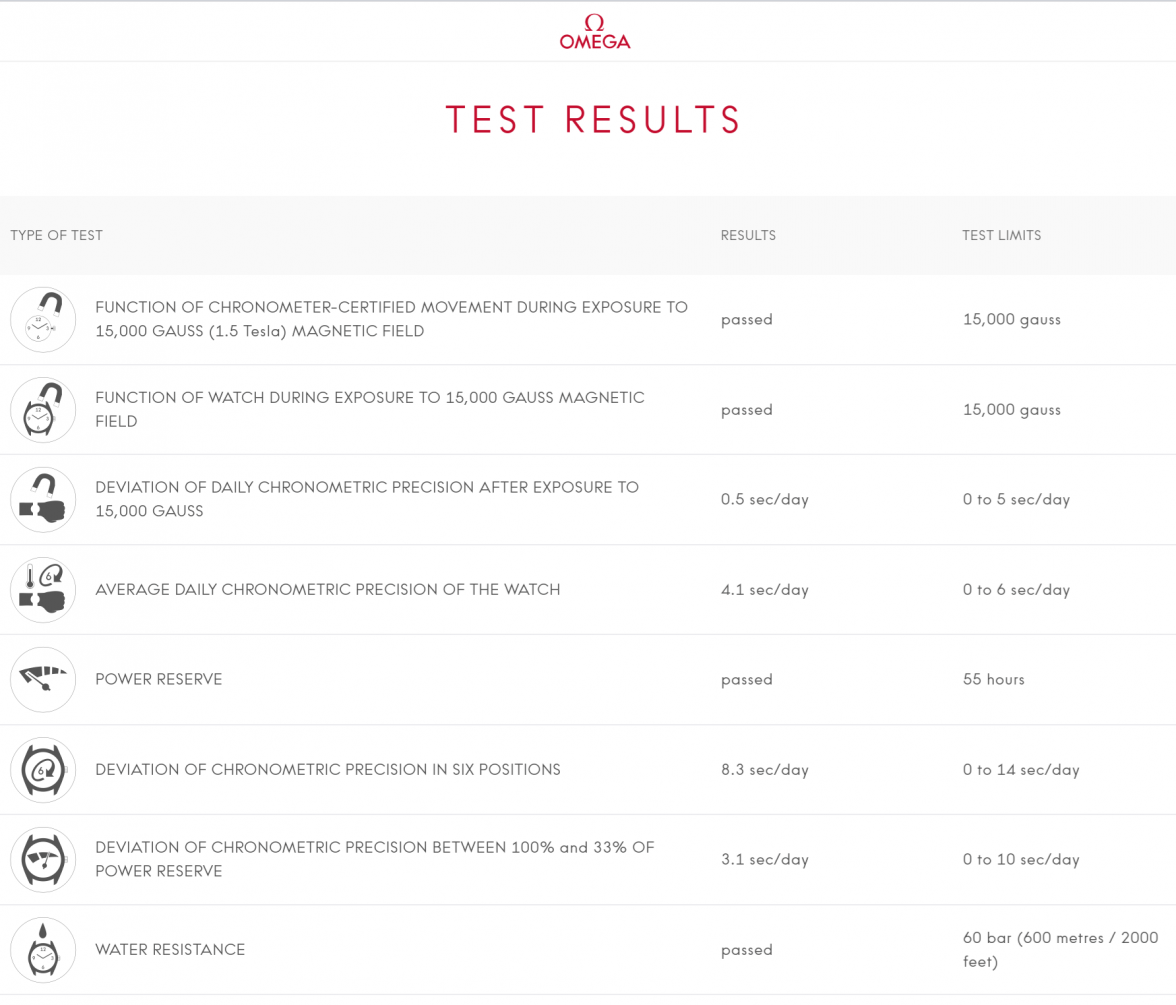
This is my METAS test results, even if 8.3s/day added to 3.1s/day that is still far from 20s I observed.

Edited:
 
Posts
203
Likes
58
I have a 2018 SMP and have had it for about a year. In the 1st few months I’d get +1/3 spd wearing and +4/6 spd in any position at rest. Almost a year later I’ve noticed I now get -1/3 spd wearing it, and 0/-2 spd at rest. I called omega and spoke a few reps who were a little unenthusiastic at best, but they are sending a shipping package. I don’t even want to send it out, but I’ll see how things go. Anyhow, kind of disappointed as it is stated that it is not supposed to lose time.. My aqua terra has been consistent for over 2 years at about +2/4 per day mixed wear and rest. anyway my 2 cents.

Did you get an answer from Omega on this? I only have a Seamaster 8800 that I bought new and noticing an issue. When I first got it, it would gain 1 second per day. The normal position that it would always gain time was overnight with dial up. Suddenly, one night it started to lose time in that position and ever since, I’d say it’s overall -1 second per day. I don’t mind it but the sudden change in accuracy has me curious. The watch has never been banged around or handled roughly, so I’m even more curious. In the grand scheme of things I can’t say I’m really bothered though. If/when it gets really bad then I’ll send it to Omega.

from the looks of it, others here have a similar issue, not with the watch running slow, but a sudden change in rate where it was previously running fast and is now on the slow end
Edited: