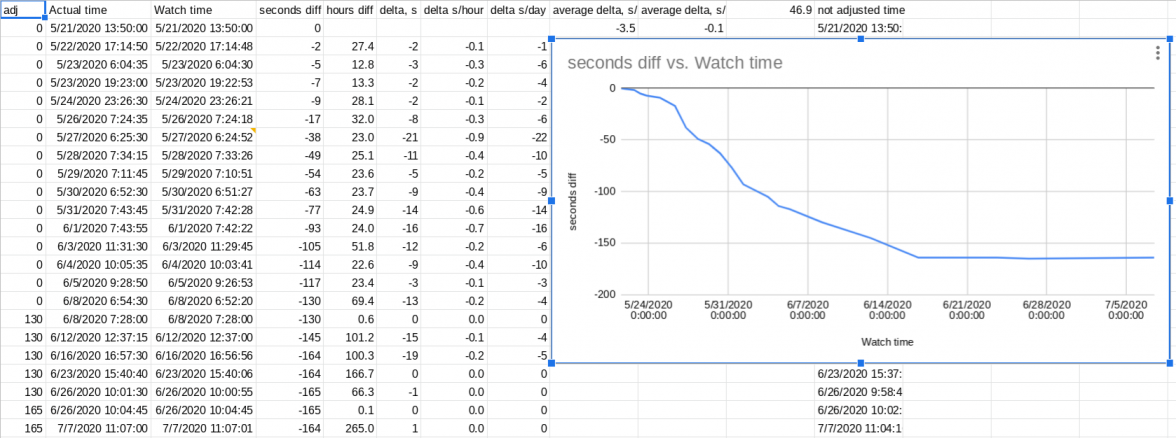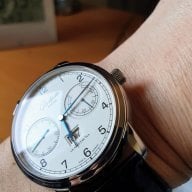
Who has a METAS movement that is losing time?

Posts
824
Likes
1,399
Did you get an answer from Omega on this? I created this thread a while ago for my PO8900 and it’s been sold since. I now only have a Seamaster 8800 that I bought new and noticing an issue. When I first got it, it would gain 1 second per day. The normal position that it would always gain time was overnight with dial up. Suddenly, one night it started to lose time in that position and ever since, I’d say it’s overall -1 second per day. I don’t mind it but the sudden change in accuracy has me curious. The watch has never been banged around or handled roughly, so I’m even more curious. In the grand scheme of things I can’t say I’m really bothered though. If/when it gets really bad then I’ll send it to Omega.

from the looks of it, others here have a similar issue, not with the watch running slow, but a sudden change in rate where it was previously running fast and is now on the slow end

My PO 8900 was purchased in January 2017 and consistently gained about 1-2 seconds per a day. Last month it started losing about 0.5 seconds per a day. It is close enough but it does make me wonder why it suddenly changed.
 
Posts
5,636
Likes
5,810
These watches are more magnetic resistant than older but they can still me magnetized.
 
Posts
6
Likes
8
just an update: after almost a month of more or less consistently being late the watch suddenly righted itself and now is on average loses 1.1 s/d while worn, but gains ~4s/d when dial is down, which averages out to +0.1s/d

I wonder that this is due to the fact that the watch was laying down in the warehouse somewhere for a long time and had to work through some stale lube.
 
Posts
6
Likes
1
hi. I just made an account only for this...
maybe one of you guys can explain this... (thx in advance!)
I got many watches and recently bought a timegrapher.
every watch seems ok and the results match with the type of the movement; with one exception:
my sm_300 1957reedition...8806 movement...(still under warranty)

fully wound (min/max/seconds a day):
dial up: -7/-5
dial down: 0/+1
12h: -1/+1
3h: -1/+1
6h: 0/+3
9h: +1/+3

after 24 hours (min/max/seconds a day):
dial up: -7/-8
dial down: 0/+1
12h: 0/+1
3h: 0/+1
6h: 0/+3
9h: +1/+3

beat error is 0,0 /0,2; amp is also fine with 270/300...
well the weird thing (to me) is that dial up means dial up...
...means: only in the exact horizontal position (dial up) the watch is losing that much time...(?)
if I move the watch on the timegrapher for only one millimeter into any other angle(e.g. if I put a toothpick under the timegrapher), the figures will get normal...
so what is this phenomenon? THANK YOU!
mike
Edited:
 
Posts
1,396
Likes
2,706
hi. I just made an account only for this...
maybe one of you guys can explain this... (thx in advance!)
I got many watches and recently bought a timegrapher.
every watch seems ok and the results match with the type of the movement; with one exception:
my sm_300 1957reedition...8806 movement...(still under warranty)

fully wound (min/max/seconds a day):
dial up: -7/-5
dial down: 0/+1
12h: -1/+1
3h: -1/+1
6h: 0/+3
9h: +1/+3

after 24 hours (min/max/seconds a day):
dial up: -7/-8
dial down: 0/+1
12h: 0/+1
3h: 0/+1
6h: 0/+3
9h: +1/+3

beat error is 0,0 /0,2; amp is also fine with 270/300...
well the weird thing (to me) is that dial up means dial up...
...means: only in the exact horizontal position (dial up) the watch is losing that much time...(?)
if I move the watch on the timegrapher for only one millimeter into any other angle(e.g. if I put a toothpick under the timegrapher), the figures will get normal...
so what is this phenomenon? THANK YOU!
mike

Wow, there's some detail and data in this post, all I do is wind, wear and enjoy these wonderful mechanical marvels, hope you get the answers you are looking for.
 
Posts
16
Likes
28
Interesting seeing the results of other 300M watches here is mine for comparison.
Not overly concerned about the time it loses still beats my Rolex when it comes to keeping track of time 😀

 
Posts
5,636
Likes
5,810
hi. I just made an account only for this...
maybe one of you guys can explain this... (thx in advance!)
I got many watches and recently bought a timegrapher.
every watch seems ok and the results match with the type of the movement; with one exception:
my sm_300 1957reedition...8806 movement...(still under warranty)

fully wound (min/max/seconds a day):
dial up: -7/-5
dial down: 0/+1
12h: -1/+1
3h: -1/+1
6h: 0/+3
9h: +1/+3

after 24 hours (min/max/seconds a day):
dial up: -7/-8
dial down: 0/+1
12h: 0/+1
3h: 0/+1
6h: 0/+3
9h: +1/+3

beat error is 0,0 /0,2; amp is also fine with 270/300...
well the weird thing (to me) is that dial up means dial up...
...means: only in the exact horizontal position (dial up) the watch is losing that much time...(?)
if I move the watch on the timegrapher for only one millimeter into any other angle(e.g. if I put a toothpick under the timegrapher), the figures will get normal...
so what is this phenomenon? THANK YOU!
mike
I believe that is actually out of spec. You might ask for it to be serviced under warranty.

But before you do, how does it keep time on the wrist?
 
Posts
29,664
Likes
76,817
I believe that is actually out of spec.

Depends what set of numbers you take...if you look at the fully wound set and use the highest rates, it's easily within spec. If you use the lowest rates, it's not. If I were to take the average of the lowest and highest rates, it's still in spec.
 
Posts
7,175
Likes
23,246
I believe that is actually out of spec. You might ask for it to be serviced under warranty.

But before you do, how does it keep time on the wrist?
Depends what set of numbers you take...if you look at the fully wound set and use the highest rates, it's easily within spec. If you use the lowest rates, it's not. If I were to take the average of the lowest and highest rates, it's still in spec.

I read this thread and others like it. The concepts seem to elude many members, so please...

 
Posts
5,636
Likes
5,810
Forgot to mention you need to know the category of your watch. My Railmaster LE is a Ib, if I remember right?
 
Posts
29,664
Likes
76,817
I read this thread and others like it. The concepts seem to elude many members, so please...


If you look at the full wind numbers that the OP posted, he gives two for each position - note that this is not how it's done, but this is what we have to work with...

The high set of numbers are all positive with the exception of dial up. If you average all those high numbers, it comes to +.67 s/d, so average rate falls within the 0 to +6 seconds range that is allowed. The Delta (difference between fastest and slowest positions) is 8 seconds, so it falls well within the 14 seconds allowed.

If you do the same with the lower numbers, the average rate is -1.33 and that is out of the average rate range, but the Delta is still 8 so fine.

If you take the average of the high and low for each position given, the average rate is -0.33, and the Delta is still 8. So my bad on that one as I must have misread a number yesterday doing this in my head, so this one is just under the minimum.

The Delta at 24 hours after full wind is still well within spec. and the timing numbers don't change much.

As much as you typically want dial up and dial down rates to match, overall this isn't terrible by any means. If it is a warranty claim will depend entirely on how it tests at Omega. No idea if the OP knows the proper way to use a timing machine, so if proper stabilization times were observed between positional readings for example so I'm not sure I would read a lot into this.

BTW the METAS link that VetPsychWars posted is all irrelevant to this issue really, as that is not the criteria that is used in the assessment of the watch for warranty. It will be the timing specs under Work Instruction 28 that are used.
 
Posts
6
Likes
1
I believe that is actually out of spec. You might ask for it to be serviced under warranty.

But before you do, how does it keep time on the wrist?

Well, the watch is pretty accurate while being worn on the wrist.
I think it's a strange behaviour of the movement since it only shows up in one exact position.
I’ve always felt that this watch is losing time while being stored dial up in the watchbox.
And I'm electronically testing the watch for several weeks now, always with the same results.
However, I never thought it is a big issue of the movement (till now) and there would be a more or less good explanation to this😀
thank you!
 
Posts
199
Likes
849
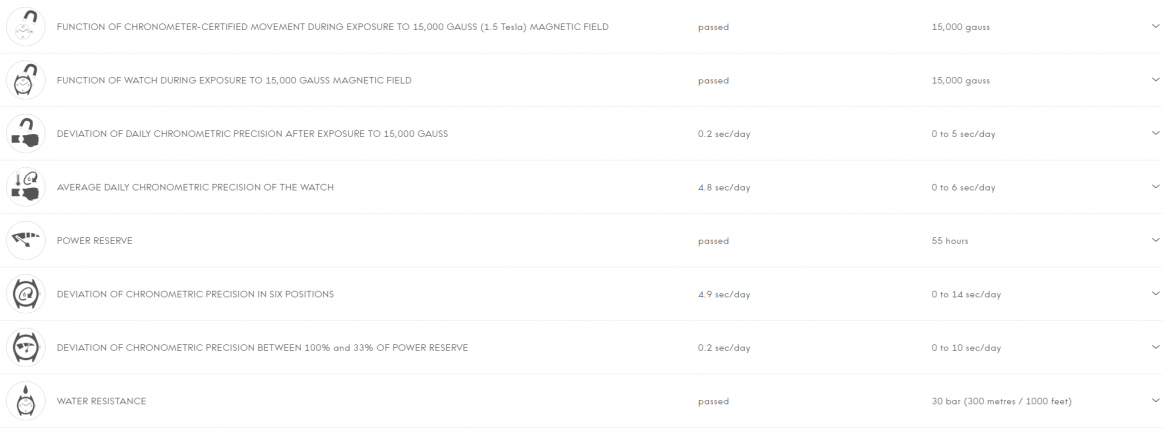
Here is my METAS data, FWIW

standard.jpg
 
Posts
2
Likes
0
I also have a theory....my watch is on my wrist maybe 15-16 hours a day and I see from many owners that this movement tends to lose time or run slower when worn (opposed to resting stationary). However, many are also not wearing it for 15-16 hours like I am - they’ll wear it maybe 10-12 hours a day. I’m thinking because they’re not subjecting the watch to as much wrist time, it allows things to balance out when they’re resting the watch at night.
I certainly agree with your theory based on my experience with my 2018 SMP 300m Diver. When I wear my watch occasionally or less than 10 hours, I noticed it lags approximately -1 spd. However, if I consistently wear my SMP for 13-16 hours daily, it averages +1.4 spd. I contacted an Omega technician last month about my SMP slowing down and he explained all Omega automatic watches needs a specific amount of rotations daily to maintain its timing. See the following link for details: https://www.omegawatches.com/fileadmin/Customer_Service/calleo/faq/FAQ-watch_winder_EN.pdf

For those owners experiencing a loss of time, perhaps try wearing your watch more than 10 hours daily and hopefully, the time loss will be resolved.
 
Posts
3
Likes
0
FWIW I had my SMP 8800 for about 5 months and ran at -5s/d. Took it into the OB and the watchmaker regulated it to match my wear habits. Ticks away at +2/3. The slowest it runs is 0spd in the crown down position.
 
Posts
2
Likes
0
Bought an Omega PO 8900CAL 2 weeks ago and the watch ticks -2spd. I noticed it doesn't gain time whatsoever in any of the positions when resting overnight. On wrist it loses -2 up to -4spd. So, for me, it loses time constantly in AVERAGE (I know some people really love being specific here).

That for me is out of spec for METAS. Do you agree?

I will give the watch a bit more time and if it doesn't change, I will take send it in for regulation as a warranty claim.
 
Posts
18,201
Likes
27,508
Bought an Omega PO 8900CAL 2 weeks ago and the watch ticks -2spd. I noticed it doesn't gain time whatsoever in any of the positions when resting overnight. On wrist it loses -2 up to -4spd. So, for me, it loses time constantly in AVERAGE (I know some people really love being specific here).

That for me is out of spec for METAS. Do you agree?

I will give the watch a bit more time and if it doesn't change, I will take send it in for regulation as a warranty claim.
your watch, over night position makes no difference, then send it in hopefully your not +4 on average with large positional changes when you get it back.
 
Posts
2
Likes
0
your watch, over night position makes no difference, then send it in hopefully your not +4 on average with large positional changes when you get it back.
Are you saying that I should leave it as it is, as it's kind of constant and without big variations...?
 
Posts
18,201
Likes
27,508
Are you saying that I should leave it as it is, as it's kind of constant and without big variations...?
I’m saying it’s a possibility since while your technically out of metas, it could end up not as accurate in Metas.