Who has a METAS movement that is losing time?

Posts
1,396
Likes
2,706
Fascinating discussion, whether my watch is a perfect timekeeper or not is something I’ve ever really worried about, I just accept that anything mechanical will behave differently depending on how the owner uses it.

If we own a car we know that our real world MPG is never as stated by the manufacturer as you can never replicate test conditions in your driving, so having a mechanical watch a few seconds out out is no big deal IMHO.

Great debate looking forward to reading more on this subject.
 
Posts
18
Likes
9
Sure they could, but from a business point of view, why would they? By the time most people have figured out that a tolerance like this doesn't mean that "the watch will never run slow" they have already bought the watch and aren't likely to take it back because of this. Shareholders are happy...😉
If I want it regulated to run fast instead of slow, will Omega do it under warranty?
 
Posts
29,665
Likes
76,819
If I want it regulated to run fast instead of slow, will Omega do it under warranty?

If it's running within specs, they have no obligation to do so, but they might do it as a courtesy.
 
Posts
18
Likes
9
If it's running within specs, they have no obligation to do so, but they might do it as a courtesy.
Thanks
 
Posts
18
Likes
9
If it's running within specs, they have no obligation to do so, but they might do it as a courtesy.
Here is the response from Omega:
"I have spoken with our workshop manager and he has advised that the tolerance range for your caliber is -0 +5 seconds. If your timepiece is losing 1 second per day consistantly this is a minor issue in which we can rectify by conducting a regulation."
They also suggested I wind it 40 turns to see if that helps. I've now done so and will see how it performs over the next few weeks, if it doesn't help I'll take it in to Omega.
 
Posts
33
Likes
28
I’m looking for some feedback from those who have PO 8900s/8800s and SMP 8800s and notice their watches losing time over 24 hour periods.
I've had a total of 3 Planet Ocean 8900s: two of them were -0.5 and -1 sec per day and one was +1 sec per day. All were bought new. Because two of these lost time after 24 hours, I'm chalking it up those two having much tighter tolerances than the other one that gained. When I registered these watches on the Omega website and looked at the individual performance results, the two watches that lost time over a 24hr period always had an average that was closer to 0, while the one that gained had an average of 4.6 sec per day in a range of 0-5 seconds.

I'm think the loss might be normal because my first PO 8900 that lost time, I sent it over to Omega for diagnostics and testing. They had it for a week and reported that it was within METAS specs, but on my wrist that was never the case. I've seen numerous other people here and watchuseek.com with METAS movements post about how their watches lose time in a 24 hour period, usually ranging from -2 to -0.5. I find it odd because theoretically a METAS movement should never lose time. But I also know that if the watch spends most of its time in a slow position, that will skew the accuracy.

With my latest PO 8900 purchased only a week ago, I notice it'll lose 1.5 seconds over 15 hours of wrist time. When I set it at night, crown up, it'll gain 0.5 seconds back so the total loss over 24 hours is 1 second. I think crown up is the "fast" position for this particular watch, but the only issue is that it doesn't make up for what it lost fast enough. I'm hopeful this will improve since it's still a new watch, but I've been reading that "settling in" and "break in" periods for mechanical watches are just myths.

Is there anyone else with a METAS movement noticing a loss over 24 hours?
 
Posts
33
Likes
28
No mechanical watch will keep perfect time,no matter who certifies it,or what the manufacturer claims!
I have three Speedmasters,all with 1861 movements.One is eight years old and was serviced by Omega four years ago,one is eighteen months old,the other two months old.I rotate them wearing each one for two weeks!
I fully wind the watch I am wearing ,then fifteen winds each morning.
I take the watch off at night and lie it flat,or the side away from the pushers.
Over fourteen days all my watches gain one minute,which is very consistent!
Edited:
 
Posts
1,925
Likes
4,958
There are 6 positions...

I think the formerly living artist formerly known as Prince said it best ... and according to him there are 49
 
Posts
1,925
Likes
4,958
I set this when we changed to daylight savings, 105 days ago.


I set my sundial some 14 years ago ... still absolutely bang on ... to the nanosecond ... only 2 moving parts (countless jewels though)
 
Posts
234
Likes
153
I've been monitoring my 8800 movement for about 4 months now since purchasing. Amazing accuracy but after 3+ months it is now running slow in the usually overnight positions that I use. No worries though because dial down is my go to position now to speed it up. I feel this shift started when it got warmer where I live as summer is kicking in.
Overall though the accuracy has been amazing!
 
Posts
922
Likes
493
I set my sundial some 14 years ago ... still absolutely bang on ... to the nanosecond ... only 2 moving parts (countless jewels though)

What app do you use to track the accuracy of the sundial?
 
Posts
33
Likes
43
I've been monitoring my 8800 movement for about 4 months now since purchasing. Amazing accuracy but after 3+ months it is now running slow in the usually overnight positions that I use. No worries though because dial down is my go to position now to speed it up.

Exactly my findings on my 8800. Crown down slows, dial down speeds up. Makes regulation very simple.
 
Posts
16,862
Likes
47,901
Oh I see.
Keeping it simple then 😀

Not that simple

About 140 AD, Ptolemy, the Alexandrian astronomer, sexagesimally subdivided both the mean solar day and the true solar day to at least six places after the sexagesimal point, and he used simple fractions of both the equinoctial hour and the seasonal hour, none of which resemble the modern second.[6]Muslim scholars, including al-Biruni in 1000, subdivided the mean solar day into 24 equinoctial hours, each of which was subdivided sexagesimally, that is into the units of minute, second, third, fourth and fifth, creating the modern second as 1⁄60 of 1⁄60 of 1⁄24 = 1⁄86,400 of the mean solar day in the process.[7] With this definition, the second was proposed in 1874 as the base unit of time in the CGS system of units.[8] Soon afterwards Simon Newcomb and others discovered that Earth's rotation period varied irregularly,[9] so in 1952, the International Astronomical Union (IAU) defined the second as a fraction of the sidereal year. Because the tropical year was considered more fundamental than the sidereal year, in 1955, the IAU redefined the second as the fraction 1⁄31,556,925.975of the 1900.0 mean tropical year. In 1956, a slightly more precise value of 1⁄31,556,925.9747was adopted for the definition of the second by the International Committee for Weights and Measures, and in 1960 by the General Conference on Weights and Measures, becoming a part of the International System of Units (SI).[10]

Eventually, this definition too was found to be inadequate for precise time measurements, so in 1967, the SI second was again redefined as 9,192,631,770 periods of the radiation emitted by a caesium-133 atom in the transition between the two hyperfine levels of its ground state.[11] That value agreed to 1 part in 1010 with the astronomical (ephemeris) second then in use.[12] It was also close to 1⁄86,400 of the mean solar day as averaged between years 1750 and 1892.

However, for the past several centuries, the length of the mean solar day has been increasing by about 1.4–1.7 ms per century, depending on the averaging time.[13][14][15] By 1961, the mean solar day was already a millisecond or two longer than 86,400 SI seconds.[16] Therefore, time standards that change the date after precisely 86,400 SI seconds, such as the International Atomic Time (TAI), will get increasingly ahead of time standards tied to the mean solar day, such as Greenwich Mean Time (GMT).

When the Coordinated Universal Time standard was instituted in 1961, based on atomic clocks, it was felt necessary to maintain agreement with the GMT time of day, which, until then, had been the reference for broadcast time services. Thus, from 1961 to 1971, the rate of (some) atomic clocks was constantly slowed to remain synchronised with GMT. During that period, therefore, the "seconds" of broadcast services were actually slightly longer than the SI second and closer to the GMT seconds.

In 1972, the leap-second system was introduced so that the broadcast UTC seconds could be made exactly equal to the standard SI second, while still maintaining the UTC time of day and changes of UTC date synchronized with those of UT1 (the solar time standard that superseded GMT).[11] By then, the UTC clock was already 10 seconds behind TAI, which had been synchronized with UT1 in 1958, but had been counting true SI seconds since then. After 1972, both clocks have been ticking in SI seconds, so the difference between their readouts at any time is 10 seconds plus the total number of leap seconds that have been applied to UTC (37 seconds as of January 2019).

https://en.m.wikipedia.org/wiki/Leap_second

 
Posts
922
Likes
493
Not that simple

About 140 AD, Ptolemy, the Alexandrian astronomer, sexagesimally subdivided both the mean solar day and the true solar day to at least six places after the sexagesimal point, and he used simple fractions of both the equinoctial hour and the seasonal hour, none of which resemble the modern second.[6]Muslim scholars, including al-Biruni in 1000, subdivided the mean solar day into 24 equinoctial hours, each of which was subdivided sexagesimally, that is into the units of minute, second, third, fourth and fifth, creating the modern second as 1⁄60 of 1⁄60 of 1⁄24 = 1⁄86,400 of the mean solar day in the process.[7] With this definition, the second was proposed in 1874 as the base unit of time in the CGS system of units.[8] Soon afterwards Simon Newcomb and others discovered that Earth's rotation period varied irregularly,[9] so in 1952, the International Astronomical Union (IAU) defined the second as a fraction of the sidereal year. Because the tropical year was considered more fundamental than the sidereal year, in 1955, the IAU redefined the second as the fraction 1⁄31,556,925.975of the 1900.0 mean tropical year. In 1956, a slightly more precise value of 1⁄31,556,925.9747was adopted for the definition of the second by the International Committee for Weights and Measures, and in 1960 by the General Conference on Weights and Measures, becoming a part of the International System of Units (SI).[10]

Eventually, this definition too was found to be inadequate for precise time measurements, so in 1967, the SI second was again redefined as 9,192,631,770 periods of the radiation emitted by a caesium-133 atom in the transition between the two hyperfine levels of its ground state.[11] That value agreed to 1 part in 1010 with the astronomical (ephemeris) second then in use.[12] It was also close to 1⁄86,400 of the mean solar day as averaged between years 1750 and 1892.

However, for the past several centuries, the length of the mean solar day has been increasing by about 1.4–1.7 ms per century, depending on the averaging time.[13][14][15] By 1961, the mean solar day was already a millisecond or two longer than 86,400 SI seconds.[16] Therefore, time standards that change the date after precisely 86,400 SI seconds, such as the International Atomic Time (TAI), will get increasingly ahead of time standards tied to the mean solar day, such as Greenwich Mean Time (GMT).

When the Coordinated Universal Time standard was instituted in 1961, based on atomic clocks, it was felt necessary to maintain agreement with the GMT time of day, which, until then, had been the reference for broadcast time services. Thus, from 1961 to 1971, the rate of (some) atomic clocks was constantly slowed to remain synchronised with GMT. During that period, therefore, the "seconds" of broadcast services were actually slightly longer than the SI second and closer to the GMT seconds.

In 1972, the leap-second system was introduced so that the broadcast UTC seconds could be made exactly equal to the standard SI second, while still maintaining the UTC time of day and changes of UTC date synchronized with those of UT1 (the solar time standard that superseded GMT).[11] By then, the UTC clock was already 10 seconds behind TAI, which had been synchronized with UT1 in 1958, but had been counting true SI seconds since then. After 1972, both clocks have been ticking in SI seconds, so the difference between their readouts at any time is 10 seconds plus the total number of leap seconds that have been applied to UTC (37 seconds as of January 2019).

https://en.m.wikipedia.org/wiki/Leap_second

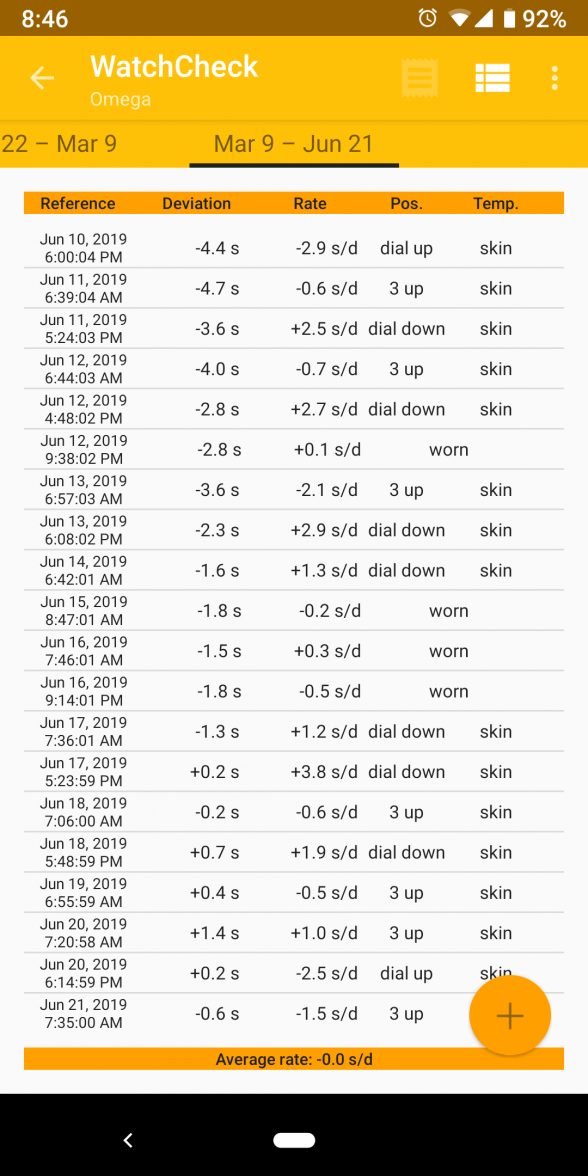
Is there an app to cover off on that.
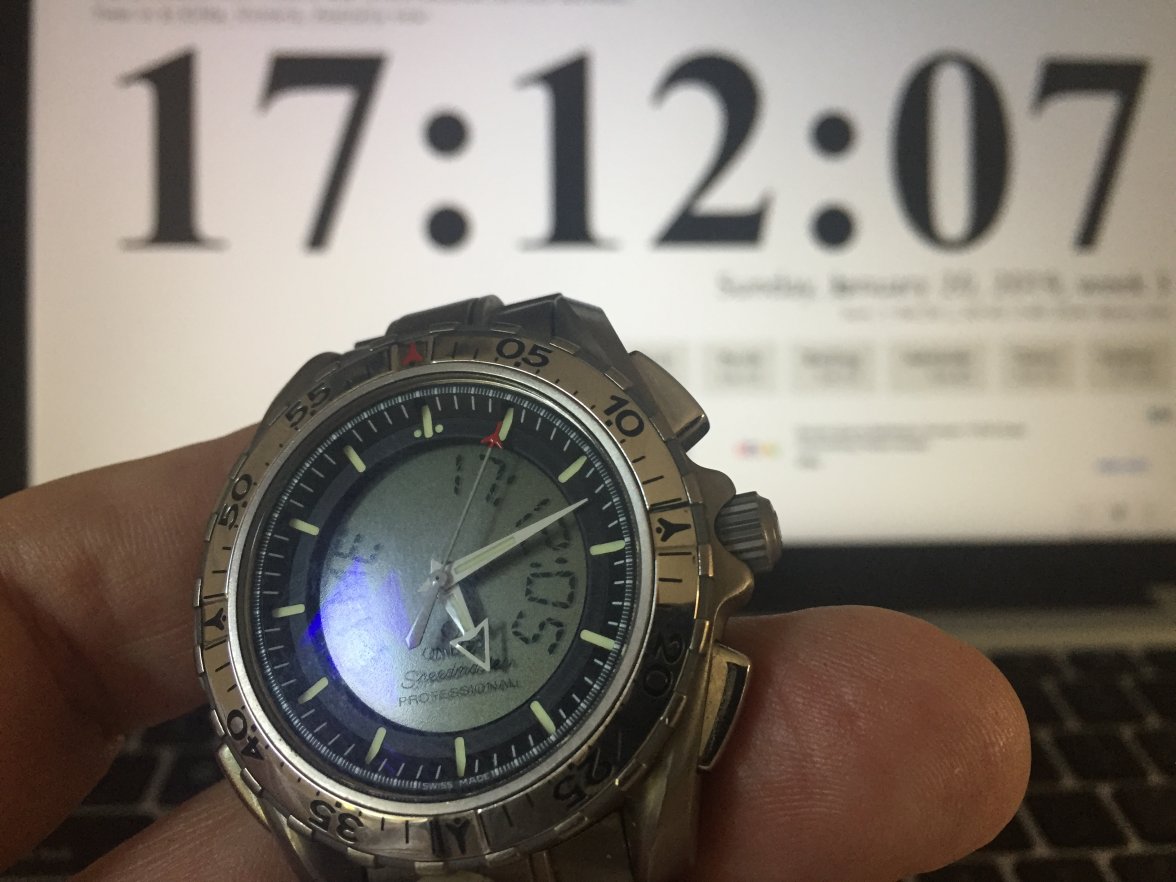
I want to check the accuracy of my Speedy.
 
Posts
125
Likes
148
Just revisited this interesting thread as my 2018 300M Diver is now running slow when in the drawer. I’ll give it some more solid wear this week (it’s been playing second fiddle to a new G-Shock for a bit) and see what happens.
 
Posts
1,396
Likes
2,706
Is there an app to cover off on that.
I want to check the accuracy of my Speedy.

Me too, I am concerned that my non METAS / COSC Speedy may be a second or two out, and that's a worry. 😗 😀 🙄
 
Posts
18
Likes
9
Just revisited this interesting thread as my 2018 300M Diver is now running slow when in the drawer. I’ll give it some more solid wear this week (it’s been playing second fiddle to a new G-Shock for a bit) and see what happens.
Over June my PO 8900 was losing 1 to 2 secs a day. I took it in to Omega a week ago and they are seeing what the problem is. Hope to get it back in a week or so.
 
Posts
32
Likes
10
My SMP 8800 loses about -0.5 to -1sec/day. It’s about 2 months old. Started with +2 sec/day. Randomly, it may gain a second here and there. Not sure if I should send it to Omega now because in the grand scheme of things, -1 sec/day is crazy accurate. Maybe when it goes way off spec or before the warranty runs out I might go ahead and send it in.