- Posts
- 648
- Likes
- 2,085
adi4
·All this talk of mechanical inaccuracy has me thinking about what (wrist) watch Citizen will put this baby in:

Please consider donating to help offset our high running costs.

Sure. The accuracy since the adjustment has been incredible. It is almost exactly 2 months since I received it and it is currently about 1 second fast, without having been reset at all!
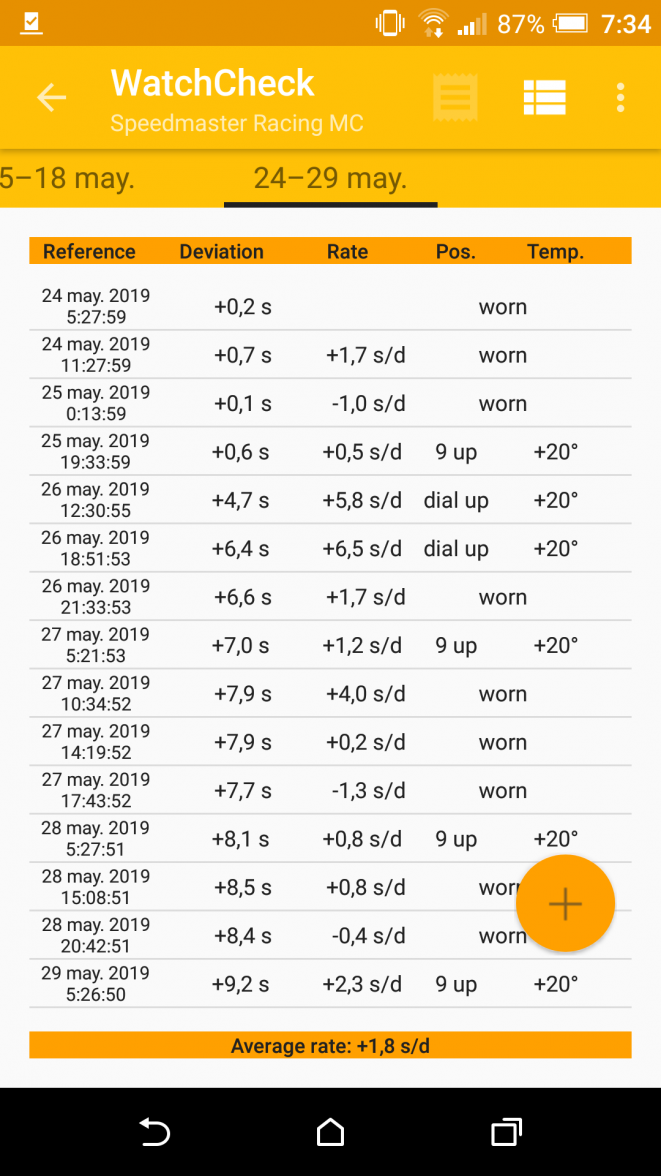
Out of curiosity, I had used an iPhone app to time it in each position when it returned from service. I found that all were within .5-3 seconds of perfect accuracy but that it lost a bit when resting crown up, so I began leaving it that way on my nightstand each night. It would then be almost perfectly back on real world time when I wake up, and will then gain a second or two by the time I go to bed the next night... then, repeat. Near perfect day-to-day accuracy.
So I’m very thrilled with the performance of the movement and the outcome of the servicing. It’s crazy to think that I can keep it within a second indefinitely without resetting (except for date changes) just by figuring out the timing of the position.

Sure. The accuracy since the adjustment has been incredible. It is almost exactly 2 months since I received it and it is currently about 1 second fast, without having been reset at all!
Out of curiosity, I had used an iPhone app to time it in each position when it returned from service. I found that all were within .5-3 seconds of perfect accuracy but that it lost a bit when resting crown up, so I began leaving it that way on my nightstand each night. It would then be almost perfectly back on real world time when I wake up, and will then gain a second or two by the time I go to bed the next night... then, repeat. Near perfect day-to-day accuracy.
So I’m very thrilled with the performance of the movement and the outcome of the servicing. It’s crazy to think that I can keep it within a second indefinitely without resetting (except for date changes) just by figuring out the timing of the position.

Nope - not even close. Metas watches are not specified to be anywhere near that accurate...

I've had my PO 8900 for 9 months. When I first bought it the watch gained about 1 second a day. Then it would gain for some days and suddenly not gain or lose for a number of days. Then it became erratic and would lose say 1 second a day for a while and then correct itself and gain a small amount. Since I adjusted the hour hand for the end of daylight savings in early April it first gained and now is often losing up to 1 second a day. Over the last few months it first gained up to almost 20 seconds and is now only about 6 seconds fast. I always rest it crown up overnight. So all in all there is no consistency. Any thoughts?
It sounds pretty consistent to me. If it’s only gaining or losing about 1-2 sec/day depending on your activity and the temperature, and has never been more than 20 seconds off of atomic time after a few months, and it is now only 6 seconds fast overall after 9 months of running, then it can’t get any better than that.


I’ve raised this with my AD. He says only be worried if it’s losing time. My 8900 typically runs +2s per day with daily use, but will stay at +5s face up in the box. I tend to keep on the winder now when not in use and wear evenings and weekends. I have to say, it’s the least accurate watch I own as due to the band of rates it runs at. At least I only have to pull the crown out and wait for time to catch up once a week. This doesn’t bother me any more. My Tudor is very accurate, but consistently loses 1-2s per day regardless of position or wear. This is a pain, so need to set fast every few weeks.
My serviced SM120 at 18 years old is the best at +/-1s. I guess this demonstrates that the new watches aren’t adjusted meticulously, just with tolerance. Later on at point of service, the watch maker can spend more time. Only another 9 years for the PO before service no. 1.
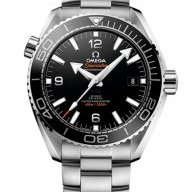

I’m looking for some feedback from those who have PO 8900s/8800s and SMP 8800s and notice their watches losing time over 24 hour periods.
I've had a total of 3 Planet Ocean 8900s: two of them were -0.5 and -1 sec per day and one was +1 sec per day. All were bought new. Because two of these lost time after 24 hours, I'm chalking it up those two having much tighter tolerances than the other one that gained. When I registered these watches on the Omega website and looked at the individual performance results, the two watches that lost time over a 24hr period always had an average that was closer to 0, while the one that gained had an average of 4.6 sec per day in a range of 0-5 seconds.
I'm think the loss might be normal because my first PO 8900 that lost time, I sent it over to Omega for diagnostics and testing. They had it for a week and reported that it was within METAS specs, but on my wrist that was never the case. I've seen numerous other people here and watchuseek.com with METAS movements post about how their watches lose time in a 24 hour period, usually ranging from -2 to -0.5. I find it odd because theoretically a METAS movement should never lose time. But I also know that if the watch spends most of its time in a slow position, that will skew the accuracy.
With my latest PO 8900 purchased only a week ago, I notice it'll lose 1.5 seconds over 15 hours of wrist time. When I set it at night, crown up, it'll gain 0.5 seconds back so the total loss over 24 hours is 1 second. I think crown up is the "fast" position for this particular watch, but the only issue is that it doesn't make up for what it lost fast enough. I'm hopeful this will improve since it's still a new watch, but I've been reading that "settling in" and "break in" periods for mechanical watches are just myths.
Is there anyone else with a METAS movement noticing a loss over 24 hours?

Omega never made that claim though...
It was posted on the previous page of this thread, but I'll post it here again so you can read it. This will explain why your expectations are not realistic:
https://omegaforums.net/threads/timing-tolerances-a-guide-to-understand-how-they-work.87293/
Cheers, Al

Thanks for your valuable input Archer, you have enlightened me already on this topic.
Do you think Omega could be clearer about this?