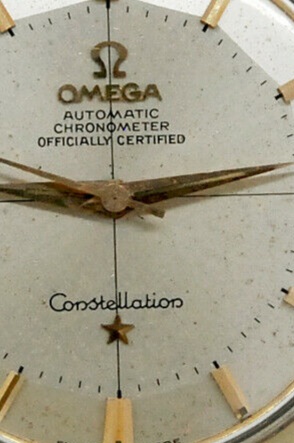
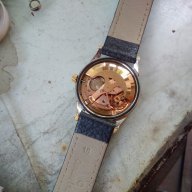
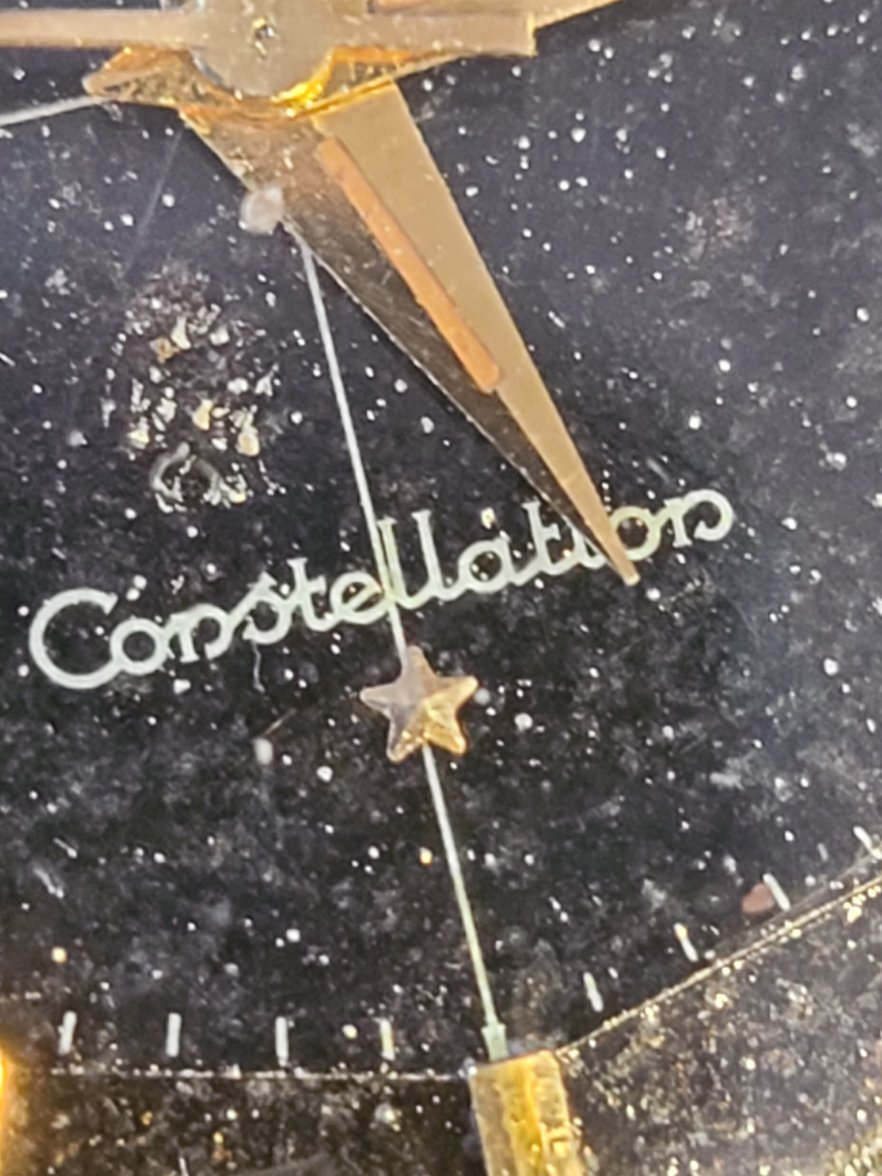
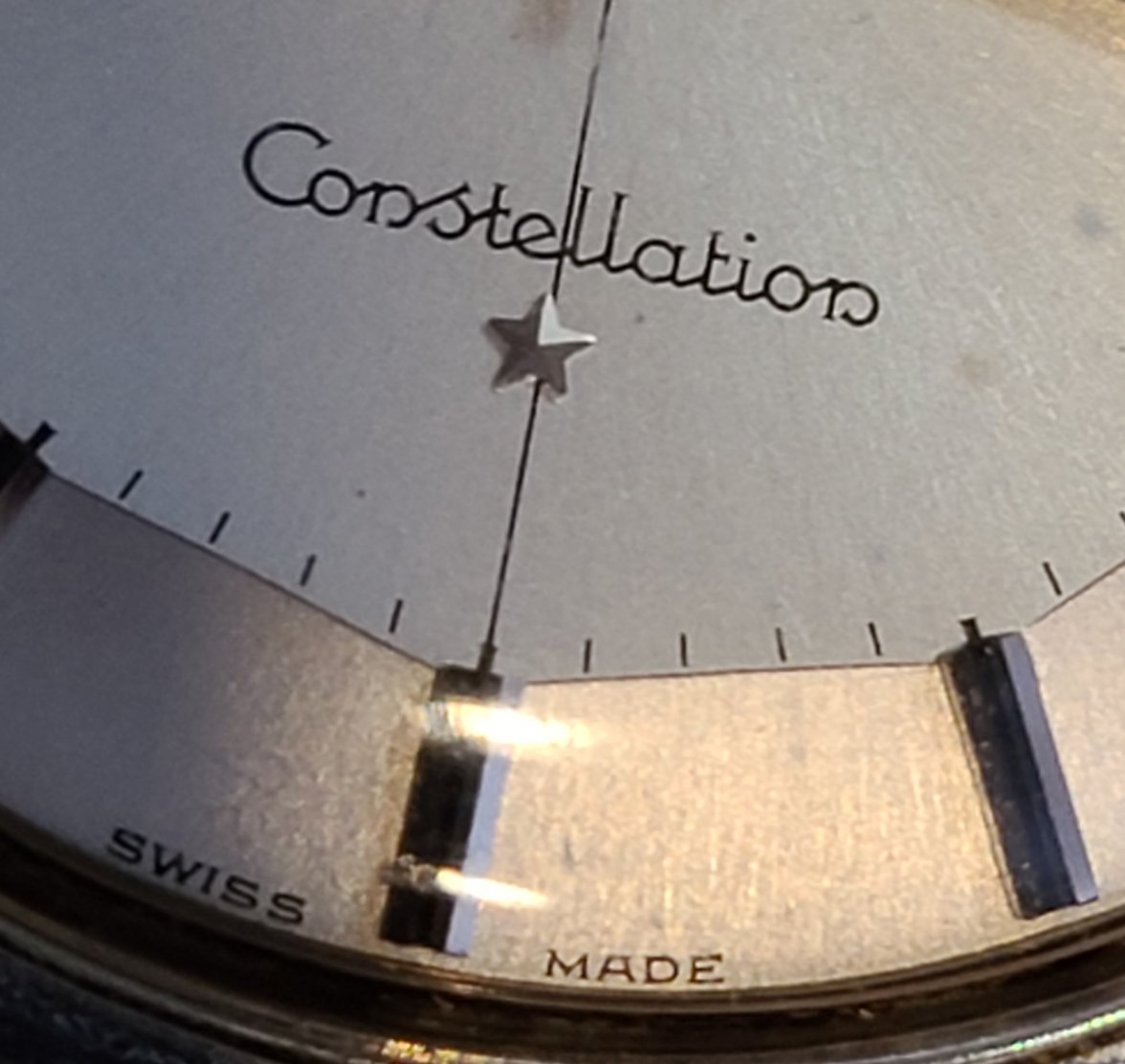
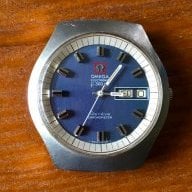
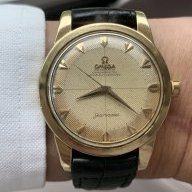
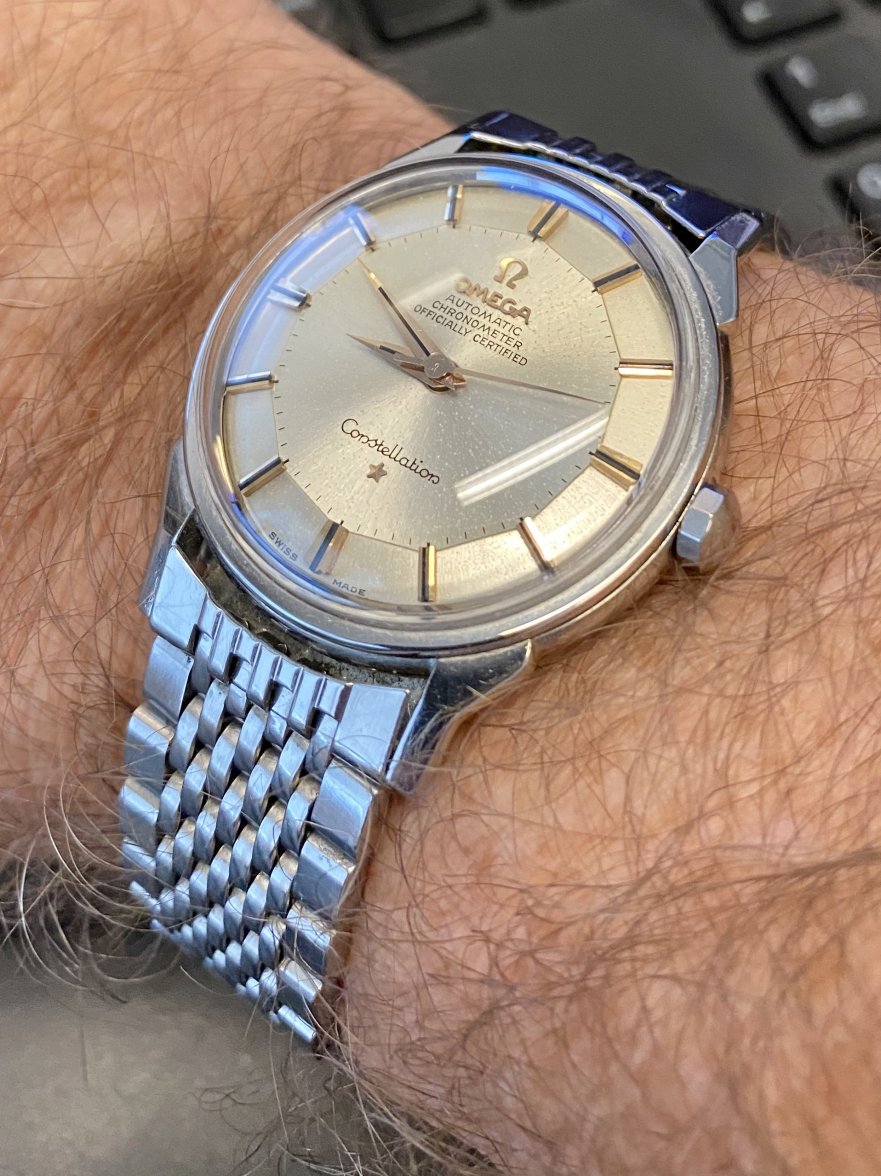
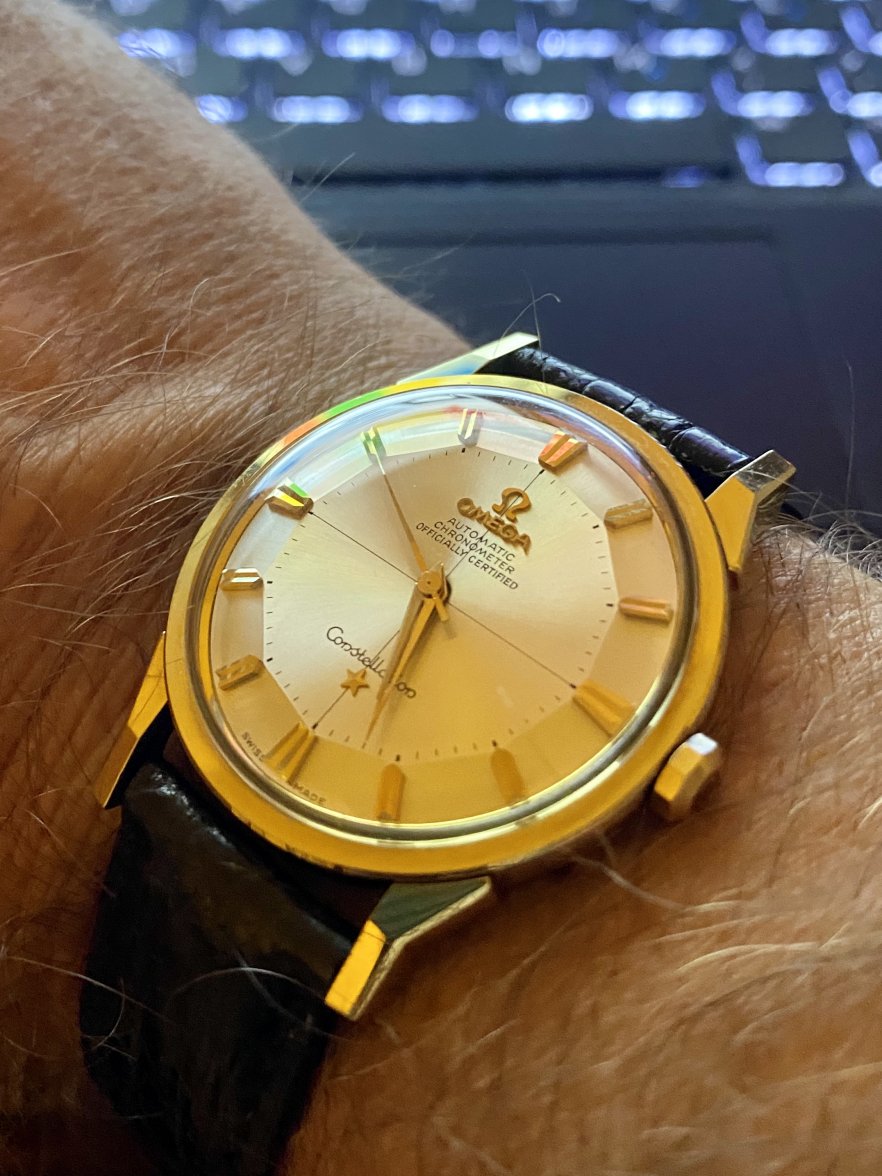
Is this a redial constellation piepan ?

Posts
3,731
Likes
6,337
If you can post this area with high resolution, I can tell for sure
 
Posts
50
Likes
85
If you can post this area with high resolution, I can tell for sure
I just won the bid so im thinking seriously if i should cancer this order cuz there are some suspicious things from descriptions ..
 
Posts
15
Likes
4
I also think the cross hair has to be thinner and run closer to the "L".
 
Posts
3,731
Likes
6,337
I just won the bid so im thinking seriously if i should cancer this order cuz there are some suspicious things from descriptions ..
What I want to see is the serif of the font and the markers like in these photos. The cross hair and where it cuts.

 
Posts
10,309
Likes
16,133
I have to disagree with you here @Dan S If you see a polygon shape at what you call the step it’s a genuine pie pan and not just a trick of the brushing. The step as you call it is more obvious on some than others. It is not the defining pp feature. It often gets softened when dials are repainted but is sometimes not extreme to start with. It’s the polygonal shape made by the plane change which is key, not the step which is likely just a consequence of the stamping process and quite variable. Don’t get hung up on steps, that is more a Speedmaster feature.

The Op dial is most certainly a pie pan.

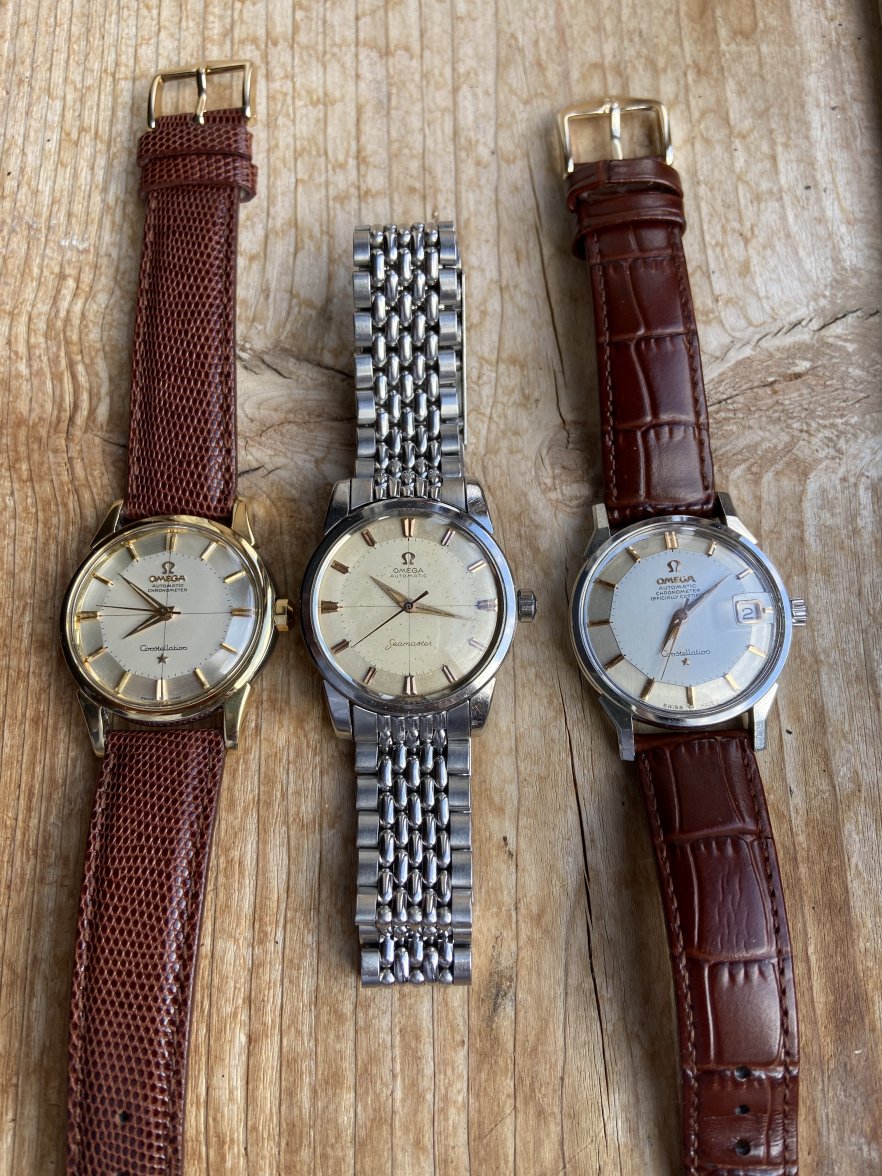
To demonstrate my point. Here are 2 PP Connies on either side of a dome dial SM 2846 which uses brushing to give a faux PP effect like you describe. The Op watch by comparison seems to have pretty uniform brushing.

Note the circular brush edge on the faux one and also how the RH Connie has a much more pronounced step than the watch on the LHS.

Edited:
 
Posts
50
Likes
85
I have to disagree with you here Dan. If you see a polygon shape at what you call a step it’s a genuine pie pan and not just a trick of the brushing. The step as you call it is more obvious on some than others. It is jot the defining pp feature and often gets softened when dials are repainted but is sometimes not extreme to start with. It’s the polygonal shape made by the folds, not the step.

The Op dial is most certainly a pie pan.
Do you think mine is redial / repainted ?
 
Posts
10,309
Likes
16,133
It looks within normal variation to me. There are marks on the cross hair making it look like it has printing issues (and thus a redial) but I think it’s just dirt.

It does however need a regulating screw like Dan notes and probably a full service since if it needs the regulating arm that far over to run well it likely isn't running well. Or it is in fact running like crap already.
Edited:
 
Posts
955
Likes
3,879
In my opinion , the font looks original.
However, I suspect that the crosshair was added later?

Regards,
Teerapat
 
Posts
9,596
Likes
27,692
I'm just talking about the specific dial in this thread. Blow up the photo and look closely and tell me if you think it has an actual step. I have no idea if it's correct for a 167.005, if the case-back has been replaced, etc. I'm really just trying to get this issue sorted out.

I disagree with you on this one. I get the point re. the 168.004 dials, but earlier ones have a more pronounced transition from horizontal to sloped area. This is not a dome dial with painted effects.
 
Posts
9,550
Likes
52,723
I have to disagree with you here @Dan S If you see a polygon shape at what you call the step it’s a genuine pie pan and not just a trick of the brushing. The step as you call it is more obvious on some than others. It is not the defining pp feature. It often gets softened when dials are repainted but is sometimes not extreme to start with. It’s the polygonal shape made by the plane change which is key, not the step which is likely just a consequence of the stamping process and quite variable. Don’t get hung up on steps, that is more a Speedmaster feature.

The Op dial is most certainly a pie pan.

To demonstrate my point. Here are 2 PP Connies on either side of a dome dial SM 2846 which uses brushing to give a faux PP effect like you describe. The Op watch by comparison seems to have pretty uniform brushing.

Note the circular brush edge on the faux one and also how the RH Connie has a much more pronounced step than the watch on the LHS.

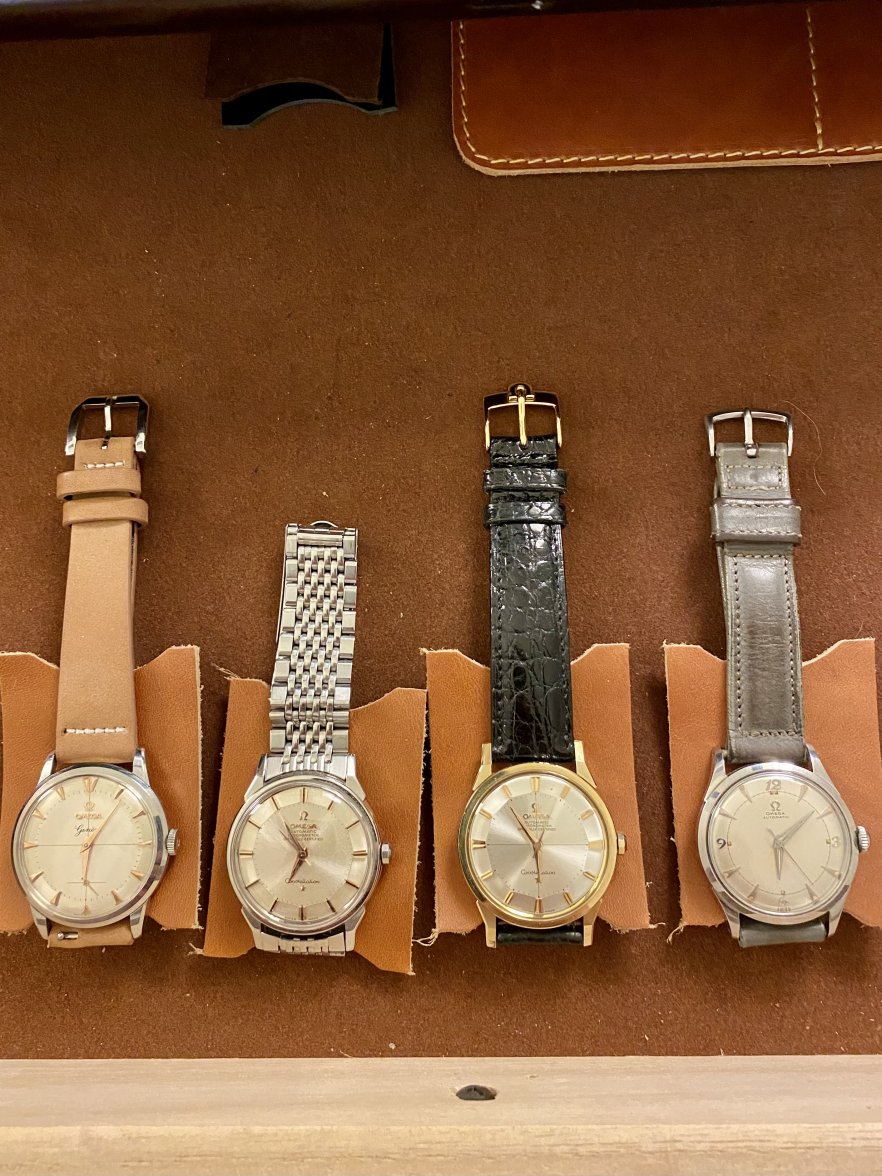
Exactly right. Here are a few of my vintage Omegas. From the left are a Geneve 2903, a Constellation 167.005 (same reference as the OP’s watch), a Constellation 14900 and a Seamaster 2635. Both Connies are pie pan references. The Geneve has a two tone dial that appears to give it a bit of a pie pan effect, but it’s clearly not a pie pan when compared to the Constellation references. The 2635 is a dome dial.
Edited:
 
Posts
23,489
Likes
52,217
Interesting, I have looked very hard, but I cannot see any actual step or change in slope on the dial originally shown in this thread, and I believe that the OP has identified various examples of this 005 reference with two distinct types of dials, one with a true change-of-plan pie-pan and one with the painted effect. Apparently different people are sincerely seeing different things, and I don't think we can resolve it from the photos posted here.
 
Posts
23,489
Likes
52,217
Exactly right. Here are a few of my vintage Omegas. From the left are a Geneve 2903, a Constellation 167.005 (same reference as the OP’s watch), a Constellation 14900 and a Seamaster 2635. Both Connies are pie pan references. The Geneve has a two tone dial that appears to give it a bit of a pie pan effect, but it’s clearly not a pie pan when compared to the Constellation references. The 2635 is a dome dial.

The Geneve is not the same thing, since the painted effect is totally circular, and doesn't have line segments mimicking the pie-pan effect.
 
Posts
23,489
Likes
52,217
I have to disagree with you here @Dan S If you see a polygon shape at what you call the step it’s a genuine pie pan and not just a trick of the brushing. The step as you call it is more obvious on some than others. It is not the defining pp feature. It often gets softened when dials are repainted but is sometimes not extreme to start with. It’s the polygonal shape made by the plane change which is key, not the step which is likely just a consequence of the stamping process and quite variable. Don’t get hung up on steps, that is more a Speedmaster feature.

The Op dial is most certainly a pie pan.

To demonstrate my point. Here are 2 PP Connies on either side of a dome dial SM 2846 which uses brushing to give a faux PP effect like you describe. The Op watch by comparison seems to have pretty uniform brushing.

Note the circular brush edge on the faux one and also how the RH Connie has a much more pronounced step than the watch on the LHS.


I would need to see better photos, but I think that the Connie on the right is a true PP, but the one on the left is not. Are you sure there is actually a step? It has been established, I believe, that some of these dials have a polygon-shaped paint job that tricks the eye into seeing a step. But if you look very closely using a loupe, even at an angle, one cannot actually see any abrupt change of slope. It can be an illusion due to the change of paint color and the angle of the brush strokes.

One must be willing to look with an open mind and to challenge long-held assumptions. In this thread, and the previous one where we discussed this, a few people have claimed that some of the dials actually have a very slight step/kink that is hard to see. I have asked them to show good photos illustrating this feature, but nobody has done so. Perhaps @padders will take on this challenge with a macro shot taken at the appropriate angle.
Edited:
 
Posts
9,550
Likes
52,723
The Geneve is not the same thing, since the painted effect is totally circular, and doesn't have line segments mimicking the pie-pan effect.
We can agree to disagree, Dan. Your posts are always reasonable and thoughtful. I don’t profess to be an expert on all things Omega and you may well be correct on this one.
 
Posts
23,489
Likes
52,217
We can agree to disagree, Dan. Your posts are always reasonable and thoughtful. I don’t profess to be an expert on all things Omega and you may well be correct on this one.

I can't tell from your photo whether those two Connies have actual steps or the polygonal paint job, but I would love to see close-up photos. I am honestly trying to get a better handle on this and am not arguing simply for the sake of argument.
 
Posts
4,593
Likes
10,806
interesting discussion and I am also of the opinion that Constellations with the angled shaped dials are piepans regardless of how pronounced the edge is.
not curved, but angled. The paint style doesn't matter.
 
Posts
23,489
Likes
52,217
interesting discussion and I am also of the opinion that Constellations with the angled shaped dials are piepans regardless of how pronounced the edge is.
not curved, but angled. The paint style doesn't matter.

Yes. Like this IWC dial is definitely a pie-pan (borrowed from a current sales listing). Not polygonal, but there is a distinct change in the slope of the dial just inside the applied markers. The dial is painted uniformly. Mathematically this could be called a "kink". Not really a step. But I assume everyone is talking about the same thing, just using different words.

1-jpg.1071642
 
Posts
4,593
Likes
10,806
Yes I think you are right Dan, a "kink" or fold is piepan material 👍
 
Posts
9,550
Likes
52,723
I can't tell from your photo whether those two Connies have actual steps or the polygonal paint job, but I would love to see close-up photos. I am honestly trying to get a better handle on this and am not arguing simply for the sake of argument.
Here are better photos of my 167.005 and 14900, Dan. Hope these help.