Newbee question (about mainsprings)...

Posts
110
Likes
79
Been following with interest.

馃憤

The hairspring is, in my opinion, the most delicate and temperamental component in a watch mechanism.
Everything else is rather agricultural in comparison (except maybe the pallet stones), and problems can usually be identified and rectified with relative ease.

Look at a balance assembly the wrong way and the fun begins.

馃榿

Jim - I believe you.

I hadn't really run in to comparable problems working with my modern ETAs and Sellitas. But I have learned a lot working on this movement (thanks to the generous members of this forum).

Also pleased that some members have enjoyed following my first-time foibles. 馃槻馃槨馃檨馃榿 馃嵖

As COYI points out - all credit to @Archer and @Deafboy for their invaluable assistance. And all of those on the forum that take the time to share their hard-earned knowledge.

-Paul

 
Posts
110
Likes
79
And just to drive home @JimInOz 's point about the hairspring...

In all of the balance manipulation - trying to get the watch in beat - I managed to damage the hairspring! 馃が馃槨馃檨

So this thread becomes more educational (at least for me). I guess that's a good thing. Now the question is - how to resolve.

I'm fairly sure this hairspring could be "straightened". But I wouldn't be the best man for the job.

I'd like some of your thoughts on best course of action:
Is it possible to source a replacement hairspring assembly?
A whole balance assembly?
I know I can find whole movements.

Feeling a bit discouraged - but that's all part of the learning process (at least it makes me feel better to tell myself).

-Paul
 
Posts
2,219
Likes
4,946
An interesting thread. Everybody has things that don't turn out well but, a bit of a shame at the end.

You usually buy a "balance complete" as the hairspring and balance wheel are a matched pair. You can buy blank hairsprings but, just calculating the stiffness needed is not a trivial task and you'd have little chance forming the overcoil. Even with a new balance complete, you may have to adjust the endshake (for example).

The way you described the issue you had with the noise makes me think that the overcoil was hitting the centre wheel as it was only happening at high amplitudes. Sometimes, you just need to loosen the screw holding the stud and move the stud up or down a fraction to solve that sort of issue.

How bad is the damage? Always best to try and recover the existing part if you can so, do you have a picture with the balance off the cock?

Good luck, Chris
 
Posts
110
Likes
79
...How bad is the damage? Always best to try and recover the existing part if you can so, do you have a picture with the balance off the cock?

Good luck, Chris

Hey Chris,

Thanks for commenting. I did separate the cock from the rest of the assembly so that I could see what shape the hairspring was in.

I don't think the damage is all that bad (except for my level of inexperience). I will see if I can get some good pictures with my camera. I should be able to get better pics next week - as I have a camera attachment coming for my microscope. I'll see what I can get with my trusty Olympus.

Thank you!
-Paul
 
Posts
29,196
Likes
75,443
Sorry to hear this, but trust me it's happened to everyone at some point who's worked on a number of watches. In school we would go to lunch and come back to find all our balance springs bent up by the instructor...was sometimes frustrating after you had a movement running really well to see it all bent up. But you learn by doing.

The good news is that often balance springs that look very bad can have just one bend that is causing a lot of it, so it may not be too difficult to fix, but good photos from the top of the spring and around the sides will help us understand what's going on.

As Chris mentioned, balance springs are matched to balances, so swapping the springs will often give less than satisfactory results. A balance complete would be the way to go if you can't fix this. Donor watches are always good to have on hand, but often you find the parts in the donor are not better than what you are trying to replace on these very old watches.

Post some photos and hopefully we can guide you...

Cheers, Al
 
Posts
110
Likes
79
Sorry to hear this, but trust me it's happened to everyone at some point who's worked on a number of watches. In school we would go to lunch and come back to find all our balance springs bent up by the instructor...was sometimes frustrating after you had a movement running really well to see it all bent up. But you learn by doing.

The good news is that often balance springs that look very bad can have just one bend that is causing a lot of it, so it may not be too difficult to fix, but good photos from the top of the spring and around the sides will help us understand what's going on.

As Chris mentioned, balance springs are matched to balances, so swapping the springs will often give less than satisfactory results. A balance complete would be the way to go if you can't fix this. Donor watches are always good to have on hand, but often you find the parts in the donor are not better than what you are trying to replace on these very old watches.

Post some photos and hopefully we can guide you...

Cheers, Al

@Archer - thank you for the support! I definitely feel a bit better reading this.

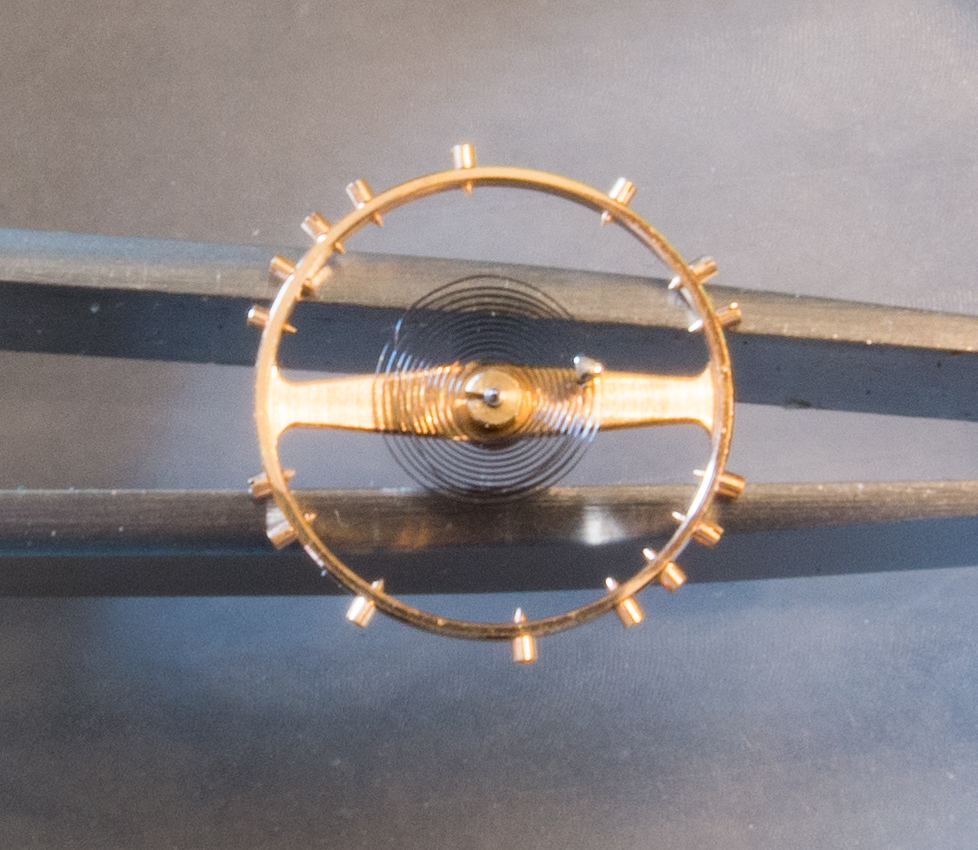
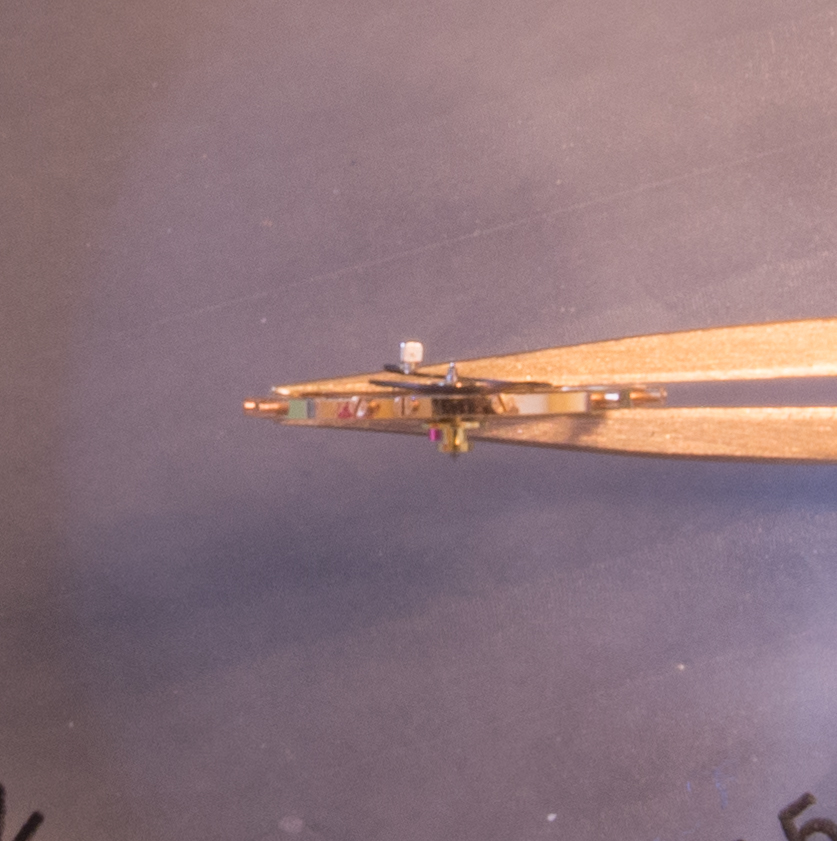
Not sure how much help these two pics are - but should get us started. I do have a macro lens that I may want to put on for this. But have a camera attachment coming for my microscope tomorrow. So, that will most likely be the best source.

Top view...


This side angle shows what I believe to be the main damage.
But probably need to remove the spring from the staff to really see where the bend(s) is (are)???


ALSO - I presume that I will need to remove the spring from the balance in order to straighten?
Which (I think) means I will need to add to my tools. Is a staking set the proper kit for that? Thinking about installing the spring back on to the staff - assuming that it needs to be removed.

-Paul
 
Posts
29,196
Likes
75,443
Tough to see much there in those photos, so to give you any really specific direction, I would need to see these closer and more in focus. It appears this is mostly an out of flat condition based on those photos.

The key thing is to identify where the bend is, so if you look under good magnification (10X loupe at least, or microscope maybe better for someone starting out) you should be able to see where a coil is laying over to one side when viewed from above. So looking around a coil and following it, it would look vertical, and then there would be a spot where the coil is leaning over - the spot where this happens is the bend.

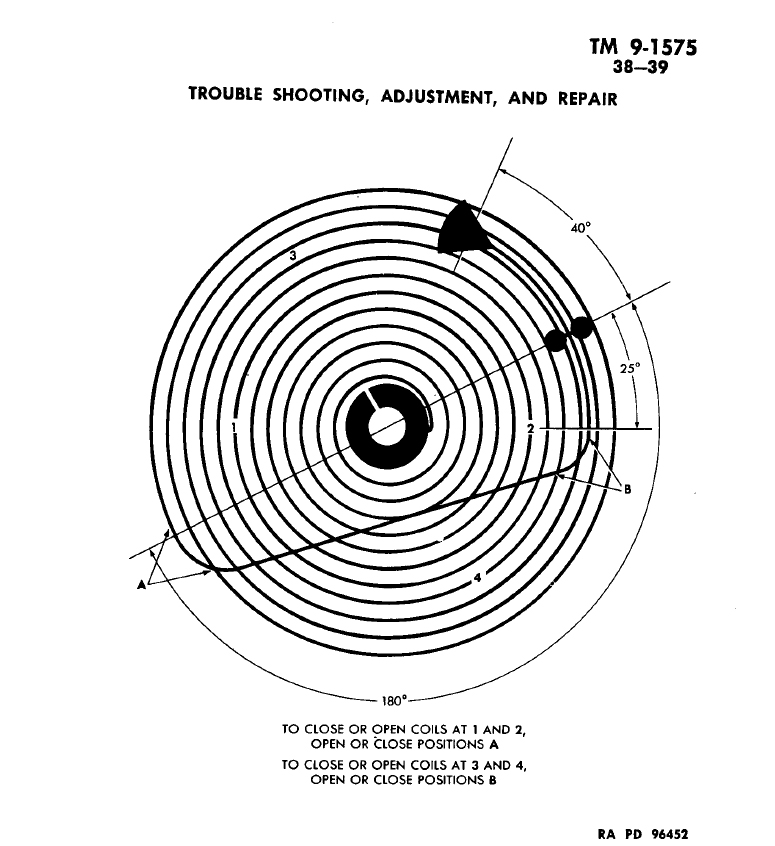
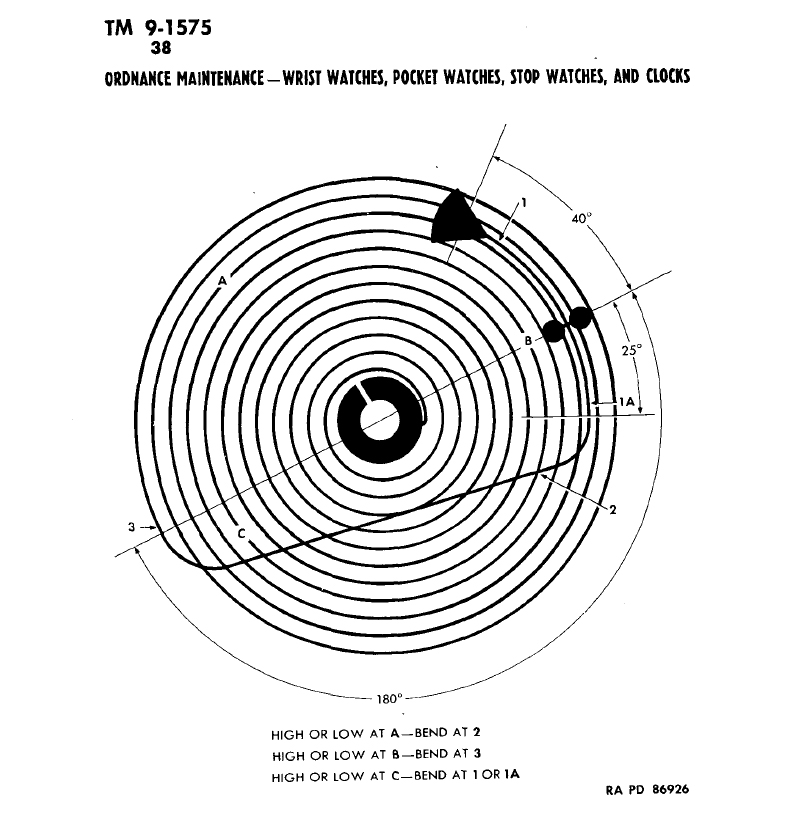
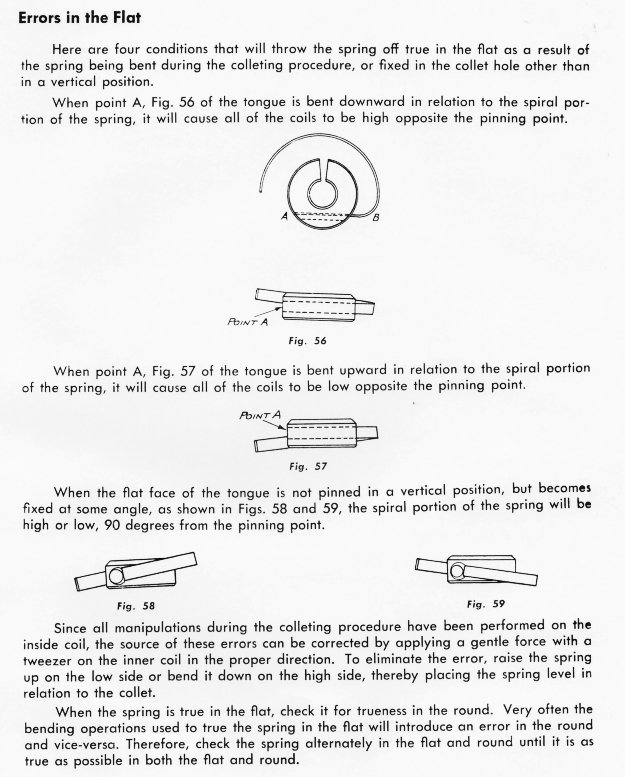
You can often help narrow down the area where the bend is by the how the spring is bent up. Honestly this is a little difficult to put into words since I do all this without really thinking about it at this stage. But these might help - they come from a US manual from WWII showing the procedures for watch repairs. This TM 9-1575 manual is available on-line usually with a search to download, and is a good one for basics.

This indicates where to bend to resolve errors in the round:


And this one is for errors in the flat:


So using the second one, and looking where the coils are raised, you can work back to the most likely area to find the bend.

Hope this helps.

Cheers, Al
 
Posts
110
Likes
79
Tough to see much there in those photos, so to give you any really specific direction, I would need to see these closer and more in focus. It appears this is mostly an out of flat condition based on those photos.
...
Hope this helps.

Cheers, Al

Al, indeed - it's all very helpful.

Let me see what kind of photos I can get from the microscope this week.

Should I remove the spring from the balance for this? Or attempt adjustments with it in place?

And if removal (re-install) is called for. Would it be a good idea to pick up a staking set? Or?

Many many thanks.
-Paul
 
Posts
29,196
Likes
75,443
At this point, I would not remove the spring from the balance. There's a fair amount of risk involved for an inexperienced person doing that, and also when putting it back on (which indeed is typically done with a staking set).

In most cases (for me anyway), removing the balance spring is not needed, but it depends on the severity of the bends in question.
 
Posts
110
Likes
79
At this point, I would not remove the spring from the balance. There's a fair amount of risk involved for an inexperienced person doing that, and also when putting it back on (which indeed is typically done with a staking set).

In most cases (for me anyway), removing the balance spring is not needed, but it depends on the severity of the bends in question.

Okay - very good. I will hold off on doing anything until I can post some better pics. Which should be some time this week.

-Paul
 
Posts
2,219
Likes
4,946
This doesn't look too bad but, as Al says, very hard to know from those photos. A watchmaker with vintage experience will probably resolve this so, I wouldn't spend lots of money on a new balance. I have seen a lot worse.

Be interested to see your photos with better resolution but, you may like to send this to someone to fix as it's going to be very hard to give logical advice and it won't be easy anyway. In plane errors are much easier to fix than out of plane, in my opinion, and you've introduced an out of plane issue.

These things are difficult so, don't jump in without a lot of thought.

Good luck, Chris
 
Posts
110
Likes
79
This doesn't look too bad but, as Al says, very hard to know from those photos. A watchmaker with vintage experience will probably resolve this so, I wouldn't spend lots of money on a new balance. I have seen a lot worse.

Be interested to see your photos with better resolution but, you may like to send this to someone to fix as it's going to be very hard to give logical advice and it won't be easy anyway. In plane errors are much easier to fix than out of plane, in my opinion, and you've introduced an out of plane issue.

These things are difficult so, don't jump in without a lot of thought.

Good luck, Chris

Thank you Chris!

I will post better photos when I am able. As, I say - I should be able to this week.

I would be totally in favor of sending to someone - but the question is who? The reason that I decided to do a little training in watch repair was that I couldn't find a local watchmaker (that I trusted) that would take in "outside work". All of the fine jewelers here (Kansas City, USA) have watchmakers - but they only work on watches that they sold. Or maybe they all have watchmakers they work with - but won't send them any work other than watches that they sold.?.?

I finally got a jeweler to give me a name - but when I contacted him, he was retiring and not taking in anymore work.

I'll get the better pics up this week and see what you guys think after you have something you can actually see.

Many, many thanks.
-Paul
 
Posts
110
Likes
79

Tom,

That's a sizable list. Thank you very much.

Jules Borel would be great (as he is very close to where I work), but looks like he is running a materials supply. So, not sure that he would take in any work. But even if he doesn't, there's a decent chance he may know someone. 馃榾

I will investigate this as an option. Thank you!
-Paul
 
Posts
110
Likes
79
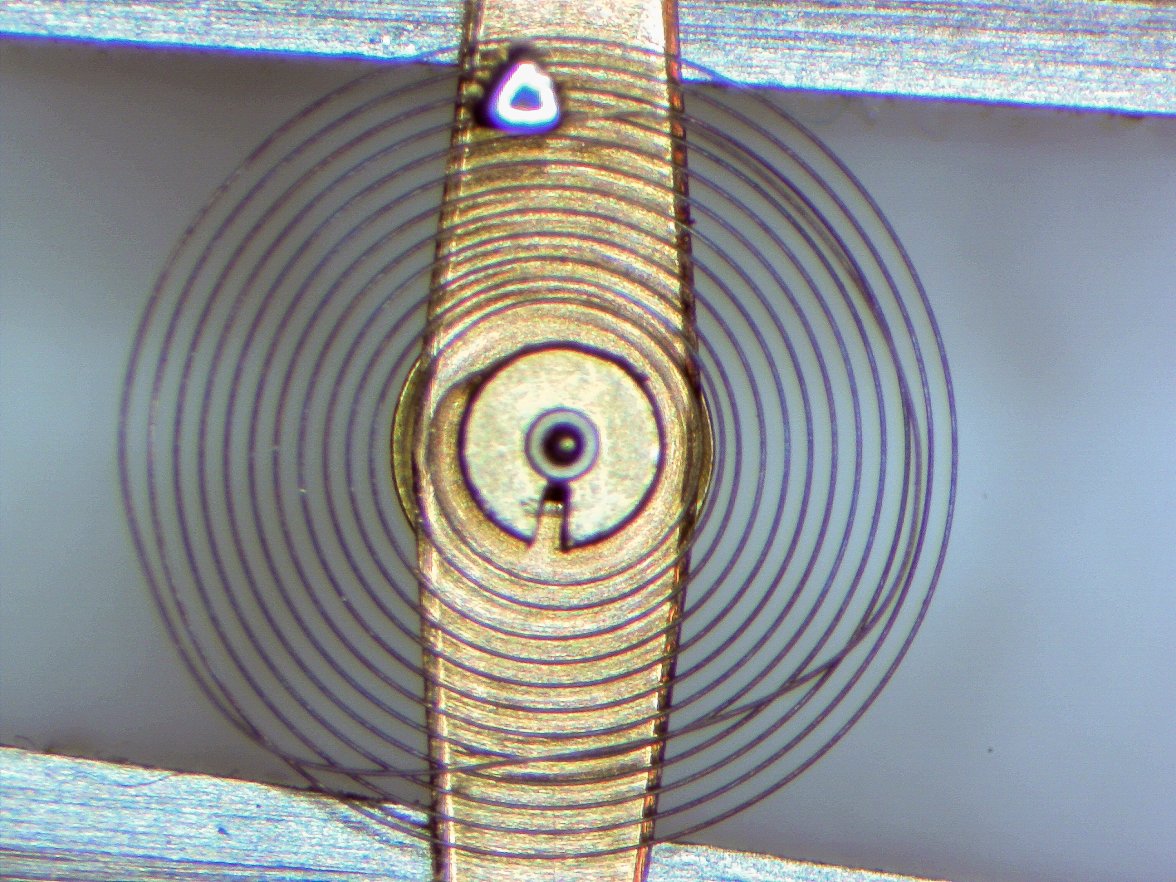
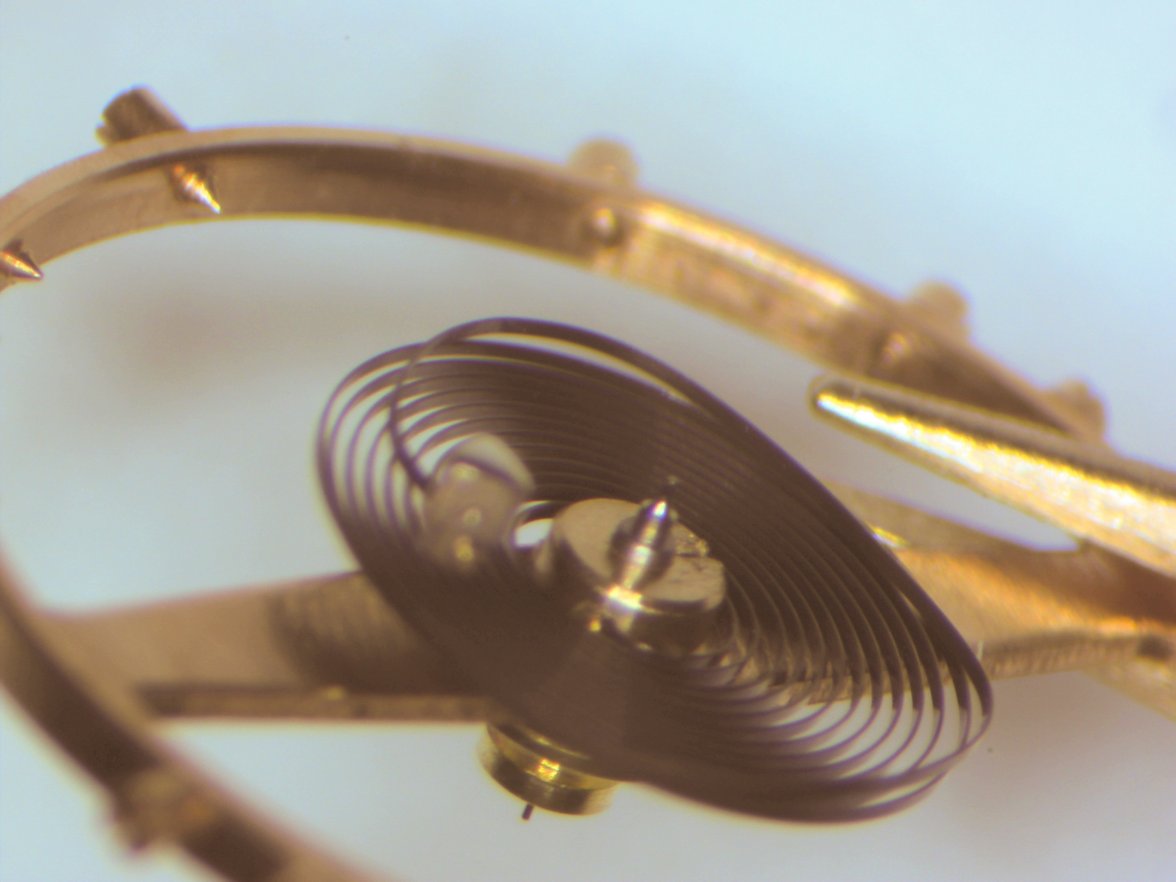
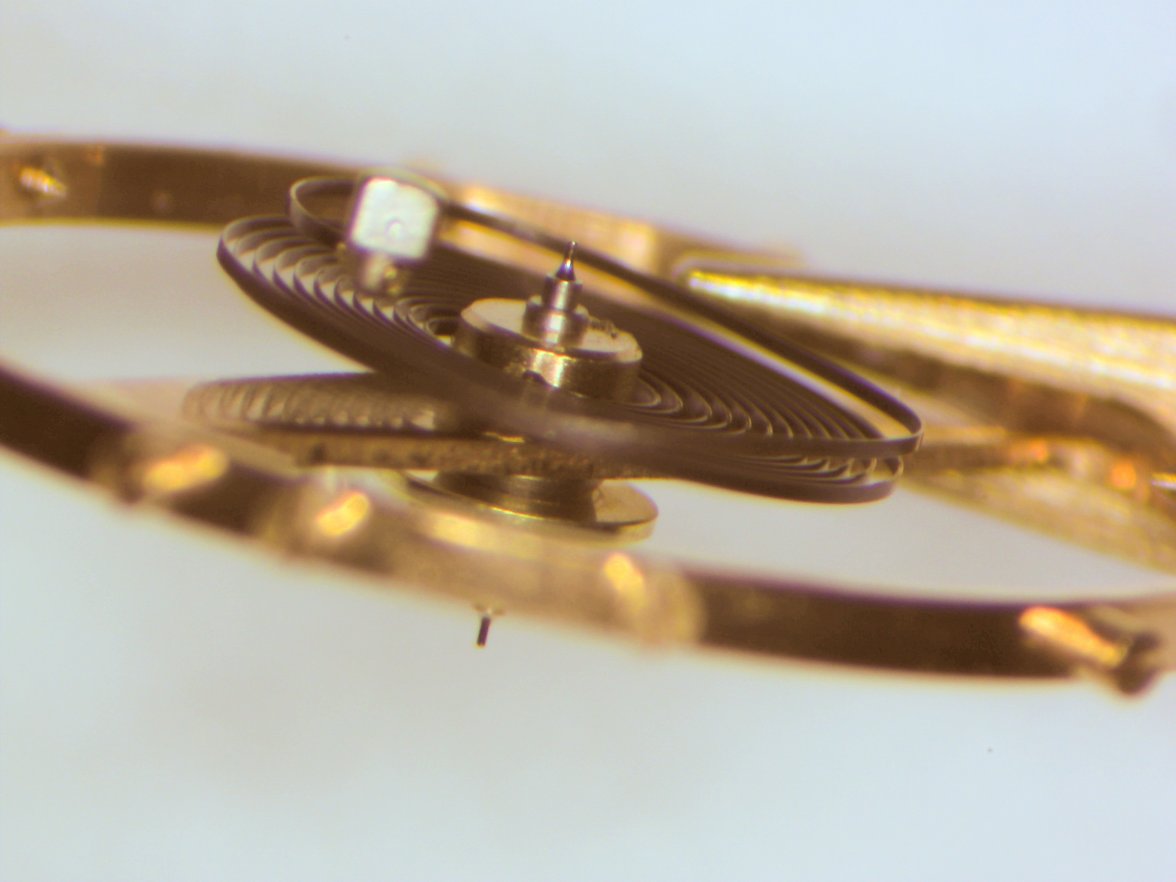
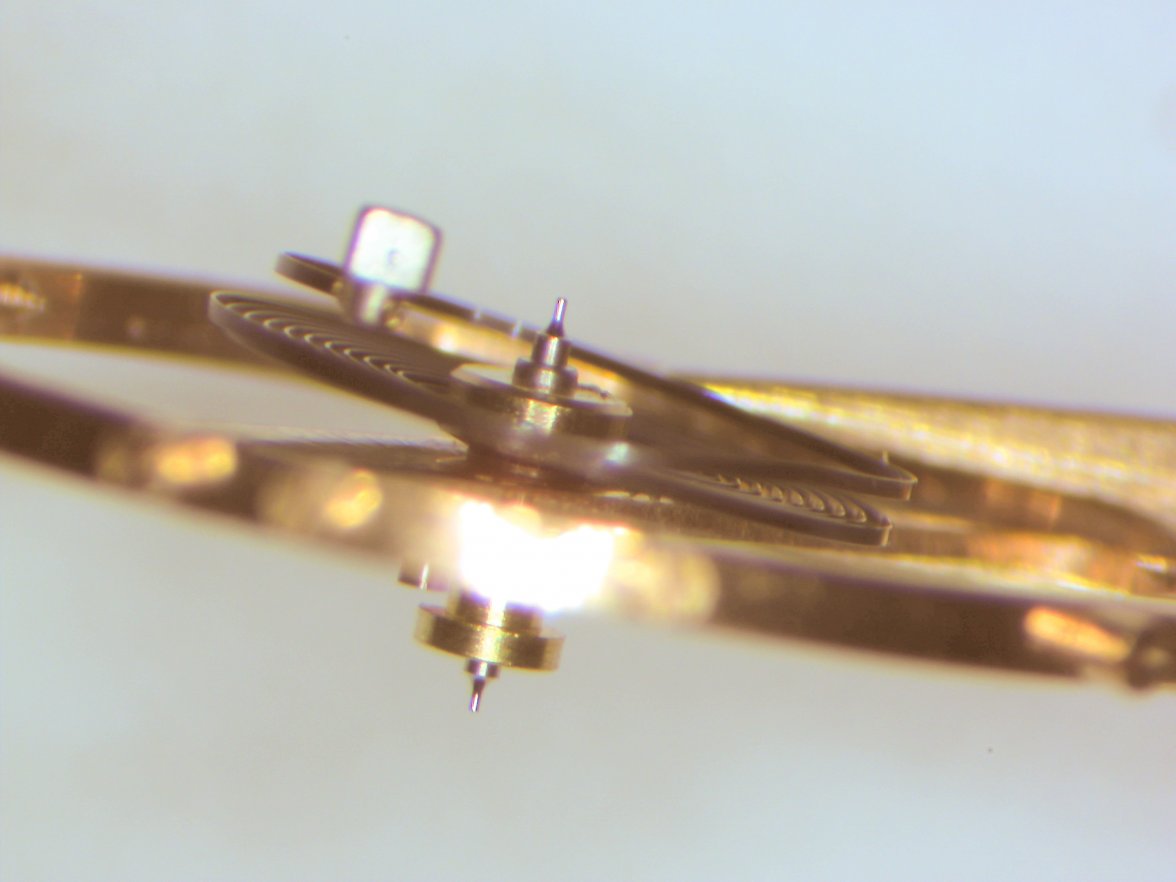
Okay - here are a few pics.

I will need to spend some time with the camera software. I'm not very impressed so far. But I think it might be okay after I have a chance to use it some more and read through the manual.

I'm not sure that you will be able to give any specific guidance from these pics - but they are definitely better than the first couple that I took with a portrait lens on my Olympus.


For some reason, in this "overhead" angle, the exposure is really crappy (and focus wasn't good) - but you can see the where the spring is. Albeit a little fuzzy.


The rest of the these pics are much better.


-Paul
 
Posts
2,406
Likes
6,949
Others with more experience can chime in but I wonder if the spring is simply magnetized and sticking to the balance arm.
 
Posts
110
Likes
79
Others with more experience can chime in but I wonder if the spring is simply magnetized and sticking to the balance arm.

I am sure that it's not magnetized - as I had sole custody of all the parts. 馃榾

Though it is hard to see where the bend is that is causing the out-of-plane issue.

I think if the "overhead" (straight on) pic was better - it would be possible to see in there.
I will try to find (and photograph) where I believe the bend(s) is(are).
That would be good for me to do anyway.

Thanks Deafboy.
 
Posts
2,406
Likes
6,949
Since the the coils of the spring generally lie on a plane, but the whole plane is tilted, then, if there is a bend, my guess it would be at the point where the spring attaches at the collet.

 
Posts
2,219
Likes
4,946
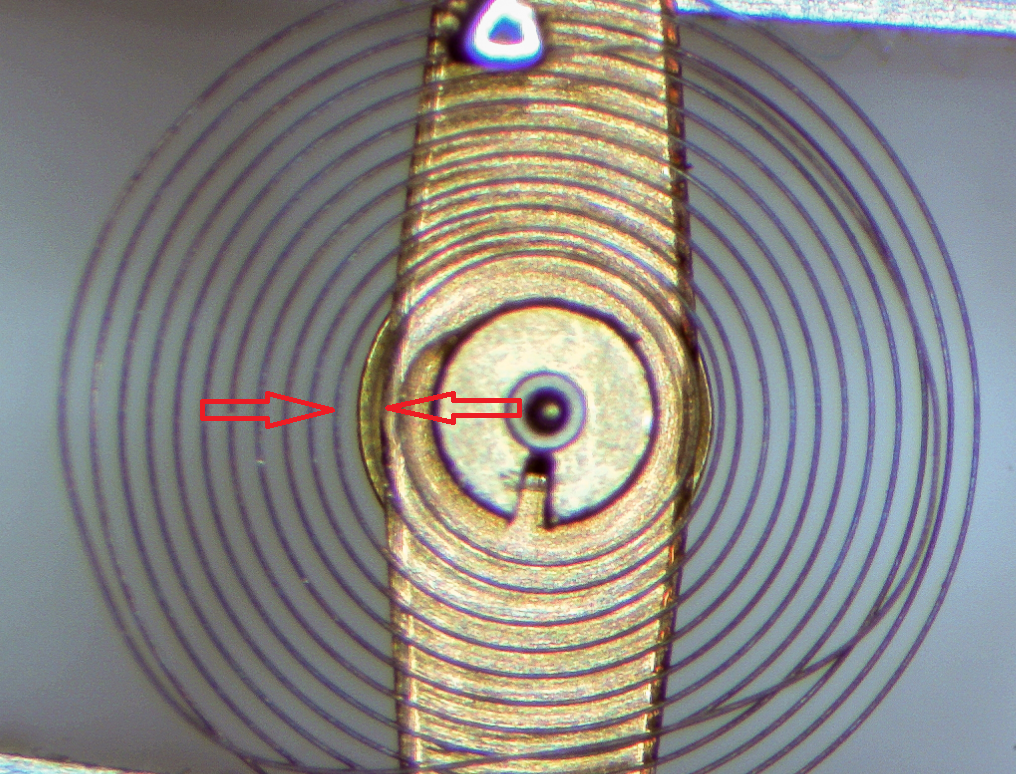
I think this would be very hard to advise on with pictures but, as a first comment, look at the spacing on the coils marked here and on the other side of the spoke (180 degrees around). I suspect you have caught the hairspring here or on the other side but, you can't tell from this photo if the coils are vertical. Try and get a detailed shot of the inner coils. @Deafboy might be right and that it is also at the collet but, look at this first as it may be that the first coil is parallel to the spoke and undisturbed - again, not clear to me.

Good luck, Chris

 
Posts
29,196
Likes
75,443
Others with more experience can chime in but I wonder if the spring is simply magnetized and sticking to the balance arm.

The balance is not made of material that would allow this - most likely Glucydur...