Newbee question (about mainsprings)...

Posts
110
Likes
79
The amplitude difference of 20 degrees between dial up and dial down is excessive, and not something that should be let go, but it will depend a great deal on your skill level if this is something you can correct or not...

[including the following two images for reference]


Cheers, Al

@Archer - after removing and (re)cleaning and close inspection of the end-stone face. I can verify that there is no divot as seen in the two photos above. There are some small surface imperfections similar to the two photos that I left in the quote.

Mine isn't quite as bad as either, but more similar to the second picture.

I can't see the end of the pivot clearly enough to gauge it's condition. So, I guess I'll proceed with your first recommendation (to re-clean, re-oil, and see what the DU/DD difference is after that).

Looking at the top end-stone before re-cleaning, I did see that it wasn't spotlessly clean. So, hoping this resolves the issue.
I'll post the results as soon as I have them. It's a holiday here in the US (Thanksgiving) though, so not sure how much time I'll have for this today.

-Paul
 
Posts
110
Likes
79
So, after re-cleaning, inspection and re-oiling (9010) I now see...
[set at 49 deg lift angle]

DU 295 deg; -43 sec/day; 0.2ms BE
DD 300 deg; -45 sec/day; 0.2ms BE

So, dial down now looks slightly better that dial up (??) - but I expect (hope) these numbers are acceptable.

-Paul
 
Posts
29,196
Likes
75,443
So, after re-cleaning, inspection and re-oiling (9010) I now see...
[set at 49 deg lift angle]

DU 295 deg; -43 sec/day; 0.2ms BE
DD 300 deg; -45 sec/day; 0.2ms BE

So, dial down now looks slightly better that dial up (??) - but I expect (hope) these numbers are acceptable.

-Paul

Much better, so why not give us a full set of positional checks at full wind, and then again at 24 hours after full wind.

Note that full wind readings are taken between 30 and 90 minutes after full wind, so wait at least 30 minutes before starting the readings.

Cheers, Al
 
Posts
110
Likes
79
Much better, so why not give us a full set of positional checks at full wind, and then again at 24 hours after full wind.

Note that full wind readings are taken between 30 and 90 minutes after full wind, so wait at least 30 minutes before starting the readings.

Cheers, Al

@Archer - sure thing.

So, is a complete set: DU, DD, PL, PR, PU, PD? Or are there others considered part of a "complete set".

ALSO - does it matter if I have adjusted DU/DD timing to be closer to +/- 0? Of course, I can easily re-center the rate adjustment if it should be.

Thanks!
-Paul
 
Posts
29,196
Likes
75,443
@Archer - sure thing.

So, is a complete set: DU, DD, PL, PR, PU, PD? Or are there others considered part of a "complete set".

ALSO - does it matter if I have adjusted DU/DD timing to be closer to +/- 0? Of course, I can easily re-center the rate adjustment if it should be.

Thanks!
-Paul

Yes those are the full set of readings - so 6 at full wind and 6 24 hours after full wind. And I would adjust the dial down rate to be slightly positive to start the test.

Cheers, Al
 
Posts
110
Likes
79
Here are the full-wind numbers...

Fully wound at 4:08 CST Friday 11:29
Measurements starting at 4:53.

DD +2 s/d 298 deg 0.0 ms
DU +2 s/d 294 deg 0.1 ms
PD +23 s/d 260 deg 0.1 ms
PL -1 s/d 260 deg 0.0 ms
PR +7 s/d 262 deg 0.1 ms
PU -13 s/d 261 deg 0.1 ms

I assume the -13 to +23 isn't ideal 😀

But the numbers seem pretty good to me (not really knowing what to expect).

I assume the variance in the vertical positions indicate a heavy (or light) spot in the rotating (oscillating) mass?

Should the 24 hour numbers be taken 24 hours from the wind? or 24 hours from the first measurement?

-Paul
Edited:
 
Posts
110
Likes
79
Here are the full-wind numbers...

Fully wound at 4:08 CST Friday 11:29
Measurements starting at 4:53.

DD +2 s/d 298 deg 0.0 ms
DU +2 s/d 294 deg 0.1 ms
PD +23 s/d 260 deg 0.1 ms
PL -1 s/d 260 deg 0.0 ms
PR +7 s/d 262 deg 0.1 ms
PU -13 s/d 261 deg 0.1 ms

I assume the -13 to +23 isn't ideal 😀

But the numbers seem pretty good to me (not really knowing what to expect).

I assume the variance in the vertical positions indicate a heavy (or light) spot in the rotating (oscillating) mass?

Should the 24 hour numbers be taken 24 hours from the wind? or 24 hours from the first measurement?

-Paul

Here are the 24 hour numbers:
(taken a little shy of 24 hours [23:45])

DD +1 s/d 267 deg 0.1 ms
DU +3 s/d 267 deg 0.1 ms
PD +14 s/d 231 deg 0.0 ms
PL -1 s/d 231 deg 0.1 ms
PR +20 s/d 222 deg 0.2 ms
PU +5 s/d 225 deg 0.2 ms

And if that was all I had to report, I would feel pretty okay with this second set of readings.
HOWEVER, that's not it. I was seeing some really strange periods where one of the timing traces was tracking somewhat erratically. This was accompanied by reporting a large beat error (between 5 and 9 ms) with a large reduction in amplitude. 😲

I am guessing this must be something in the oscillating mass making contact with something it shouldn't (in one direction). Not 100% consistent though, as I was able to get a complete set of 2nd readings without this "interference".

Not feeling as good as I was yesterday. 😵‍💫 🙁

Thoughts?

-Paul
 
Posts
110
Likes
79
Here are the 24 hour numbers:
(taken a little shy of 24 hours [23:45])

DD +1 s/d 267 deg 0.1 ms
DU +3 s/d 267 deg 0.1 ms
PD +14 s/d 231 deg 0.0 ms
PL -1 s/d 231 deg 0.1 ms
PR +20 s/d 222 deg 0.2 ms
PU +5 s/d 225 deg 0.2 ms

And if that was all I had to report, I would feel pretty okay with this second set of readings.
HOWEVER, that's not it. I was seeing some really strange periods where one of the timing traces was tracking somewhat erratically. This was accompanied by reporting a large beat error (between 5 and 9 ms) with a large reduction in amplitude. 😲

I am guessing this must be something in the oscillating mass making contact with something it shouldn't (in one direction). Not 100% consistent though, as I was able to get a complete set of 2nd readings without this "interference".

Not feeling as good as I was yesterday. 😵‍💫 🙁

Thoughts?

-Paul


I beieve this is also accompanied by a weird sound to the tick. I can only hear it holding the case tight to my ear, but it sounds a little strange. Like a "twang" sound on one half of the oscillation.

-Paul
 
Posts
110
Likes
79
...Letting almost all of the power out of the mainspring - no funky twang, and no weird beat issues.

Not sure if these numbers are useful, but with almost no wind I read"

DD +17 s/d 184 deg 0.1 ms
DU +18 s/d 178 deg 0.2 ms
PD -40 s/d 146 deg 0.1 ms
PL -5 s/d 144 deg 0.0 ms
PR +49 s/d 136 deg 0.3 ms
PU +88 s/d 143 deg 0.5 ms

I put some more wind on to test - and the funky twang (that I believe accompanies the BE and lower amp readings) only exists in a mid range of wind. Starting somewhere roughly around 1/2 wound and going down to a point greater than minimum wind.

Are there any "usual suspects" to check for - for something like this? Or is this too weird for usual suspects?

-Paul
 
Posts
110
Likes
79
AND - looking at the traces from the timegrapher, it seems that the problem is on one side of the oscillation. As one trace runs in a normal line, and the other is somewhat erratic. Presumably making contact with something which is shorting one side of the period - and causing the erratic trace along with huge beat error.

any ideas?

-Paul
Edited:
 
Posts
65
Likes
66
Gotta give it up to @Archer for all the help he's given here.

Great read, IMO, and makes me excited to get into working on watches myself. I read through this all tonight. Though I feel like if you're posting multiple times a day, some 7 minutes apart, with a lot of questions maybe give it some time to trouble shoot and figure out which questions are the one you really need help with? Especially when someone is kind enough to be helping you out. But that's just me.
 
Posts
2,406
Likes
6,949
Not sure if these numbers are useful, but with almost no wind I read"

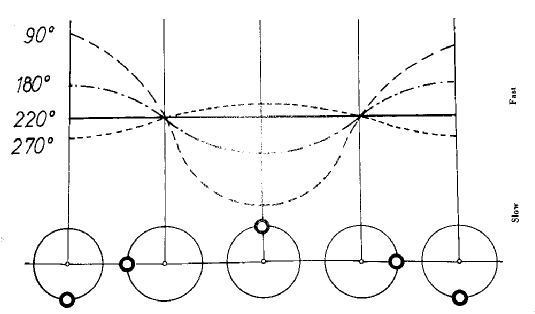
In fact they are useful. The graph below shows the effect an unbalanced balance wheel on rate for several amplitudes when the watch is in a vertical position (the graph doesn't apply for dial-up and dial-down positions). For example, the leftmost data shows the rates when the extra mass is located at the bottom of the wheel. We see at amplitudes below 220 degrees the watch will be fast and for amplitudes above 220 degrees the watch will be slow. If the extra mass is located at the top (middle section of the graph) then the reverse is true, that is, fast at high amplitude and slow at low amplitude. Looking at your data, for PD, it's slow (-40 s/day) at low amplitude and fast at high amplitude (23 s/day). This proves the extra mass is at the top of the balance wheel in this position (extra mass near 9 o'clock, assuming you defined the "pendant" as the crown at 3 o'clock). The rest of the data in the vertical positions also support this.


Posts
29,196
Likes
75,443
Here are the full-wind numbers...

Fully wound at 4:08 CST Friday 11:29
Measurements starting at 4:53.

DD +2 s/d 298 deg 0.0 ms
DU +2 s/d 294 deg 0.1 ms
PD +23 s/d 260 deg 0.1 ms
PL -1 s/d 260 deg 0.0 ms
PR +7 s/d 262 deg 0.1 ms
PU -13 s/d 261 deg 0.1 ms

I assume the -13 to +23 isn't ideal 😀

But the numbers seem pretty good to me (not really knowing what to expect).

I assume the variance in the vertical positions indicate a heavy (or light) spot in the rotating (oscillating) mass?

Should the 24 hour numbers be taken 24 hours from the wind? or 24 hours from the first measurement?

-Paul

Sorry - had some surgery this week, so not posting much as I recover...

Anyway, seeing these numbers, they actually fall within Omega's accepted tolerances for this movement.

For the Cal. 266, the tests at Omega are only done over 3 positions, and the average daily rate should fall between -1 and +16 seconds per day at full wind. Your watch has an average daily rate of just under 3 seconds, so that's well within tolerance.

The Delta (positional variation) is allowed to be as much as 40 seconds at full wind, and 50 seconds 24 hours after full wind - remember this is only over 3 positions, and the larger number of positions you measure, the more difficult it is to keep the Delta number low. Your Delta at full wind is 34 seconds, so it meets the standards. Your Delta gets better at 24 hours after full wind, so again well within Omega's tolerances.

So what does this tell us? Mostly that Omega has very loose tolerances for these movements, and why I personally use them just as a starting point only. But overall this is a pretty good result for a watch of this age and with an inexperienced repair person. Often these movement have worn holes in the main plate and barrel bridge, worn out barrels, worn wheels, and all these lead to low amplitudes and timing issues, but none of that is present here, so I can pretty safely assume that the movement is actually in very good condition, and is not really worn out. So if that was all you had to report, I would say job well done.

Now about the strange noises, increase in beat error, and reduction in amplitudes, this is unusual. All I can say is that you need to observe what positions this happens in, and see if anything is rubbing, such as the overcoil of the balance spring contacting a wheel for example.

Until you sort this issue out, then set aside issues of poise and timing, because you need the fundamentals to be absolutely perfect before you move on to that process. Many things that may appear to be poise errors can be errors in the shape of the balance spring, so that in particular has to be absolutely perfect before you move on - you don't want to correct errors in the balance spring by messing with the poise, and that is a trap many inexperienced people run into when they learn dynamic poising as it becomes the "go to" solution for every vertical timing issue. It's like when the only tool you have is a hammer, everything starts to look like a nail...

You might also want to look for something like debris in the teeth of slower turning wheels, or perhaps a bent or damaged tooth. Ideally all these would have been inspected before assembling the movement, so you don't have to take it apart again, but check the barrel teeth for defects and the center wheel teeth in particular, since this sounds like a very intermittent issue that could be related to slow moving parts.

Regarding the "almost no wind" readings, these aren't really used unless you have already detected a poise error and are doing something about it. You don't need these readings to detect poise errors, as they are typically very evident in the full wind timing numbers, but low amplitude numbers (below 180 - I usually use readings in the 160's in vertical positions) to locate the heavy spot during dynamic poising. They may be usefuly for understanding how things change with poise errors and if the balance is accelerating or decelerating as it comes into and out of the lift angle, but they aren't used as a normal set of readings done in timing checks.

Let us know what you find with that noise...

Cheers, Al
 
Posts
110
Likes
79
Sorry - had some surgery this week, so not posting much as I recover...

Anyway, seeing these numbers, they actually fall within Omega's accepted tolerances for this movement.

Let us know what you find with that noise...

Cheers, Al
Al,

So sorry to hear that you required surgery. I hope and trust that all went well.

And - as always - huge thanks for your patience and willingness to share your professional skills. I can't thank you enough.

I must say - I have learned a lot of things in this exercise thus far - that I didn't know that I needed. I guess that's a case of not knowing what you don't know. Having said that - this is the best part about learning about watch repair and maintenance. Learning is probably my most favorite thing to do.

I will see what I can come up with - tracking down that noise.

Hope you are feeling better than ever soon.

-Paul
Edited:
 
Posts
110
Likes
79
In fact they are useful. The graph below shows the effect an unbalanced balance wheel on rate for several amplitudes...

@Deafboy,

Thank you sir!

I had some idea from your prior posts about the low amplitude readings being more sensitive to a poise problem.

Thank you so much for having a look at my numbers and confirming that all of the readings seem to "agree".

I am going see if I can isolate/identify the source of the strange noise, amplitude, and BE issue before proceeding. Since whatever it is will almost certainly interact with any kind of timing/adjustment/regulation.

I'll post thoughts and observations as I go.

-Paul
 
Posts
2,406
Likes
6,949
Until you sort this issue out, then set aside issues of poise and timing, because you need the fundamentals to be absolutely perfect before you move on to that process.

I am going see if I can isolate/identify the source of the strange noise, amplitude, and BE issue before proceeding. Since whatever it is will almost certainly interact with any kind of timing/adjustment/regulation.

Fully agree here.
The funny tracking you described should be looked into before poising and such. As Al suggested, it seems there might be an object that is interfering with the proper motion the movement at times.
 
Posts
110
Likes
79
@Archer, @JimInOz, et.al.

So - after several days of observation, I feel pretty confident in declaring the problem "resolved".

Going back to last Sunday AM. I was somewhat at a loss for a plan to track down this strange noise (and all of the related symptoms). But from what I had observed to that point, I thought I would start with (re) cleaning the hairspring and balance assembly.

So, that's what I started with. And after the following reassembly I haven't seen or heard any hint of the issue. Testing at various power levels, and operating positions, over several days. So, even though I didn't specifically find the "wrench in the works". Re-cleaning resolved the problem.

It also added a few tenths of beat-error. Which makes sense to me. As whatever was wrong seemed to be effecting the balance rotation in one direction (or one one side of the oscillation).

I am going to attempt to get the BE back close to 0. And then I'll post another full set of positional checks.

Again, many thanks to all. And Al, I hope the recovery is going well.

-Paul
 
Posts
17,577
Likes
36,773
Been following with interest.

👍

The hairspring is, in my opinion, the most delicate and temperamental component in a watch mechanism.
Everything else is rather agricultural in comparison (except maybe the pallet stones), and problems can usually be identified and rectified with relative ease.

Look at a balance assembly the wrong way and the fun begins.

😁
 
Posts
499
Likes
742
I'm not sure I'm brave enough to ever try tinkering with one of my watches but I really enjoyed reading this thread.
Many thankst to@PaulHelmuth for taking the time to share his experiences. It looks like your perseverance has paid off as the watch seems to be running really well considering its age.

A special thanks to @Deafboy and @Archer for being so helpful and forthcoming in sharing their expertise. Threads like this make me appreciate what a great community we have at omegaforums.