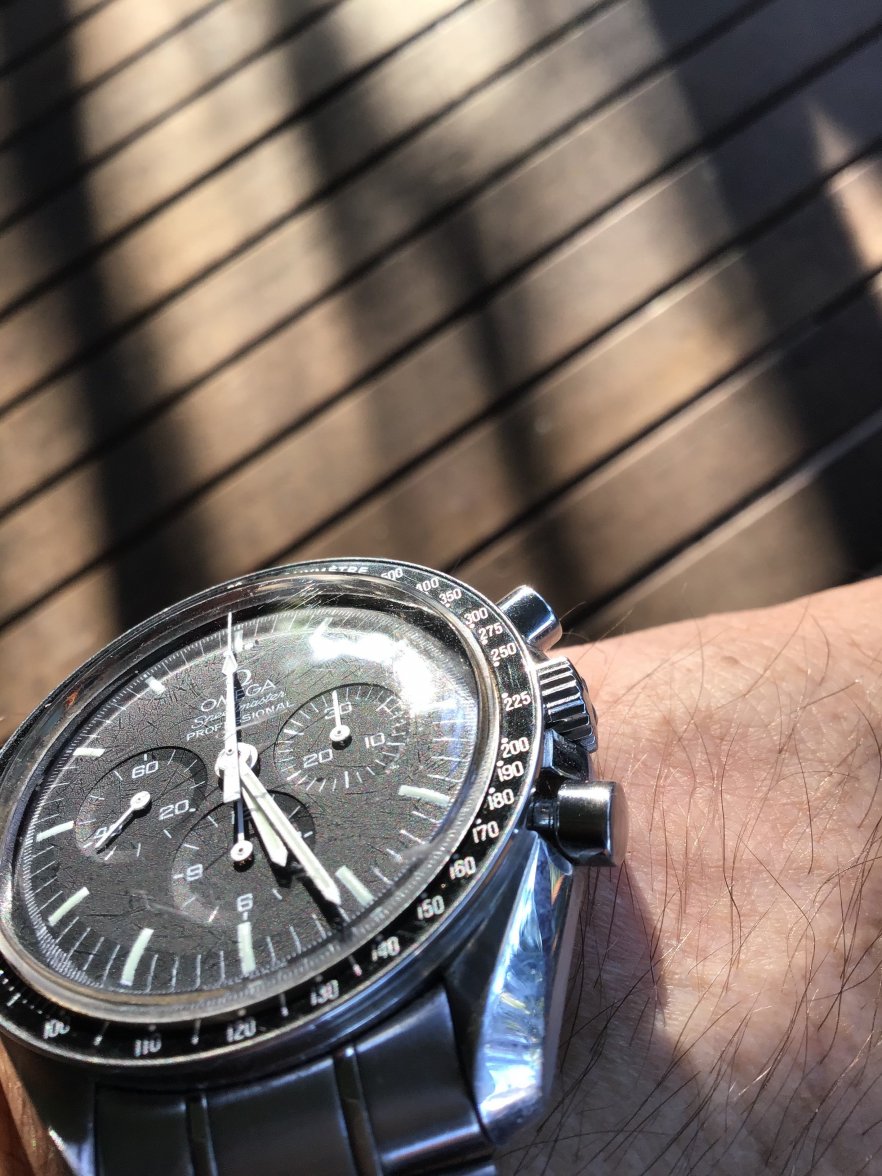
Speedy Pro shock resistant

Posts
12
Likes
3
Yeah. I love my Casio MR-G. At £2400, I should do too. I wear it almost all the time and every day. It's worth adding that the MR-G is a gorgeous watch. Absolutely worth checking out videos on it, for someone wanting a truly tough watch. The G1000B is the all black one that I have.

I was looking for a Seamaster for other times. Owning the Seamaster would mean I would wear my Casio a bit less.


I did just find a couple more websites talking about International Standard ISO 1413. They go on to say describe the equivalent test. This webpage sets out the test, and relates it to 5000g and International Standard ISO 1413. https://www.watchtime.com/featured/dive-watch-defined/

The shock-resistance standard is intended to simulate the shock a watch receives if it is dropped from a height of one meter onto a hardwood floor. The test involves delivering two shocks - one to the 9 o’clock side of the case and one to the top or face of the watch. The shock is delivered by what looks like a croquet mallet suspended between vertical supports so that it swings like a pendulum. Between the supports, at the bottom, is what looks like a large, rubber golf tee. The mallet, which has a plastic head weighing 3 kg or about 6.6 pounds, is raised to a height of one meter and released. The head hits the watch, which sits on the rubber tee, at a speed of 4.43 meters per second, delivering a shock equal to about 5,000 Gs. To meet the ISO standard (International Standard ISO 1413 mentioned in above paragraph on page), after the test the watch must keep time to within +/-60 seconds per day, compared with its rate before the test.


Thsi must be right then that 5000g and International Standard ISO 1413, equals I meter drop onto wooden floor. However, and this is a big 'but'. It says at the end, quote,
"To meet the ISO standard, after the test the watch must keep time to within +/-60 seconds per day, compared with its rate before the test."

That would possibly not be good enough: after the test the watch can be out by one minute a day.

Who would want to have to take their watch to Omega or another specialist for regulation after a drop? It means, 'don't drop your watch'.


It does seem a bit extreme that watch however can not survive a 1m drop without bad consequences. It was only one website that mentioned that the watch has to survive and stay within one minute/day accuracy.
Edited:

 
Posts
12
Likes
3
Anyway, I have found the information on three individual pages about:

5000g and International Standard ISO 1413, equals I meter drop onto wooden floor.

I am accepting that as correct. Now to decide if I really want a mechanical watch with this specification. To be honest, I think I would be OK. Having had a Seamaster before, go crazy after a small drop it's worrying though. This was going back sometimes though. New calibres now. Plus I think my previous Seamaster was faulty.
Edited:
 
Posts
29,239
Likes
75,608
The reason I ask is because I had a Seamaster automatic before, and it did like the person above said. drop of under two feet onto carpet, and it went mad. Gaining minutes per day.

This is a bit of bad luck. Likely what happened when your watch was dropped, was that the balance spring became snagged on the stud. This effectively shortens the length of the spring, and this makes the watch run very fast.

It's not uncommon, and the impact to cause this has to be just at the right time in the cycle of expansion/contraction of the balance spring, and the shock has to be at just the right angle and direction.

Here is an ETA 7750 based watch with a snagged balance spring:


Different angle shows it a bit better:


It's simple to unhook the spring, and sometimes the spring may need some adjustments - this one did:


Here's the same thing on a Rolex:


And what it should look like:


Some Seiko movements are notorious for this issue, and often you will see remedies on forums like smacking the watch into the palm of your hand to dislodge the spring.

It's never adviseable to drop your watch, but really ther stars need to align for this specific issue to happen - most times the watch comes out okay from a small drop.

Cheers, Al
 
Posts
16,856
Likes
47,859
Chopped trees down all day with a Axe after a cyclone with a Speedmaster on.
Just wear it like it’s stolen like tool watches are meant to be.
 
Posts
12
Likes
3
@Archer

It actually happened twice within a very short space of time.

First was it slipped of a very low sofa on to carpeted floor. (Maybe 40cm drop to carpet with no underlay.) Second it slipped out of a shirt pocket. The shirt was on a bed, and then slid onto a carpeted (with underlay) floor; at 50cm drop max. Both times, same thing, the timekeeping went very fast.
 
Posts
12
Likes
3
Anyway, I have found the information on three individual pages about:

5000g and International Standard ISO 1413, equals I meter drop onto wooden floor.

I am accepting that as correct. Now to decide if I really want a mechanical watch with this specification. To be honest, I think I would be OK. Having had a Seamaster before, go crazy after a small drop it's worrying though. This was going back sometimes though. New calibres now. Plus I think my previous Seamaster was faulty.

It does seem a bit extreme that watch however can not survive a 1m drop without bad consequences. It was only one website that mentioned that the watch has to survive and stay within one minute/day accuracy.

The ISO standard, International Standard ISO 1413. https://www.iso.org/standard/62753.html
ISO 1413:2016 specifies the minimum requirements for shock-resistant wrist watches and describes the corresponding test method.

It is based on the simulation of the shock received by a wrist watch while falling from a height of 1 m onto a horizontal wooden floor (an equivalent surface is described in B.1.1).

(Going by info found in links I listed above, that relates equivalently to 5000g which Omega specify. Taking information from those links, it means Omega's watches conform to International Standard ISO 1413.)

https://www.iso.org/obp/ui/#iso:std:iso:1413:ed-3:v1:en

Make of it what you will. I think it's more reassuring when folk post pictures of their watches going though the mill though. Is it me, or is it a risk buying an automatic?
Edited:
 
Posts
29,239
Likes
75,608
@Archer

It actually happened twice within a very short space of time.

First was it slipped of a very low sofa on to carpeted floor. (Maybe 40cm drop to carpet with no underlay.) Second it slipped out of a shirt pocket. The shirt was on a bed, and then slid onto a carpeted (with underlay) floor; at 50cm drop max. Both times, same thing, the timekeeping went very fast.

Rather than worrying about shock resistance ratings, you really need to stop dropping your watches...
 
Posts
12
Likes
3
Bit like stating the obvious.

Why not try postulate as to why I am concerned about shock resistance?
 
Posts
29,239
Likes
75,608
Bit like stating the obvious.

It's obvious for a reason. Is your nickname "butterfingers" by any chance? 😉

Let's remember the premise of this thread:

"Reason I ask is: I love doing outdoor activities like backpacking, hiking and bushcrafting. When backpacking (and camping) I often baton wood (prepare wood for fire) using a knife. I hold the knife with my left hand (my watch hand) and hit the spine of the knife with a stick of wood (baton it) to split wood for fire.
Will this (impact or jolt) cause any damage to the the speedy?
Thanks in advance"

While the Speedmaster is fine for the activities suggested in the original post, there's no mechanical watch out there that is going to okay to drop repeatedly. So if you are looking for one that is based on this:

It does seem a bit extreme that watch however can not survive a 1m drop without bad consequences.

Then you are going to be disappointed...no matter what the model and what the brand is.

Cheers, Al
 
Posts
792
Likes
915
Then you are going to be disappointed...no matter what the model and what the brand is.

I love that reference to Sinn propaganda "Part of our QC is to subject every watch we make to a 1m fall to test it's shock resistance" or something like that.

I can just see some simpleton in a QC vest with a bucket of watches, dropping each on the floor and then looking to see that it's still running, then sorting out the ones that stop. That sounds like a reliable test.

Even the ISO test described above is fraught with variables that will change the way the hairspring responds (and maybe gets stuck) so it's not a very repeatable test.

My only personal experience was with a TAG Aquaracer; I fatfingered it off of a kitchen counter onto a hardwood floor. Stopped dead as a donut. Fast forward nine months and I get a shiny new Jaxa which I took to my Aquaracer at first opportunity. I was expecting that I had popped the shock protector loose or broken it, so I planned to move the balance wheel and judge if the bearings were adequate.

I noticed that the hairspring was bunched up to one side. When I grabbed the balance rim, it didn't move up or down as I would expect with bearing damage, but it was sprung to one end of travel (rebanked). I moved it back and forth about its rotation and observed that it could spring away but then return to the position. I continued to move it about its rotation more and more and then suddenly it started running.

Describing all this to a watchmaker, he said that on a good hit, it is possible that an outer coil loops inside an inner coil and gets stuck. My moving the balance was enough to straighten it out.

It did change the rate though, and just recently I put it up on the timegrapher and it's got a fair amount of beat error, so there's obviously some hairspring mischief going on. Since it runs well and I was able to regulate it within reason (I think it lost maybe 10 s/d and now it's -3 or 4) I don't plan on doing anything until it's time to service, then I'm going to attempt correcting the hairspring.

Fun times ahead!
 
Posts
12
Likes
3
I was actually all packed and ready to go look at the Seamasters yesterday. As a last minute thing I decided to look at shock resistance of the model, on the Omega website. It actually listed 5000g as part of being a METAS certified watch. However shock resistance doesn't show up under the METAS testing. Hence I stopped in my tracks and started googling, and never made it out the house.

On another note:

Ironically I bought a TAG (Aquaracer like above) in quartz, some time ago. That was because Omega don't make quartz anymore in Seamaster. To continue the watch dropping saga I actually managed to drop that, but from about 1.2m. No idea how, because I was just looking at it. (This actually was on to a wooded floor.) Of course it survived without a single problem. No marks on the case.

This was a drop of over twice the height of my Omega automatic. It was on to a wooden floor, and not on to carpet like my Seamaster automatic landed. Quartz, much more durable. Much more.


Anyway, I amidst all that, I must be daft even thinking about buying a mechanical Omega. I suppose I can be encouraged by the fact that some folk's automatics are claimed to be durable. I know I'll have an accident though, one day.

(Regarding Omega Quartz, there are only three models. Two X-33 Skywalkers, and one X-33 Regatta. Both have digital displays too. While I like dual displays for information, am not sure the digital displays will always look perfect. Sometimes pixels go faulty on them, or parts go dark.)
Edited:
 
Posts
12
Likes
3
I think what brings me back to wanting an automatic however, is what some people say about them. Or rather particular models. E.g. some of them were developed for soldiers in the two world wars. Always comments about how durable and tough the movements were.

It's not just about war models though. There's always videos or user comments about tough durable automatic movements, for watches.


Why is it me, just me and a few others that suffer. 🙁 (Haha.)