Single Or Double Ts?

Posts
9,596
Likes
27,692
I thought this discussion warrented its own thread, I hope that @Engee and @dsio don't mind me quoting their posts for starting the debate.

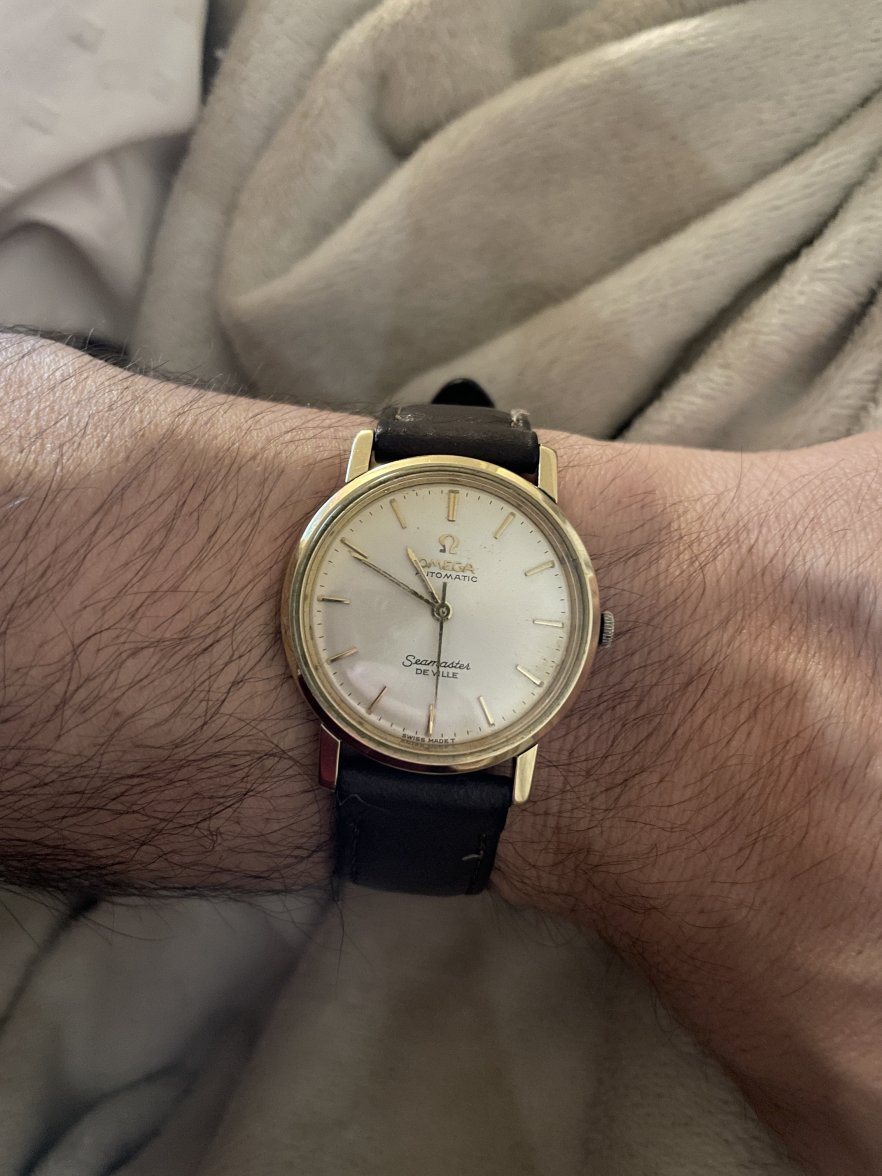
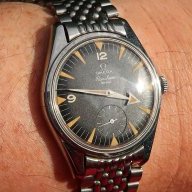
That's my grail watch. Problem is they don't look like they will send it to the UK.

As a matter of interest, my understanding is one "T" after Swiss Made means Tritium hands, not hour markers, and I see no lume plots around the edge, but I do see that the hour markers have cut outs which would appear to be for lume. Is that correct?

Yea I assumed that based on some devilles that it seemed to fit for regarding the single T but it isn’t the case

I have yet to see a convincing case for saying that single or double Ts are anything but a stylistic choice. Perhaps it has to do with the total amount of tritium?

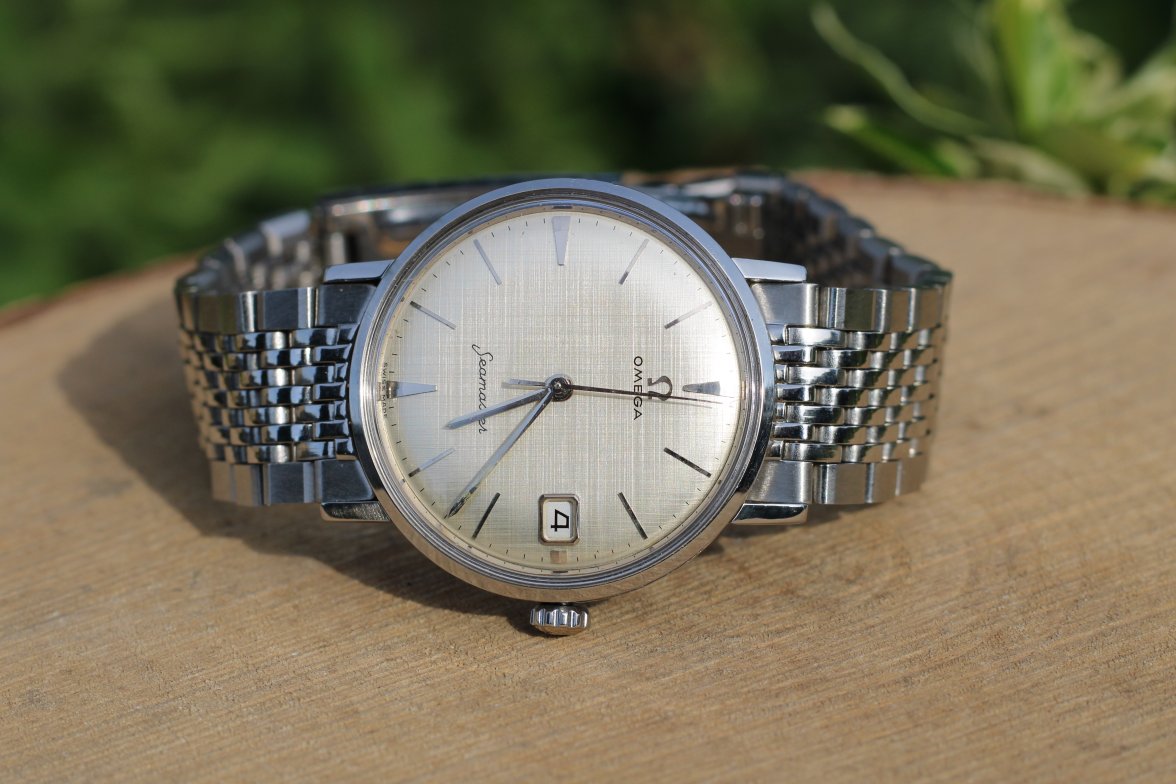
Besides some (seemingly) special order Seamasters from the fifties and a single odd-ball seventies chronograph, I haven't seen any Omegas that have lume only on the hands and not the dial.

While I can easily see that lume on the hands would be enough to give some amount of low light practicality for the user, I cannot see that there would be any demand for a watch that had only some lume instead of the full practicability.

Have anyone seen production Omegas with only hand lume?

 
Posts
896
Likes
3,708
I dont have anything to add from a scholarly perspective other than an example that I can add to the discussion. It was a deville that I owned in the past. It had "swiss made T" but lume on both hands on dial.

 
Posts
2,606
Likes
3,044
I can imagine someone who bought a no-lume version just going to an Omega dealer, indicating they rather have lumed hands, and with no parts restrictions 50-60 years ago and a booming watch ecosystem, it could be a natural source of lumed hands on non-lumed dials?
 
Posts
12,950
Likes
22,412
I don’t believe that a single or double T alongside Swiss Made has anything to do with the amount of tritium or where it is/isn’t located.

I have however seen several examples of late 60’s/70’s Omegas with lumed hands and no lume on the dial. I’ll try and dig out some examples.
 
Posts
9,596
Likes
27,692
I don’t believe that a single or double T alongside Swiss Made has anything to do with the amount of tritium or where it is/isn’t located.

I have however seen several examples of late 60’s/70’s Omegas with lumed hands and no lume on the dial. I’ll try and dig out some examples.

Cool, hope you can find them 👍
 
Posts
12,950
Likes
22,412
I’ll try and have a look over the next day or so (current battling tiredness with a newborn!) but when this question comes up I always think of the c-cased Cosmics from the late 60’s/70’s (not the Cosmic 2000’s, but the 135.016 for example).

These frequently seem to pop up with either lumed dials and not hands or possibly vice versa. Of course this could just be because the hands have been changed but it seems to appear much more frequently on these models than others.
 
Posts
10,305
Likes
16,126
Interesting thread. I too feel there is no actual link between the Ts and the layout. What is weird is that they occasionally skipped the Ts altogether so it seems it wasn't actually a legal requirement, more a choice or gentleman's agreement perhaps. Unless the rules were relaxed at some point that is.

I can't see any utility at all for a combination of dial with lume but no hand lume so my vote is that is deffo a result of a hand swap. The other way round might well have been a factory arrangement as that has some use, but it was certainly rare if so.
Edited:
 
Posts
12,950
Likes
22,412
Interesting thread. I too feel there is no actual link between the Ts and the layout. What is weird is that they occasionally skipped the Ts altogether so it seems it wasn't actually a legal requirement, more a choice. Unless the rules were relaxed that is.

Again something frequently seen on the Seamaster Cosmics (especially the cosmic 2000’s), where they have lume but dashes rather than T’s flanking ‘Swiss Made’
 
Posts
3,728
Likes
6,328
I have seen lots of lumed hands going with no lumed dials and vice versa but I call them frankened and don't pay much attention to them.
 
Posts
18,104
Likes
27,413
🍿
Agreed one way or the other this will be an epic thread. The potential for great info alongside idiotic posts are very very high.
 
Posts
1,727
Likes
14,715
On this one, with no lumen there is a T-delete 😀

 
Posts
9,596
Likes
27,692
Again something frequently seen on the Seamaster Cosmics (especially the cosmic 2000’s), where they have lume but dashes rather than T’s flanking ‘Swiss Made’

No-T lumed dials are a different kettle of fish and discussed some time ago here too. Very common on C-case Constellations too.


What is weird is that they occasionally skipped the Ts altogether so it seems it wasn't actually a legal requirement, more a choice or gentleman's agreement. Unless the rules were relaxed at some point that is.

It could also be due to a different mix of materials in the lume? My own (few!) observations with no-T dials are that lume on them deteriorate differently from what I'd expect from tritium lume...


On this one, with no lumen there is a T-delete 😀


Am I missing something, Thomas? To me this appears to be a non-lumed dial with 'swiss made'? 😀
 
Posts
10,305
Likes
16,126
I don’t personally believe the theory about a different material. There was quite a heated debate about that here a few years back and I saw nothing there or since that suggests to me anything significant was different about the lume used on the No-T or single T watches. The only technology for non-Radium persistent lume available until the 1990s was Tritium or Promethium excited Zinc Sulphide. The problem with Promethium is the 2.6 year half life so it is useless in as few as 10 years and AFAIK Omega never used it, though interestingly I believe NASA did on capsule dials. They of course weren't worried about long term performance. There is a chance the No-Ts used Promethium but I’ve seen nothing to support this. The potency of the beta emissions could have had a bearing on the markings used but again the lack of consistency puzzles me.
Edited:
 
Posts
6,065
Likes
9,380
I’m pretty sure that I had a conversation with Desmond whereby he suggested that it was not unusual for lyre lugged Constellations to have lumed hands and no lume on the dial.

I guess the trouble is, without the proof of old adverts showing these watches as standard offerings, we don’t know if they were special order or even hands that were replaced at service.

would you care to add your ha’peth to the debate Desmond?
@mondodec
 
Posts
843
Likes
878
On the matter of tritium there was a Swiss regulation that required identification of one T up to a certain volume of the material, and two Ts if the volume exceeded that limit. Hence, you will see both lumed hands with no lume on the dial with a T mark, as well as lumed hands and hour markers. So ConElPueblo is absolutely right when he suggests it was about volume.

Pmg I have seen numerous examples of lumed hands with no lume on the dial, some obviously changed over at the dealership at service on request, but others sold as such. Back in the 50s and 60s "glow in the dark" was a big deal.
 
Posts
18,104
Likes
27,413
On the matter of tritium there was a Swiss regulation that required identification of one T up to a certain volume of the material, and two Ts if the volume exceeded that limit. Hence, you will see both lumed hands with no lume on the dial with a T mark, as well as lumed hands and hour markers. So ConElPueblo is absolutely right when he suggests it was about volume.

Pmg I have seen numerous examples of lumed hands with no lume on the dial, some obviously changed over at the dealership at service on request, but others sold as such. Back in the 50s and 60s "glow in the dark" was a big deal.

if it’s a Swiss ref then there is a record of it.

so prove this statement. Otherwise it’s bollocks.
 
Posts
9,596
Likes
27,692
Thank you for chiming in, Desmond. I would really like to see something more tangible than what we have now in order to say anything definite about the lumed hands/non-lumed dials. Ideally a number of specimens with close serial numbers signifying a production run with the same characteristics.


It may be due to my English skills lacking finesse, but I don't read anything from that link re. the difference between one or two Ts? Isn't this text about T vs T 25?