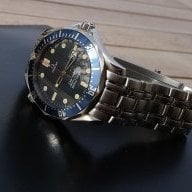
Seamaster 2222.80.00 noisy rotor

Posts
2
Likes
0
Hi everyone,

I recently purchased a 36mm Omega Seamaster (ref. 2222.80.00), which was originally bought and worn by the previous owner since 2013.
I’ve noticed that the rotor makes a noticeable noise when I shake or rotate the watch.

Is this normal for this model? Has anyone else experienced the same thing? Thanks!
 
Posts
271
Likes
441
Hi everyone,

I recently purchased a 36mm Omega Seamaster (ref. 2222.80.00), which was originally bought and worn by the previous owner since 2013.
I’ve noticed that the rotor makes a noticeable noise when I shake or rotate the watch.

Is this normal for this model? Has anyone else experienced the same thing? Thanks!
The movement (basically an Eta 2892, but with a Co-Axial escapement) has a rotor with ball bearings which can indeed be quite loud.

But if it hasn't been serviced since 2013, you should get it checked anyways.
 
Posts
34,269
Likes
38,891
Hi everyone,

I recently purchased a 36mm Omega Seamaster (ref. 2222.80.00), which was originally bought and worn by the previous owner since 2013.
I’ve noticed that the rotor makes a noticeable noise when I shake or rotate the watch.

Is this normal for this model? Has anyone else experienced the same thing? Thanks!
So this is my collector (not watchmaker) perspective from anecdotal experience, @Archer would be able to offer a trained opinion if he sees this.

I found auto winding systems that use ball bearings to carry the rotor like the Cal 2500 in the 2222.80 tend to be louder in general than a sleeve bearing system in good health. The Omega Cal 5xx, 7xx, my older Rolex cal 15xx and 31xx models and Cal 8500 models with bushing / sleeve bearings are very quiet when they're properly maintained while the ETA based calibres I've had with ball bearings were quite noisy.

Then when one of those sleeve bearing movements isn't well maintained and has just been worn for decades without service, they become very noise as the rotor rubs the case-back, movement or just generally chews up the post it runs on. When that happens you can typically hear a difference in how its winding based on how it's positioned.

I'm sure ball bearings reach a point where they get worn and flogged out too but I've never had a ball bearing based movement reach that point where it was rubbing on anything else of significantly failed, so they appear to last longer even with neglect, but make some noise while doing it.
 
Posts
271
Likes
441
So this is my collector (not watchmaker) perspective from anecdotal experience, @Archer would be able to offer a trained opinion if he sees this.

I found auto winding systems that use ball bearings to carry the rotor like the Cal 2500 in the 2222.80 tend to be louder in general than a sleeve bearing system in good health. The Omega Cal 5xx, 7xx, my older Rolex cal 15xx and 31xx models and Cal 8500 models with bushing / sleeve bearings are very quiet when they're properly maintained while the ETA based calibres I've had with ball bearings were quite noisy.

Then when one of those sleeve bearing movements isn't well maintained and has just been worn for decades without service, they become very noise as the rotor rubs the case-back, movement or just generally chews up the post it runs on. When that happens you can typically hear a difference in how its winding based on how it's positioned.

I'm sure ball bearings reach a point where they get worn and flogged out too but I've never had a ball bearing based movement reach that point where it was rubbing on anything else of significantly failed, so they appear to last longer even with neglect, but make some noise while doing it.

Exactly. I can also confirm this from my watchmaking experience (but less than Archer, for sure).
 
Posts
29,672
Likes
76,832
So this is my collector (not watchmaker) perspective from anecdotal experience, @Archer would be able to offer a trained opinion if he sees this.

I found auto winding systems that use ball bearings to carry the rotor like the Cal 2500 in the 2222.80 tend to be louder in general than a sleeve bearing system in good health. The Omega Cal 5xx, 7xx, my older Rolex cal 15xx and 31xx models and Cal 8500 models with bushing / sleeve bearings are very quiet when they're properly maintained while the ETA based calibres I've had with ball bearings were quite noisy.

Then when one of those sleeve bearing movements isn't well maintained and has just been worn for decades without service, they become very noise as the rotor rubs the case-back, movement or just generally chews up the post it runs on. When that happens you can typically hear a difference in how its winding based on how it's positioned.

I'm sure ball bearings reach a point where they get worn and flogged out too but I've never had a ball bearing based movement reach that point where it was rubbing on anything else of significantly failed, so they appear to last longer even with neglect, but make some noise while doing it.
Yes, for sure. The type of ball bearing is important also - ceramic bearings tend to be louder than steel.
 
Posts
2
Likes
0
Thank you all for your responses!

Now that I’ve read them, I feel reassured. I was starting to think there might be something wrong with my watch, but luckily that’s not the case 😀
 
Posts
188
Likes
268
Thank you all for your responses!

Now that I’ve read them, I feel reassured. I was starting to think there might be something wrong with my watch, but luckily that’s not the case 😀
2013 noisy 2892, there is something wrong with your watch. At least wear your watch a full day then check how long it takes for it to stop without wearing it after. If not at least 35 hours, you are good for a repair.

Well know problem on that movement when old and not maintained.
 
Posts
29,672
Likes
76,832
2013 noisy 2892, there is something wrong with your watch. At least wear your watch a full day then check how long it takes for it to stop without wearing it after. If not at least 35 hours, you are good for a repair.

Well know problem on that movement when old and not maintained.
The Cal. 2500 that is in this watch is quite different from a 2982 when it comes to the winding system, so it doesn't have the issues with automatic winding that the 2892 can have.