Omega closing down archives extract service??

Posts
215
Likes
923
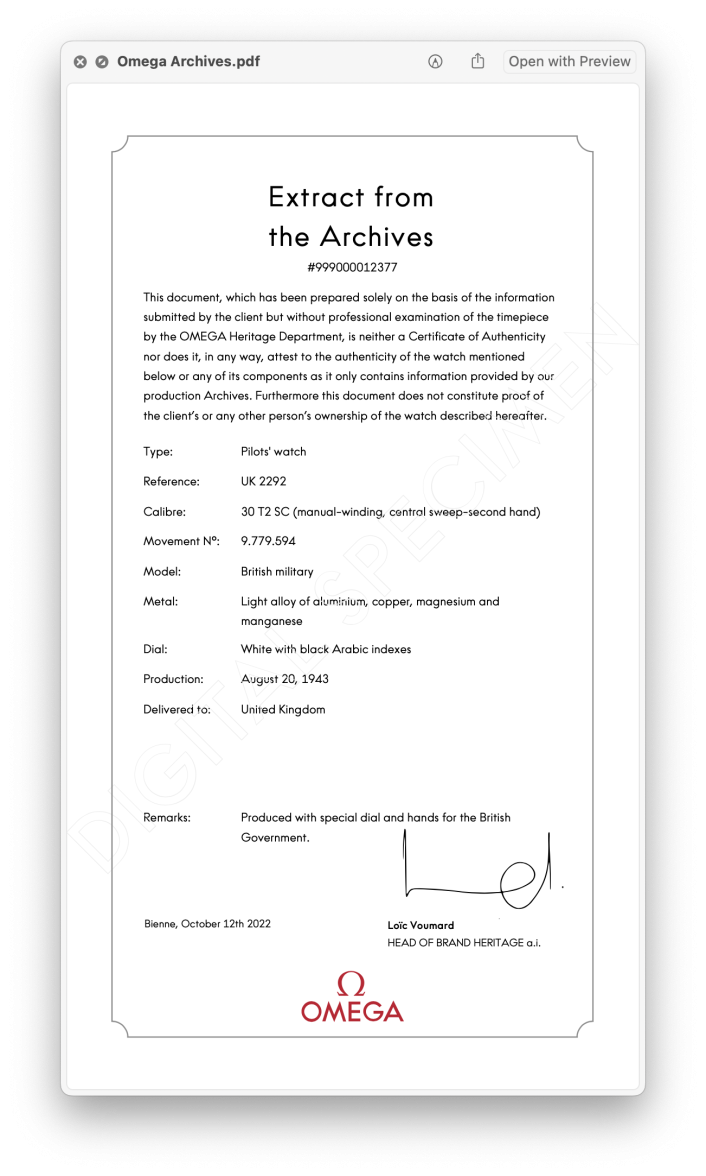
The practical utility of the extracts is marginal, but there are plenty of good, or at least benign, purposes for requesting an extract. People are interested in knowing the history of their watches, and it can be useful to check if a movement is original to a reference. It explicitly illustrates the long heritage of the brand, and demonstrates that Omega cares about that heritage. It encourages collectible interest in the brand and engages owners with the company. Many other brands see the benefit in providing this service.
Sure. In Omegas case it is just a movement number. It would be more worth if the movement number could be traced back to an actual case serial rather than just a reference.

I don’t think Omega sells many more watches for offering this service. But what do I know. I just think it will be easier for them to stop rather than risking more bad press in cases where the extracts later prove to be wrong.

As a collector I see it as a nice way to learn a tiny bit more about a watch. Personally the biggest upside is when an extract comes back empty. Then I know something is off. The extract itself adds zero value to me as I know how easily this is used for someone wanting to cheat. Each to their own though on that. Business wise I still have a tough time seeing that Omega will feel it is worth doing in the future. Hopefully I am wrong.

 
Posts
1,553
Likes
5,761
Even if it creates bad PR costing millions? 😀

Responsibilities will be placed on a few individuals, not on a flawed system. And I think that's probably right.
 
Posts
744
Likes
1,393
https://omegaforums.net/threads/phillips-auction-speedmaster-a-3-000-000-fake.160146/

And on various global news sites that have reported on the issue. The 3m chf put-together speedy is probably just one of many pieces that have been sold the last years with extracts verifying its provenance. I doubt the small fee for the manual work digging up serial numbers in the archives is worth the bad press they have received and may receive in the future.

The "Bad PR" isn't really due to the extract process. It's due to Omega employees allegedly commiting fraud. Discontinuing the extract program because of employee fraud would be kind of like eliminating pharmacy prescriptions because some unscrupulous doctors have been known to prescribe medications illegally.
 
Posts
215
Likes
923
Responsibilities will be placed on a few individuals, not on a flawed system. And I think that's probably right.
The "Bad PR" isn't really due to the extract process. It's due to Omega employees allegedly commiting fraud. Discontinuing the extract program because of employee fraud would be kind of like eliminating pharmacy prescriptions because some unscrupulous doctors have been known to prescribe medications illegally.
Does it really matter? Damage is done and I doubt many will be able to tell what is what. It hurts the brand and it could very well happen again.

Let’s hope the extracts do come back. 😀
 
Posts
744
Likes
1,393
The practical utility of the extracts is marginal,

And if we're going to be honest, the practical utility of mechanical watches in general is pretty marginal these days. But I still own way too many. And I've even paid for extracts for a couple, despite knowing the limitations of the document. But, as @Dan S says, I like knowing a little bit of the history of my watches.
 
Posts
384
Likes
593
I always think the EoA service sets some brands / manufacturers apart from (and imho above) those that don't offer it. Rolex, for example, don't do it. They don't even have museum and you can't easily contact them (hence they get away with saying things such as the Oyster was the first waterproof wristwatch case and implying Hillary wore one to the summit of Everest in 1953. You can't challenge them and it looks arrogant.)

The Omega EoA service was helpful for military watches and for references that are often frankens (e.g. SM300).
 
Posts
3,554
Likes
7,591
It would be more worth if the movement number could be traced back to an actual case serial rather than just a reference.

I think you don´t know the fact that this is possible for many of the older watches - I have several extracts which confirm both serial## and I am happy about it. So I know that movement and case have left the factory together...
 
Posts
215
Likes
923
I think you don´t know the fact that this is possible for many of the older watches - I have several extracts which confirm both serial## and I am happy about it. So I know that movement and case have left the factory together...
And in those cases it is of course much more worth. 😀
 
Posts
337
Likes
613
The Omega EoA service was helpful for military watches and for references that are often frankens (e.g. SM300).

Finally, someone has said it. They are essential for military watches such as the PAF to prevent purchasing either watches that claim to be issued to the military or were cobbled together using some parts that once belonged to a military dial (such as engraved case back, which frankly, can very easily be recreated). Yes, they only tell you that the "movement" was delivered to said establishment but I've had requests for extracts rejected (with no refund) because the movement did not match the reference that I had. So not invaluable by any means, but has helped me at least avoid watches of the kind that I collect.
 
Posts
744
Likes
1,393
Finally, someone has said it. They are essential for military watches such as the PAF

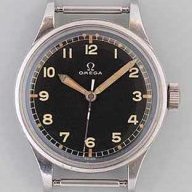
Yes. Also helpful for older watches such as the 6B/159 or HS↑8 models delivered to the British Ministry of Defense in World War 2. Sure, my watch's movement could have been re-cased (though I don't think the special alloy would be available elsewhere), and, yes, the dial may have been refinished (probably was, in fact), but the extract does provide some reassurance of the watch's authenticity even though it's not a guarantee.

 
Posts
6,190
Likes
21,194
Yes. Also helpful for older watches such as the 6B/159 or HS↑8 models delivered to the British Ministry of Defense in World War 2. Sure, my watch's movement could have been re-cased (though I don't think the special alloy would be available elsewhere), and, yes, the dial may have been refinished (probably was, in fact), but the extract does provide some reassurance of the watch's authenticity even though it's not a guarantee.


...and helpful for watches such as Speedmaster Apollo XI straight-writing that originally only sold in Japan.
 
Posts
6,190
Likes
21,194
And if we're going to be honest, the practical utility of mechanical watches in general is pretty marginal these days. But I still own way too many. And I've even paid for extracts for a couple, despite knowing the limitations of the document. But, as @Dan S says, I like knowing a little bit of the history of my watches.

+1. They're FUN! Can't we just want a little fun too?
 
Posts
384
Likes
593
Yes. Also helpful for older watches such as the 6B/159 or HS↑8 models delivered to the British Ministry of Defense in World War 2. Sure, my watch's movement could have been re-cased (though I don't think the special alloy would be available elsewhere), and, yes, the dial may have been refinished (probably was, in fact), but the extract does provide some reassurance of the watch's authenticity even though it's not a guarantee.

Actually there was no Ministry of Defence [sic] in WW2. (I think they were ordered by the Ministry of Supply and delivered to the Air Ministry. Sorry, I'm being pedantic.) You're right about the alloy cases though.
 
Posts
1,479
Likes
3,006
I think the overall problem is the value and creed we collectively put into a piece of paper. It's a literal piece of paper. Once it gained some level of perceived value and buyers began expecting it or insisting on an EoA and sellers began offering or providing it as a prerequisite to a sale, all was lost. If you want an EoA I can print one out and slap onto a box. If I don't care about ripping you off with a bum watch, I can certainly print out a decent looking EoA that'd fool you. An EoA is worthless. It's a curio. It sheds a little light on your personal watch. It has no value. It means nothing. Omega is in part to blame for this since they've hoisted the EoA process as special and vaunted certificate of detail. I'd be perfectly happy with an email service where I ask about a serial number and they just reply back with the information they have. It would be boring, not special, simple, and provide the same information.
 
Posts
13,309
Likes
18,419
I'd be perfectly happy with an email service where I ask about a serial number and they just reply back with the information they have. It would be boring, not special, simple, and provide the same information.
In my very early days in this hobby, that’s exactly what many watch companies did. Omega, JLC, Universal and several others had archivists that would looks stuff up for free as public relations.

Once the vintage watch bubble started inflating in the mid-2000’s, these people got overwhelmed with requests and the companies started charging for these services (Longines being a notable exception), and providing fancy certificates so that people felt they were getting something for their money.

Fast forward 15 years or so, these certificates became valued to collectors as some kind of official “approval” by a brand for a particular watch even though they were never intended to be anything of the sort.

Now Omega, who was one of the companies who started this trend (see OmegaMania, circa 2007) allegedly got caught with their hand in the proverbial cookie jar, people lost their jobs and others may have been defrauded, all over pieces of paper that are apropos of nothing.

Frankly, I hope Extracts never come back and we go back to emails, which are as good as the computer they are printed on. There is just too much potential for funny business, as we have seen in the past year.
gatorcpa
 
Posts
6,190
Likes
21,194
I think the overall problem is the value and creed we collectively put into a piece of paper. It's a literal piece of paper.

Once it gained some level of perceived value and buyers began expecting it or insisting on an EoA and sellers began offering or providing it as a prerequisite to a sale, all was lost. If you want an EoA I can print one out and slap onto a box. If I don't care about ripping you off with a bum watch, I can certainly print out a decent looking EoA that'd fool you. An EoA is worthless. It's a curio....

Not to disagree with you (although I disagree that it has no value), but it isn't just the EoA. It wouldn't matter how detailed their database was or if they examined the watch in person, there is no system that could provide 100% certainty of authenticity. Even if the manufacturer confirmed that every single part of the watch was the same part that was on the watch when it left the factory, the moment that watch leaves the authenticators, it is vulnerable to manipulation.

This argument that the EoA is valuable or not valuable is kind of a moot point. There is NO system that will be absolutely reliable. It's possible that by arguing that the EoA has no value, we might be suggesting that a different system would provide that missing assurance. Likewise, by arguing that the EoA has some value, we aren't saying it provides assurance of authenticity. There is some value in knowing that a reference that was only sold in Japan has an extract that says it was originally sold in Italy. That gives me assurance that this watch is inauthentic. If it says it was sold in Japan as expected, that doesn't mean it's autentic, but it doesn't prove that it's not. There's some value in that imho.

The best and most reliable system is the reliability of the seller and the knowledge of the buyer.
 
Posts
6,190
Likes
21,194
Frankly, I hope Extracts never come back and we go back to emails, which are as good as the computer they are printed on. There is just too much potential for funny business, as we have seen in the past year.
gatorcpa

Omega will send a pdf in email. But pdfs can be faked or altered. Emails can be altered. Paper is no better or worse.

A blockchain would come the closest to being a reliable system for determining authenticity. Even with that, there's probably some clever fraudster who could work around it.
 
Posts
13,309
Likes
18,419
This argument that the EoA is valuable or not valuable is kind of a moot point.
Not when the market values the EoA, even if it can be manipulated.

That’s what created the opportunity for fraud.
gatorcpa
 
Posts
2,842
Likes
4,537
Ideally Companies like Omega would scan the ledgers and microfiche of the punch cards. Then users could do the cross referencing themselves.

In this day and age it is easy to OCR text. Even handwritten faded text in old ledgers. There are projects afoot to decrypt things like Charles Dickens' short hand writings. The man could barely hold a pen. His works are covered in blots and crossings insertions etc. (there were specialist typesetters who could read his manuscripts.)

Probably a place where some simple AI could be of use.

I still think I would be perfect for the job of Omega Archivist.
 
Posts
337
Likes
613
If the worry is the EoA's can be faked (yes, they can - digitally), then only trust the ones you actually apply for yourself, not those given to you by other sellers. Sure it's additional cost, but that's the price of a little peace of mind.

I've had potential watch sales stall because buyers (mostly dealers) would not buy certain vintage watches without an extract. Their placing some "value" in it implied they were valuable. Agreed they are not, in monetary terms, but for certain watches, they help or aid in the decision-making process of the watch being what it claims to be.