New Speedmaster "Moonwatch" owner looking for advice.

Posts
24
Likes
25
What are you measuring it against, and how exactly?
I'm synchronising my Casio G shock digital watch with the omega so on a morning the seconds are in sync. I know it's not exactly the most scientific way but it gives me an idea.
I left it crown down this morning and it hasn't gained any time at all, whereas yesterday leaving it dial up it had gained 6 seconds in 12 hours.
 
Posts
10,442
Likes
16,328
I'm synchronising my Casio G shock digital watch with the omega so on a morning the seconds are in sync. I know it's not exactly the most scientific way but it gives me an idea.
I left it crown down this morning and it hasn't gained any time at all, whereas yesterday leaving it dial up it had gained 6 seconds in 12 hours.
In which case your average in your testing is around +5s which is a lot better! Easy answer is to leave it crown down when not wearing it and monitor its overall performance when on the wrist. Maybe a free or cheap app like Twixt may help. Not very accurate but maybe better than manual checking.
 
Posts
1,699
Likes
1,654
Is the G Shock one of the ones that synchronize themselves to WWV automatically? Have you checked that it's being done successfully? If not, how are you sure the G Shock is keeping time correctly? When working properly, they are more accurate than mechanicals, but gremlins can attack anything, even quartz.

I prefer to synchronize to a computer whose clock is continuously synchronized using NTP. And look at its status. Cell phone clocks are also synchronized to the cell phone tower so they're usually reliable.
 
Posts
29,672
Likes
76,830
I'm synchronising my Casio G shock digital watch with the omega so on a morning the seconds are in sync. I know it's not exactly the most scientific way but it gives me an idea.
I left it crown down this morning and it hasn't gained any time at all, whereas yesterday leaving it dial up it had gained 6 seconds in 12 hours.

I would suggest using something like time.gov for timing the watch to, rather than a digital watch.

How much time does it gain/lose when you actually wear it for the day, or is that where the +10 second number comes from in your original post? Keep in mind that the tolerances that were stated earlier in this thread of -1 to +11 seconds per day are correct, but they are an average of all positions checked on this movement (3 positions) and not the tolerance for each individual position. Each individual position can vary more than that in terms of the spread, so at full wind those 3 positions can be as much as 15 seconds between the fastest and slowest position, and 24 hours after full wind it increases to 20 seconds. If you happen to leave it for 24 hours in the fastest or slowest position then you can't really use the tolerances above as a guide - most people don't understand how these timing numbers work, so some do get upset about things that are actually just fine.

For example, let's say the readings for the 3 positions measured are 0 (no gain or loss), +7 seconds, and +15 seconds. The spread between the slowest and fastest position is 15 seconds, so that is in tolerance, and the average of the three is +7.3 seconds, so the watch is fine. But if you left it in the +15 position for 24 hours, you would be "annoyed" with it being out of tolerance, but it's not.

Before you take the step of bringing the watch back for adjustment, check all 6 positions and let us know what the results are, then I have one more test I would like you to do...so when you wind it every day as you complete your positional testing, try to count how many turns of the crown it takes to get to full wind as this will help with the test I'd like you to do.

Cheers, Al
 
Posts
24
Likes
25
In which case your average in your testing is around +5s which is a lot better! Easy answer is to leave it crown down when not wearing it and monitor its overall performance when on the wrist. Maybe a free or cheap app like Twixt may help. Not very accurate but maybe better than manual checking.

Yes this is going to be the best course of action I think.
I'll have a look for that app, thanks.

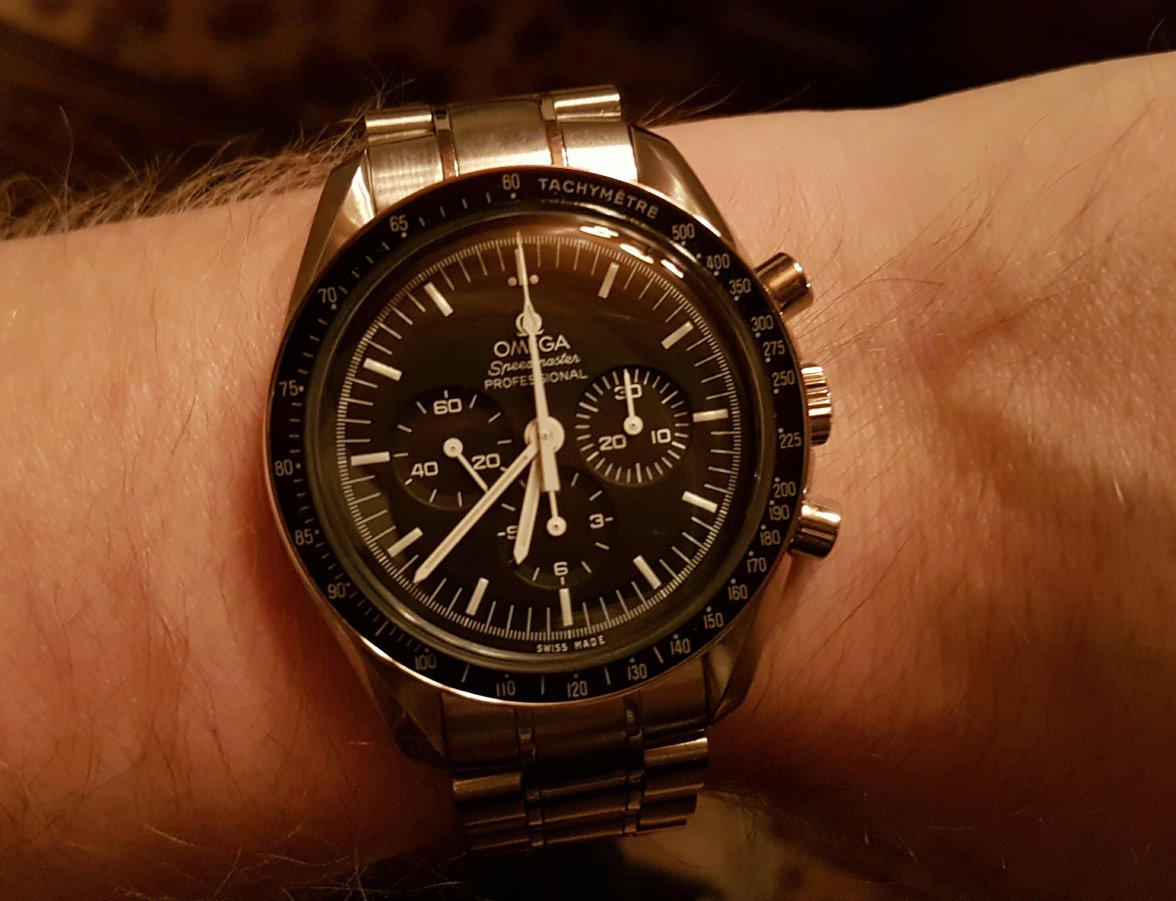
Congrats on the Speedmaster. If only we could get a nice wrist shot of said Speedy 😗

As requested.
 
Posts
29,672
Likes
76,830
Okay posting this here for everyone to see - the OP has sent me some positional timing information via PM:

Crown down: +2 secs, 38 winds.
Crow up: +7 secs, 42 winds.
Crown right: +10 secs, 44 winds.
Crown left: +1 sec, 41 winds.
Dial up: +8 secs, 42 winds.
Dial down: +16 secs, 43 winds.

So assuming the number of winds is telling me that he wound it fully (until it stops winding) every day, we can glean some information from this testing. Omega only requires that this movement be checked in 3 positions, so dial up, crown down, and crown left. So those are +8, +2, and +1 respectively. The Delta (difference between fastest and slowest positions) of these three positions can be as much as 15 seconds for this movement, and here we have 7 (8-1=7). The average rate can be between -1 and +11, and here we have 3.7, so it's well within Omega's specs.

However this watch illustrates the fault in just using 3 positions, since some others are significantly different. Looking at all 6 measurements, the Delta increases to 15 and the average rate increases to 6.3. Now these are still within specs, and actually omega's "target average rate" they typically adjust to is +6 seconds per day, so this is right on there. In short there's nothing wrong with the watch, however it could be better with some adjustment certainly.

If I were servicing this watch I would first look at is the average of all horizontal positions compared to the average of all vertical, so 12 for horizontal, and 5 for the vertical. To me this suggests the regulating pins may be too far apart (and also not parallel, causing the dial up to dial down difference to be quite high), provided of course that the coils of the balance spring are concentric and the outer coil is centered between the pins. I would adjust them closer and correct any angles, which would bring the two averages closer, then slow the whole thing down - that would probably be enough, but I would have to see what the possible poise error between crown left and crown right does...it may need to be adjusted if it doesn't come more in line.

So in short OP, Omega is not likely going to adjust this for you under warranty since it's well within their specs. If you asked a boutique nicely they may be able to adjust the average slower for you so it doesn't run quite so fast. The old timers call this adjusting to the wearer - I prefer to get it adjusted well enough this isn't required personally.

Hope this helps.

Cheers, Al
 
Posts
24
Likes
25
Thank you for such detailed information, I think if I just leave it crown down or crown left when I'm not wearing it then the additional time will be virtually unnoticeable. Maybe when it comes to getting it serviced I can mention the time gain.
 
Posts
1,452
Likes
6,641
Crown down: +2 secs, 38 winds.
Crow up: +7 secs, 42 winds.
Crown right: +10 secs, 44 winds.
Crown left: +1 sec, 41 winds.
Dial up: +8 secs, 42 winds.
Dial down: +16 secs, 43 winds.

Am I missing something? Is crown right not the same thing as dial up (and left the same as dial down)?
 
Posts
24
Likes
25
Crown down: +2 secs, 38 winds.
Crow up: +7 secs, 42 winds.
Crown right: +10 secs, 44 winds.
Crown left: +1 sec, 41 winds.
Dial up: +8 secs, 42 winds.
Dial down: +16 secs, 43 winds.

Am I missing something? Is crown right not the same thing as dial up (and left the same as dial down)?

I was confused by this also at first till Archer explained to me what the positions are. Crown left/right are the watch stood on it's lugs where the bracelet meets the watch, so either the 12 or 6 positions on the dial are pointing straight up in to the air.
 
Posts
1,452
Likes
6,641
I was confused by this also at first till Archer explained to me what the positions are. Crown left/right are the watch stood on it's lugs where the bracelet meets the watch, so either the 12 or 6 positions on the dial are pointing straight up in to the air.
Proving once again that I learn something new every day. Thanks.
 
Posts
373
Likes
389
Maybe a free or cheap app like Twixt may help. Not very accurate but maybe better than manual checking.
Very good information in this thread, thanks.

Just a small correction: Twixt isn't for free any longer and not cheap either with 20€. BUT they have introduced a new optical method of time measurement (by locating the exact position of all hands relative to the time scale on the dial). If used correctly it is VERY accurate.
 
Posts
19
Likes
7
It sounds like your watch is running similarly to mine. I've had mine since September or so.

After a few months of wearing in, I tracked it's accuracy using an iPhone app called WatchTracker. With this app, you basically record the time that's displayed on the watch and the app calculates how much the watch drifts over time when compared to the atomic clock, which the app syncs to.

I found, as you did, that my watch gains at a rate of between +5 and +10 seconds per day when wearing it. My watch also loses time very slightly when rested crown down overnight, at a rate of around -2 to -3 seconds per day. When averaged out, this results in a "real world wearing experience" (my term) of the watch gaining about +4 seconds per day. Over the course of a full week, I measured the watch every morning when I woke up, wound it fully, wore it all day, then measured it again when I went to bed, resting the watch crown down on my nightstand.

The results look like this in the WatchTracker app. This first graph shows the gradual increase in time over the course of 7 days. The X axis is days, the Y axis is seconds. You can see the 0 point on the Y axis is roughly where the watch started on the morning of the first day.

31675441294_fa3b52e164.jpg

This next graph shows, over the same period, the "seconds per day" rate that was measured at each data point. This shows a good picture of the consistency of the rate during the day, and at night. Note that on day 4, I took 2 datapoints during the day, which is why that "peak" looks more like a plateau. As you can see, the average gain rate over the course of a day's wearing is between 5 and 10, with an average around +7 to +8 seconds or so. And, the average loss rate over the course of a night resting crown down is pretty consistently right around -2 to -3 seconds per day rate.

31707217273_84f945cd51.jpg

Note, that the rates stated are rates, not seconds gained. For example, during a normal day where the watch gained at a rate of +7.6 seconds per day, the watch actually gained 4.9 seconds in 15.4 hours of wear during the day. Similarly, when the watch lost time at a rate of -3.2 seconds per day over night resting crown down, the watch actually lost 1.1 seconds over 8.2 hours.

I hope this helps!
 
Posts
3,861
Likes
8,804
Thanks for the replies. Yes my wife is amazing.
I have left the watch in a different position today to see if that has any effect on the time gain. So the reason for the gain could be simply that I am not wearing it daily? Is the movement affected by just sitting in one position for long periods? Sorry for all the questions but I really want to make sure I look after the watch.

Yes. No. Possibly. Get it regulated if it bugs you.

Ask your wife to buy you another watch. It will help. Trust me, you'll soon be well and you won't worry as much.
Edited: