
- Posts
- 192
- Likes
- 178
LuckyLes
·I think both of those pie shops have now gone. But there is no doubt that we do make some very good pies in this country.
Please consider donating to help offset our high running costs.
I’ve always been curious about water resistance as it pertains to Omega screw down crowns. Based on what you’re saying, the act of screwing down the crown itself does not contribute to water resistance - correct? If that’s the case then I wonder why Omega doesn’t openly state that, similar to how they state the He valve is WR to 50m if left unscrewed.
Would either the 300m or Planet Ocean (non chrono) be water resistance to their full depth rating if the crowns are left open?
I think both of those pie shops have now gone. But there is no doubt that we do make some very good pies in this country.



So, this question comes up frequently, so here's some photos for the you. Starting with a freshly serviced watch:
Standard pressure test using vacuum and pressure. -0.7 bar vacuum, and +10 bar pressure:
With the crown screwed down, of course it passes easily:
Let's unscrew the crown now:
Test it again, and it passes:
Here you can see that the crown is unscrewed:
Now let's pull the crown all the way out to the time setting position, so pulled out as far as it can be pulled out:
Test it again, and it passes:
The gasket that is inside the crown doesn't leave contact with the case tube, no matter what position the crown is in. No one is suggesting that you should intentionally leave the crown unscrewed on the watch, but if you do and the seals are in good condition, then most likely you will be fine.
There are some people on watch forums (this one included) for whom water resistance is a topic that can't be thought about in any rational fashion. They will tell you that getting your watch wet will result in doom and chaos, but these watches are designed to resist water, and if they are in good condition (this is the key) then they will be fine.
Cheers, Al

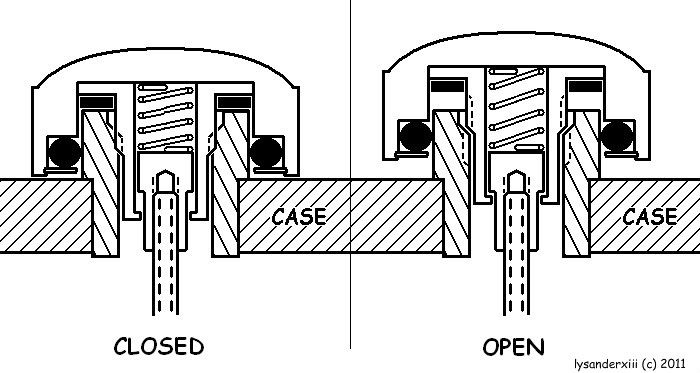
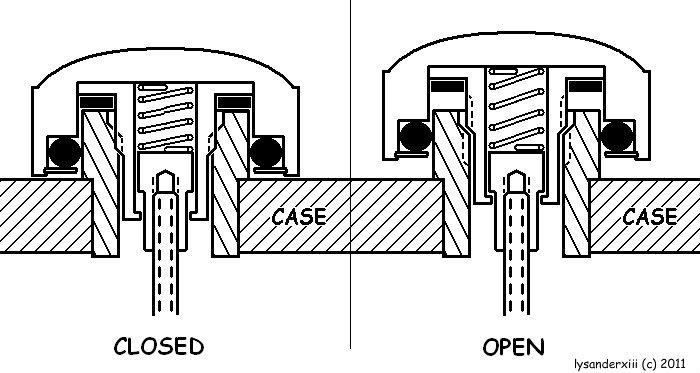
The solid black are the seals. The round one is a O-ring that seals against the crown tube, both when its closed and open. The rectangular one is a flat gasket that seals when the crown is closed only. The flat gasket withstands a higher water pressure because of the higher mecanical compression of the gasket when the crown is tightened down on to it.
If the seals are worn or have gone hard with age the waterresistans is lowered.
When in doubt get the seals replaced and the watch pressure tested. It cant be that expensive to have a watchmaker do that job. Watchmakers need to work and watches need watchmakers to work. Support your local watchmaker!
Oh and dont forget to tighten that crown.

Interesting thread, if only for the reason that I now know the difference between hydrodynamic (of, relating to, or operated by the force of liquid in motion) and hydromaniac (used to describe a person who is obsessed with water and the damage it causes).
The gasket that is inside the crown doesn't leave contact with the case tube, no matter what position the crown is in. No one is suggesting that you should intentionally leave the crown unscrewed on the watch, but if you do and the seals are in good condition, then most likely you will be fine.
There are some people on watch forums (this one included) for whom water resistance is a topic that can't be thought about in any rational fashion. They will tell you that getting your watch wet will result in doom and chaos, but these watches are designed to resist water, and if they are in good condition (this is the key) then they will be fine.
Cheers, Al
Brilliant explanation!
I’ve heard that the new SMP 300M Divers (with the cal. 8800) can have the He valve opened underwater. Not sure why someone would do that (since it’s for saturation diving), but Tim from the WatchBox keeps making that claim in his YouTube reviews.
Can anyone confirm?
Thanks. Makes you wonder how automatic HEVs that come flush with the case (like a Sea-Dweller, for example) do not compromise water resistance.
Checking Google...
From Bob’s Watches:
From a strictly functional standpoint, automatically operated helium escape valves offer a superior design, as they require no action on the part of their wearers and will do their job no matter how preoccupied the diver might be during decompression. Additionally, since they are only open for a split second while pressures are being equalized, the potential for dirt/debris to enter the case through the opening is minimal. With that in mind, some collectors prefer manually operated valves for the added visual intrigue of having a second crown on the case, and also for the ability to screw the valve shut to offer added security when not in use.
Only a stopover on the way to an even more remote place...
But Dubbo apparently has the best pies in Australia (along with the hundreds of others who make that same claim)...
It was pretty tasty...
"hydromaniac shock" there's a lot of that going around on watch forums mate. 😉

Only a stopover on the way to an even more remote place...
But Dubbo apparently has the best pies in Australia (along with the hundreds of others who make that same claim)...
It was pretty tasty...
"hydromaniac shock" there's a lot of that going around on watch forums mate. 😉