Speedmaster 60th waterproofness

Posts
66
Likes
125
For Omega, 60m means 60m, and if they were concerned about movement of the watch under water, for their own sake they would say something about it in their water resistance information or the watch manual.

I agree that everyone needs to do what is right for them, but please unless you have proof of what you claim, stop making things up. Please do the math for us, and remember to show your work. If you want to refute those who have done the work already, saying it's "common sense" doesn't cut it, because it isn't when you do the math...

Cheers, Al
If people put on a 60m Chronograph and engage in jumping or diving into water then there is a higher possibility that the watch will fai than if you simply wear it and engage in a more sedate activity while in the waterl.

I can only say what I know to be true and saw with my own eyes, that a guy I know at the gym who swam all the time in his 100m Rated watch got it to leak water in due to the more strenuous aqua aerobics workout for 1 hour imposed on his watch.
It was not an Omega nor a Chronograph but it had been quite at home with the water in the past when he swam in it on top of the water, perhaps it was a coincidence that the first time he used it in the aqua aerobics class it decided to fail?

Anyway as I said I personally would not risk wearing a 60m water resist watch especially a Chronograph at the swimming pool for swimming and diving in to the water the way I do as I would not trust it to keep out the water.
That is what my Seamaster or my Casio G shock are for.
 
Posts
10,307
Likes
16,128
Post old wives tales and expect to be challenged. Sniping has nothing to do with it.
 
Posts
16,856
Likes
47,859
@Bulldozer please just read the whole first post of the link I posted and come back and give us your thoughts on the post.
 
Posts
29,234
Likes
75,575
If people put on a 60m Chronograph and engage in jumping or diving into water then there is a higher possibility that the watch will fai than if you simply wear it and engage in a more sedate activity while in the waterl.

As I said, if that is your belief, then do the math and show us how it is true.

I can only say what I know to be true and saw with my own eyes, that a guy I know at the gym who swam all the time in his 100m Rated watch got it to leak water in due to the more strenuous aqua aerobics workout for 1 hour imposed on his watch.
It was not an Omega nor a Chronograph but it had been quite at home with the water in the past when he swam in it on top of the water, perhaps it was a coincidence that the first time he used it in the aqua aerobics class it decided to fail?

As a watchmaker who deals with these sorts of things daily, the first question I would ask is how old is that watch? When was the last pressure test done? When were the seals replaced last?

Coincidence Causation

What you see with your own eyes is not necessarily the whole story. Seals work, right up until they don't anymore, which is why at the bottom of that chart I posted Omega recommends getting your watch pressure tested at least once per year to ensure that the seals are in good shape.

Anyway as I said I personally would not risk wearing a 60m water resist watch especially a Chronograph at the swimming pool for swimming and diving in to the water the way I do as I would not trust it to keep out the water.
That is what my Seamaster or my Casio G shock are for.


A perfectly valid approach if that is your preference - there's no need to justify your preferences by asserting things that are not true from a technical standpoint. I come here to help people better understand their watches, and unfortunately many people on watch forums continue to spout "alternative facts" about them that are simply not true. I have no problems with anyone wishing to debate a subject with a well reasoned argument, but so far you have not come close to meeting that standard. It's not sniping, just trying to prevent people from spreading more false information.

Cheers, Al
 
Posts
66
Likes
125
@Bulldozer please just read the whole first post of the link I posted and come back and give us your thoughts on the post.

I read the post and it is very interesting and it covers swimming underwater and moving your arms faster than is humanly possible while underwater. It does say that what manufacturers claim as a warranty for even a similar watch off the conveyor belt can have different water resistance than each other.and that makes sense so does the extra expense for testing the watches at different levels of water resist and keeping the highest priced ones that way as they are sold for that reason (even though perhaps a far cheaper one from the same firm can equal its performance)
It does not cover diving into a pool off a high board etc but as we would be travelling at around 16 feet per second (for the 1st second falling and then 62 feet per second for the second second falling and then 138 ft per second for the third second and then over 240 feet a second for the 4th second of falling and so on.

I conclude from this further evidence that the condition of our watch would be the last thing to worry about at that speed. he he
I bow to your scientific proof and must conclude that the accident with the guy I know from the Gym in the aerobics class was simply his watch decided to fail

It does however mention in the article that manufacturers claim that up to 50m is not suitable for swimming or diving and then the next jump is to 100m. which is their warranty for swimming This Speedmaster Chrono is a 60m water resist watch.and even though most likely as the claim is that it should be ok for light swimming, I would not trust it as there are better choices to get in the water with.
 
Posts
15,242
Likes
44,766
Interesting that the OP hasn’t posted again, since starting this thread. Seems more interest has been generated amongst others than The guy with the problem. Any watch that has once proven to be water resistant, can develop a leak. Best of luck to those to feel,otherwise.
 
Posts
29,234
Likes
75,575
It does however mention in the article that manufacturers claim that up to 50m is not suitable for swimming or diving and then the next jump is to 100m. which is their warranty for swimming This Speedmaster Chrono is a 60m water resist watch.and even though most likely as the claim is that it should be ok for light swimming, I would not trust it as there are better choices to get in the water with.

Once again, read the Omega chart. Omega clearly says the watch is fine for swimming.
 
Posts
66
Likes
125
Once again, read the Omega chart. Omega clearly says the watch is fine for swimming.
I know what they say but I just said that I would not get into the water with one on as I would use a more appropriate watch.
 
Posts
1,813
Likes
9,393
Coincidence Causation

What you see with your own eyes is not necessarily the whole story. Seals work, right up until they don't anymore...

Amen to that! I recall a rather good newspaper advertisement that captured that very nicely:-
 
Posts
1,813
Likes
9,393
@Archer, where are the seals located in the pushers exactly? Looking at that Trilogy teaser X-Ray video I could see what looks like a seal for the crown, but nothing in the pushers. Edit: maybe those double black points within the case?
Could just be artistic license wrt the video of course. Anyway, just curious to know how the sealing is typically executed.

Cheers

Nick
 
Posts
5,501
Likes
9,399
It does not cover diving into a pool off a high board etc but as we would be travelling at around 16 feet per second (for the 1st second falling and then 62 feet per second for the second second falling and then 138 ft per second for the third second and then over 240 feet a second for the 4th second of falling and so on.
I assume you are still working on the fluid pressure calcs still, as that is what tells the story.
 
Posts
66
Likes
125
I assume you are still working on the fluid pressure calcs still, as that is what tells the story.
I have already (in this last post of mine before your own, if you read it ) agreed with the poster Stanbys scientific evidence that he put forward, that water pressure by normal jumping and or diving even from a high board in a swimming pool , will not cause enough extra pressure to make a true 60M water resist watch leak water unless there is a faulty seal in one of the chrono pushers or the crown.

That being said maybe the highest cliff divers would make the watch leak water as they jump from over 190 feet and hit the water in around 3.5 seconds.but any faster than that we would no longer be concerned with the state of our watch but the state of our skeleton, lol
 
Posts
29,234
Likes
75,575
@Archer, where are the seals located in the pushers exactly?

Here are some photos to show the basic construction of the pushers - note that this is for a regular Speedy Pro and others may differ slightly.

The pushers are made of several parts:

1 - The pusher tube or body
2 - The pusher cap
3 - The pusher screw
4 - The spring
5 - The seal
6 - The titanium washer

Here I'm about to change a set of pushers, and I start by unscrewing the pusher screw from the inside of the case:


The caps are then removed, and the spring can be taken out of the pusher body (red arrow):


The pusher tubes are then unscrewed from the case, using the appropriate tools:


This is a photo of the pusher cap on the left, and the pusher tube on the right. The seal has deteriorated on this one, but would be on the inside of the pusher tube, and the post that the pusher screw threads into to hold the cap on is what contacts the seal. So at the red arrow you can see some residue of the deteriorated seal on that post, as that outside diameter of the post is what goes into the inside diameter of the seal, and seals the pusher:


Pushing the pusher under water does not make the seal lose contact with the post or anything - again as I've stated the concern here is that water that may get under the pusher cap could be forced inside the case. Water is not compressible so if it's trapped under the pusher cap and the pusher is depressed, it can possibly force the water past the seal.

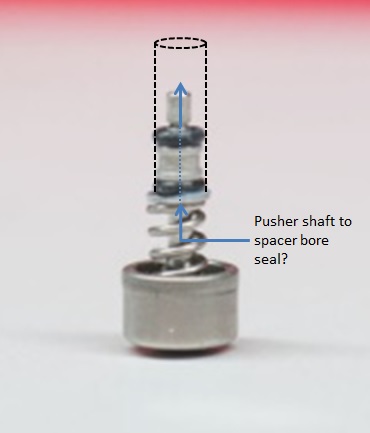
Note that Omega's diving chronographs that have pushers that can be used under water are constructed quite differently. This does not show the pusher tube that screws into the case, but these are the parts that have been removed to replace both seals:


So left to right:

1 - Pusher cap with the post built in
2 - Spring
3 - Washer
4 - Seal #1
5 - Spacer
6 - Seal #2
7 - Clip - this is what holds all these parts into the case via the small groove in the post on the pusher.

Here is what the stack looks like ready to be installed in the case:


In this case there are 2 seals instead of just 1, and the tolerances/fit is a fair bit tighter on everything with this style of case. This particular watch is rated to 300 m.

Hope this helps.

Cheers, Al
 
Posts
2,219
Likes
4,947
Interesting discussion about dynamic pressure. Bernoulli knew what he was doing (!) and most basic equations for hydrodynamic work came from him.

I think the confusion arises because it's related to velocity squared. So, if I said that moving at 100 mph would generate an additional dynamic pressure in water equal to the static pressure at 100m, then you can see why people might be concerned about adding an extra 10m of water pressure to the watch when swimming. But, as it's related to the square of velocity, moving at 10 mph would only generate a dynamic pressure of about, (sorry, I was thinking in bar) 1m.

So, James Bond wasn't too worried about his Rolex in Thunderball on that powered sled...

I've done this very simply using the dynamic pressure equation: pressure = 0.5 *fluid density*velocity which is for incompressible fluids and water is essentially that. Pressure in pascals, density in Kg/m3 and velocity in m/s. Much easier than imperial units and working in slugs etc...

Cheers, Chris
 
Posts
1,813
Likes
9,393
That's a great reply Al, very clear (as always), thank you very much!👍

Now my curiosity has been raised concerning those Diver Chrono pushers. Is there an internal seal between the pusher post and the spacer tube as well as the external ones on the spacer? What's to stop water passing along the surface of post to the inside of the case?
Edit: I need new glasses. I see that the O-Rings are top and bottom of, not around the spacer, I’ll just get my coat now.::facepalm1::


@ChrisN Looks like the pressure (force) would be even lower due to normal underwater swimming since arm acceleration is a vector quantity, i.e. the direction and magnitude need to be specified and not always acting in the same direction.

As to cliff diving then there is something else to consider; the water pressure will be more or less a step impulse transient, something akin to the water hammer effect in hydraulic pipes...or maybe it's nothing like that since the "system" is not completely bound as in a pipe with a head of water at one end and valve at the other; anyway trying to work it out involves way too much calculus for a Saturday night - I'm off for a Beer with my Grünkohl, Pinkel & Kassler.
Edited:
 
Posts
37
Likes
134
[QUOTE = "Archer, poste: 869803, membre: 2441"] Encore une fois, lisez le tableau Omega. Omega dit clairement que la montre est parfaite pour le nager. [/ CITATION]


Encore une fois 😀) fait comme tu veux mais moi comme beaucoup de personnes font sur ce forum et ailleurs ils ne le font pas, il ne faut pas croire tous les écris Apres fait ce qu'il a un pas de soucis 😀)
 
Posts
2,219
Likes
4,947
All of you must be fun at parties.

Wow, I wish I was like you instead! I'm sure you are los cojones del perro. LOL, Wut etc...

Please, any advice appreciated as your comment has changed my life and I now feel completely inadequate🙁
 
Posts
408
Likes
953
I was not waiting such a discussion to take place. That's great, a lot of information! To give you more details, the watch had been dropped at Omega Genève this morning (no way to drop it before). They said It would be covered by the warranty (défaut étanchéité) and will take up to two weeks to get it back.
My daughter is only two and it was her first "real" time at the swimming pool so I just went for half an hour in the water (50cm deep), the chronograph was not activated under water or during this swimming pool episode. Obviously I cannot exclude that accidentally the reset pusher was pushed. That's comical cause it's my first new watch (only own vintages) and it's the first time I put a watch in water, there won't be another one I promise.

Btw thanks guys for all your comments, advices!