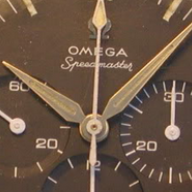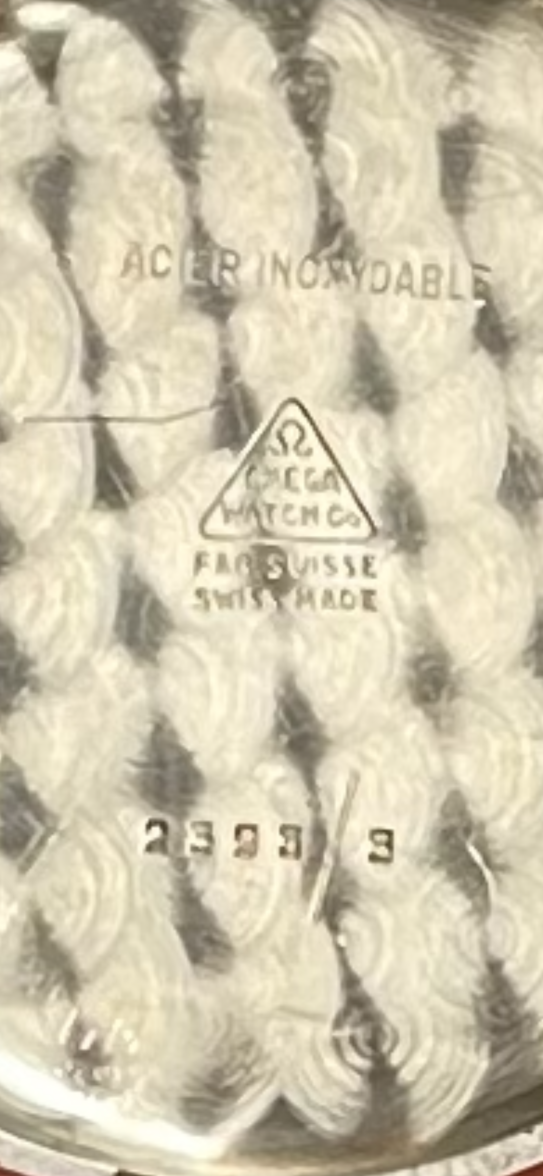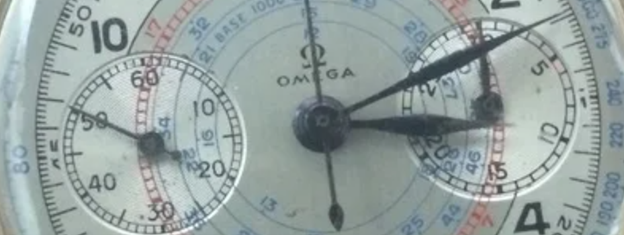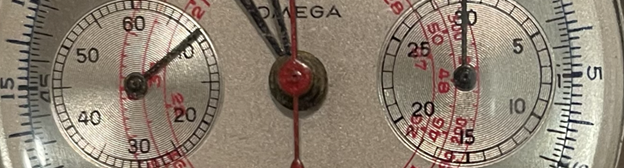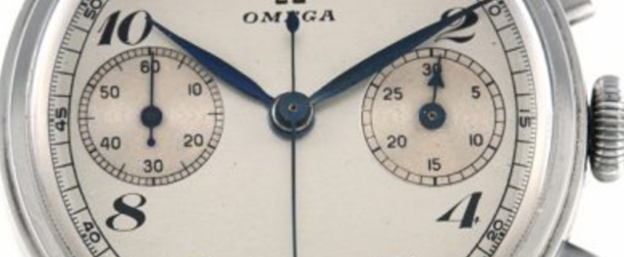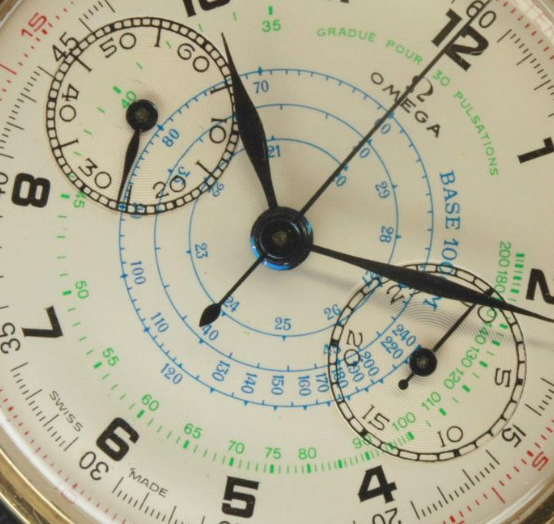
Omega CHRO 33.3 Reference Number

Posts
1,447
Likes
3,018
POCKET OMEGA: This helps for sure OllieOnThe Rocks. I enjoy going down the various Chro 33.3 rabbit holes. Hopefully I have not breached any forum etiquette in my quest to learn more

1. I cannot see the attached caseback picture, I presume you tried to add one? I would be interested in knowing the depth of this model to the rim of the bezel - do you have vernier callipers?

2. I think it would be easier if you find examples that don't look right to you and we can discuss our opinions, there can be certain peculiarities, but usually they are 'known' in other words, when we see the issue we will say, yes this is common.

3. From this image you have provided I would confidently say it is original and correct. The fonts of SWISS MADE look correct to me, and their placement. Everything appears to be very accurate and neat.

4. This type of silver is not conclusively unheard of it is just a contributing factor that helps us make a conclusion when combined with other factors.

5. To me I know this is correct as there are various other examples of this dial that are identical with same placement and proportions. If it was a redial it is highly highly unlikely someone made more than one and those were both on google or a forum for us to observe. This is also corroborated by the patina, it is very hard to create an 'mock' patina and make it look convincing.

6. Yes that 'mess' is quite normal on these highly detailed, usually the difference of colour helps bring clarity, however clearly on that black dial they are all white which makes it more troublesome. I am not sure of the originality of that dial though, I would need to make a more conclusive decision on it's authenticity. From what I see it looks fantastically accurate in other areas so it wouldn't surprise me that this is authentic. A lot of us use a catalogue of reference images that we build through our investigations to help us with particularly detailed dials.

7. The red is not original on that example either in my opinion, it just doesn't feel cohesive to the overall design to me. As far as I am aware all hands should be the same colour.That said we do sometimes see a blued second hand combination with silver hands, so I could be wrong, I doubt it though.

Best wishes,

Oliver
Edited:
 
Posts
3,554
Likes
7,591
1. I cannot see the attached caseback picture, I presume you tried to add one? I would be interested in knowing the depth of this model the the rim of the bezel - do you have vernier callipers?

2. I think it would be easier if you find examples that don't look right to you and we can discuss our opinions, there can be certain peculiarities, but usually they are 'known' in other words, when we see the issue we will say, yes this is common.

3. From this image you have provided I would confidently say it is original and correct. The fonts of SWISS MADE look correct to me, and their placement. Everything appears to be very accurate and neat.

4. This type of silver is not conclusively unheard of it is just a contributing factor that helps us make a conclusion when combined with other factors.

5. To me I know this is correct as there are various other examples of this dial that are identical with same placement and proportions. If it was a redial it is highly highly unlikely someone made more than one and those were both on google or a forum for us to observe. This is also corroborated by the patina, it is very hard to create an 'mock' patina and make it look convincing.

6. Yes that 'mess' is quite normal on these highly detailed, usually the difference of colour helps bring clarity, however clearly on that black dial they are all white which makes it more troublesome. I am not sure of the originality of that dial though, I would need to make a more conclusive decision on it's authenticity. From what I see it looks fantastically accurate in other areas so it wouldn't surprise me that this is authentic. A lot of us use a catalogue of reference images that we build through our investigations to help us with particularly detailed dials.

7. The red is not original on that example either in my opinion, it just doesn't feel cohesive to the overall design to me. As far as I am aware all hands should be the same colour.That said we do sometimes see a blued second hand combination with silver hands, so I could be wrong, I doubt it though.

Best wishes,

Oliver

Oliver, you are a very patient guy! 馃憤
 
Posts
5,598
Likes
9,424
Ok. It's a redial. No doubt. For a normal observer, it's well executed with the mentioned flaws. To me, it's done by Causemann. Now your dial is on the Internet. And will be used by others as a reference in the future. Many dials, you find in Google searches , are repainted. Even most of the vintage watches with lousy dials , you send to the factory for restoration and NOS Dials are no longer available , are repainted by Omega ( mostly outsourced ) . Which does not make them original either.
Edited:
 
Posts
6,667
Likes
11,570
My 2 cents - the story of this dial is told by two numbers 15 and 45.
 
Posts
34
Likes
2
1. I cannot see the attached caseback picture, I presume you tried to add one? I would be interested in knowing the depth of this model the the rim of the bezel - do you have vernier callipers?

2. I think it would be easier if you find examples that don't look right to you and we can discuss our opinions, there can be certain peculiarities, but usually they are 'known' in other words, when we see the issue we will say, yes this is common.

3. From this image you have provided I would confidently say it is original and correct. The fonts of SWISS MADE look correct to me, and their placement. Everything appears to be very accurate and neat.

4. This type of silver is not conclusively unheard of it is just a contributing factor that helps us make a conclusion when combined with other factors.

5. To me I know this is correct as there are various other examples of this dial that are identical with same placement and proportions. If it was a redial it is highly highly unlikely someone made more than one and those were both on google or a forum for us to observe. This is also corroborated by the patina, it is very hard to create an 'mock' patina and make it look convincing.

6. Yes that 'mess' is quite normal on these highly detailed, usually the difference of colour helps bring clarity, however clearly on that black dial they are all white which makes it more troublesome. I am not sure of the originality of that dial though, I would need to make a more conclusive decision on it's authenticity. From what I see it looks fantastically accurate in other areas so it wouldn't surprise me that this is authentic. A lot of us use a catalogue of reference images that we build through our investigations to help us with particularly detailed dials.

7. The red is not original on that example either in my opinion, it just doesn't feel cohesive to the overall design to me. As far as I am aware all hands should be the same colour.That said we do sometimes see a blued second hand combination with silver hands, so I could be wrong, I doubt it though.

Best wishes,

Oliver
Thank you again for all of your input. Yes, I tried to post a picture of the case back but it messed up. I' ll try here again. I don't have calipers so I can't measure it. Any reason why you want to know this? I will try to respond to the rest of your comments as time allows.
 
Posts
34
Likes
2
My 2 cents - the story of this dial is told by two numbers 15 and 45.
Hi MSNWatch. Are you referring to the amount of the 15 at 3 o'clock and the 45 at 9 o'clock that is covered by the subdials?
Thanks
 
Posts
6,667
Likes
11,570
Hi MSNWatch. Are you referring to the amount of the 15 at 3 o'clock and the 45 at 9 o'clock that is covered by the subdials?
Thanks
Yes. That discrepancy would not be present in an original factory dial.
 
Posts
34
Likes
2
Yes. That discrepancy would not be present in an original factory dial.
That is very interesting as I came across another watch on omegaforums with this discrepancy...the forum accepted that watch and didn't question its originality.

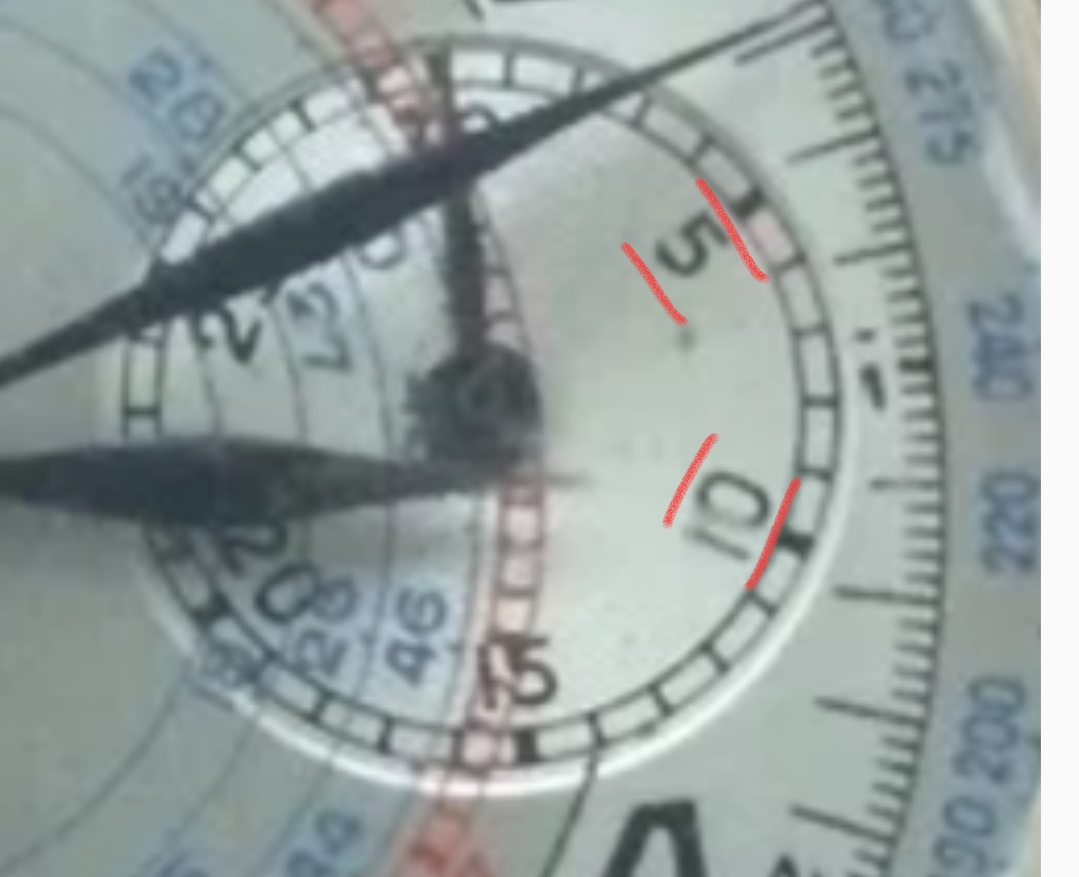
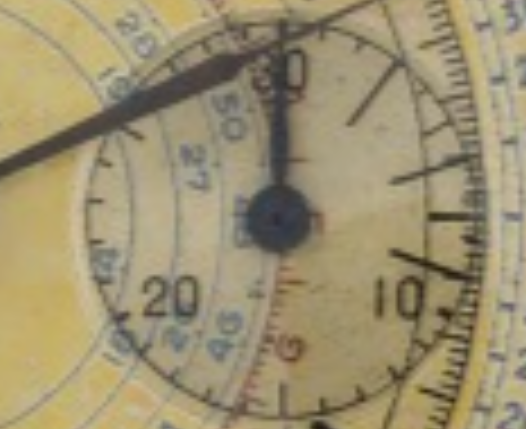
Other Watch


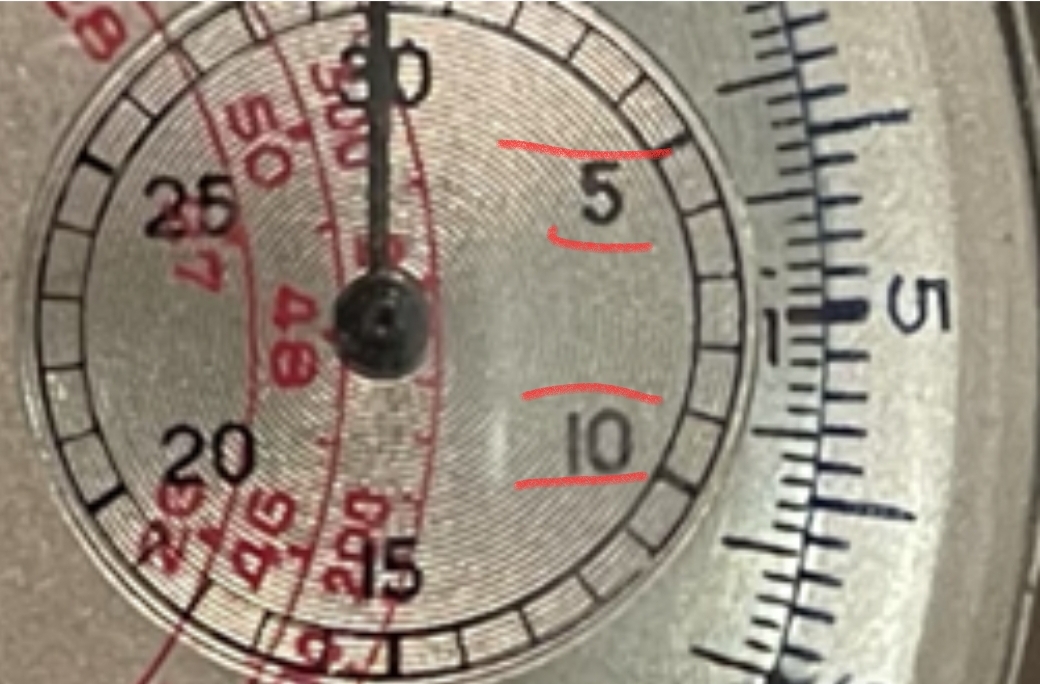
My Watch.

It appears to me that this issue is the same for each watch. Mine shows more of the 45 but less of the 15. The other watch shows less of the 45 but more of the 15. So, basically the same net discrepancy.

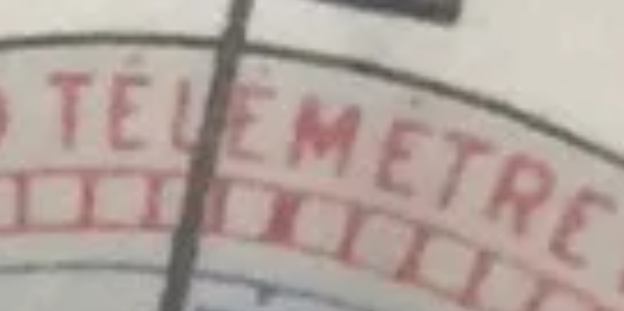
Also, the other watch has other inconsistencies in my opinion. For example, the "M" in "Telemetre" appears way to to thick when compared to the other letters. The "E"'s also do not appear consistent (Photo Below).


Perhaps these determinations is an art and more of a gut feel.
 
Posts
6,499
Likes
10,178
Look at a 1000 dials and by that time you'll get the feel.....
 
Posts
1,567
Likes
12,406
Quick google search and I couldn't find other examples with number position like yours.
 
Posts
34
Likes
2
Quick google search and I couldn't find other examples with number position like yours.
Here are a few more variants...different but they illustrate that Omega used different patterns in this regard?

https://www.vintagewatchcentre.com/product/omega-chronograph-cal-170-1942-breguet-dial/
https://www.worthpoint.com/worthopedia/1939-18k-solid-gold-omega-chronograph-1774427142
The left sub-dial on this one is not typical either as the numbers are circular around the sub-dial; not placed on a horizontal base like the vast majority. The point being that the orientation on the left sub-dial is not always on the horizontal. And there is some evidence that this was also the case for the right-hand sub-dia. I hope I described that properly!
Edited:
 
Posts
7,901
Likes
35,852
This thread starts to get very confusing when redials are used for reference purposes.

I think the concensus is the OP's watch is a redial and we should leave it there!
 
Posts
1,447
Likes
3,018
That is very interesting as I came across another watch on omegaforums with this discrepancy...the forum accepted that watch and didn't question its originality.

It appears to me that this issue is the same for each watch. Mine shows more of the 45 but less of the 15. The other watch shows less of the 45 but more of the 15. So, basically the same net discrepancy.

Also, the other watch has other inconsistencies in my opinion. For example, the "M" in "Telemetre" appears way to to thick when compared to the other letters. The "E"'s also do not appear consistent (Photo Below).

Perhaps these determinations is an art and more of a gut feel.

I think you hit the nail on the head there, like many of the other guys here, I immediately have an instinctual understanding as to whether an omega from this era is authentic because I have seen so many. I would not be so confident in watches from the 60s onwards as they are not my area of interest. Sometimes we're not 100% sure, but for your one unfortunately it appears to be quite unanimous. Factors such as above are us trying to justify our opinions with evidence, and as I mentioned above can contribute to the overall assessment. My primary focus is usually always on the logos, fonts and subdials. They are key areas that are hard to get right.

Your focus on the thickness on M on the other watch I think is misguided, it is much more simple than this, as Zapatta remarks it is very unusual orientation for the numbers on the subdial to the right of the dial.

Thanks for the post. I understand your point. I did a literal 2 minute search and came up with another variant. This one fetched CHF25,000 at a Phillips Auction. It is either original or someone wasn't doing their homework? https://www.phillips.com/detail/omega/CH080119/89?fromSearch=omega chr&searchPage=2


This one is original yes.

Here are a few more variants...different but they illustrate that Omega used different patterns in this regard?

https://www.vintagewatchcentre.com/product/omega-chronograph-cal-170-1942-breguet-dial/
https://www.worthpoint.com/worthopedia/1939-18k-solid-gold-omega-chronograph-1774427142
The left sub-dial on this one is not typical either as the numbers are circular around the sub-dial; not placed on a horizontal base like the vast majority. The point being that the orientation on the left sub-dial is not always on the horizontal. And there is some evidence that this was also the case for the right-hand sub-dia. I hope I described that properly!
The top dial is described as a refinished dial, the second one is clearly refinished so they cannot be used as reference images.
 
Posts
6,667
Likes
11,570
I think you hit the nail on the head there, like many of the other guys here, I immediately have an instinctual understanding as to whether an omega from this era is authentic because I have seen so many. I would not be so confident in watches from the 60s onwards as they are not my area of interest. Sometimes we're not 100% sure, but for your one unfortunately it appears to be quite unanimous. Factors such as above are us trying to justify our opinions with evidence, and as I mentioned above can contribute to the overall assessment. My primary focus is usually always on the logos, fonts and subdials. They are key areas that are hard to get right.

Your focus on the thickness on M on the other watch I think is misguided, it is much more simple than this, as Zapatta remarks it is very unusual orientation for the numbers on the subdial to the right of the dial.


This one is original yes.


The top dial is described as a refinished dial, the second one is clearly refinished so they cannot be used as reference images.

What takes a seasoned collector a few seconds (in the case of this dial maybe 30 seconds) to determine whether it is a redial or not takes much more time to explain to others. This forum thrives because members like yourself take the time to put pen to paper so to speak.
 
Posts
34
Likes
2
I think you hit the nail on the head there, like many of the other guys here, I immediately have an instinctual understanding as to whether an omega from this era is authentic because I have seen so many. I would not be so confident in watches from the 60s onwards as they are not my area of interest. Sometimes we're not 100% sure, but for your one unfortunately it appears to be quite unanimous. Factors such as above are us trying to justify our opinions with evidence, and as I mentioned above can contribute to the overall assessment. My primary focus is usually always on the logos, fonts and subdials. They are key areas that are hard to get right.

Ollie, thank you so much for taking the time to explain the methodology and process involved when assessing the originality of vintage dials. This really helps me on what is still the steep part of the learning curve for me. As I mentioned previously in this thread, I do respect the opinion given. I hope that I do not come off as sounding adversarial or combative. As I mentioned previously, I am not trying to make arguments about whether my watch is a redial or not; the forum has spoken on this and I respect this opinion. To me, all of my posts are to gain an understanding of the methodology used to make such a determination. Not for my watch (as the community has spoken) but for any vintage watch. This, I think, is what makes the Omega forum, and posts like yours in particular, so valuable! It is in this light that I make my posts.

I appreciate forum members who are willing to pull back the veil and explain how such determinations are made. It takes time to do and time is precious. So I am grateful. I think that, from a learning perspective it is important, to me anyway, to dig deeper and not end a thread once a determination is made.

As an aside, my watch was purchased in the late 1990's from Gisbert A. Joseph Watches which appeared to do a lot of business in Germany. Here is a link to their website:
https://www.joseph-watches.com/
So, maybe it was , as watchyouwant suggested, a Jurgen Causemann redial as Causemann is located in Germany. If this is the case, it would be a redial done by one of the best in the business.

In the spirit of learning, I note MSNWatch's statement "My 2 cents - the story of this dial is told by two numbers 15 and 45" and my response to it. MSNWatch appears to me to be one of the forum experts as he has made over 6500 posts. This is only my 27th post! My understanding is that the other watch was accepted by the community as being original even though it had the same inconsistency. The watch is in Mark020's forum post: https://omegaforums.net/threads/new-in-33-3-chrono-in-14k.48337/. It would really help the community (learners like me really) to know what other factors tipped the balance in favor of this watch if the story is told by the 15 and 45. Perhaps if Mark020 could post a higher resolution photo of this watch it would help the discussion?
 
Posts
1,447
Likes
3,018
Ollie, thank you so much for taking the time to explain the methodology and process involved when assessing the originality of vintage dials. This really helps me on what is still the steep part of the learning curve for me. As I mentioned previously in this thread, I do respect the opinion given. I hope that I do not come off as sounding adversarial or combative. As I mentioned previously, I am not trying to make arguments about whether my watch is a redial or not; the forum has spoken on this and I respect this opinion. To me, all of my posts are to gain an understanding of the methodology used to make such a determination. Not for my watch (as the community has spoken) but for any vintage watch. This, I think, is what makes the Omega forum, and posts like yours in particular, so valuable! It is in this light that I make my posts.

I appreciate forum members who are willing to pull back the veil and explain how such determinations are made. It takes time to do and time is precious. So I am grateful. I think that, from a learning perspective it is important, to me anyway, to dig deeper and not end a thread once a determination is made.

As an aside, my watch was purchased in the late 1990's from Gisbert A. Joseph Watches which appeared to do a lot of business in Germany. Here is a link to their website:
https://www.joseph-watches.com/
So, maybe it was , as watchyouwant suggested, a Jurgen Causemann redial as Causemann is located in Germany. If this is the case, it would be a redial done by one of the best in the business.

In the spirit of learning, I note MSNWatch's statement "My 2 cents - the story of this dial is told by two numbers 15 and 45" and my response to it. MSNWatch appears to me to be one of the forum experts as he has made over 6500 posts. This is only my 27th post! My understanding is that the other watch was accepted by the community as being original even though it had the same inconsistency. The watch is in Mark020's forum post: https://omegaforums.net/threads/new-in-33-3-chrono-in-14k.48337/. It would really help the community (learners like me really) to know what other factors tipped the balance in favor of this watch if the story is told by the 15 and 45. Perhaps if Mark020 could post a higher resolution photo of this watch it would help the discussion?

Just a quick response as I am on my way to work - irregularities can sometimes be forgiven if everything else appears to be correct. But, and this is with emphasis everything must really be unanimous.
 
Posts
34
Likes
2
Just a quick response as I am on my way to work - irregularities can sometimes be forgiven if everything else appears to be correct. But, and this is with emphasis everything must really be unanimous.

I appreciate your comment Ollie. I find it interesting that these determinations are often made by viewing what appear to me to be low resolution photos. This aspect in many cases makes correct determinations as to originality (and condition) more of a challenge.

For instance, I came across a few forum posts relating to Mark020鈥檚 watch. In 2016 there was consensus to the effect that the watch was unanimously accepted as being original. See this thread: https://omegaforums.net/threads/new-in-33-3-chrono-in-14k.48337/

Then, four years later, in 2020 there were two other threads in which the watch was thought to be a redial. See threads: https://omegaforums.net/threads/help-needed-vintage-chronograph-33-3-from-1939.112937/page-2

And https://omegaforums.net/threads/wonderful-33-3-at-shucktheoyster.115653/page-2

Also, I came across Mark鈥檚 watch currently for sale at Shuck the Oyster where it is described as being fully original.: https://www.shucktheoyster.com/portfolio/omega-multiscale-14k-gold-vintage-chronograph-33-3-mint/ Is there another thread where it is unanimously agreed that the watch is original or is the end result that there is a difference of opinion?

Given that vintage watch collecting and grading, when compared to other collections (e.g. art, autos, sports cards which have more refined criteria), is rather in its infancy, perhaps some resolution standards can be encouraged on the forum for posters when submitting photos and requesting comments on originality (redial, movement etc.). Particularly given that assessments online are made without a watch being in hand.