Learn How To Fish - A Guide - Not For Enquiries

Posts
8,830
Likes
73,379
Apologies if this was already covered and I missed it, but does anyone have some good advice and picture examples for what to look for (and look out for) when looking at the movement of the watch? I've been looking at a few vintage Seamasters but finding it difficult to determine if the internal movements are in good enough quality based on putting, scratches, discoloration, etc. Also, is the "amount" of service dates scratched into the case back a good way to judge the condition of the movement, or can that be misleading?

Some watchmakers mark and some don’t and there’s no way of telling. The best practice is to ask the seller and if he says it has been ask who by and for proof by receipt. Some sellers just get their nephews (😉) to waft a can of WD40 near the watch, polish the case and fit a new cheap strap.

If the answer is no, perfectly proper to ask for an additional discount. Be suspicious of ‘no returns’.

And finally …. AFTER you’ve done your own due diligence and think the watch and the price might be okay, but BEFORE you buy post here on OF, with good photos, your assessment and details of the price and some or all of OF will chip in to with views.

Also, as posted earlier, check out the OF Private Sales thread. Good luck.

 
Posts
322
Likes
163
As stated earlier, a service by a reliable watchmaker if your choice is the best way for you to be sure that the movement has been checked and properly looked after ; he'll tell you exactly what he has found and done. Same when I buy a vintage Harley : my mechanics will systematically change all the engine fluids, the fork oil, and will do a 100% check of the whole bike as this is also safety related.
Back to a watch movement, I personnally avoid the movements whose holding screws are scratched, as it may indicate that the watch hasn't been properly looked after. But then it's down to whether you are hunting the lower or the higher end of the value range of a specific model.
 
Posts
2
Likes
1
Hi there! I just wanted to share a resource I have been putting together for months, collecting and categorizing pictures of original dials discussed/spotted online
This is a non-commercial public effort, so just pasting the link here in case it is helpful to someone https://www.vintagedial.com/
It is hard to be exhaustive given all the different types of dials, but at least it an organized starting point for reference 😀
 
Posts
70
Likes
226
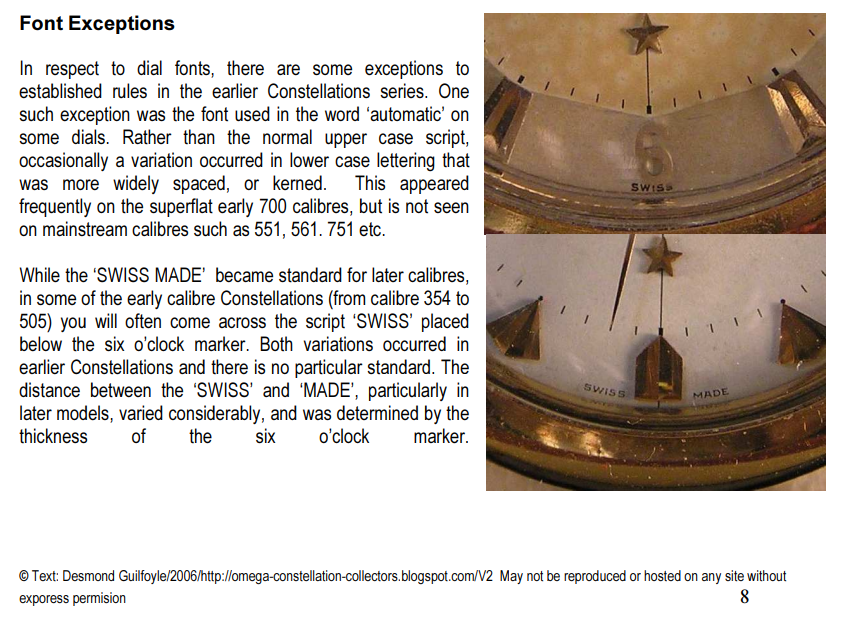
Can I ask if this went through re-dial or retouch? I notice that this dial only “swiss” and not “swiss made”. Most of the examples I find on the internet is “swiss made”.

The info you'll see below apply to Constellations. Thus double checking the years of production between your model and the ones in the picture below may help. What i can say, and it's what i remembered having read, is that it is possible for some watches to repost only the "SWISS" text, depending on the year they were produced.

 
Posts
18,181
Likes
37,936
MOVEMENTS

Following is courtesy of @SOG53


As a collector with limited knowledge of watchmaking, when I have 1 or more movement photos, I look for the following:

Does it look clean, or filthy?
Any signs of case corrosion around the perimeter?
Any signs of rust in movement?
Is there a caseback seal present?
Are there any missing screws, jewel holes without a jewel?
Are case clamps present, with screws?
Are the visible wheels intact- any obvious missing teeth?
Are the screwheads damaged, suggesting amateur work?
Is the regulator way off to one side- fast or slow suggesting dire need of service?
Does the automatic rotor show signs of wear on top edges, suggesting rotor rub?
If its a chronometer does it have the correct markings for jewels and temperature adjustment etc to fit the reference?
Do the various bridges have a consistent color?

The movement above would pass most of not all of these questions BTW
While you cant tell how it runs, the above checks will give insight into how the watch has been kept by prior owners.

Im sure others can add to this list.
 
Posts
18,181
Likes
37,936
CANON PINION CHECK

Courtesy @hoipolloi and @TIMElyBehaviour


With the watch running, you can check the cannon pinion by pulling the crown one notch, turn the hands backward.
If second hand jerks backwards or stops, it is good.
If second hand keeps on going like normal, it is bad 😥

Regarding the cannon pinion. When you turn the hands and it feels way too easy the cannon pinion is loose and the hands may not turn with the time. If it is very tight to turn don’t force it. This means the cannon pinion is way too tight and all you will do is strip the teeth off the minute wheel.
 
Posts
18,181
Likes
37,936
This thread has been cleaned up to confine content to education and advice about finding your first, or tenth vintage Omega.

It is not for general enquiries. If you have a watch, or are thinking of buying a watch, create a thread and you will get answers.

Many of the replies that were in this thread were simply in appreciation of the work done by the OP, and their proliferation obscured the actual valuable information presented.

If you do appreciate the posts made by the OP and others, simply indicate this by using the reaction (likes) option and help keep this thread as an educational resource.