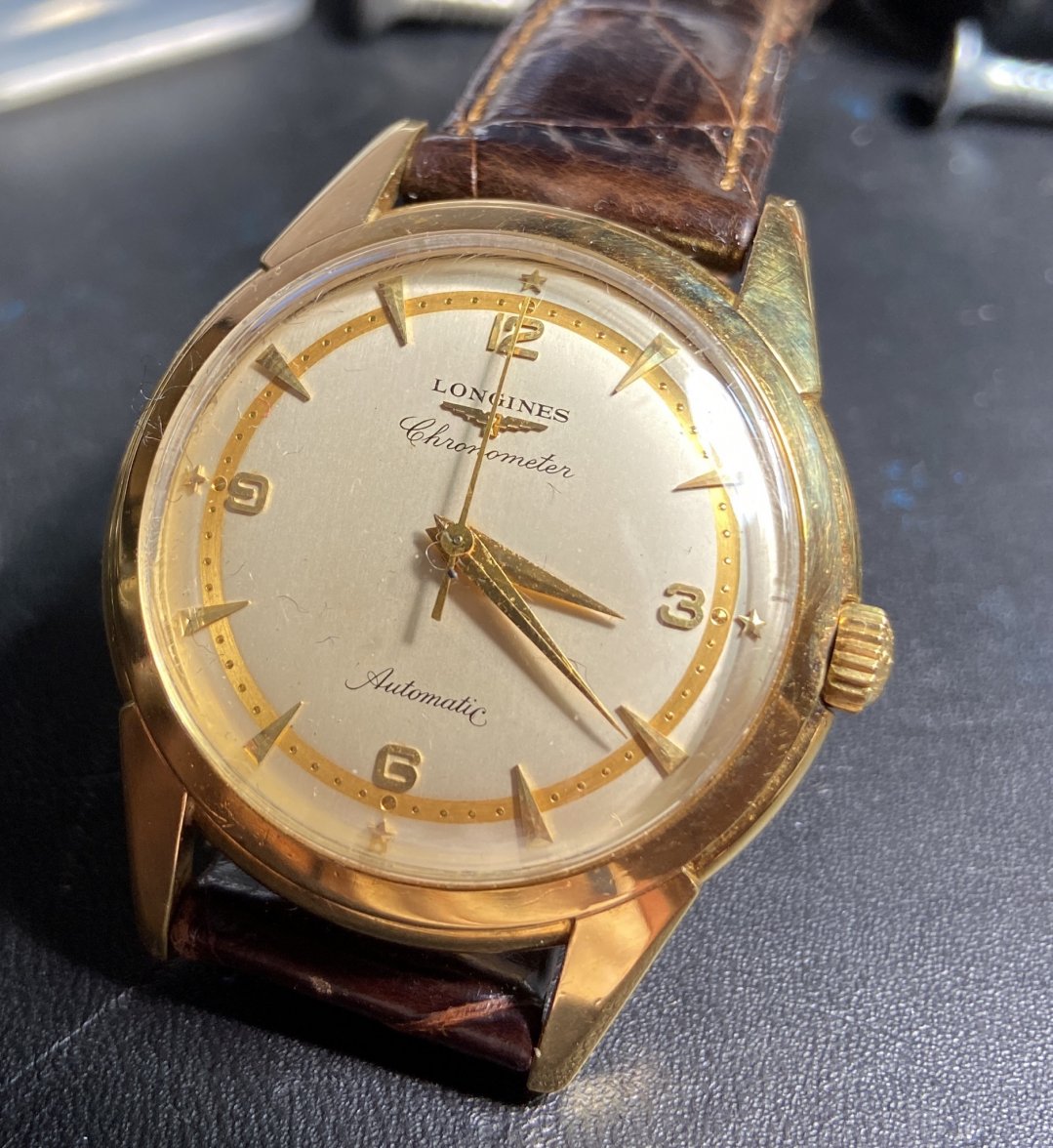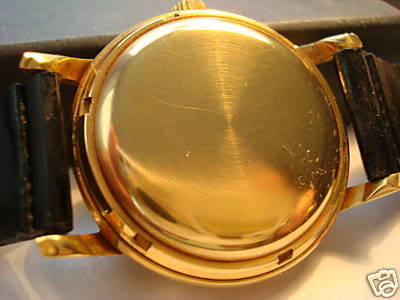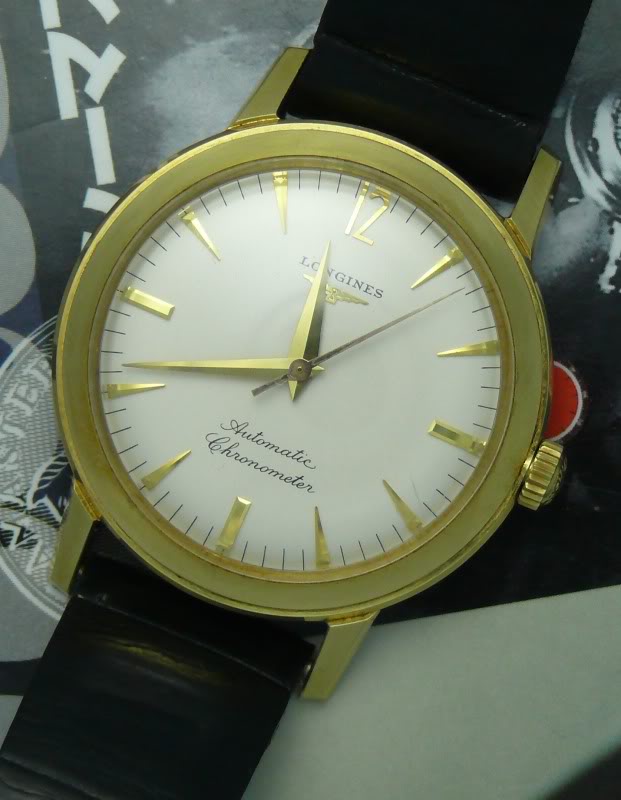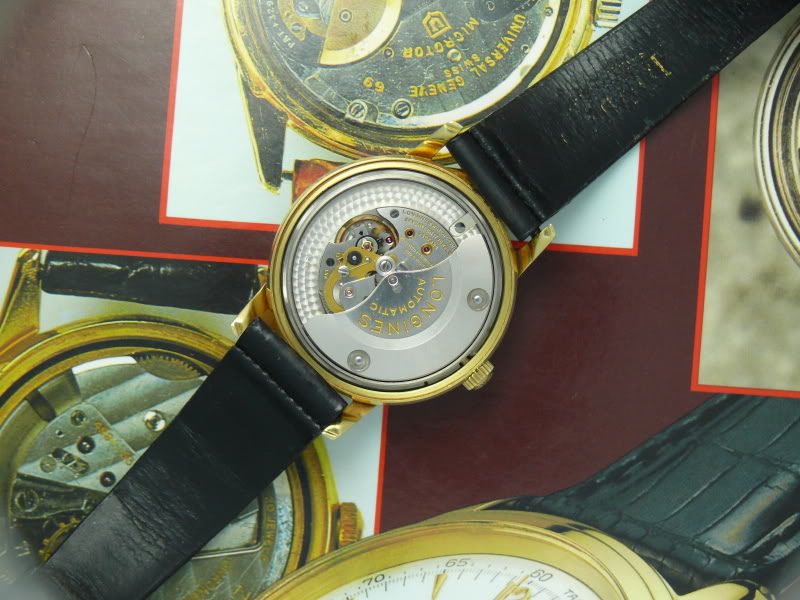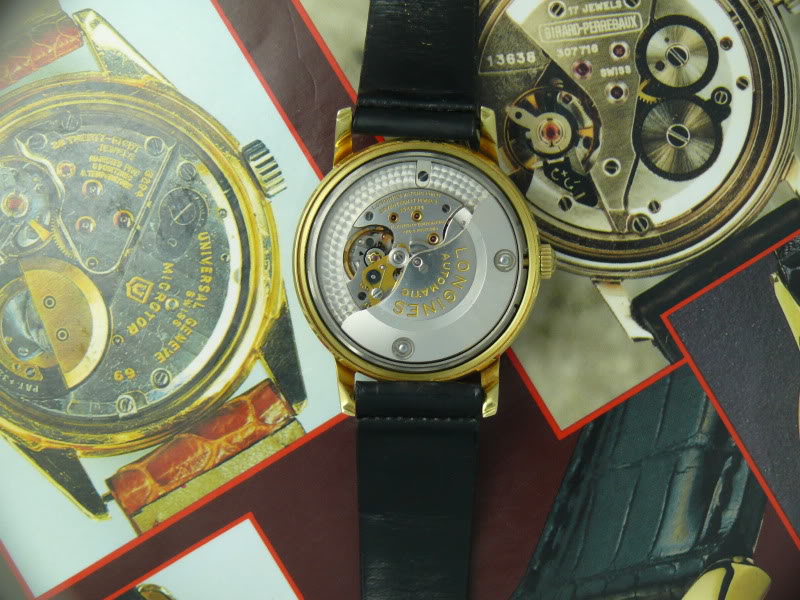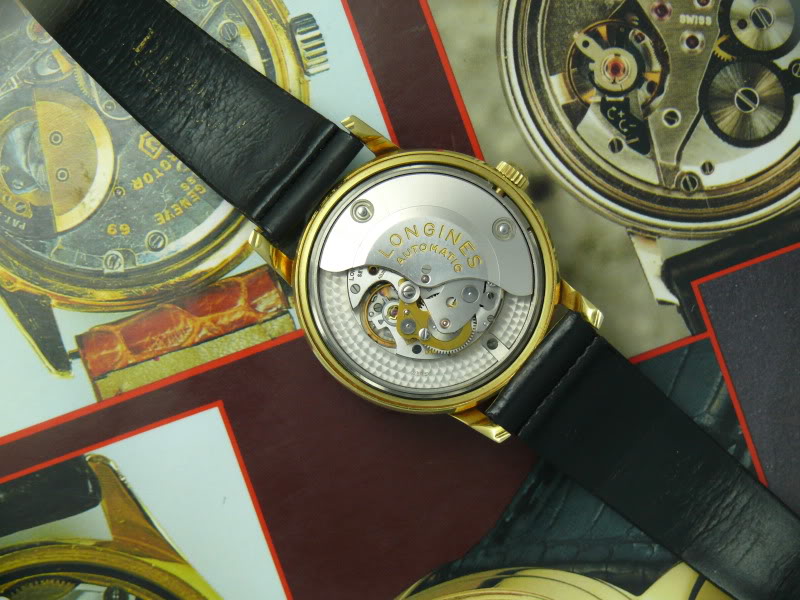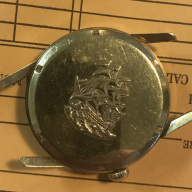
Lady Luck delivers an early Longines Chronometre

Posts
810
Likes
1,652
I don't have any numbers at all, I was just reading (inaccurately indeed) from your post some figures which I'm now realizing were dollars vs Swiss francs.
Still interested in the price comparison -- and appreciate your update.
The bottom line is that for some reason Longines apparently chose not to compete head to head with regards to smaller sized chronometer grade calibers.

And while vintage Longines enthusiasts sometimes bemoan Longines' current mid-range positioning within the array of the Swatch group products, your research suggests that Longines may have made a similar choice itself at least at one point in its history.
What then happened with the production of later chronometer models such as the Conquest, Flagship, etc is of course another chapter.

And of course all of this makes the OP watch even more remarkable.

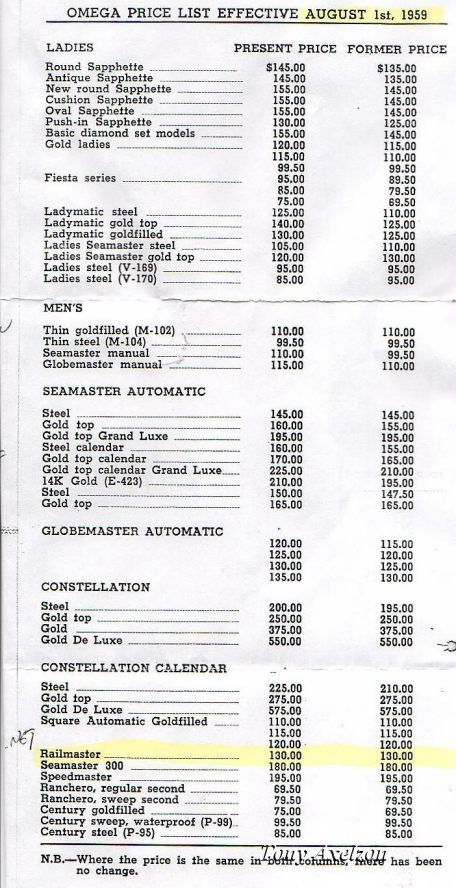
I’m not sure this was true across the entire line, but my 18k 22AS chronometer was priced exactly the same as a Connie in the late 1950’s. $375 for each.
 
Posts
57
Likes
68
Hi,
Just a little assumption from what I know, there's also a possibility pre-1950 Longines wrist chronometers are rare because they were more expensive than Omega. Before 1951, most Omega 30T2 (SC) Rg were not tested by the independent "Bureaux Officiels" but in-house. On the other hand, Longines, from what I know, sent all their 12.68Z and 15.68Z to official chronometer certification. In theory, non independent in-house testing could result in some savings for Omega, thus they would be able to produce more "chronometers".
Anyway, after 1951, this is no more relevant since it was no more optional to sent watches to the Bureaux Officiels for them to bear the "chronometer" name.
Also note in defense to Longines that all other manufacturers too did produce a quite limited number of chronometer. Only Omega and Rolex were able to produce more than 10000 chronometers a year the 1950s, all the others hardly went beyond a couple hundred, 3000 at most for Eterna which was then the third biggest chronometer maker.
I guess it all comes down to marketing strategy, Omega and Rolex pushed harder to sell their chronometers while other cared a little less. To further illustrate the point that chronometer production had nothing to do with affordability or quality, Patek Philippe almost never sold any chronometer (and yet their watches were far more expensive and of higher quality than Omega). IWC, which were about the same quality than Longines and Omega best offerings, barely made any wrist chronometers too.
 
Posts
8,004
Likes
28,103
I guess it all comes down to marketing strategy, Omega and Rolex pushed harder to sell their chronometers while other cared a little less. To further illustrate the point that chronometer production had nothing to do with affordability or quality, Patek Philippe almost never sold any chronometer (and yet their watches were far more expensive and of higher quality than Omega). IWC, which were about the same quality than Longines and Omega best offerings, barely made any wrist chronometers too.

Every (mens) Patek Philippe produced from the '40s–'60s was capable of chronometer performance. Their in-house standards were probably every bit as as stringent as those of the official testing agencies. Other than rare entries into competitions for bragging rights, PP felt no need to send their watches to Observatories, as they (reasonably) considered the movements to be second to none. It would be naïve to conclude that a chronometer from another manufacturer necessarily had greater potential for accuracy than a typical, "uncertified" Patek Philippe.

IWC, though not on the level of Patek Philippe, took the same basic approach. They felt no need to have a third-party confirm what they knew to be the case through in-house testing, namely that their movements had chronometer potential, and were typically very accurate when they left the factory.
 
Posts
57
Likes
68
Just thinking further, I don't know what other may think about it, but I also wonder if Longines made less effort to market their chronometer because it was not as profitable for them than their direct competition like Omega and Zenith.
What I mean is although the late 1950's Constellation, presumably with the 505 calibre, had the same price, it seems to me the 22as from Longines had a better finish, with chatons, perlage, highly polished and bevelled steel parts down to the lever escapement, breguet overcoil and so on. So one might suspect Longines movements were more expensive to make with such great finish, but if in the end they cost the same as an Omega, then maybe their margins were much smaller and then they were more reluctant to promote them, instead focusing on more profitable models such as the Conquest line ?
Just pure assumptions here, sorry if I go off-road ! But I admit it can be confusing than although Longines competed in the same market as Omega, Zenith and Eterna, and made such intense efforts to win some observatory trials, they wouldn't produce as much chronometers as its direct concurrents.
 
Posts
4,524
Likes
9,330
I’m not sure this was true across the entire line, but my 18k 22AS chronometer was priced exactly the same as a Connie in the late 1950’s. $375 for each.

@Rumar89

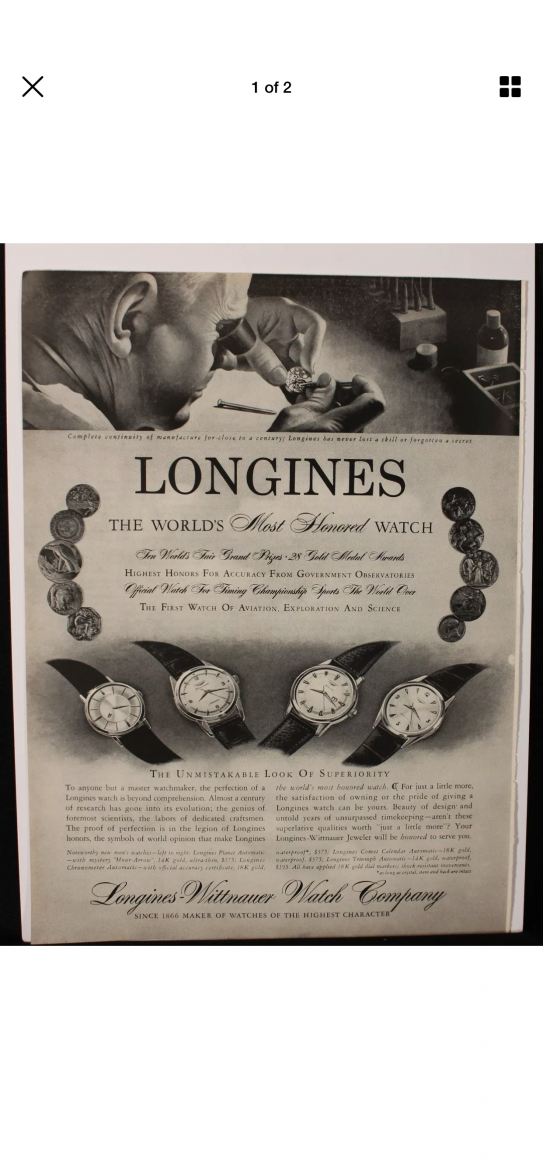
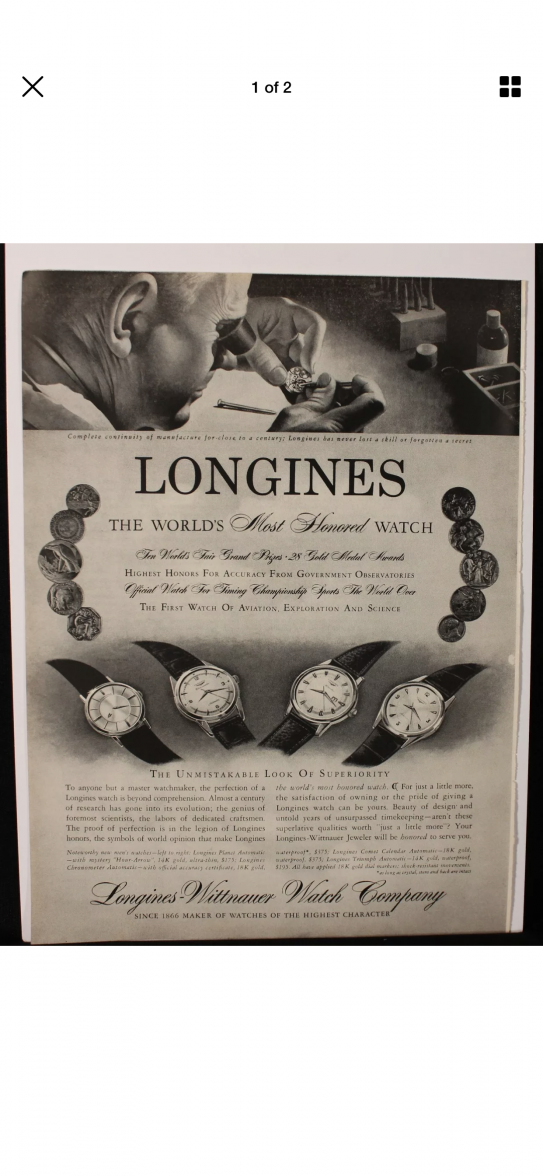
thanks for posting the ad . I also have the same automatic chronometre longines w the Star markers ! I salute it every time I wear it !!
Will post a pic....
Good hunting
Bill
 
Posts
13,130
Likes
18,025
Advertising and marketing were generally done by the importers in each specific market. During the 1950’s, the company that imported Longines watches to the US was not Longines, but a separate company called Longines-Wittnauer, Inc.

L-W also imported Wittnauer, LeCoultre and Vacheron & Constantin watches (many times just the movements) from Switzerland.

If one looks at advertising for all four brands during this period, there was not a heavy emphasis on the sales of rated chronometer watches for any of them. I’m not sure if that is because of cost or not. Although one would think that the higher grade Swiss made and cased movements from these four brands would have performed very well in chronometer testing had they been submitted.

The US had no standards or testing agency for chronometer performance at that time. Some industries, like railroads, had their own standards for specific watches. So the concept of an “officially certified chronometer” was not well known in the US until Omega and Rolex started pushing the concept in their US targeted advertising.

Hope this helps,
gatorcpa
 
Posts
4,524
Likes
9,330
I’m not sure this was true across the entire line, but my 18k 22AS chronometer was priced exactly the same as a Connie in the late 1950’s. $375 for each.
Hi @Rumar89

as promised I just found a pic of my Longines chronometre ! Same as in your ad .


Posts
810
Likes
1,652
Hi @Rumar89

as promised I just found a pic of my Longines chronometre ! Same as in your ad .


Bill, I should have been more precise. Mine is the more common version with the big 12 dial (a version I think you also have). That star version is absolutely fantastic and is the only example of these that I’ve ever seen. I only know of 4 22AS chronometers, 2 of which you own. Someday we need to get that star dial exported back to its homeland. 😁

 
Posts
7,635
Likes
21,906
I can’t help but notice that the Longines-Wittnauer ad @Rumar89 posted concludes with, “are those superlative qualities worth just a little more?”.

So in the end the hypothesis that Longines wanted to keep margins down in order to keep watches affordable may— or may not be true.
If Patek didn’t bother enlisting in chronometer tests because they knew their watches were superior anyhow, Longines may have held a similar viewpoint.
As I understand it, it was the largest manufacture at the time.
 
Posts
810
Likes
1,652
If Patek didn’t bother enlisting in chronometer tests because they knew their watches were superior anyhow, Longines may have held a similar viewpoint.
As I understand it, it was the largest manufacture at the time.

I think this may be the key. Longines entered watches into the observatory trials to prove the quality of their movements and got a limited amount chronometer certified (maybe just to hype on the advertising) but didn’t feel the need to certify the vast majority of their movements as the results spoke for themselves.
 
Posts
4,524
Likes
9,330
HI @Rumar89

Wow , did not know the survival rate of these.... Yes i do have one like your as well.... They are all great watches...

Lets get together for a cup of coffee and talk trades.... you can also send me yours!

Best
bill


Looking forward
Bill, I should have been more precise. Mine is the more common version with the big 12 dial (a version I think you also have). That star version is absolutely fantastic and is the only example of these that I’ve ever seen. I only know of 4 22AS chronometers, 2 of which you own. Someday we need to get that star dial exported back to its homeland. 😁

 
Posts
4,524
Likes
9,330
HI @Rumar89

Wow , did not know the survival rate of these.... Yes i do have one like your as well.... They are all great watches...

Lets get together for a cup of coffee and talk trades.... you can also send me yours!

Best
bill


Looking forward
Hi @Rumar89

just found some photos of my other Longines ..

 
Posts
234
Likes
168
i have to admit i have never seen one of these for sale. They look great. I am assuming they are somewhat rare?
 
Posts
2,408
Likes
6,951
The US had no standards or testing agency for chronometer performance at that time. Some industries, like railroads, had their own standards for specific watches. So the concept of an “officially certified chronometer” was not well known in the US until Omega and Rolex started pushing the concept in their US targeted advertising.

Coined in 1714, the term “chronometer” meant a precision clock for marine navigation. The Swiss later appropriated the term for pocket and wristwatches.
 
Posts
3,799
Likes
10,391
Absolutely stunning watch Tony and great write up. Put me in the "I can't believe I've missed this post for so long" category.