Lady Luck delivers an early Longines Chronometre

Posts
810
Likes
1,652
Let me first say thank you to Denise Rodrigues at the Bibliotheque de la Ville La Chaux-de-Fonds. She was instrumental in providing the following information and I’m extremely grateful for her help.

In looking through Fritz von Osterhausen’s Wristwatch Chronometers, I came upon an excerpt from the Journal Suisse d’Horlogerie that showed chronometer certification by testing location for 1956. I decided to dig deeper, to see if this information was published for additional years. Thanks to Denise’s help, I was able to find chronometer production by manufacturer from 1948-1956.

During this period, Longines had 635 montres de bracelet and 12 montre de poche certified as chronometers. Unfortunately, the information is not broken out by caliber, but some educated inferences can be made. The highest year for certification for Longines was 1956, when 447 montres de bracelet were certified (my guess being the majority of these were 30L’s, coinciding with the introduction of that movement). The next highest years were 1955 with 73 montres de bracelet (also likely majority 30L’s) and 1950, when 72 montres de bracelet were certified, including 6 automatiques (the automatics must be 22A/22AS movements as this was Longines’ only automatic movement at the time).

Interestingly, there was some commentary earlier in this thread that brands like IWC, LeCoultre, Vacheron, AP, etc didn’t emphasize or feel the need to have a third party certify their movements as chronometers. All of these brands are represented to some degree on this list. The only major manufacturer that is not represented is Patek.
 
Posts
8,004
Likes
28,103
Good information!

Patek, IWC, and AP did not, to my knowledge, sell certified wrist chronometers to the public, and, as mentioned previously, did not feel the need to do so because of their stringent in-house standards. The watches that they submitted for testing would have been competition chronometers, not serial production.
 
Posts
810
Likes
1,652
Good information!

Patek, IWC, and AP did not, to my knowledge, sell certified wrist chronometers to the public, and, as mentioned previously, did not feel the need to do so because of their stringent in-house standards. The watches that they submitted for testing would have been competition chronometers, not serial production.

For AP, it seems from the information that they were submitting too many examples for these to just be competition chronometers. From 1950-1953 all of their certifications took place in Sentier. From 1954-1956, their certifications were divided between Du Locle and Sentier. For example, below is the information regarding their submissions:

1951: 21 bracelet
1952: 25 bracelet
1953: 19 bracelet
1954: 104 bracelet
1955: 46 bracelet
1956: 19 bracelet

For IWC, all certifications took place in Bienne. Below are their numbers for bracelets. Again, the certification volume in 1953 and 1956 looks too high to be simply competition chronometers.

1948: 28 bracelet
1949: 16 bracelet
1950: 13 bracelet
1951: 11 bracelet
1952: unfortunately this copy is missing the information from Bienne
1953: 36 bracelet
1954: 29 bracelet
1955: 29 bracelet
1956: 41 bracelet
 
Posts
8,004
Likes
28,103
I disagree completely. Do you imagine that ten or twenty or thirty watches were certified in a given year to be sold to the public? Do you have any evidence that either of those companies ever sold certified chronometers to the public?
Edited:
 
Posts
7,635
Likes
21,906
For AP, it seems from the information that they were submitting too many examples for these to just be competition chronometers. From 1950-1953 all of their certifications took place in Sentier. From 1954-1956, their certifications were divided between Du Locle and Sentier. For example, below is the information regarding their submissions:

1951: 21 bracelet
1952: 25 bracelet
1953: 19 bracelet
1954: 104 bracelet
1955: 46 bracelet
1956: 19 bracelet

For IWC, all certifications took place in Bienne. Below are their numbers for bracelets. Again, the certification volume in 1953 and 1956 looks too high to be simply competition chronometers.

1948: 28 bracelet
1949: 16 bracelet
1950: 13 bracelet
1951: 11 bracelet
1952: unfortunately this copy is missing the information from Bienne
1953: 36 bracelet
1954: 29 bracelet
1955: 29 bracelet
1956: 41 bracelet
@Rumar89, thanks for the cool info. I don’t know anything about those watches but if you imagine they sold thousands in a year certainly figures like those above are very small and appear way too limited to be a product that’s marketed to the public at large. Think about it, it’s way smaller than even limited editions.
At the very least it’s far from a foregone conclusion.
 
Posts
810
Likes
1,652
@Rumar89, thanks for the cool info. I don’t know anything about those watches but if you imagine they sold thousands in a year certainly figures like those above are very small and appear way too limited to be a product that’s marketed to the public at large. Think about it, it’s way smaller than even limited editions.
At the very least it’s far from a foregone conclusion.

My contention isn’t that these chronometers from AP or IWC were marketed or sold to the public. I was simply responding to a statement that was made earlier where it was suggested that these companies didn’t feel the need to have their watches certified. Clearly, based on the data, that simply isn’t true; they were submitting examples to the B.O. for chronometer certification whether they were then sold to the public or not or that information was used to advertise a particular model/movement.

As for the competition chronometer statement, I do not believe these lists include competition chronometers. Those competitions, to my knowledge, took place at the Observatories of Neuchâtel and Geneva. These lists are just the volume of movements produced by each manufacturer that went through standard B.O. certification.
 
Posts
810
Likes
1,652
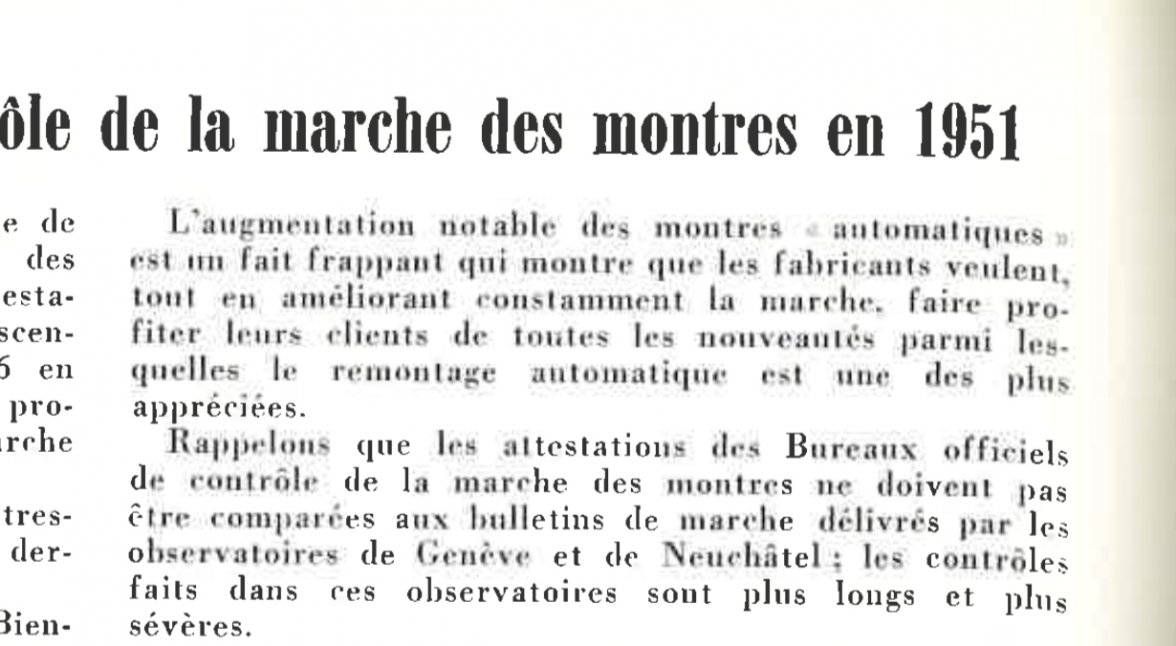
Actually, the 1951 report makes it quite clear these aren’t competition examples.


“Remember that the certificates of the official watch market monitoring offices should not be compared to the reports issued by the Geneva and Neuchâtel observatories; the checks made in these observatories are longer and more severe.”
 
Posts
8,004
Likes
28,103
My contention isn’t that these chronometers from AP or IWC were marketed or sold to the public. I was simply responding to a statement that was made earlier where it was suggested that these companies didn’t feel the need to have their watches certified. Clearly, based on the data, that simply isn’t true; they were submitting examples to the B.O. for chronometer certification whether they were then sold to the public or not or that information was used to advertise a particular model/movement.
.

Can you provide any evidence that either company used those watches for marketing purposes? Perhaps they did, but I cannot recall having seen any such material. Furthermore, what meaningful impact might such material have had? They would have essentially have been saying that a tiny number of production movements were certified, yet the customer would be purchasing non-certified examples.

In any case, competition chronometers were ostensibly used for marketing purposes as well, so it is a distinction without a meaningful difference.

My initial point stands. Neither PP nor AP felt the need to produce and sell officially certified chronometers, as they were confident that their internal standards were sufficiently high.
Edited:
 
Posts
810
Likes
1,652
My initial point stands. Neither PP nor AP felt the need to produce and sell officially certified chronometers, as they were confident that their internal standards were sufficiently high.

If that is your point, then that is all well and good. I just wanted to clarify the below statement, as these companies did submit at least some movements to the B.O. for chronometer testing (except for Patek).

“IWC, though not on the level of Patek Philippe, took the same basic approach. They felt no need to have a third-party confirm what they knew to be the case through in-house testing, namely that their movements had chronometer potential, and were typically very accurate when they left the factory.”

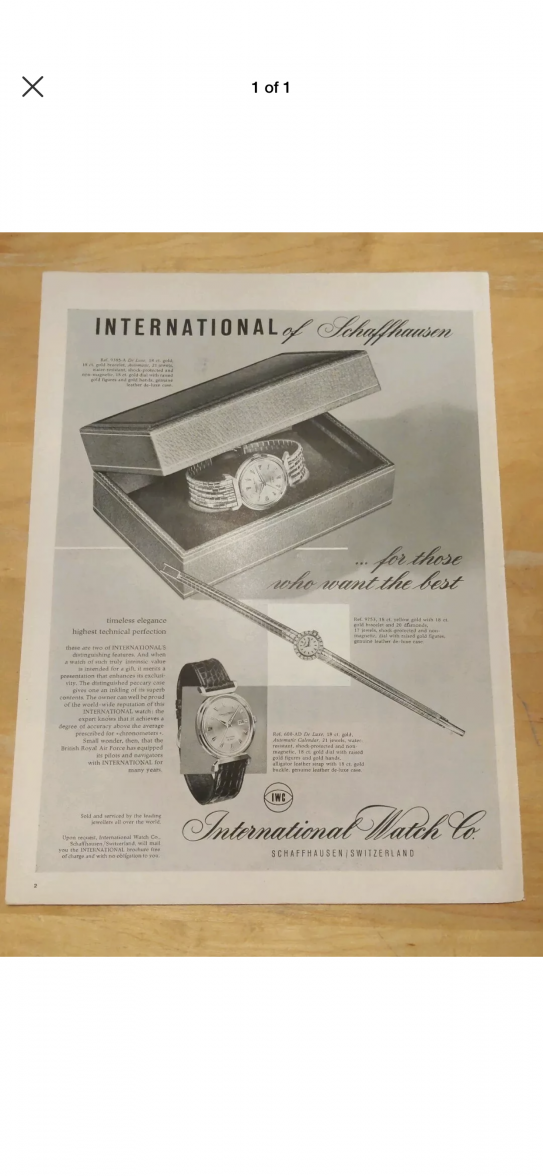
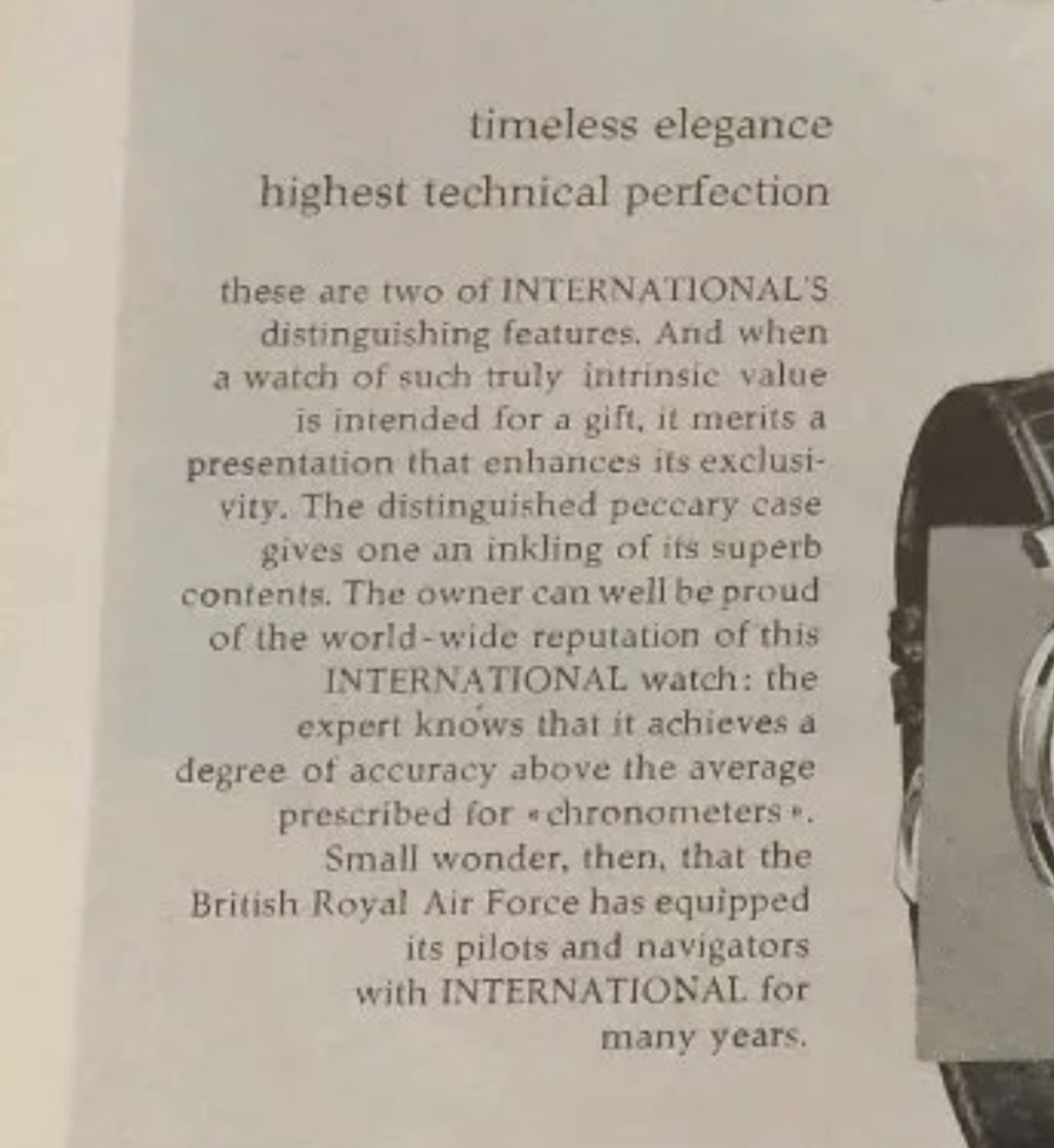
IWC did advertise that their watches exceeded average chronometer performance. Presumably, they needed some independent evidence to back up the claim.


I do feel like this has drifted somewhat away from my main point though, which essentially was that Longines Chronometers, particularly those like the example you have @Tony C. are rare as hen’s teeth. Until 431 Ultra-Chron production started, Longines wristwatch chronometer production was extremely scarce indeed.
 
Posts
477
Likes
1,645
Thank you for this interesting discussion!
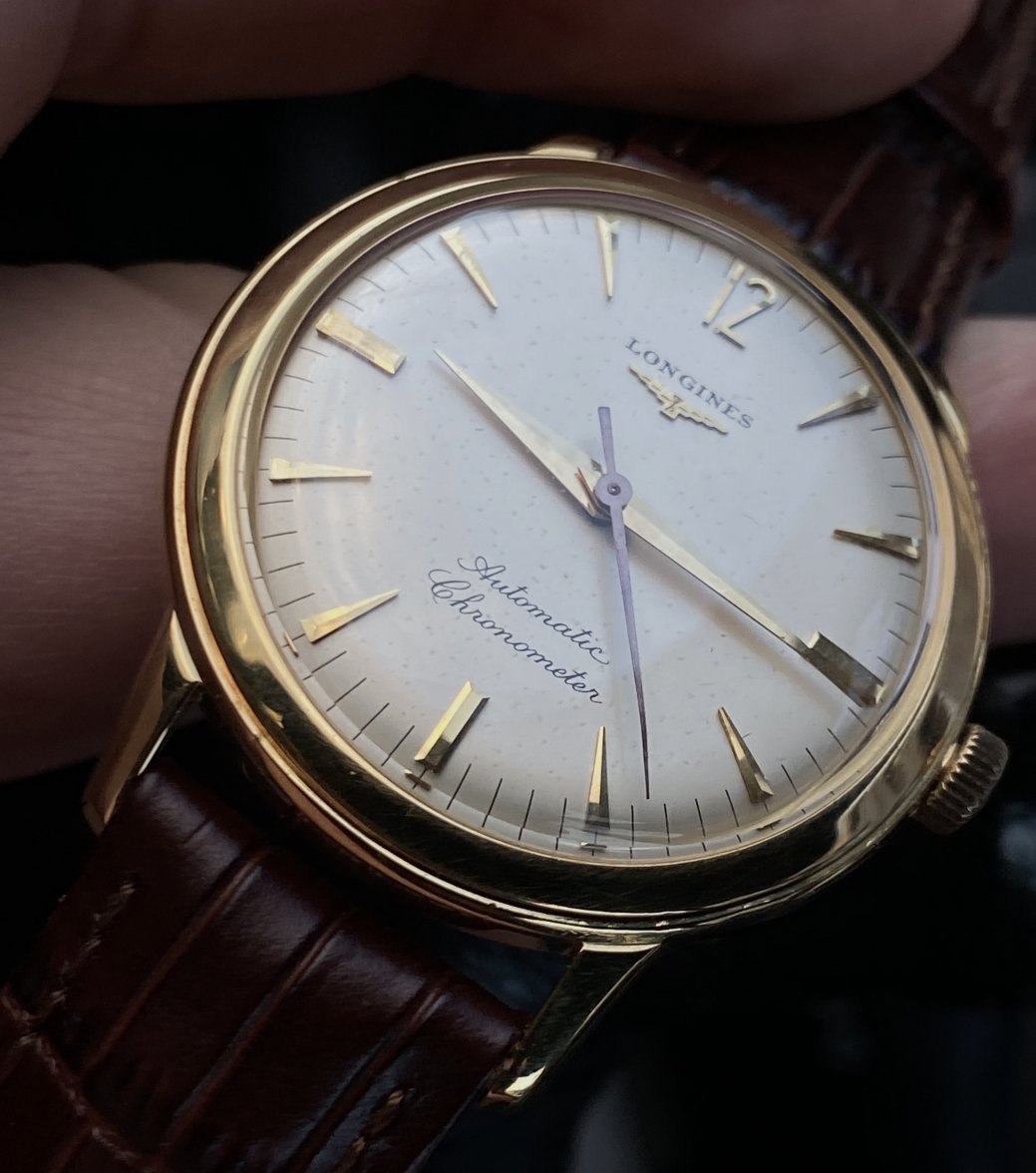
Here is the fourth LONGINES chronometer (screw back case 18ct. ) which seems to be currently known. Sold in 1961 to Canada as far as I remember - in anyway it is confirmed by factory exstract.
I
 
Posts
4,524
Likes
9,330
Thank you for this interesting discussion!
Here is the fourth LONGINES chronometer (screw back case 18ct. ) which seems to be currently known. Sold in 1961 to Canada as far as I remember - in anyway it is confirmed by factory exstract.
I

HI @divetime

Nice watch!! hey @Tony C. remember the example you saw that was oddly polished years ago..?

maybe 5 examples... have been seen over the years...

Good Hunting
Bill
 
Posts
13,130
Likes
18,027
IWC did advertise that their watches exceeded average chronometer performance. Presumably, they needed some independent evidence to back up the claim.
Why? The US had no specific chronometer standards like the Swiss at that time.

No one is arguing that IWC didn’t make adjustments to their watches to get them to the accuracy as advertised. This is one of the reasons that IWC did not have the words “Officially Certified” on the dial, but many of their movements were marked as adjusted for multiple positions and termperature.
gatorcpa
 
Posts
19
Likes
3
LG14r.jpg

Longines and Omega

Within the context of vintage watch collecting, Longines and Omega share some important, broad similarities. They both hold clear places in the “mid-high” category, as judged by their production during the golden era of watchmaking (i.e. roughly the early 1940s through the early ‘60s). They both designed and produced several outstanding, workhorse calibers (e.g. 30mm, 30L, etc.), and also made strong, lasting impacts with specialty watches (e.g. divers, chronographs, etc.).

One interesting divergence, relatively speaking, occurred in an exalted category: chronometers produced for the consumer market. Omega was (and remains) very well known for the impressive array of wristwatch chronometers that it produced, beginning with the superb 30T2Rg in 1943. Their 30mm movements, with either the Rg or swan-neck regulators, subsequently became the base for a large number of automatic chronometers, as well. Any cursory review of the Observatory trials from the period will confirm the success that Omega enjoyed in producing competition chronometers, and the company’s sales records underscore, at least in part, the success of a marketing strategy that emphasized the production of chronometers for consumers.

Conversely, Longines chose not to emphasize wristwatch chronometers to nearly the same degree, at least through the 1950s. They did produce and market a relatively small number of Flagship chronometers, tuning the already excellent cal. 30L movement so that its performance potential matched that of its high-class competitors. They also produced the fine Observatory calibers 30Z and 30B, and, as a related aside, regularly marketed their sports timers (i.e. stopwatches, etc.) through associations with the Olympics and other organized sports. There is, however, an interesting and relatively little known chapter of Longines’ history as it pertains to wristwatch chronometer development. It begins in the early 1940s, and closer look will help to illuminate an important transition for both the company and the Observatory trial competitions.


Neuchâtel Observatory Trials

While a few wristwatches were submitted to other Observatory trials held in previous years (notably Rolex and Omega at Teddington), the importance of such trials, especially those held in the Swiss cantons of Neuchâtel and Genève, began to grow considerably when new rules and criteria for wristwatches (or, more precisely "wrist chronometres") were developed in 1941. Looking at the table listed below, one can’t help but notice certain patterns. Omega, for example, showed great consistency from 1943 onwards - a testament to the quality of their 30mm movements, while Zenith became a major player with the development of its iconic cal. 135.

But note also the early success enjoyed by Longines, unequivocally the dominant manufacturer represented at Neuchâtel in the early through mid-‘40s. What accounted for such extraordinary successes? Furthermore, what happened in 1949, when Longines experienced a stunning drop from those dizzying heights to a period of drought until the mid-‘50s? Those are questions that I hadn’t considered until a recent acquisition piqued my interest.

ObTri.jpg


The Big Boys: 14.68Z and 15.68Z

Collectors of vintage military watches are keenly aware of Longines’ contributions to the genre. Such collectors often focus on the large, distinctive, cushion-cased watches of Czech army origin, which feature the excellent cal. 15.68Z. These were 14.5 ligne (34mm) movements, first produced in 1939, and are strikingly similar in design to the smaller, very successful, and far more widely produced caliber 12.68Z (27mm). These calibers came in both “Z” and “N” versions, the latter being center second, and the former sub-second. Here is an example of the 15 jewel 15.68Z caliber found in the oversized military watches:

1568M.jpg

Beginning with the 1941 Neuchâtel trials, the maximum diameter for a competition wristwatch caliber was restricted to 34mm. There were only six watches entered that year, and only three of those received certificates. Longines entered the fray the following year with cal. 15.68Z, some nearly identical cal. 14.68Z (more on this later), and a smaller number of 12.68Z movements. The results speak for themselves, as those movements dominated their competition for five consecutive years, and stood atop the standings in six of seven annual trials through 1948.

The mystery of why Longines fell so sharply from its dominant position is, as it turns out, rather easily explained. In 1948, the Swiss Observatories imposed a new limit of 30mm in the wrist chronometer category. So, in one fell swoop, Longines' larger diameter movements were excluded, and it was forced to begin to play catch-up with Omega and Zenith, companies which had already been focusing on 30mm movements for a number of years.

As an interesting aside, Longines did enter and achieve success with the 15.68Z movements in the Geneva trials well into the 1950s. This was not because the wrist chronometer standards were different from those at Neuchâtel, but rather because there was a “poche petit” (small pocket) category of 30–38mm. 1957 was, apparently, the final year that a 15.68Z movement was entered in competition.

As mentioned earlier, it is clear that Longines chose not to emphasize their successes at the Observatory trials through advertising to nearly the degree as Omega (or Rolex and Zenith, for that matter). They also chose not to produce many chronometers for public consumption. Actually, that is an understatement. Longines is, like most manufacturers, rather tight-lipped about its historical production numbers, but it is clear that in the context of manual-wind chronometers produced during the ‘40s and ‘50s, the company sold very few to consumers. Furthermore, if one excludes the Flagship chronometers of the mid-late ‘50s, the number most certainly becomes very small indeed. Having said all of that, I was able to find one advertisement from the 1940s trumpeting Longines' success with their 14/15.68Z movements. Note that they are referred to as 33mm movements in the advertisement, which raises some other questions as well.

LGObserv.jpg


As Luck Would Have It

There are a number of variables that contribute to the acquisition of a fine, rare and desirable vintage watch, but luck, especially as it relates to timing, may well be the most important. I do enjoy an advantage over some in that I am self-employed, and have a fair number of opportunities to search the web for interesting watches that are fresh to market. But the vintage watch gods must have also been smiling when I happened across the chronometer that is the subject of this post.

It is a reference 6059, cased in 18k yellow gold. It is powered by a 17j cal. 14.68Z chronometer movement, bimetallic split rim balance, and Breguet overcoil hairspring. It is 36mm in diameter excluding the crown, and, with the exception of the mainspring, which was replaced during a recent service, is, to my knowledge, fully original. It was originally invoiced to Messrs. Ostersetzer, who were at the time Longines’ Italian agent, on July 11, 1953. The movement dates to around 1947-48, but rather large disparities between production and sale dates were not uncommon at the time, especially in the case of low production movements.

LG14o.jpg

LG14a.jpg

Like many collectors, I don’t acquire watches solely for their historical significance, or even because of some particularly impressive technical characteristic(s). I insist, first and foremost, that they be both attractive and wearable, and anything beyond that is a bonus. On rare occasions, I come across a watch that truly satisfies in every respect, and this is most certainly one of those.

The wrist presence, a characteristic that I believe to be often underrated, is tremendous. Keep in mind that the cal. 14.68Z is not only 34mm in diameter, but 5.2mm high, over three times the height of V&C’s ultra-thin cal. 1003 which measures 1.65mm. So this watch has real substance, a quality that I happen to like, especially in such a beautifully designed and balanced case. It also features an exceptional crown that compliments the substantial case perfectly. The dial is a classic '50s design, featuring a large, sunken sub-second dial. The applied markers and Longines logo are, of course, made of gold, as are the hands. In fact, I'm fairly certain that the hour and minute hands have a higher gold content than was typical of the era, as they show no degradation whatsoever, which is unusual.

LG14j.jpg


Cal. 14.68Z: Questions, Answers, and Speculation

I mentioned earlier that the cal. 14.68Z is virtually identical to the cal. 15.68Z. This is reflected in the Longines materials sheet seen below, as there was apparently no point in creating two separate sheets. But this is where things become a bit unclear, as, for example (and alluded to earlier), the 15.68Z is listed as having a diameter of 34mm, while the 14.68Z is listed at 33mm. Now why would two movements that are nearly identical be produced with one being a mere one mm wider than the other? And isn't it interesting that the advertisement posted above lists the diameter of the Observatory movements as 33mm? Before I continue, I want to give great credit to Jennifer Bochud, Museum Curator in the Longines Historical Department. Jennifer, as some collectors know, is extremely helpful when supplying historical information, and she went far beyond her usual call of duty when kindly researching and answering some of my esoteric questions about this particular chronometer.

LGmat.jpg

From what I can gather, the relationship of the 15.68Z and 14.68Z calibers is somewhat, if not closely analogous to Movado’s cal. 125 and 126. The cal. 125 was widely produced, while the low-production cal. 126 was the chronometer version, and shared most of the same parts. What is interesting is that while the cal. 126 featured clear, distinguishing characteristics, the number “125” was still found on its barrel bridge. In the case of the subject chronometer, it is recorded by Longines in the archives as a cal. 14.68Z, yet 15.68Z is etched below the balance.

LG14f.jpg

There are other reasons that lead me to believe that the 14.68Z was used primarily, if not exclusively as a chronometer version of the 15.68Z. Not only do searches of the web produce remarkably few references to the former caliber, but even Ms. Bochud, with the great benefit of access to the expertise of Longines watchmakers and historical records, was able to find very little specific information on the caliber. She was not even able to confirm whether or not any 14.68Z movements were sold in non-chronometer form!

There are at least two telltale differences between the standard version of the 15.68Z and subject 14.68Z chronometer, and they are consistent with the primary distinctions between the subsequent Flagship chronometers and the basic 30L movements: the regulator tails are truncated in order to accommodate Breguet overcoil hairsprings. Different balances were almost certain to have been used on chronometer movements as well. Presumably these parts would also have been fitted on the 15.68Z movements that were produced for chronometer competitions, but an obvious question remains: Why, if the 14.68Z was essentially a chronometer version of the 15.68Z, was the latter also entered into Observatory competitions?

Aside from the large balance, a characteristic which ties together most of the best calibers of the era, this 14.68Z is decorated with, to my eye, a particularly attractive version of Côtes de Genève (i.e. Geneva Stripes). Further underscoring the special nature of the movement, you can see the same stripes below on the bottom plate (in the second image), which would only be seen on disassembly by a watchmaker! And speaking of watchmakers, I’d like to thank mine, Keaton Myrick, for his insights into, and work on this movement, as well as many of the fine photos used in this post.

There was no shock absorbing technology employed, which is consistent with other watches that were designed for Observatory testing, and it is also interesting to note that unlike what collectors have come to expect of most chronometers of the era, there were no inscriptions on the bridges relating to adjustments, or otherwise identifying these movements as being special. That understated approach - allowing the finely finished movement and its performance to do the talking - appeals to me greatly.

LG14q.jpg

LG14e.jpg

Based on the image seen below, taken from a Swiss catalogue, and converting to 1950 dollars, the cost of (what I believe to be) a 12.68Z chronometer in 1953 would have been roughly 140 dollars. That certainly wasn’t inexpensive, given that the average automobile cost around $1,500 at the time, though the new to market automatic Seamaster and Constellation chronometers in 18k were, for comparison, catalogued the same year at 950 Swiss francs. I suspect that the 14.68Z would have been slightly more expensive than the 12.68Z version, but am unable to confirm that hypothesis.

LGchrCAT.jpg

As a final note, this is yet another example of why I find vintage watch collecting to be so compelling. By that I don't simply mean being lucky enough to find and acquire a special watch, but rather the way in which an acquisition - or merely research into a possible acquisition - can lead to a fascinating and exciting journey. Thanks for joining me on this particular one - I hope that you enjoyed it!

Cheers,

Tony C.
A wonderful read. Thank you!
 
Posts
106
Likes
133
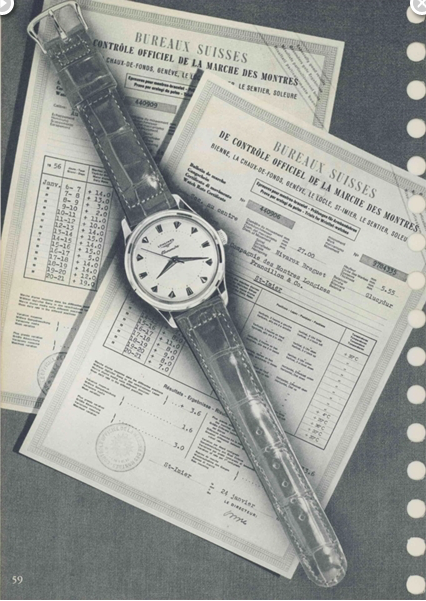
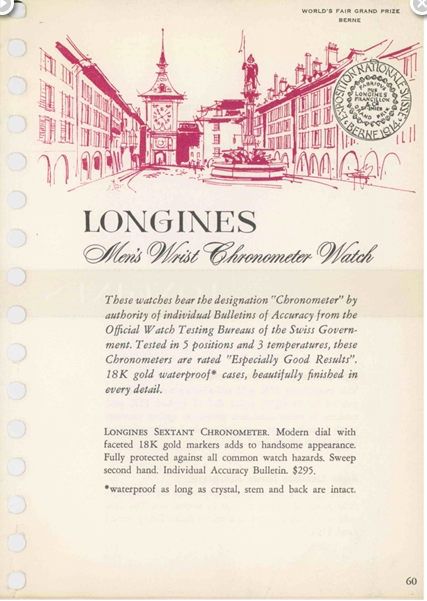
I came across this interesting ad from a 1958 sales brochure for Longines-Wittnauer (USA). It does show an add for a Longines certified chronometer; a model that is referred to as the "Longines Sextant Chronometer." This was probably a name used by Wittnauer for the US market. The price of the model is $295 and it comes in an 18kt gold case with a dial that has faceted markers. The dial is very similar to a Conquest from the same timeframe, but only reads "Longines" and "Chronometer." The watch features a waterproof case and a sweep second movement, which makes me think it made use of the same case and movement as a Conquest (the cal. 19as). Here are the scanned images from "Peter's Vintage Longines Watches" website.
Edited:
 
Posts
165
Likes
84
I’m not sure this was true across the entire line, but my 18k 22AS chronometer was priced exactly the same as a Connie in the late 1950’s. $375 for each.

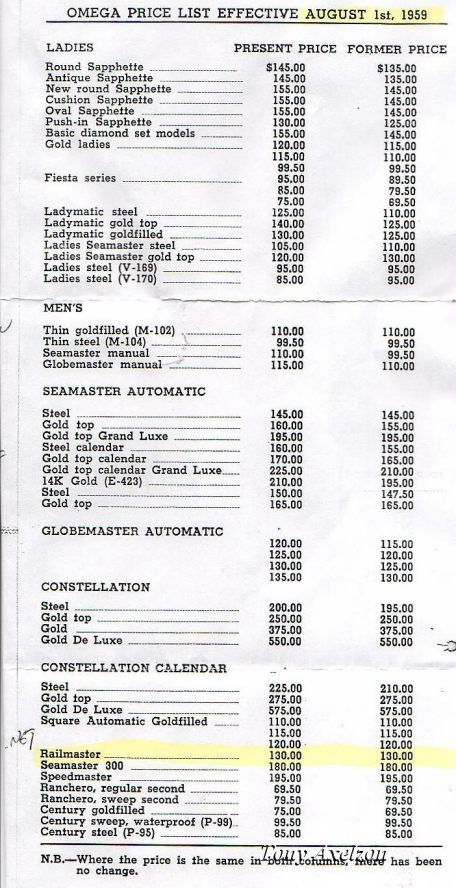
Oh man my gold capped constellation was more expensive than the speedmaster. Imagine if the money was used to buy that instead...
 
Posts
372
Likes
343
I want to add my appreciation for all the work that has gone into this.

It is interesting to think that we as consumers think a lot about the technical nature of wristwatches. However, I wonder how much the consumer of the time would have known or been interested in the movement construction and finishing. It makes sense that chronometer certificates are useful for a consumer to distinguish the quality of the movement particularly in the absence of other information. It is also interesting to note that in some cases, there may be a drawback in certifying watches.

If I were thinking about whether to certify watches outside of any marketing purpose, I would think that certifying a handful would be a good exercise for the watchmakers and as an external control measure on the quality of the product.
 
Posts
57
Likes
68
The dial is very similar to a Conquest from the same timeframe, but only reads "Longines" and "Chronometer." The watch features a waterproof case and a sweep second movement, which makes me think it made use of the same case and movement as a Conquest (the cal. 19as).

Hi,
I remember seeing this exact case and dial with a 27.0S calibre. As far as I know, I never saw any 19a(s) chronometer or an automatic Longines without "automatic" written on dial.

However, I wonder how much the consumer of the time would have known or been interested in the movement construction and finishing.

This is a question I have been asking myself a lot. Clearly, from the early 1950s to mid 1960s, before any quartz wristwatch, the finish quality of high end watches fell down sensibly, notably for every brand that was just under PP, AP and VC in price and grade. I'm encline to think this move was more corporate than consumer driven, but clearly there was an ongoing effort from the mid 1950s to cut down some finishing. Almost paradoxically, as finish quality lowered, chronometer certification raised...
But it seems there was no clear overall marketing strategy with chronometers. As almost every swiss company from middle to high grade made some, not every one promoted them, or some promoted them but in specific eras or markets : if it's true PP made extremely few wrist chronometers, they were far more prolific with pocket watches for the south american market (think of the popular Cronometro Gondolo). As for Longines, it seems most of its wrist chronometers of the mid to late 1950s were oriented to the north american market (same for Omega). Only Rolex consistently marketed its wrist chronometers.

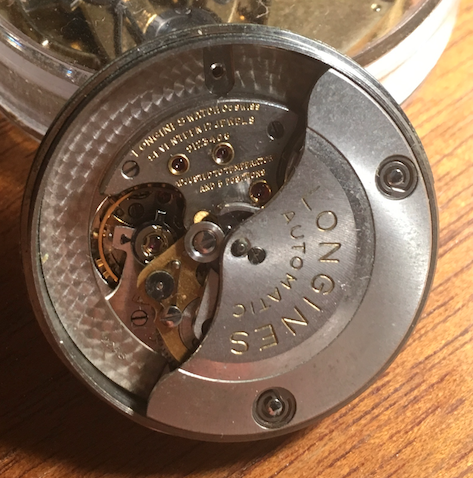
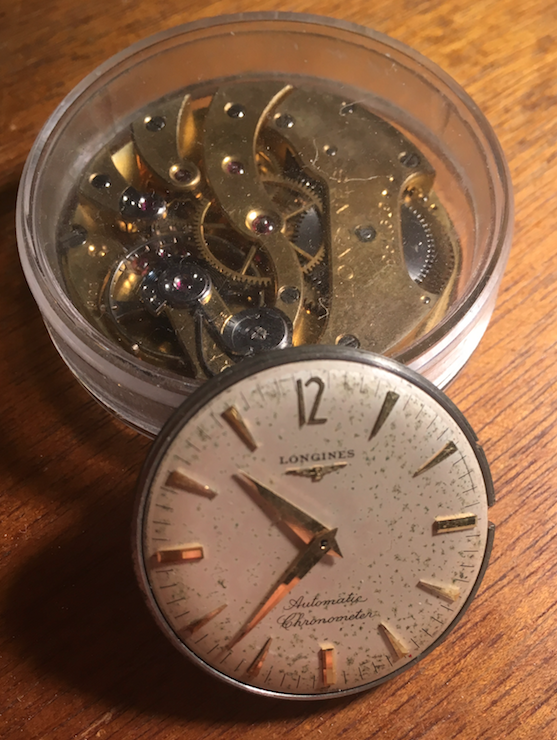
Here's my two Longines chronometers, sadly in not so good shape, without any case (or secondhand). I'm seriously considering a custom made one, but I fear it won't be in gold like it originally was...
 
Posts
106
Likes
133
Hi,
I remember seeing this exact case and dial with a 27.0S calibre. As far as I know, I never saw any 19a(s) chronometer or an automatic Longines without "automatic" written on dial.

Beautiful movements! It's a shame that the cases are gone. Probably scrapped for gold. Perhaps you could look for a gold filled or plated case to put one of those movements in. Maybe a 1950s Conquest case for the first one. Another OF member @Bill Sohne has a similar Longines chronometer to the bottom in an 18k case. I believe that picture is included in this thread.

That makes sense that the advertised chronometer would have a manual wind movement instead of an automatic with the absence of "automatic" on the dial, which Longines always seem to include on an automatic watch.
Edited:
 
Posts
8,004
Likes
28,103
I once owned a 27.OS chronometer...

LG27a.jpg