- Posts
- 261
- Likes
- 179
TechFounder
·People on this forum understand the (obvious) fact that not everyone is into mechanical Swiss watches, much less expensive ones. But a market does exist. That’s what caused you to post here in the first place.
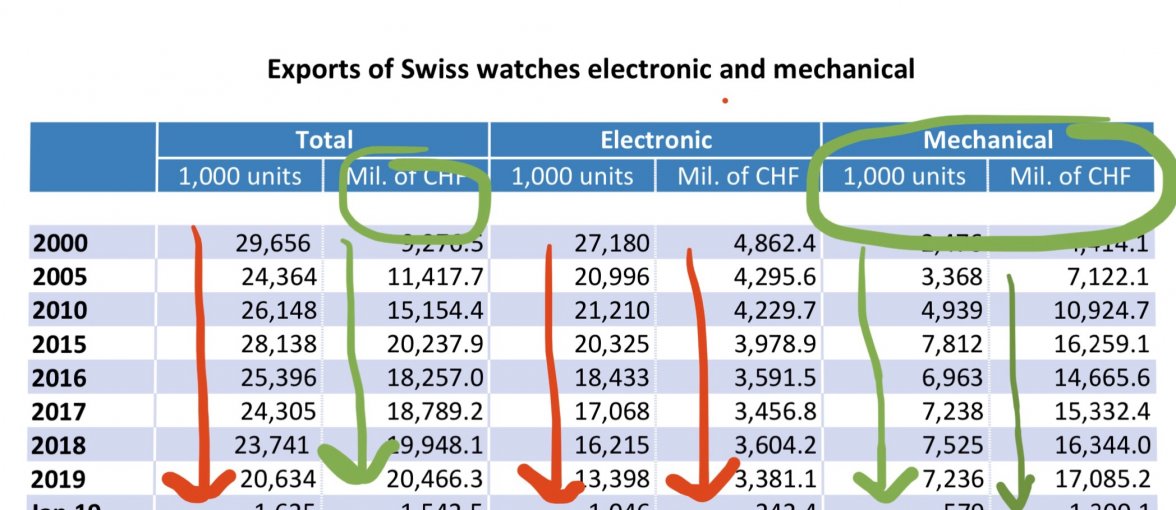
Here is where you veer away from obvious and into the incorrect. For the past 10+ years Swiss mechanical watch exports have increased, not only by unit, but also value per unit. And, those increases have come from across all major markets. China and HK have increased more than others, but they’ve all increased.
Now you’ve journeyed past both obvious and incorrect, into what I can only assume is pure armchair: based on what insider industry information do you know (A) export schedules since December, (B) supply adjustments by manufacturers (up or down) since January, (C) the status of stranded inventory in or arriving to China/HK since January, and (D) supply chain dynamics and resulting timing required for both (1) manufacturers to divert Swiss Swiss inventory to new markets, and (2) that inventory to arrive to market in those locations? I’m suspicious that you have any such insider industry insights, given that in your immediately prior point you didn’t know even the public information regarding Swiss mechanical export unit/value trends.
You can catch up to the gang starting here, here, here, here, here, and last but not least here.

Hmm, first of all, I think they have increased revenues/sales in the form of price increases but unit sales have been in decline. You can even see that in the first link that you provided. So long as you increase prices faster than your decline in unit sales, you can continue to make it look like you have a healthy business. It's a simple trick to maintain the illusion that everything's fine. When you have pricing power, it allows you to increase prices while reducing production which feeds into shortages, which feeds into more pricing power. It's a game that a lot of luxury brands play. Leica and Montblanc are two others that come to mind. Unit sales are in decline so what do they do? Jack up prices.
So, you keep saying that you understand that Rolex is a luxury brand with very expensive goods that not many people can afford but you're arguing the opposite. You know what a 1 million/year luxury watch maker's inventory looks like? Walk into any Omega ADs. That's what it looks like. You can get pretty much any watch you want. The Omega boutique on 5th Ave has multiple watches of every model waiting for someone to buy it. Furthermore, they have so much stock that gray markets are not inverted. They sell at a discount because there are so many watches.
The last data point, which was posted on this forum somewhere, said that COSC showed in 2015 that they had 900K+ of Rolex movements tested. If you think back to 2015, inventory at Rolex ADs looked pretty much like Omega's. That is, you can walk into ADs and get pretty much any watch you wanted (with the exception of the Daytona as that was always produced in limited quantities). So, which of these two scenarios you think happened in just 3 short years. 1. People who can afford and want a Rolex somehow increased 3-5 fold or 2. Rolex is manipulating supply by decreasing production drastically?
The way Rolex inventory is behaving lately with empty shelves at ADs is like what you would see in brands like Patek where production is far smaller. Granted, demand for Rolex is far greater but it's too far fetched to believe that it's 18 - 20X that of Patek. Again, I would take a close look at Omega if you want to see a company being truthful about their production and not manipulating their market.
Edited: