To be fair, it’s getting increasingly hard to.
If a watch costs $[X], then to achieve your asserted tactic and achieve an increase in profit: for every unit taken out of inventory a remaining inventory unit must be sold at >2$[X]. And to make significantly more profit, the remaining unit must be sold at >>2$[X].
Before and during the current bubble Rolex predictably (like other brands) increased unit costs every 2 years or so, by a matter of percentage points. They did not, however, in the last few years (this bubble) increase the per unit price by >2[X].
Basic maths, man.
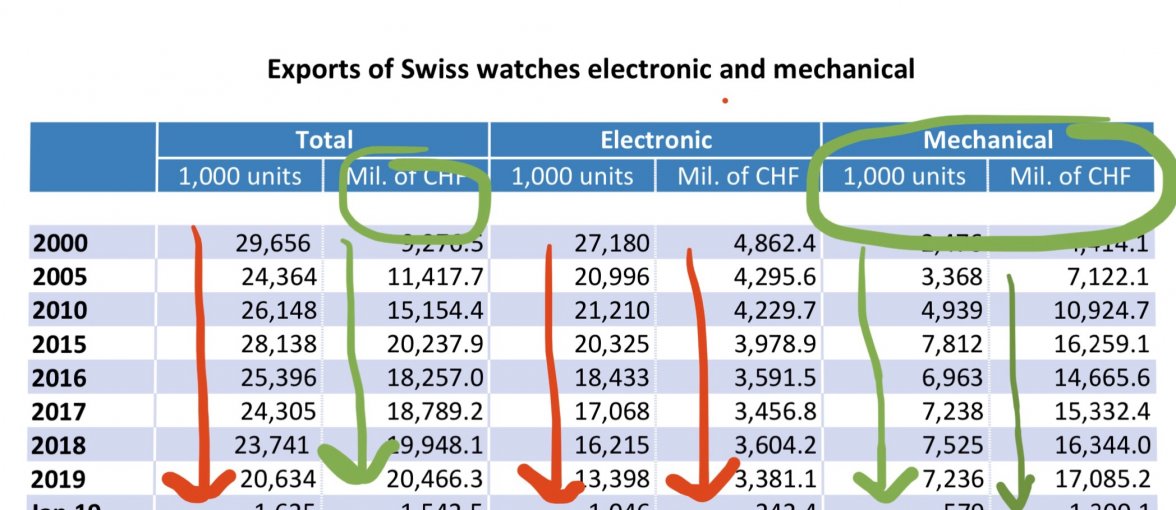
Have the decency to check even basic data:
So, over the past twenty years:
> fewer electronic watches have sold (but the ones that have, are more expensive per unit)
> mechanical watch sales have increased ~150%
> mechanical watch value by unit have increased 300%
> overall Swiss watch exports have decreased ~50% by unit (because of electronic unit declines), but increased by value ~100%
More people are wearing more watches that are more expensive; and the winners are both mechanicals and smart watches (which are replacing basic electronic/quartz market, not mechanical).
In all: no.
Sorry, I've been super busy with the markets falling out of bed lately. It looks like the pandemic is fully in effect. We still have empty shelves at stores. It's looking more and more like Rolex reduced production/inventory.
So, if you look at the Exports of Swiss watches electronic and mechanical chart you can clearly see that mechanical watch sales have plateaued. The growth of the market goes from 2000 all the way to 2015. Then Bam, it hits a wall. You can also see that the value of those same amount of watches have been going
up from 2015 which is exactly the scenario I've pointed out earlier (you could argue that it's due to product mix but unlikely). That is, instead of growing the market, they are increasing prices in order to juice their revenues. This is also the gist of my post which is not that "Rolex was simultaneously making but also not making inventory" but that they're reducing production/inventory to get in front of the inevitable future while simultaneously spreading the propaganda that they're making more. That the shortage is entirely due to overwhelming demand when this shortage was entirely of their creation.
I use to be a portfolio manager and I can't tell you how many times management of companies will come in and lie directly to your face. In securities analysis, there's a practice called mosaic theory. The idea is to look at publicly available information that's available to anyone and deduce the truth. If that truth is different than what's generally known by the market, you stand to make money. While I'm not looking to make money (
Short Richemont's stock! ) from a trade here, I do smell BS when I get a whiff of it. There's enough evidence out there for anyone who cares to look that Rolex is playing games.
Come on, do you really think it's just a coincidence that just when OCSC gets pushed to stop breaking down their numbers after 2015 also happens to be when this huge demand for Rolex watches came about? You can see that in 2016, right after the OCSC blackout, there was a big drop in production the following year. Then, two years later Richemont had to buy back some 500 million Euros of inventory. You know what that's called? Channel stuffing! It's another one of those tricks manufacturers pull when demand goes down. Unlike Rolex, Richemont is a public company and they
do have to make the numbers and report their actions. This tells you the demand for mechanical watches headed south after 2015. Or, do you really believe that only Richemont experienced lower demand?
I know it's hard for you to understand what's happening because you probably don't realize the implications of a product like Apple Watch on future sales but here it is in a nutshell. This is going a bit off topic but it's pertinent if you want to know where the Swiss watch industry is headed and thinking about. This is what keeps them up at night.
The arrival of the Apple Watch is not at all like the 70's and 80's arrival of the quartz and digital watches. Unlike those quartz and digital complements, the Apple Watch seeks to create an entirely new category. It no longer revolves around just telling time, date, reminders. The future of the fight for the placement as
the device on your wrist has begun. For Apple Watch and others like it is about healthcare. It's about having a medical diagnostic device strapped to your wrist monitoring your health 24/7 for only $300-$400 every few years. As technology continues to improve, the diagnostic capabilities of the watch will continue to get better and cover more metrics. In the coming years, you'll be able to monitor all sorts of your health stats by strapping on an Apple Watch. Mechanical watches will never be able to compete with this. Unlike the 70's and 80's complements, this is about substitutes. Since most people only wear one watch it's going to a bit like Highlander, there can be only one. No one is going to only care about their health on certain days of the week while they strap on their mechanical watch. Once the Apple Watch reaches that functional threshold where a majority of people think that they want it to monitor a certain aspect of their health, they will wear it all the time. So you tell me where does this leave the lonely Swiss mechanical watch?
Not only that but you can already see that most millennials and younger no longer wear watches. If they do, they wear an Apple Watch. Do you really expect them to go from being able to do all of those futuristic things like monitor their health to go buy something that costs 10-20 times more just so they can only use it to tell time? I'm sure there will always be those people but like the Leica buyers, they are a tiny group and getting smaller all the time. If the future, Leica customers will consist of 100 customers willing to pay $50k for a digital camera

.
Side note, I could be completely wrong and miss out on the future trend of people wearing 2 watches. In fact, I was thinking of doing this when I acquire an Apple Watch, wear my mechanical on my left and the Apple Watch on the right. I doubt that this will ever come about but we'll see.