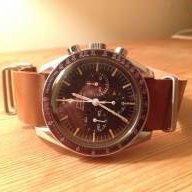
Is it weird that I wish the Speedmaster movement still had the traditional Swiss lever escapement?

Posts
291
Likes
311
So, I really love the FOIS. It's a great watch. The finishing is fantastic, and it's got the vintage look and proportions that I love. I know some people don't like the colour of the lume, but I'm ok with it.

However, one thing that's always bothered me about modern Speedmasters is that they use the new co-axial escapement. I understand it's meant to be more advanced than the traditional Swiss lever escapement, but for some reason I think changing the escapement on the Speedmaster is a little bit like changing it to an automatic.

Basically, in my mind, the Speedmaster should be a manual winding chronograph with a fairly simple, yet robust, movement. That includes the Swiss lever escapement.

Obviously, ultimately, it doesn't really make any difference what kind of movement it uses because a mechanical watch is effectively outdated technology anyway, and has been since the invention of quartz.

I think what kind of bothers me about it is that from a servicing point of view, you essentially have to send the watch back to Omega because watchmakers need specific training on coaxial escapements, and it kind of gives me similar vibes to newer computers, phones, laptops etc, where everything's kind of put together in a way that makes simple repair difficult, and it can even hurt reliability.

I might not be articulating myself very well, but I'd just feel a bit more comfortable if they used the Swiss lever escapement in the Speedmaster.

What do you think?

 
Posts
1,398
Likes
2,722
I've no concern or desire. The coaxial escapement has been proven. My experience with it has been enjoyable and impressive. I don't see one or the other being more precious or reliable.
 
Posts
13,107
Likes
22,727
I feel kinda the same. I know most people love it but but I’ve said previously I think the coaxial escapement (at least in its current form) is the answer to a problem no one had. It’s just a marketing ploy.

It offers little/no benefits and hugely restricts who can service your watch now (coupled with potential parts issues in the future?).

No upside for me and a genuine downside and it’s one of the reasons I don’t have a modern Omega in my collection.
 
Posts
16
Likes
27
The service interval for the co-axial movements is longer than the traditional movements. That is a legitimate and measurable difference.
 
Posts
23,869
Likes
53,031
The movement had already been changed from column-wheel to cam-lever. Are you ok with that?
 
Posts
13,107
Likes
22,727
The service interval for the co-axial movements is longer than the traditional movements. That is a legitimate and measurable difference.

I don’t believe that’s true. Last time I checked Omega had the same recommended service intervals for both Swiss lever and coaxial movements.
Has it changed?
 
Posts
23,869
Likes
53,031
I don’t believe that’s true. Last time I checked Omega had the same recommended service intervals for both Swiss lever and coaxial movements.
Has it changed?
They might make more detailed technical recommendations behind the scenes to service centers, but for customers it seems to be 5-8 years across the board.

In principle, a co-axial movement should experience less wear on some parts, but my sense is that a number of things did not turn out to be as expected in practice.
 
Posts
1,642
Likes
1,690
The movement had already been changed from column-wheel to cam-lever. Are you ok with that?
Having torn down quite a few chronographs now, I'll die on the hill that cam-lever is superior for a number of reasons, and was a good modification to the movement made for great reasons***. Now that Shanghai can turn out a $100 cam-lever movement in their ST19s, there is no 'mystique' to it anymore. Cam lever has better wear characteristics, results in more effective mode switching, and has gentler/less abrupt movement of the components, while being less fragile. And frankly, I appreciate the sharp 'snap' you get out of a cam-lever change vs a mushier out of cam lever (at least on Daytonas, Landerons, Speedmasters, and Venus movements I've handled or disassembled). I'll go even further: OTHER than 'prestige', the 7750 Chronograph movement is the best chronograph movement ever made.

The bit that DOES annoy me about my 3861 Speedmasters is that they gained hacking. For various reasons, it is a feature that annoys me on small-second watches.

**All that said, My EW321 is my favorite Speedy.
 
Posts
29,458
Likes
76,211
They might make more detailed technical recommendations behind the scenes to service centers,
Nope
 
Posts
1,642
Likes
1,690
In principle, a co-axial movement should experience less wear on some parts, but my sense is that a number of things did not turn out to be as expected in practice.

Having taken apart a handful of dogs-breakfast watches, it seems that the escapement isn't at all the part of the watch that wears out 'first'. I got a feeling that you could make an escapement that doesn't wear at all, and not really change the service intervals.

Just about every watch I've worked on (and I'm somewhat more biased than others in my services, because it is RARE I actually buy a watch that is running well), the failure has been either dirty balance jewels, or other pivot jewels.

I've not yet seen a pallet stone, escape wheel, or balance "worn" out on any of them, but I've seen a dozen mainspring-barrel-bushings worn to crap. In fact, I JUST finished/shipped a cheap watch for someone* (a late 60s ASchild movement that his DAD wore every day for his entire life without a service, then HE wore for a few years, and it finally stopped!) where the escapement was perfect, but the 3rd wheel had worn one of its pivots to be like 1/3 of their starting diameter, with the 2nd wheel not far behind.

So in summary: The coax escapement is REALLY cool, and I love them, but frankly, I don't think it actually solved a "wear" problem, so much as a horologically-coolness problem (and perhaps improved efficiency).

*I typically don't service for 'people', but when I posted watches for 'sale' on reddit I got a handful of people begging me to do a cheap service on their watches that aren't "worth" the money to service. I relented on a few of them for cheap to save old/cool watches with stories...
 
Posts
1,398
Likes
2,722
That specific training is required to service the coaxial escapement is inconsequential. It's not super special, it's just different to service than past movements in critical ways. Any reputable service technician or shop who is in it for the long haul will gain the certification if they want to service modern Omegas. Or they can just continue to service only the vintage in-house and ETA based movements for eternity. Complication, lack of service opportunities,. and fragility aren't reasons to fear or abhor it. That it's different than previous iterations of the "Speedmaster movement" is a reason to not prefer it, but that's happened a couple times already, hasn't it? This is just a development in design and execution.
 
Posts
84
Likes
96
I'm good with the co-axial. It's been a great movement for me (so far) and I love having the hacking feature. My Speedmaster is one of the most accurate watches I own.

The 321 is still available.
 
Posts
29,458
Likes
76,211
That specific training is required to service the coaxial escapement is inconsequential. It's not super special, it's just different to service than past movements in critical ways.
The class I went to had 5 watchmakers in it. The goal was to fully service 2 co-axial movements in 5 days. Of course there was a lot of instruction time, time required for having your work checked before you moved on, time touring the facility, and time spent learning other things like refinishing. But still this was plenty of time to service 2 watches, which by Omega standards would take about 1.5 days.

The watches were a 3 hand Aqua Terra with a 2500, and a Seamaster Chronograph with a 3313. The 2500 was familiar enough to me because I had serviced a ton of 1120's, but I had never serviced the lever escapement version of the 3313 (the 3301/3303) so this was an entirely new movement to me. I finished both watches by noon on Friday, and one other watchmaker finished by the end of the day Friday. The other 3 watchmakers didn't finish both watches, and one didn't finish the first watch.

Properly oiling a co-axial escapement is not easy. It requires a lot of precision - more so than in any other oiling task you would encounter as a watchmaker. Fully trained pros were not able to master it, so it's not just learning how to do it and you are fine - many people are incapable of doing it. The 3 watchmakers who didn't finish the 2 watches all said that they would never actually service these, and would just send them to Omega for service, so it's good that they knew their limitations.

Any reputable service technician or shop who is in it for the long haul will gain the certification if they want to service modern Omegas.
In an ideal world that would be true. But the number of people who just "wing it" can't be ignored. They sometimes contact me when they get in trouble and ask me to bail them out.

But even if they do follow the path to get certified, there's a problem with trying to compete with Omega. There are some very specific tools required for these calibers, and they are not cheap. But even if you make that investment, there's other considerations - I'll repeat some of what I posted in a recent thread here...

The escape wheel and pallet fork in a lever escapement watch rarely wear out (if there is wear say on the escape wheel, it's usually on the pivots, not the surfaces involved in providing the impulse). The co-axial wheel and pallet fork in co-axial watches are often replaced - just look at any photo that someone posts of the parts that were returned with their watch from Omega, and you will nearly always see the co-axial wheel, and often the pallet fork.

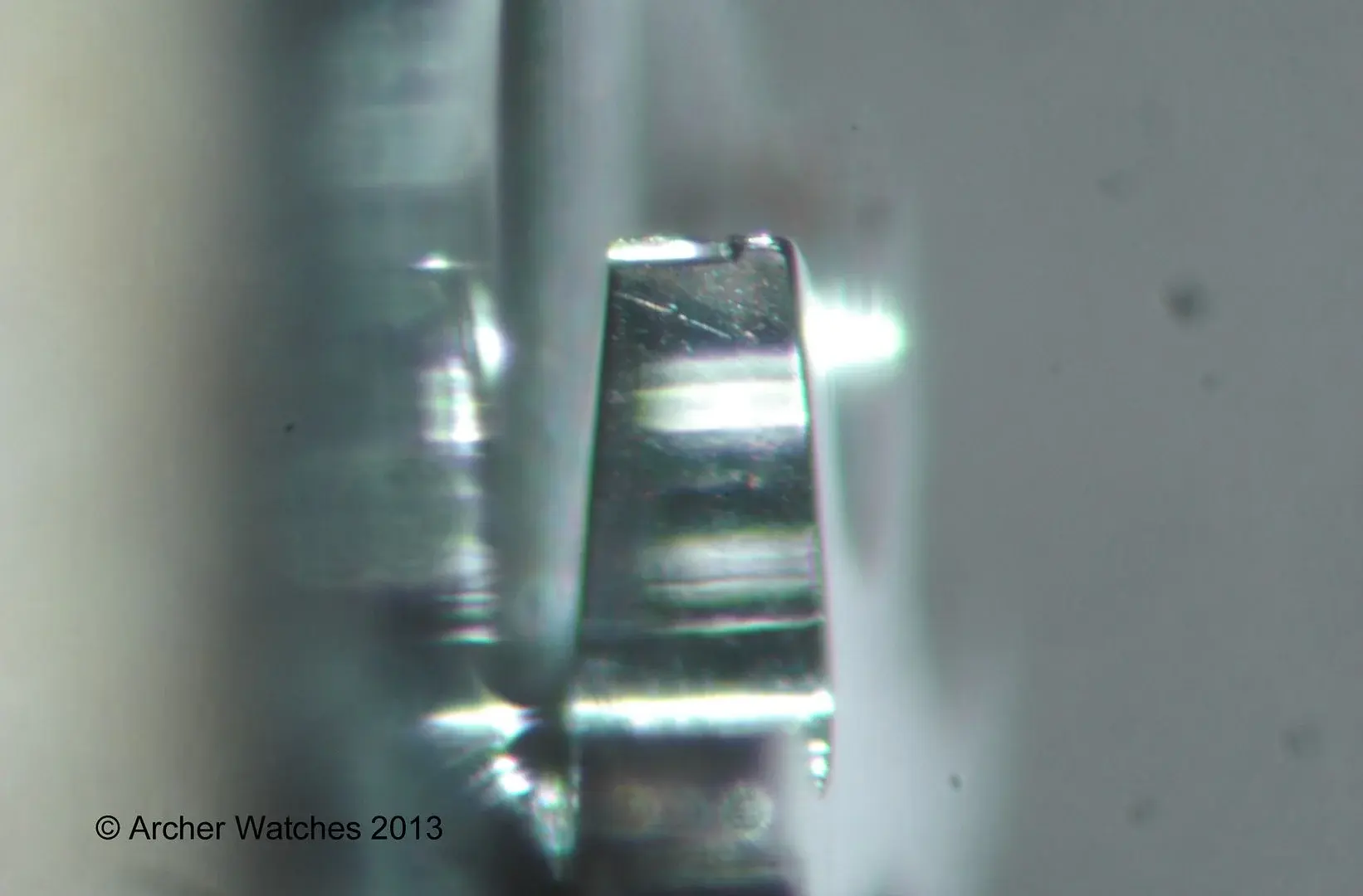
I saw this wear years ago...here's a co-axial wheel with the worn upper teeth:

1bc744d4-688e-41d7-9deb-f7b80cb3a1ea.webp


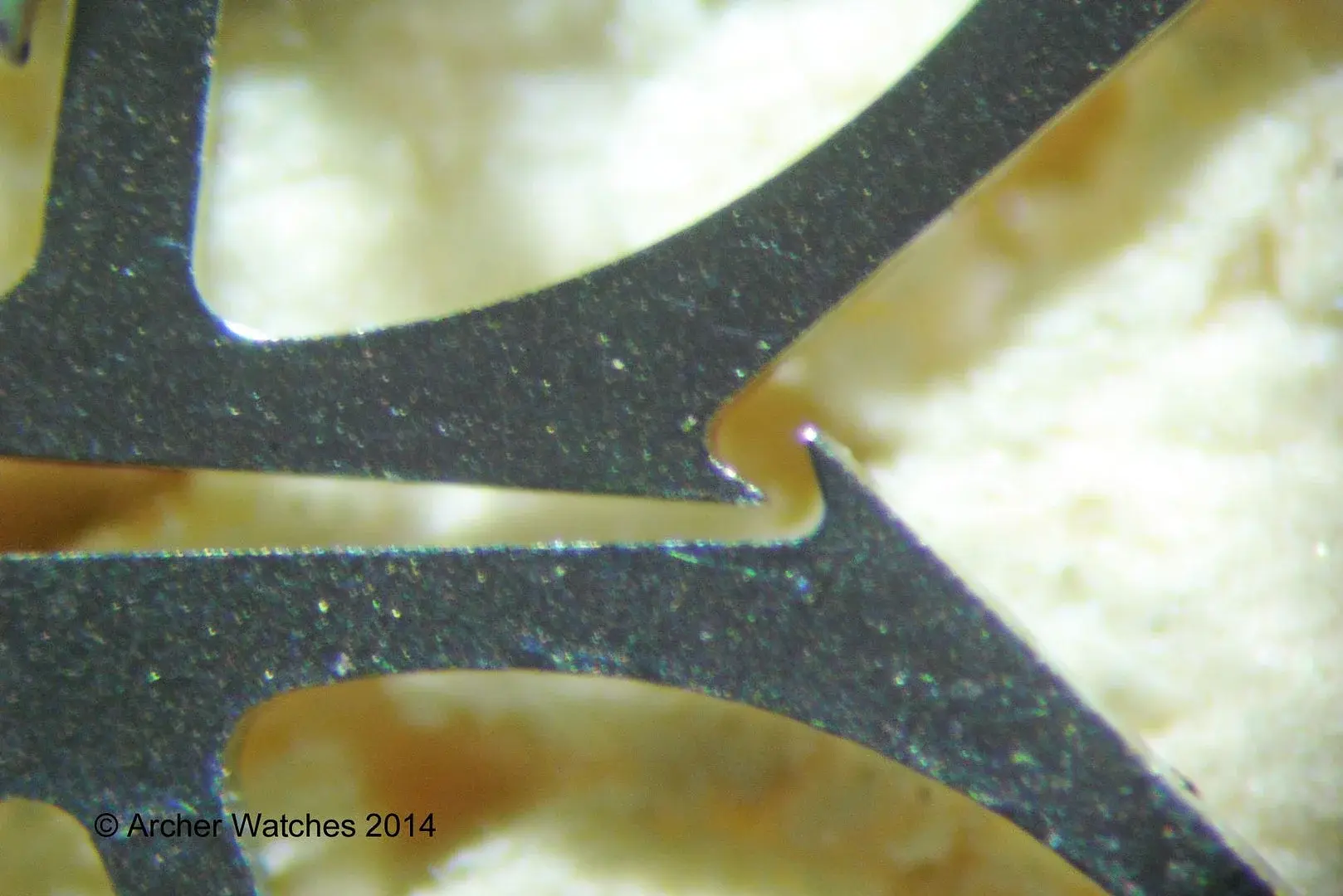
New and old wheels - you can see some of the lower teeth on the old wheel are shorter:

1e8ca63a-677b-4e75-925d-66e1a6e83120.webp


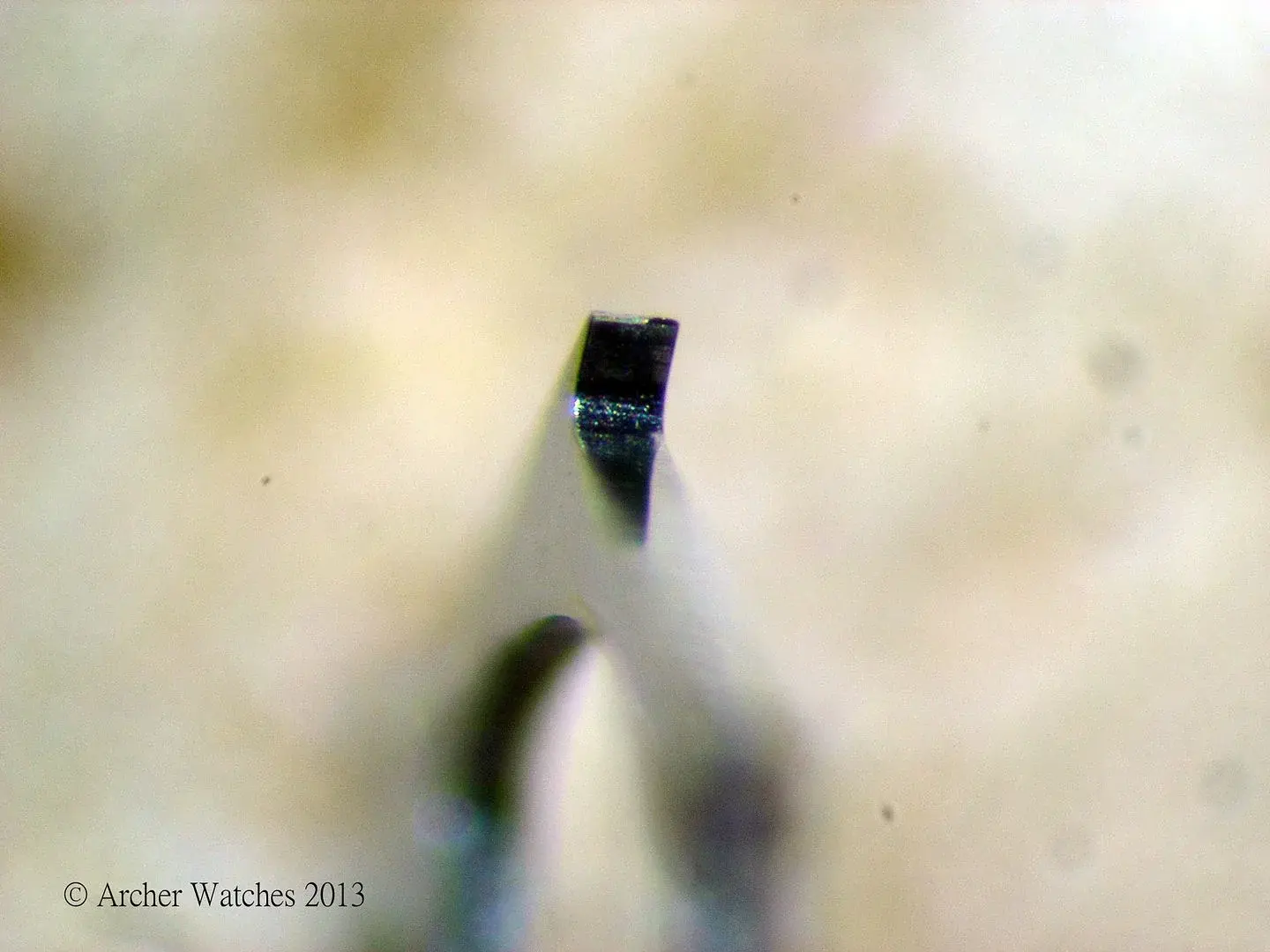
Different view of the wear on the lower teeth:

9d1488c0-5495-42d2-b115-6db354afc8fb.webp


The oil that is applied to a co-axial escapement is, according to Omega and the training I received, there to cushion impacts, rather than reduce sliding friction. The reality is that the design of the co-axial causes wear. This gif is of the interaction between the co-axial wheel teeth and the pallet fork jewel. If you watch the thin tip of the tooth go over the sharp edge of the pallet for jewel, it's not difficult to understand how the wear happens on these teeth:

3e034b30-e256-46fc-9f21-2ce03fb63a16.gif


The reality is, these will chew themselves up over time and they are pretty routinely replaced.

I no longer service these co-axial watches, for a couple of reasons. One is that my business has shifted more towards servicing vintage, and quite honestly I enjoy that kind of work much more. The other one though is just as important - cost of parts. Note that parts just went up again here, so these are current 2026 prices.

In a standard Omega Cal. 1120, the pallet fork and escape wheel are $43 Canadian each, and again these rarely need replacing.

In a Cal. 2500, the co-axial wheel is $240, and the pallet fork is $210.

In an 8900 series, the co-axial wheel is $400, and the pallet fork is $240.

Omega includes these parts in their base price, but like most watchmakers I use a flat labour fee and parts are extra. It only takes one co-axial wheel needing replacement to make my prices higher than Omega's, so I just tell people to use Omega.

So both from a training/technical standpoint, and a financial/profitability standpoint, the co-axial escapement does limit your service options, and you will find fewer and fewer watchmakers that will service these. If we can't charge a decent rate for a repair because the often replaced parts are too expensive, we just don't do that repair anymore. Simple business decision.

In the end modern Omegas are off the table for me...I'll stick with the tried and true lever escapement.
 
Posts
29,458
Likes
76,211
Having taken apart a handful of dogs-breakfast watches, it seems that the escapement isn't at all the part of the watch that wears out 'first'. I got a feeling that you could make an escapement that doesn't wear at all, and not really change the service intervals.
Not only about wear, but do you know how many watches I get in for servicing where the only problem is that the oil has dried up on the escapement? Zero.

People have talked up the theoretical benefits of the co-axial for years, but in practical terms for me there's more negative than positive.
 
Posts
1,642
Likes
1,690
Woah, that sharp point on the escape wheel is a TERRIBLE idea, and I'm surprised no one had pushed back on that when it was designed. Every machinist (on big stuff!) knows that points like that NEED a corner radius, else the metal is going to tear off. As soon as I saw your wear photo, it became clear to me that this is an obvious weakness of the design. Adding/engineering in a little bit of a roundover on that tooth would add decades to it.

Not only about wear, but do you know how many watches I get in for servicing where the only problem is that the oil has dried up on the escapement? Zero.

People have talked up the theoretical benefits of the co-axial for years, but in practical terms for me there's more negative than positive.

Yeah, escapement oil is never a problem I've seen (in my admittedly small-sample-size of sub-40 watches). PIVOT oil drying/gumming up is exactly the problem I see basically every time.

So the coaxial movement seems to me that it is a solution in need of a problem.

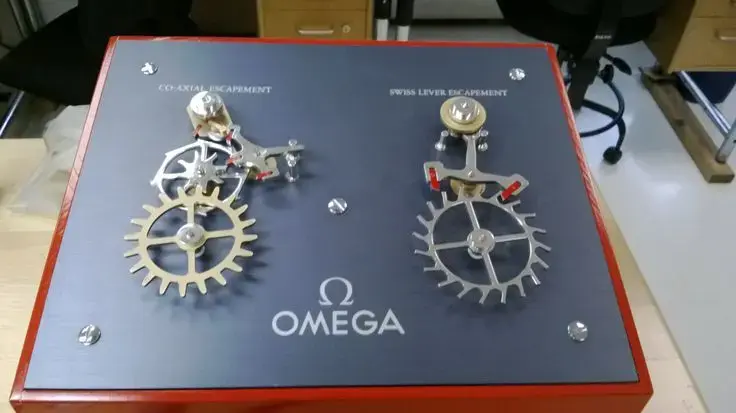
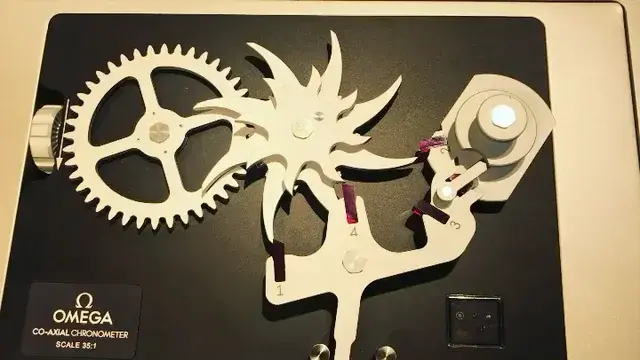
That said, the larger-than-life-sized models are REALLY cool/interesting to play with they seem. I'd love to see if I can track one down one of these days.
 
Posts
29,458
Likes
76,211
That said, the larger-than-life-sized models are REALLY cool/interesting to play with they seem. I'd love to see if I can track one down one of these days.
You mean like this?

 
Posts
531
Likes
683
The class I went to had 5 watchmakers in it. The goal was to fully service 2 co-axial movements in 5 days. Of course there was a lot of instruction time, time required for having your work checked before you moved on, time touring the facility, and time spent learning other things like refinishing. But still this was plenty of time to service 2 watches, which by Omega standards would take about 1.5 days.

The watches were a 3 hand Aqua Terra with a 2500, and a Seamaster Chronograph with a 3313. The 2500 was familiar enough to me because I had serviced a ton of 1120's, but I had never serviced the lever escapement version of the 3313 (the 3301/3303) so this was an entirely new movement to me. I finished both watches by noon on Friday, and one other watchmaker finished by the end of the day Friday. The other 3 watchmakers didn't finish both watches, and one didn't finish the first watch.

Properly oiling a co-axial escapement is not easy. It requires a lot of precision - more so than in any other oiling task you would encounter as a watchmaker. Fully trained pros were not able to master it, so it's not just learning how to do it and you are fine - many people are incapable of doing it. The 3 watchmakers who didn't finish the 2 watches all said that they would never actually service these, and would just send them to Omega for service, so it's good that they knew their limitations.


In an ideal world that would be true. But the number of people who just "wing it" can't be ignored. They sometimes contact me when they get in trouble and ask me to bail them out.

But even if they do follow the path to get certified, there's a problem with trying to compete with Omega. There are some very specific tools required for these calibers, and they are not cheap. But even if you make that investment, there's other considerations - I'll repeat some of what I posted in a recent thread here...

The escape wheel and pallet fork in a lever escapement watch rarely wear out (if there is wear say on the escape wheel, it's usually on the pivots, not the surfaces involved in providing the impulse). The co-axial wheel and pallet fork in co-axial watches are often replaced - just look at any photo that someone posts of the parts that were returned with their watch from Omega, and you will nearly always see the co-axial wheel, and often the pallet fork.

I saw this wear years ago...here's a co-axial wheel with the worn upper teeth:

1bc744d4-688e-41d7-9deb-f7b80cb3a1ea.webp


New and old wheels - you can see some of the lower teeth on the old wheel are shorter:

1e8ca63a-677b-4e75-925d-66e1a6e83120.webp


Different view of the wear on the lower teeth:

9d1488c0-5495-42d2-b115-6db354afc8fb.webp


The oil that is applied to a co-axial escapement is, according to Omega and the training I received, there to cushion impacts, rather than reduce sliding friction. The reality is that the design of the co-axial causes wear. This gif is of the interaction between the co-axial wheel teeth and the pallet fork jewel. If you watch the thin tip of the tooth go over the sharp edge of the pallet for jewel, it's not difficult to understand how the wear happens on these teeth:

3e034b30-e256-46fc-9f21-2ce03fb63a16.gif


The reality is, these will chew themselves up over time and they are pretty routinely replaced.

I no longer service these co-axial watches, for a couple of reasons. One is that my business has shifted more towards servicing vintage, and quite honestly I enjoy that kind of work much more. The other one though is just as important - cost of parts. Note that parts just went up again here, so these are current 2026 prices.

In a standard Omega Cal. 1120, the pallet fork and escape wheel are $43 Canadian each, and again these rarely need replacing.

In a Cal. 2500, the co-axial wheel is $240, and the pallet fork is $210.

In an 8900 series, the co-axial wheel is $400, and the pallet fork is $240.

Omega includes these parts in their base price, but like most watchmakers I use a flat labour fee and parts are extra. It only takes one co-axial wheel needing replacement to make my prices higher than Omega's, so I just tell people to use Omega.

So both from a training/technical standpoint, and a financial/profitability standpoint, the co-axial escapement does limit your service options, and you will find fewer and fewer watchmakers that will service these. If we can't charge a decent rate for a repair because the often replaced parts are too expensive, we just don't do that repair anymore. Simple business decision.

In the end modern Omegas are off the table for me...I'll stick with the tried and true lever escapement.
Wow, great post, as usual @Archer!
 
Posts
1,642
Likes
1,690
You mean like this?

Thats one of the variants I've seen. I THINK that is from this one?


There is also THIS one, which I think is pretty awesome too:


I'd LOVE to have either (or even just PLAY with one!), with a slight preference for the former. I've been trying to see if my OB can track one down, even if they can't sell it to me, but everyone in corporate seems to respond "oh yeah, those were cool... I wonder where they all went?"
 
Posts
6,573
Likes
51,169
I don't know about such things, other than what I read in Forum posts, but I remain deliriously happy with my mid-1980s 861.
 
Posts
2,784
Likes
4,452
I have yet to see any co-axial rust rats. Will stick with lever and Quartz for the time being.

I have Daniels book, and most of the HJ magazines from 1954 to around 2003. So there was a lot of ink spilled back in the day.

Henry in his last years wanted me to make an animated model of a co-axial Tourbion. The tech was a bit early for that. Then Henry and the other old guys passed away.

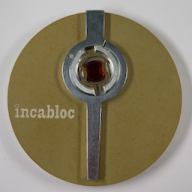
Now it would not be too much trouble fo make an acrylic model with a laser. I find playing with my Avatar incabloc model to be fun, So one could use that design to model the jewel pivots.

Priorities what seem interesting when one is in their mid 30s, Do not seem as important when one is in their mid 60s

Curios I never see much mention of cylinder escapements. Those were pretty popular back in the day. I took a bunch of photos of the manufacturing equipment in one of the museums. I have a whole tray of them somewhere. Also the remains of a repeater I was going to use CAD to model and restore ...