Dropping things from high places

Posts
5,528
Likes
9,451
And to calculate the approximate distance, take half the terminal velocity and multiply by the time. As @BlackTalon noted, this is all pretty approximate, not only because the parameters are estimates, but also because the time calculation neglects drag.
drag is part of calculating the terminal velocity, so it's in there.
 
Posts
24,592
Likes
54,615
drag is part of calculating the terminal velocity, so it's in there.
If you read my comment, I was referring to the time calculation, not the steady-state terminal velocity calculation. It's not accurate to assume constant acceleration at gravitational acceleration to reach terminal velocity. In other words, ma = mg is not the correct differential equation.

As you know, to determine the actual time required to reach terminal velocity, one would have to incorporate the drag force (approximately proportional to velocity squared) into the Newton's law differential equation.
 
Posts
5,528
Likes
9,451
I'll agree to disagree. The reason there is variability in the terminal velocity is precisely due to variations in drag.
 
Posts
24,592
Likes
54,615
It's not a matter of agreeing or not, there's correct and incorrect. Sorry to be pedantic about this but I'm an engineering professor who often teaches fluid mechanics.

I'm not talking about the value of the terminal velocity, but the amount of time that it takes to reach terminal velocity. To calculate the steady state terminal velocity, you set the drag force equal to gravitational force. That's correct. It's a simple force balance with no time dependence.

But then to calculate the time required to reach terminal velocity, you simply assumed constant acceleration, i.e. a linear increase in velocity versus time. That's incorrect because it neglects drag, which increases approximately quadratically with velocity. It's ok to do that as a rough approximation, but obviously if you want to be accurate, you can't use drag to calculate the steady state velocity but then neglect drag when calculating the amount of time required to reach that velocity.
 
Posts
6,304
Likes
21,488
.. Sorry to be pedantic about this but I'm an engineering professor who often teaches fluid mechanics...

The next question is, do any of your students notice and comment on your watches?
 
Posts
3,994
Likes
6,838
Maybe Adrian Newey could design the next phone so that no matter how you drop it, it never travels fast enough to break.
 
Posts
4,704
Likes
17,825
An Omega SMP300 would do really well at these tests as long as the helium hadn't leaked out of the valve.

Lets not forget the implications if you get a helium build up and cant release it ..... if the bracelet clasp sticks as well you could be seconds aways from bad times......
 
Posts
4,704
Likes
17,825
Maybe Adrian Newey could design the next phone so that no matter how you drop it, it never travels fast enough to break.
Easy…. train cats to carry them for you….
 
Posts
5,528
Likes
9,451
It's ok to do that as a rough approximation, but obviously if you want to be accurate, you can't use drag to calculate the steady state velocity but then neglect drag when calculating the amount of time required to reach that velocity.
Ah, theory vs practice. You are correct, Professor. In practice, the factor of safety covers it ::rimshot::
 
Posts
4,833
Likes
12,222
Ah, theory vs practice. You are correct, Professor. In practice, the factor of safety covers it ::rimshot::

I am an applied math professor and agree 100% with Dan here:

But then to calculate the time required to reach terminal velocity, you simply assumed constant acceleration, i.e. a linear increase in velocity versus time. That's incorrect because it neglects drag, which increases approximately quadratically with velocity.

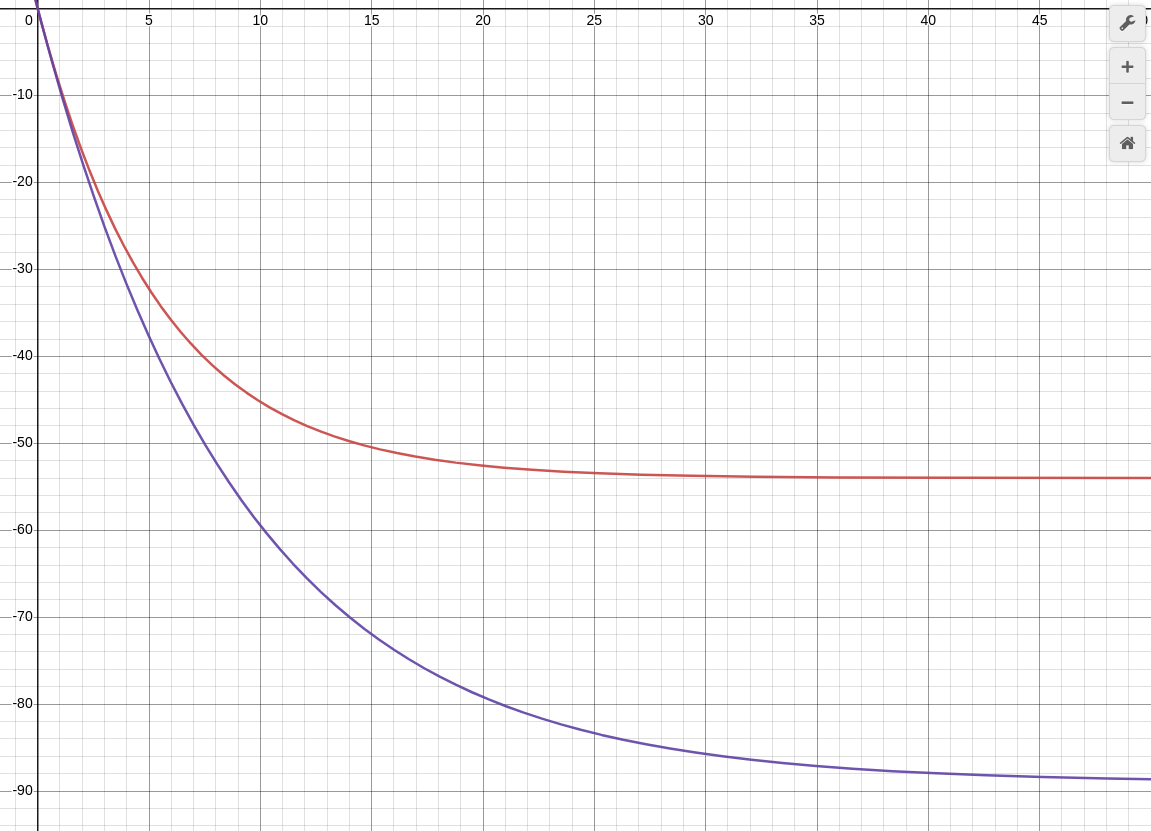
I would also add that the question of how long it takes to reach terminal velocity is ill defined, because terminal velocity is an asymptotic state. You never truly reach terminal velocity. If I make an incorrect assumption for mathematical convenience that drag is linearly related to velocity, and not quadratically, the velocity becomes

v(t)=v_T e^(-( 9.81/v_T) t) - 9.81

where v_T is the terminal velocity in meters/sec. The graphs of v(t) vs. t are shown below for v_T = 54 and v_T=89. As you can see it takes a fair bit longer to get close to terminal velocity than the rough approximation v_T/9.81. The velocities are negative because the height is decreasing.


I'm tempted to get out a DE solver for quadratic drag, but I think it is better for me to prepare for classes that start next week.

 
Posts
24,592
Likes
54,615
Ah, theory vs practice. You are correct, Professor. In practice, the factor of safety covers it
Not sure what this means, engineers need to have the mathematical abilities to make accurate and practical real-world calculations. Neglecting drag would result in a substantial underestimation of the time/distance required to approach terminal velocity. As @wagudc mentioned, terminal velocity is only reached asymptotically, so to be more precise, one would generally ask how long it takes to reach 99% or 99.9% of terminal velocity.

If you are interested in the math for a quadratic drag model, it is discussed in the hyperphysics stack entry linked below. The inclusion of drag that is quadratic in velocity approximately triples the time required to reach 99% of terminal velocity compared to ignoring drag.

@wagudc, there is a tidy analytical solution. 😀

http://hyperphysics.phy-astr.gsu.edu/hbase/Mechanics/quadvfall.html
Edited:
 
Posts
3,134
Likes
20,990
Boy did I open a can of worms. I’m pretty sure my phone reaches terminal velocity about 2 milliseconds after I drop it onto my foot. No fancy math needed here 😜. Anyone ever drop their phone on one of their toes? It’s brutal. Thing was bruised for a month.
 
Posts
6,304
Likes
21,488
Why Professors Shouldn't be Firefighters...

 
Posts
2,572
Likes
3,789
I am an applied math professor and agree 100% with Dan here:


I would also add that the question of how long it takes to reach terminal velocity is ill defined, because terminal velocity is an asymptotic state. You never truly reach terminal velocity. If I make an incorrect assumption for mathematical convenience that drag is linearly related to velocity, and not quadratically, the velocity becomes

v(t)=v_T e^(-( 9.81/v_T) t) - 9.81

where v_T is the terminal velocity in meters/sec. The graphs of v(t) vs. t are shown below for v_T = 54 and v_T=89. As you can see it takes a fair bit longer to get close to terminal velocity than the rough approximation v_T/9.81. The velocities are negative because the height is decreasing.


I'm tempted to get out a DE solver for quadratic drag, but I think it is better for me to prepare for classes that start next week.
Barkeep, another round please!
 
Posts
5,528
Likes
9,451
Not sure what this means, engineers need to have the mathematical abilities to make accurate and practical real-world calculations.
As an engineer, allow me to explain it to you. It's called a 'joke'. Even accompanied it with a fun smilie.

My fluid mechanics and other ESM classes were decades ago (eh, I did take a few ESM classes beyond the minimum in order to minor in it). In practice, the only fluids I deal with are winds -- mainly to calculate wind loads -- and water (drainage calcs). Gravity does enter into things as well, as not many people really like to see buildings fall down.

This thread motivated me to look through my work bookcase earlier this afternoon to see what books I have in the office. Alas, while I have a hydrology text I believe I either sold my fluid dynamics text shortly after finishing the class or it is packed away in the basement at home.

I appreciate the lecture(s). I am working on continuing ed hours for license renewal at the end of the month. Maybe this will inspire me to get some credits with a fluids-related course or two.