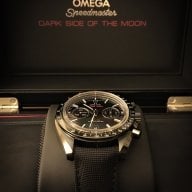
Condensation on new Seamaster!

Posts
88
Likes
101
Thanks for the update.

First, was the sales girl attractive? Regardless, she should have been well-versed in watch knowledge and shouldn't have been let off the hook so easily.

By the way, are you around very humid conditions all the time? No watch is truly hermetically sealed as it is designed to be serviceable... I'm wondering if maybe the water vapor pressure in your watch is just very high and somehow it condensed when exposed to cold... ?

 
Posts
309
Likes
419
Perhaps taking it to Omega Boutique, you'd get much better service? I'd be surprised OB would have been that indifferent if they saw the condensation
 
Posts
456
Likes
278
I live in a very humid climate and am constantly going in and out and my 46 year old Speedmaster doesn't even have this problem.
Bad gasket in caseback or crown?
 
Posts
1,694
Likes
5,401
If it genuinely goes to Omega for service, they won't simply open the watch up, allow the existing condensation to evaporate, and close it back up ... they will definitely replace the gaskets and seals, perhaps also the crown and crystal, and pressure test it before returning it to your AD. The warranty means something. Frankly the response you described from the technician sounds fishy. He should be in no doubt whatsoever about what a proper service should entail for a problem like this, and for him to claim that it's "normal" for the watch to get internal condensation is either incompetent or dishonest. Keep us posted ... ugh

😒
 
Posts
212
Likes
204
Any watchmaker that would find a quality watch with this kind of condensation under the crystal would most likely want to overhaul the watch. Any moisture can lead to rust, displace lubricants, etc., so it needs to be thoroughly cleaned, dried, resealed to insure the watch will be back to spec. Ideally Omega should handle this without complaint. I find the reaction of the place you took it downright bizarre.
 
Posts
722
Likes
952
Yea that's just incredibly unlucky it'll be fine after you get it back.
was the swimming in salt water or pool? maybe it doesn't matter, but i would worry that salt water- which can be pretty corrosive- got in there.
in which case, i would feel much better with a new watch than one with new seals/gaskets on it.

@Archer can you comment on saltwater damage vs pool water? or not much of a difference or just dry it out and it's fine regardless of water type?
 
Posts
29,217
Likes
75,504
@Archer can you comment on saltwater damage vs pool water? or not much of a difference or just dry it out and it's fine regardless of water type?

Salt water is definitely more corrosive, but any liquid water is not a good thing. Water intrusion pretty much always means a full service, at least in my opinion. If it's caught in time there's a chance corrosion will be minimal or not there at all. I just finished a 22545000 that had enough water in it that there were liquid water drops forming on the dial, and none of the parts had rusted inside the watch.

Note that air contains water vapour, so there is some level of humidity in the case, and under certain circumstances small patches of condensation can appear on the inside of the crystal without water having actually leaked into the case. It depends on how humid an environment the watch was cased up in, so if there is humid air inside the case, and you go outside to a very warm environment after spending hours in an air conditioned room, it's possible to have condensation form on the inside of the crystal. It usually is a very small patch, not really heavy, and will dissipate very quickly as the watch warms up. This is why controlling humidity in the shop is as important as controlling dust...

Cheers, Al
 
Posts
7,106
Likes
23,082
Al, ya got me confused here. If the watch case has humid air trapped in it, and the watch is in an air-conditioned room, wouldn't the water condense already on the inside of the crystal? And then moving from there to a warm environment (outside in your example), wouldn't the condensed- out water tend to return to a vapor inside the watch, as it hits the warmer air? I would think the condensation would form on the outside of the crystal, as that air, which holds more water (typically), would condense out on the surface of the colder crystal until the temp reached equilibrium.
 
Posts
333
Likes
209
11b964fcda8cc8ed6429828710686c68.jpg
I bought this nice Seamaster Aquaterra Bond edition less than a month ago, this weekend went to Cancun and had a very, very light swimming, best thing I know is that my new watch as condensation under the glass!!!. The crown was secured, how could this happen?!?!?!. I am really sad, angry and disappointed, this watch cost me top dollar and was my first Omega, I can't believe this is happening to me!. Is this normal?!, It has warranty still, but I am sure the dealer will accuse ME of mishandling my precious!. Now is in the sun, with the crown open, hoping the condensation will dissipate, but it has been for a couple of hours and no sign of improvement!!!. This watch is rubbish!!!!!


Sent via Tapatalk
it will have to go an Omega service center and they will run it through a test for water resistance. Hopefully it doesn't pass so they can fix the problem
 
Posts
722
Likes
952
Al, ya got me confused here. If the watch case has humid air trapped in it, and the watch is in an air-conditioned room, wouldn't the water condense already on the inside of the crystal? And then moving from there to a warm environment (outside in your example), wouldn't the condensed- out water tend to return to a vapor inside the watch, as it hits the warmer air? I would think the condensation would form on the outside of the crystal, as that air, which holds more water (typically), would condense out on the surface of the colder crystal until the temp reached equilibrium.

The condensation happens more when there is a temperature disparity

So equilibrated air/crystal interface might be ok

Then heat the air/vapor mix by going outside would keep it gaseous but when crystal cools quickly by going in, condensation forms inside...
 
Posts
88
Likes
101
Al, ya got me confused here. If the watch case has humid air trapped in it, and the watch is in an air-conditioned room, wouldn't the water condense already on the inside of the crystal? And then moving from there to a warm environment (outside in your example), wouldn't the condensed- out water tend to return to a vapor inside the watch, as it hits the warmer air? I would think the condensation would form on the outside of the crystal, as that air, which holds more water (typically), would condense out on the surface of the colder crystal until the temp reached equilibrium.

The weird part is that by leaving his watch in sunlight for a few hours it should have heated up enough to drop the relative humidity and get rid of the condensation... unless he's just in a super humid environment.

Only other thing he could have done is put the watch into a vacuum chamber and pull it down.
 
Posts
29
Likes
24
It is brand new, I will take it to the Omega flashship store, as soon as I return from vacations. But surely this should not have happened on a "good" watch, rated for theoretical 150m under water while having a light swim of 30 minutes, not even submerging to more than 1M!. My next watch was going to be a Globemaster, but now I really will consider a silly Apple Watch. 4b51ea1840421f936534545905c1ac58.jpg 4b51ea1840421f936534545905c1ac58.jpg


Sent via Tapatalk
That is not normal and unacceptable. Omega will fix that for you aassuming it was through an AD. My AD in Sydney is awesome would do anything. And Omega internationally would not lime this situation. Simply, take it back - they will fix it for free.

Sent from my SM-G928I using Tapatalk
 
Posts
26
Likes
43
Not normal. My $150.00 Seiko 007 is ALWAYS in water and never had condensation or any indication of moisture in the watch after water use. I find that very hard to swallow. I hope you can get this to a satisfactory resolution. Best of luck to you.
 
Posts
29,217
Likes
75,504
Just realized I had a good example of how quickly condensation can form, and not from the watch getting cooled off as one might think. This ladies Seamaster Quartz (28805000) came in not long ago, and here is a shot as I just opened the parcel - note the time displayed is 7:18 or so:


The watch is by no means cold, so just at room temperature, which is 25 degrees C this time of year. I sent an email to the owner to let them know it had arrived, and then sat the watch on my bench and prepared to take a photo as I disassembled it. Just sitting under the light for a few minutes (now showing 7:25) you can see how much the condensation had increased:


So this is a case where the watch got warmer as it sat under a light, but the condensation increased almost immediately. I see this happen all the time at the bench, where a watch that has almost no condensation visible when I open the package, shows much more once it heats up under the bench light. I suspect the air is heating up faster that the crystal is.

BTW this watch had way more problems than just condensation - had the wrong movement inside (not Omega), cell had leaked, and someone was jury rigging seals, which is why it had this condensation inside in the first place. Of course sold as being in top condition...🤦

Cheers, Al
 
Posts
29,217
Likes
75,504
Was Eta inside or.....?

Yes. Layout of components is completely different from the 1424 that should have been inside, and of course not marked Omega.

With the leakage and corrosion, movement was pretty much toast anyway...leaky cells are not a good thing for watch movements...

 
Posts
1,883
Likes
2,279
condensation happens and it's normal? is that a joke? Bullshit! It means that you have water in you watch and that one day or another the dial and movement will suffer.
 
Posts
29
Likes
24
Yeah i dont think its normal at all. Not water inside watches - period!

Sent from my SM-G928I using Tapatalk
 
Posts
1,883
Likes
2,279
I would put the watchmaker under water to see if he still finds that normal 😡
problem can either be ine the crystal sealing, back washer, crown o rings