Co-axial accuracy

Posts
4
Likes
1
Hi, new here and just looking for some advice please reagarding my 7 month old seamaster accuracy. I am losing about 2.6 secs a day. Is this ok? Have read differing acceptable loses/gains online, so just looking to clarify. Cheers.

 
Posts
1,206
Likes
1,235
The only way to truly know how the watch is running is to put it on a professional grade timegrapher and measure it in all positions both at a full wind and 24 hours later (i.e., no winding of the movement for 24 hours).

How the watch runs on your wrist involves a lot of variables such as what position it's usually in and how much you wear the watch (how much movement it gets to keep it wound).

Have you looked up the METAS statistics from when it was first tested?
 
Posts
4
Likes
1
The only way to truly know how the watch is running is to put it on a professional grade timegrapher and measure it in all positions both at a full wind and 24 hours later (i.e., no winding of the movement for 24 hours).

How the watch runs on your wrist involves a lot of variables such as what position it's usually in and how much you wear the watch (how much movement it gets to keep it wound).

Have you looked up the METAS statistics from when it was first tested?
Hi, thanks for reply. That measurement was taken "off" wrist, Sitting in a watch winder for a week. No I haven't looked up METAS. Will this be in original documents? Sorry to sound a bit thick.
 
Posts
6,283
Likes
30,640
Have you looked up the METAS statistics from when it was first tested?
Those will only show the average over 24h and the total deviation of six positions.
 
Posts
1,206
Likes
1,235
Those will only show the average over 24h and the total deviation of six positions.
I get that. But it gives an idea of where the watch started.

The only true way to know how it's running now is to be tested on a professional grade timegrapher.
 
Posts
6,283
Likes
30,640
I get that. But it gives an idea of where the watch started.

The only true way to know how it's running now is to be tested on a professional grade timegrapher.
OP could just, in absence of a timegrapher, test himself by winding the watch fully and leaving it for 24h in one position, measure the deviation and repeat in the other 5 positions.
 
Posts
1,539
Likes
3,104
FUNCTION OF CHRONOMETER-CERTIFIED MOVEMENT DURING EXPOSURE TO 15,000 GAUSS (1.5 Tesla) MAGNETIC FIELD
This test examines the movement of the watch, placing it in two different positions and subjecting it to a magnetic field of 15,000 gauss. The functioning of the movement is audibly checked using a microphone.
Requirement: PASS


FUNCTION OF WATCH DURING EXPOSURE TO 15,000 GAUSS MAGNETIC FIELD
In this test, the watch is subjected to a magnetic field of 15,000 gauss. While exposed to this field, the functioning of the watch is audibly checked using a microphone.
Requirement: PASS


DEVIATION OF DAILY CHRONOMETRIC PRECISION AFTER EXPOSURE TO 15,000 GAUSS
In this test, the watch is subjected to a magnetic field of 15,000 gauss and its chronometric precision is calculated after 24 hours. The next day, the watch is demagnetised and the chronometric precision is calculated after another 24 hours. Minimal deviation between the two days.
Requirement: 0 to 5 sec/day


AVERAGE DAILY CHRONOMETRIC PRECISION OF THE WATCH
This test is carried out over four days. During these days, the watch is placed in six different positions and two alternating temperature zones. It is also exposed to a magnetic field of 15,000 gauss. Chronometric precision is recorded each day. At the end of the four days, the results are used to calculate a daily average.
Requirement: 0 to 5 sec/day


DEVIATION OF CHRONOMETRIC PRECISION IN SIX POSITIONS
In this test, the watch is placed in six different positions and its chronometric precision is recorded in each one. Out of these six results, we show the deviation between the two most extreme results known as the Delta.
Requirement: 0 to 12 sec/day


DEVIATION OF CHRONOMETRIC PRECISION BETWEEN 100% and 33% OF POWER RESERVE
In this test, the watch is placed in six different positions and its chronometric precision is recorded at 100% power reserve in each one. This process is repeated when the power reserve of the watch reaches 33%. We then take the average results of the six measures during both states of the power reserve and give the deviation between the two.
Requirement: 0 to 8 sec/day


POWER RESERVE
This test checks the power reserve of the watch by proving that it continues to function at the limit of its expected capacity.
Requirement: 50 hours


WATER RESISTANCE
This test submerges the watch underwater, gradually applying more pressure up the point of the stated water resistance. This ensures that each watch is properly tested for underwater conditions.
Requirement: 5 bar (50 metres / 165 feet)
 
Posts
55
Likes
122
... No I haven't looked up METAS. Will this be in original documents? ...
Just chiming in to say that you should have a Master Chronometer card that has the watch's serial number and an access code on it.

With this information, if you go to https://www.omegawatches.com/masterchronometer you will find information about the average +/- seconds - measured over all six positions - that your watch performed at when tested by Omega.

The current debate is about how useful that will be; but, in any case, it could be nice to have the data available
 
Posts
1,539
Likes
3,104
My green Seamaster loses about 2 seconds or so a day, I think, but it doesn't matter over a miniscule amount of time like 24 hours or even a week. I kept it running for a couple years or so, never adjusting it except for DST - trying to keep the minute hand where it was - and the return to standard and it ended up being only +1.8 seconds when I secured the monitoring, which means a fraction of a second per day over that period. That's wearing, not wearing, different positions, winter, summer, etc.
 
Posts
6,360
Likes
21,697
Hi, new here and just looking for some advice please reagarding my 7 month old seamaster accuracy. I am losing about 2.6 secs a day. Is this ok? Have read differing acceptable loses/gains online, so just looking to clarify. Cheers.


A timegrapher will identify which position is fast versus which position is slower. For example, if you learn that your watch runs 2 seconds fast when the dial faces up, then when you take off your watch at night, you leave it with dial up. That would offset the negative 2.6 seconds. At least that's the idea.

But you asked if losing 2.6 seconds a day is okay. That's fantastic to me. But it's not my watch.
 
Posts
1,890
Likes
2,884
Off by 2.6 seconds a day is marvelous. The specs people cite are clinical, but judge the watch by how it does when you actually wear it. If you’re in that ballpark, you should consider the watch to be performing well, in my view.

One way to think of it: 86,400 seconds a day. Your mechanical watch, relying on tiny gears and springs, is off by 2.6. That’s three thousandths of one percent.
 
Posts
4
Likes
1
Wow. Thank you for replies. A lot of knowledge on here about mechanical watches. Reading reaplies it looks as though watch is running ok. Out of interest what are the 6 positions I could leave watch in? Assuming dial up/down will be 2? Also, would winding 20 times per day be considered "full" winding? I will also check out Master Chronometer card.
 
Posts
6,283
Likes
30,640
Dial up
Dial down
Crown 3 up
Crown 6 up
Crown 9 up
Crown 12 up

Just wind it 1 time till you hear it clicking.
 
Posts
2,752
Likes
3,660
Hi, thanks for reply. That measurement was taken "off" wrist, Sitting in a watch winder for a week. No I haven't looked up METAS. Will this be in original documents? Sorry to sound a bit thick.
FWIW, when I wear my Seamaster 300 daily and let it rest over night, it keeps about + 1 sec/day. If I store it on a winder (at 650 TPD, bidirectional), it will often be 20 to 30 seconds slow when I pick it up. But if I start wearing it regularly again, it does begin to gain time at the + 1 sec/day rate.

So, I suggest you wear it for a few days straight and see if that changes the rate.
 
Posts
291
Likes
212
Hi, new here and just looking for some advice please reagarding my 7 month old seamaster accuracy. I am losing about 2.6 secs a day. Is this ok? Have read differing acceptable loses/gains online, so just looking to clarify. Cheers.

Late reply, but aren't the Metas watches supposed to run 0s/day to +5s/day, and not lose time? If it bothers you, I'd take it to an Omega dealer or boutique, and have them look into warranty service options for you.
Regarding timegrapher results, what counts is how it runs for you.

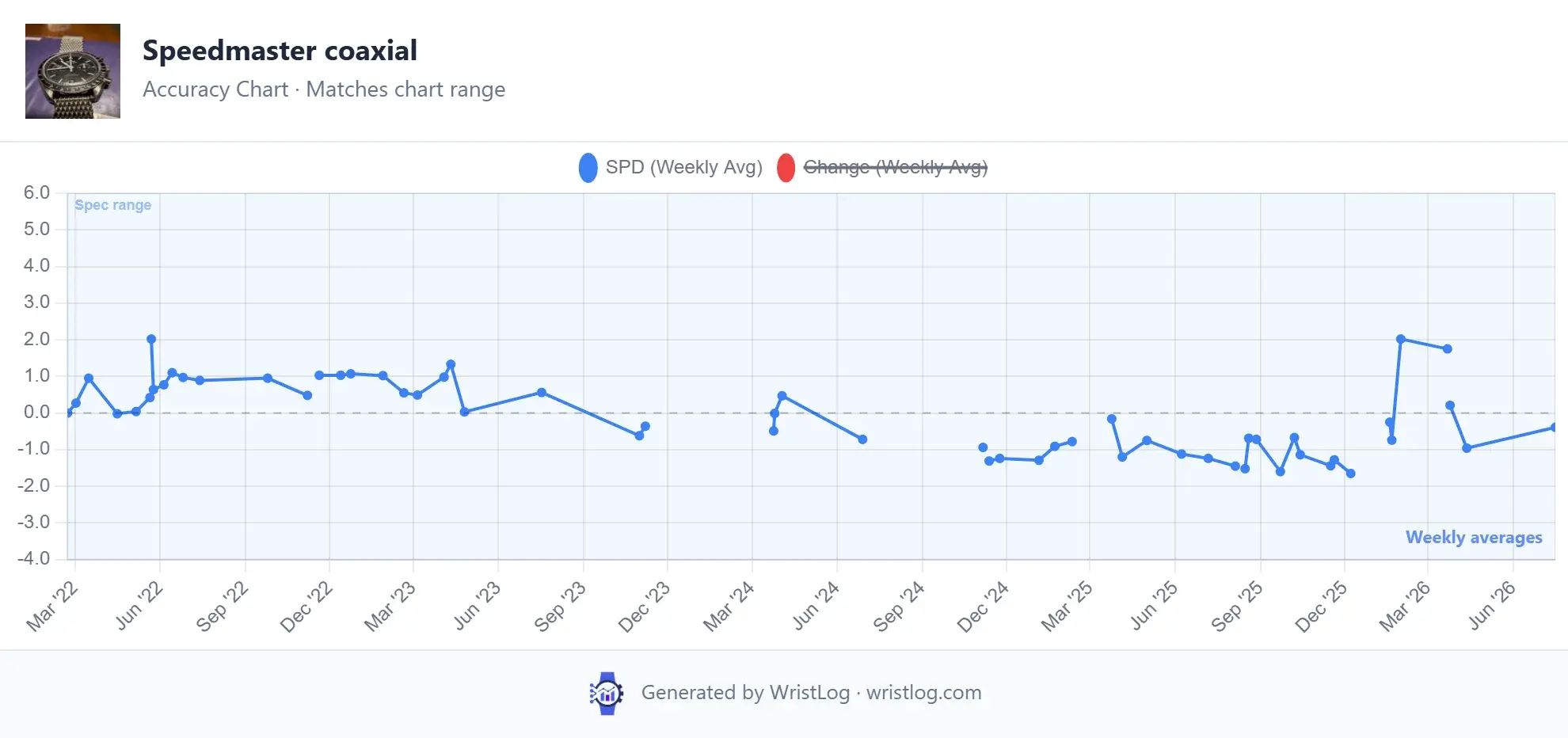
Here is how my non-Metas coaxial chrono has been running for the last four years; it's slowly drifting into negative territory, but still amazingly stable:
 
Posts
1,539
Likes
3,104
Late reply, but aren't the Metas watches supposed to run 0s/day to +5s/day, and not lose time? If it bothers you, I'd take it to an Omega dealer or boutique, and have them look into warranty service options for you.
Regarding timegrapher results, what counts is how it runs for you.

Here is how my non-Metas coaxial chrono has been running for the last four years; it's slowly drifting into negative territory, but still amazingly stable:

It's just not that simple.
 
Posts
4
Likes
1
Thanks again for all replies. Agreed, it doesn't seem that simple 😁. I have started wearing more and leaving in different positions when off wrist. I'll keep an eye on it and if not happy will be getting checked under warranty. Initial findings seems to more accurate worn than in watch winder.