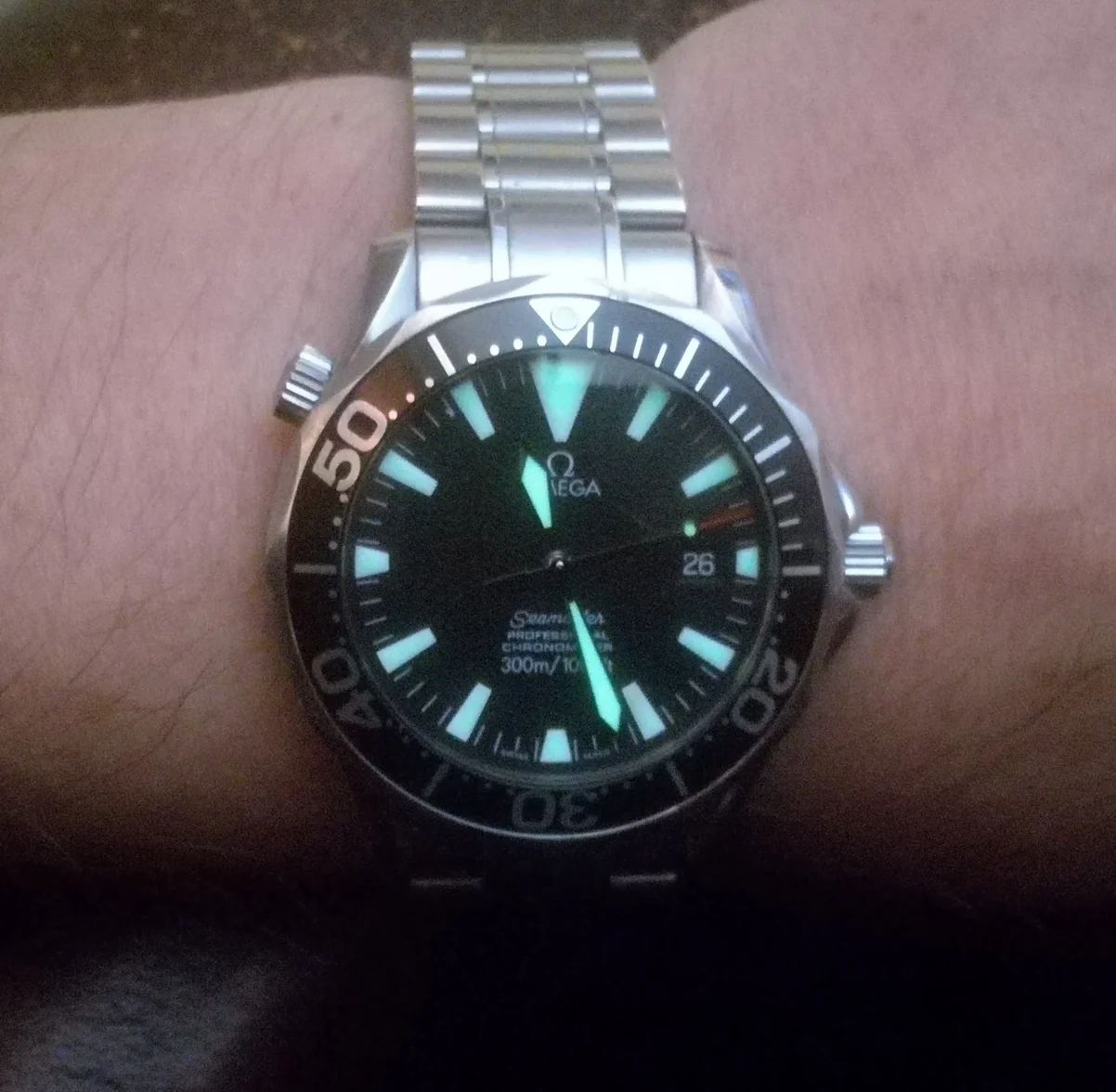
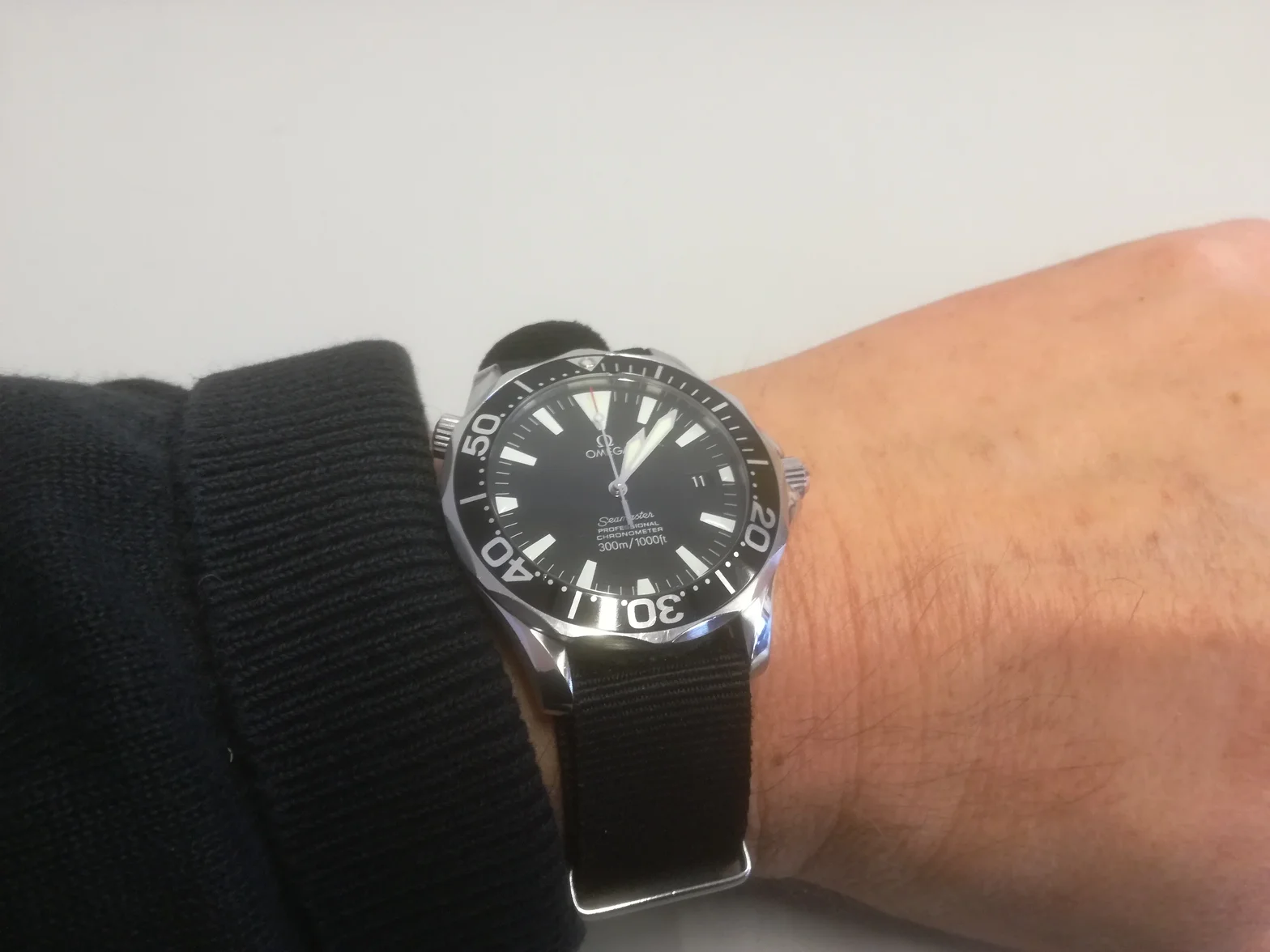
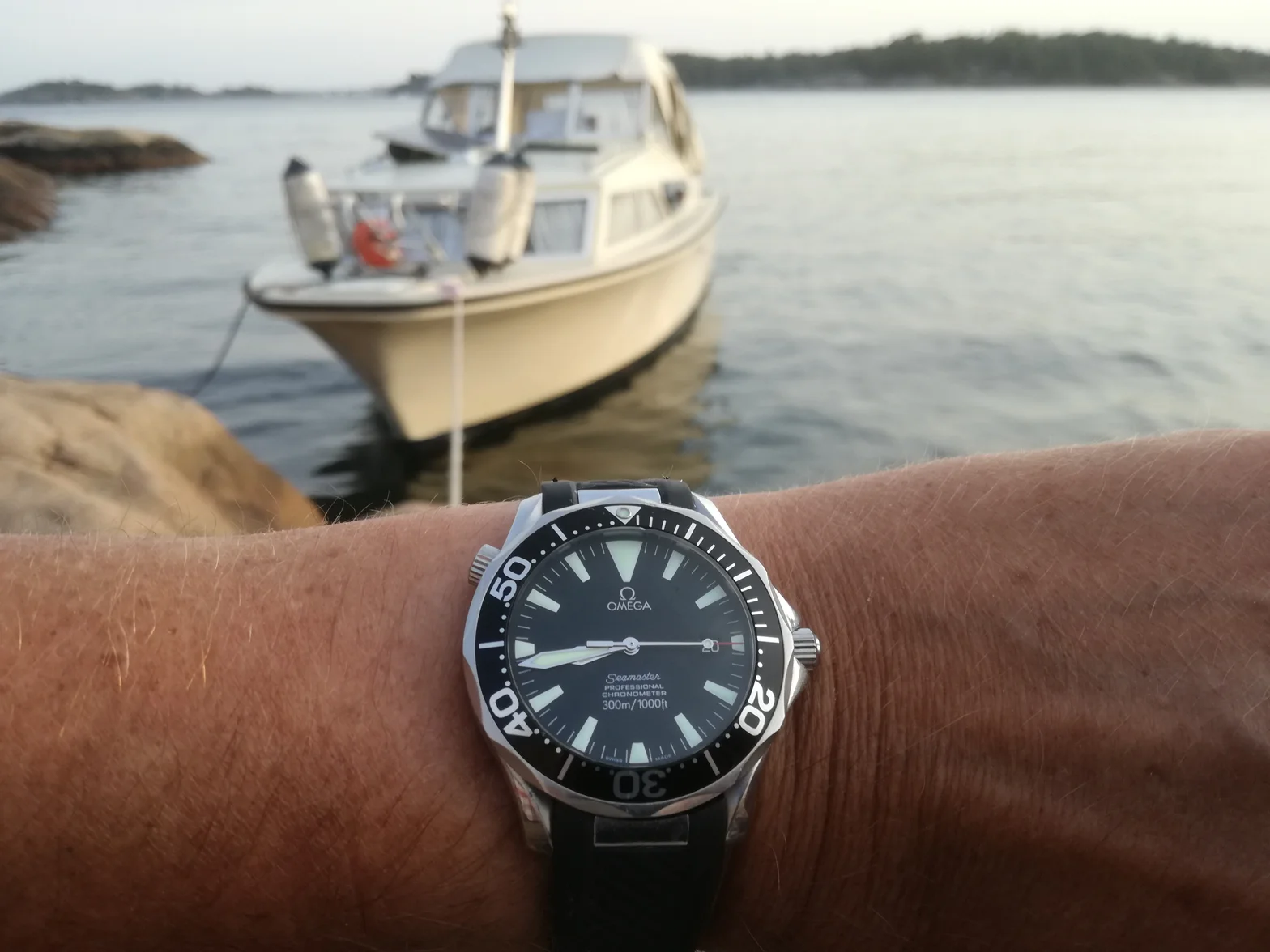
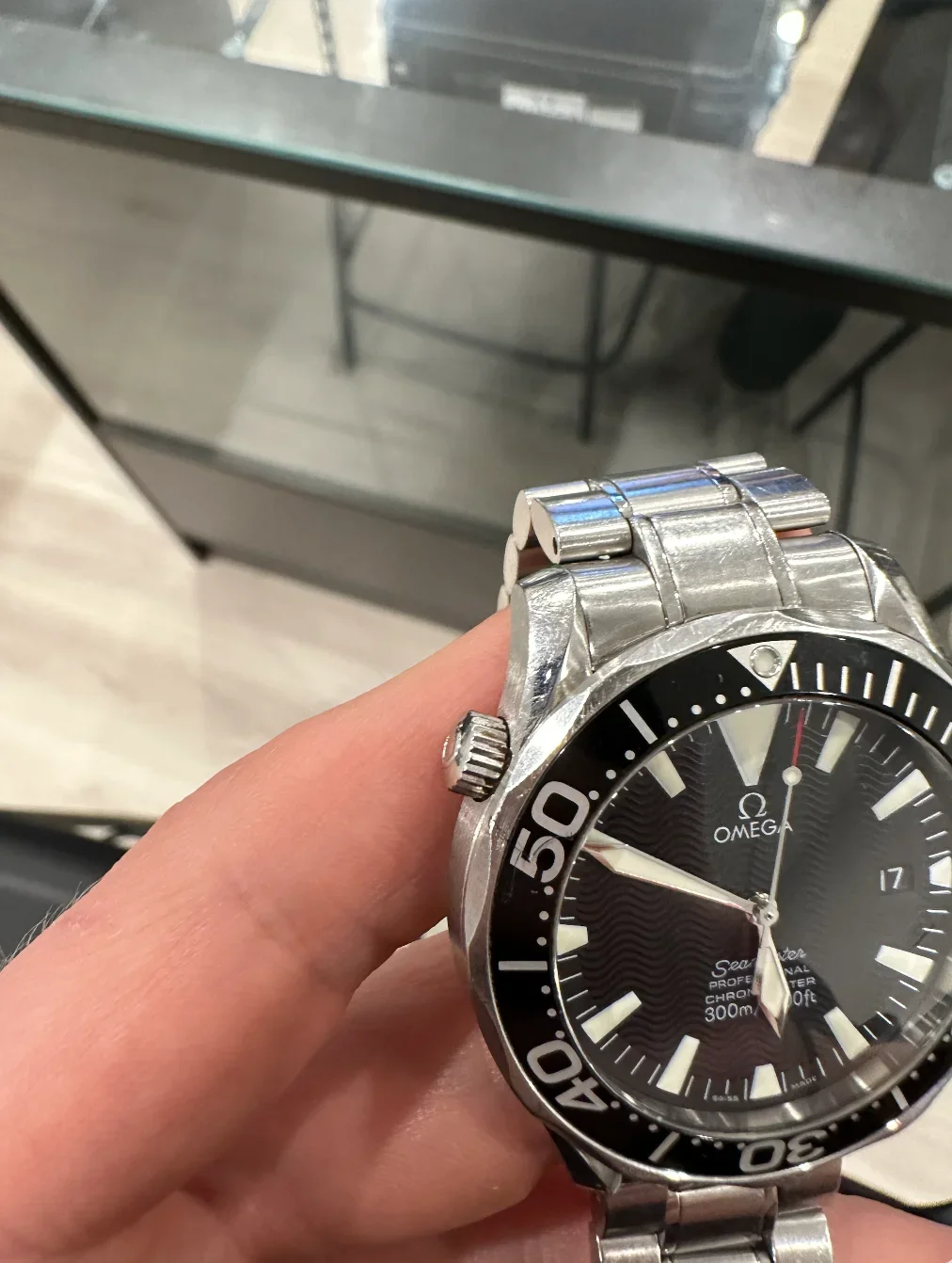
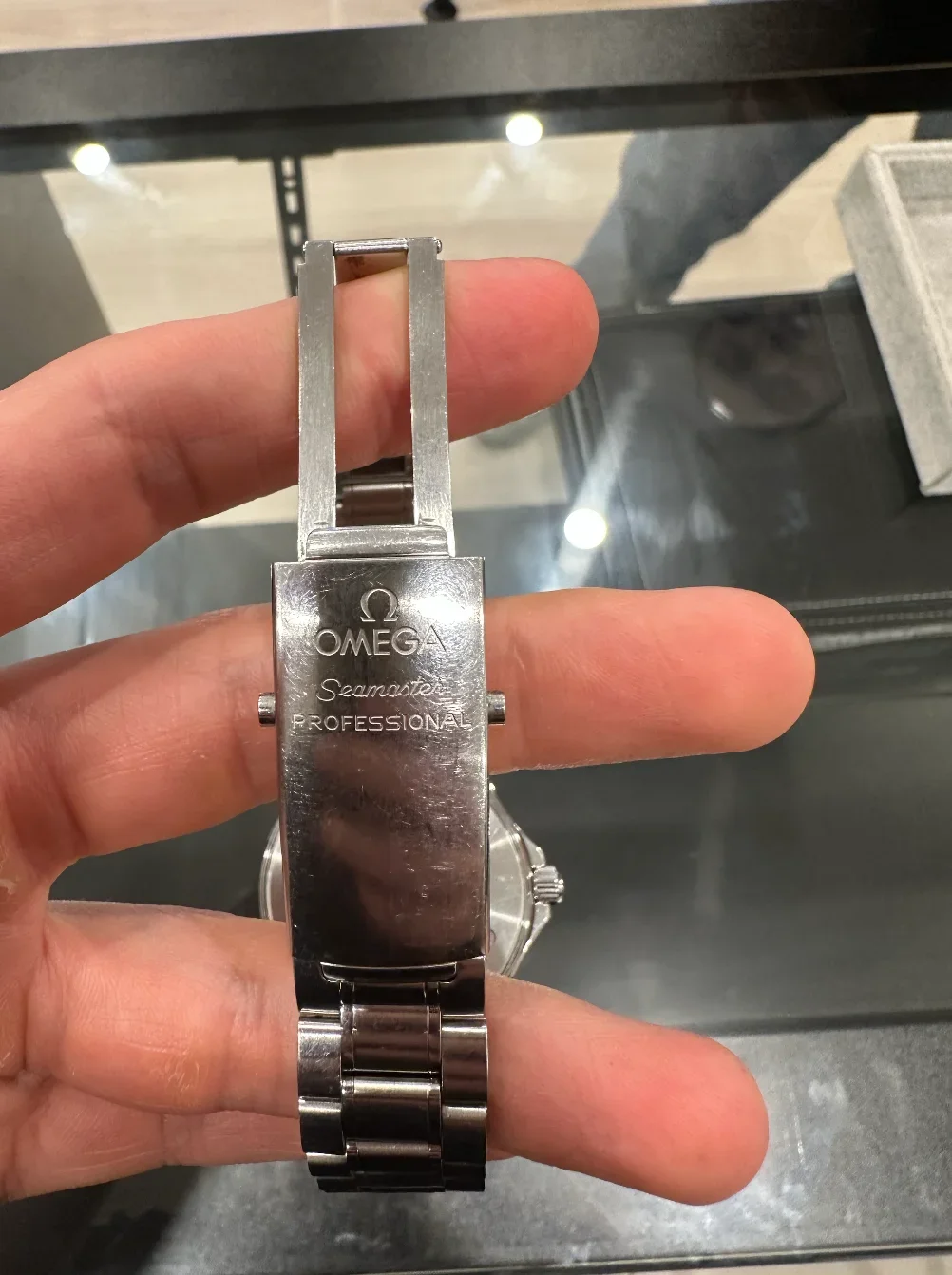
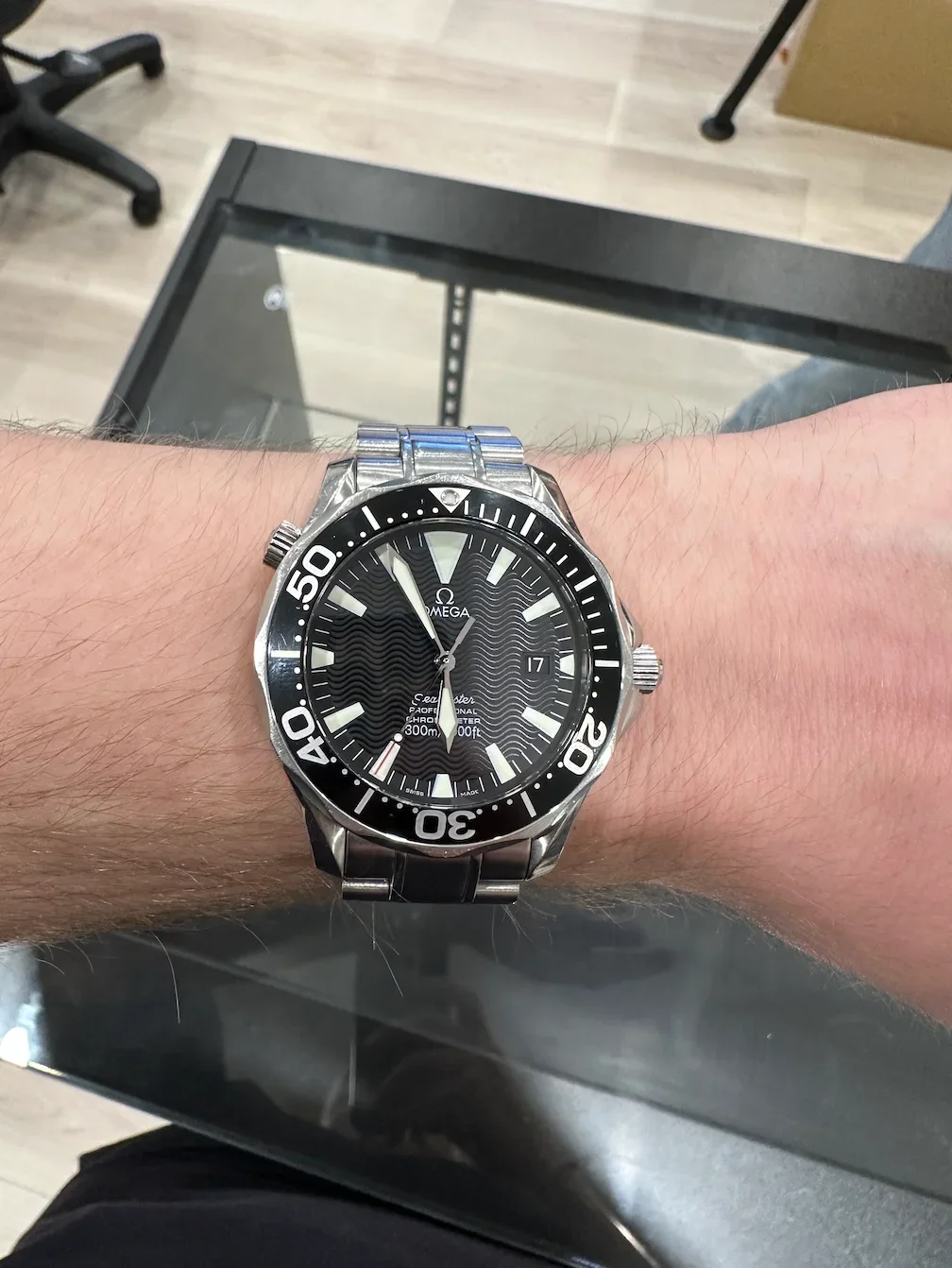
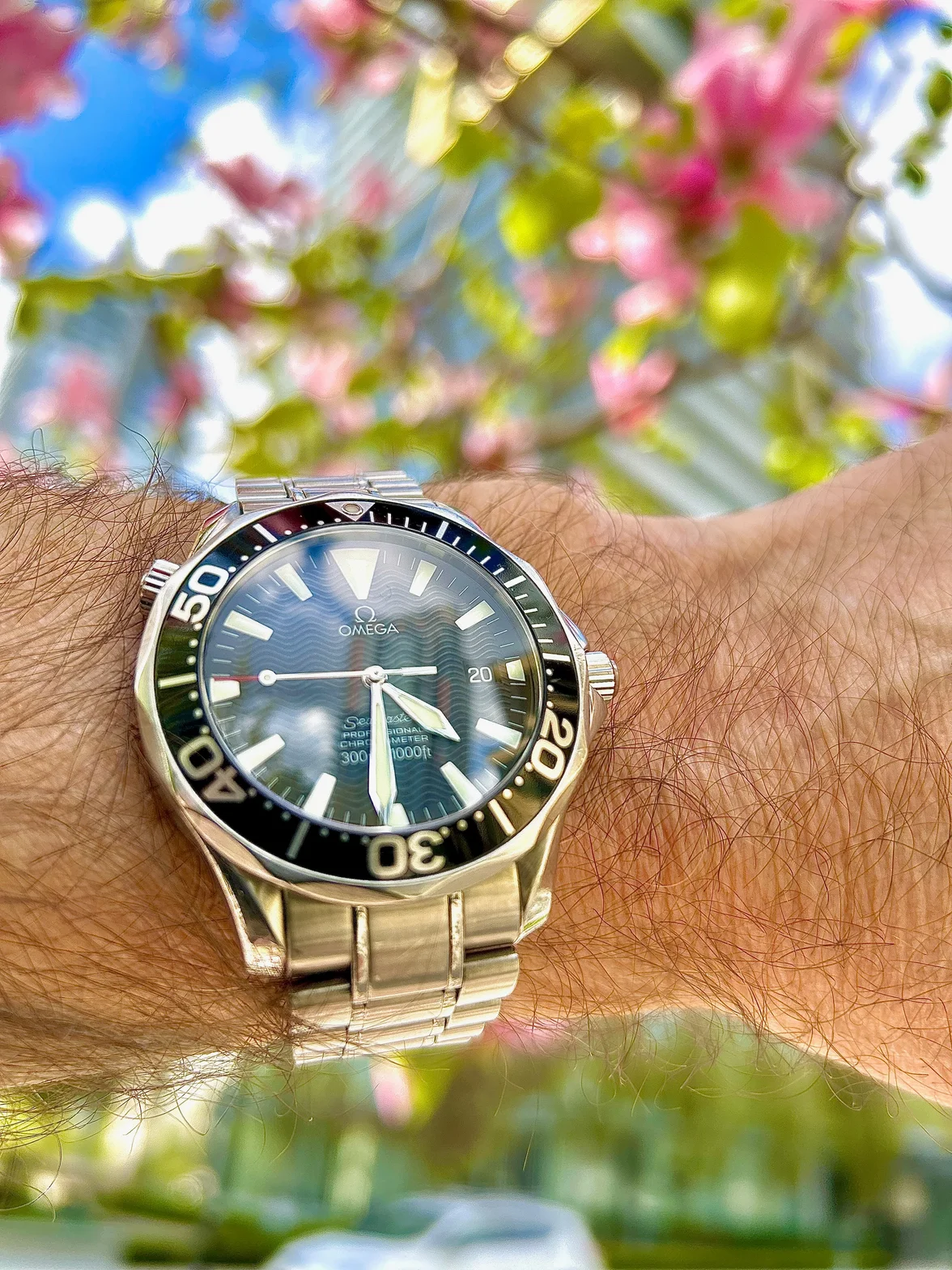
I know polishing is the big thing to look out for, so I’ve been searching far and wide and have finally found one that I believe is unpolished. The only downside is that it’s a private sale and doesn’t come with papers.
I’m not too fussed about papers for a 20-year-old watch, but my other option is to buy through a reputable dealer. The issue is that a lot of the examples I’ve seen from dealers look overly polished or have that overly shiny appearance.
Is there anything else you’d recommend asking the seller or looking out for before pulling the trigger?
I wouldn't worry too much about polished vs. unpolished for a 2254. If it is polished just make sure it's done well. The Seamaster case is much more forgiving than the older Rolex Submariner and GMT cases that had a thin bevel on the edges of the lugs. If a watchmaker uses the right tools (e.g., lapping discs for the flanks) you can get an amazingly good refinish. But some of the polish jobs are terrible. The brushed portions don't have consistent grain patterns, they have the wrong pattern (too coarse or too fine), or they've used a dremel to polish the shiny parts and have rounded off the edges. One of the big Japanese sellers on ebay uses a very coarse brushing pattern that does not look OEM. I can't remember which one but I know it when I see it.
Pay attention to the number of links in the bracelet. It really sucks to get a preowned watch and then realize it's too small, requiring you to buy more links. Omega links of this era are available from Omega/Swatch Group, but they still add about $60 per link to the cost of the watch and it can take weeks for them to arrive.
As noted by padders, unless the watch has been serviced in the last few years, calculate the service cost to the price of the watch. In the U.S. right now the service cost from Omega/Swatch Group is $800 for a standard automatic watch. With that you will get a cleaned and lubricated movement, they will replace any worn internal movement parts, replace the hands, crowns, and gaskets, pressure check the case, and refinish the case and bracelet. You also get a small red storage box. What you will not get is a new dial or a new bezel. New bezels are about $330 and new dials are about $500. For that reason I would make sure the dial looks good. No damage, no flaking lume. And make sure you're ok with the condition of the bezel unless you're willing to spend around $330 for a new one. Another thing to be mindful of is an aftermarket bezel insert. They are common and will hurt the value of the watch. The tell is ususally the lume pip, but you can also sometimes tell from the fonts or print spacing.
Also, with respect to service, if a seller says the watch was recently serviced but have no proof of it--you can be certain it was not recently serviced. I would also ask for a photo of the watch on a timegrapher. Big sellers no doubt have them and could provide it if you ask. The reason they wouldn't want to do this is if the watch is in bad shape mechanically. Private sellers probably don't have a timegrapher but they should be able to tell you how the watch is running on wrisit (e.g. it's running -20 seconds a day, or +4 seconds a day). It's not perfect, but it will tell you if a watch needed immediate intervention.
Box and papers? That's up to you. I like them when I can get them but I personally don't care. I really only like to have them if I resell a watch since those will fetch more money and you will have a larger audience to buy your watch since some people will only buy watches with box and papers. For a watch that's 25 years old and from an era when box and papers was not a big deal, you are going to find a lot more watches without than with. I'd much rather get a good watch with no box and papers than a poor example with box and papers.
If you do your homework and find one you're willing to buy, feel free to post pics here (or a link). There are several members here who are very knowledgable and can steer you in the right direction.
And if you have more questions, fire away.
Edit - By the way, I love this era of Omega watches. My every day watch is a 2531.80 Seamaster 300m (the Bond watch) made in 2000. I had it serviced last year including new hands, crowns, gaskets, bezel, dial, and a refinished case and bracelet. For just under $1,500 I got basically a new watch back. Combined with the purchase price of the watch, for less than $4,000 I got a new watch--about half the price of what Omega is charging for their current models. And my watch is smaller and thinner than the current generation (which is a major plus for me). I will also say the dial replacement was, in hindsight, not necessary. But I thought I might as well go all in on a new looking watch since it was intended to be my daily watch (and is). And I can resell the old dial (which is in excellent shape) if I ever get around to it.
The one at Bobswatches looks pretty decent, though you’d probably need to see more photos. (And maybe ask them to come down on the price.)
Since it’s just an ETA movement in these—not a co-axial—you probably don’t need to pay to send it to Omega. Any competent watchmaker should be able to handle this, I’d think, which may save you a lot of money and waiting time. (Not sure if Bobswatches offers a service at point of sale—never dealt with them.)
As noted by padders, unless the watch has been serviced in the last few years, calculate the service cost to the price of the watch. In the U.S. right now the service cost from Omega/Swatch Group is $800 for a standard automatic watch. With that you will get a cleaned and lubricated movement, they will replace any worn internal movement parts, replace the hands, crowns, and gaskets, pressure check the case, and refinish the case and bracelet. You also get a small red storage box. What you will not get is a new dial or a new bezel. New bezels are about $330 and new dials are about $500. For that reason I would make sure the dial looks good. No damage, no flaking lume. And make sure you're ok with the condition of the bezel unless you're willing to spend around $330 for a new one. Another thing to be mindful of is an aftermarket bezel insert. They are common and will hurt the value of the watch. The tell is ususally the lume pip, but you can also sometimes tell from the fonts or print spacing.
Good to know that parts like the hands and bezel can be replaced. Those seem to be some of the most commonly worn parts when trying to find one in decent condition.
Edit - By the way, I love this era of Omega watches. My every day watch is a 2531.80 Seamaster 300m (the Bond watch) made in 2000. I had it serviced last year including new hands, crowns, gaskets, bezel, dial, and a refinished case and bracelet. For just under $1,500 I got basically a new watch back. Combined with the purchase price of the watch, for less than $4,000 I got a new watch--about half the price of what Omega is charging for their current models. And my watch is smaller and thinner than the current generation (which is a major plus for me). I will also say the dial replacement was, in hindsight, not necessary. But I thought I might as well go all in on a new looking watch since it was intended to be my daily watch (and is). And I can resell the old dial (which is in excellent shape) if I ever get around to it.
I actually tried on a 2531.80 recently, and it’s such an excellent watch with so much character. I was debating between that and the 2254, but I already have a blue Aquaracer that was a gift, so I didn’t want to double up on another blue-dial diver.
The one at Bobswatches looks pretty decent, though you’d probably need to see more photos. (And maybe ask them to come down on the price.)
Since it’s just an ETA movement in these—not a co-axial—you probably don’t need to pay to send it to Omega. Any competent watchmaker should be able to handle this, I’d think, which may save you a lot of money and waiting time. (Not sure if Bobswatches offers a service at point of sale—never dealt with them.)
I think the ETA movement is a big part of the 2254’s appeal, too. It’s reliable, straightforward to service, and relatively easy to repair.
Welcome to Omega Forums @WatchFrank ! Good first post about a great watch.
The only use you have for papers (and box) are when you sell it, and you are never going to sell the 2254, are you?
There is plenty good advice above, so the only thing this tread needs are pics.
I tried one on recently at a dealer, and the first thing I noticed was just how shiny it looked. I’m not sure if they’d applied something to the case, but I was under the impression that the 2254 was supposed to have a predominantly brushed, matte finish. It almost looked like it had been polished (despite them saying it was completely unpolished), so I was curious whether that was normal or if something had been done to it.
We are glad you like it here on OF, its the best forum i have been on. Looking forward to your posts in the future.
The Seamaster in your pictures looks like it has sharp corners, they probably just wiped it with a cloth like Cape Cod or something. The only brushed parts of a Seamaster case is the sides. The rest is glorius polished stainless steel. Remember Mr. Bond its supposed to be as good for fighting bad guys under water, as seducing women in the casino. 😉
The one at Bobswatches looks pretty decent, though you’d probably need to see more photos. (And maybe ask them to come down on the price.)
Since it’s just an ETA movement in these—not a co-axial—you probably don’t need to pay to send it to Omega. Any competent watchmaker should be able to handle this, I’d think, which may save you a lot of money and waiting time. (Not sure if Bobswatches offers a service at point of sale—never dealt with them.)
Just a small point of clarification. The Omega Cal. 1120 is based on an ETA movement, but it has some differences that are relevant during a service. Several parts in the 1120 are not compatible with the 2892A2, so access to Omega parts will be important.