US import duty

Posts
551
Likes
2,596
We pay no custom duty in Singapore, but we have to pay 8% GST(VAT). And it is going to be 9% next year.
 
Posts
590
Likes
4,935
In New Zealand we pay 15% GST (VAT) but only have to pay duties on products over $1000 NZD (roughly $600USD). This has been pretty handy when purchasing watches from Japan as opposed to when I lived in Germany where they charged duty on anything over €23.

The absurd thing about the German system was having to front up to the customs office and pay for birthday gifts which friends and family had sent me... it always put a dampner on the occasion.
Edited:
 
Posts
10,751
Likes
52,789
I bought a watch from Singapore. I believe in the US we pay custom fees or whatever on anything over 800usd ( correct me if I’m wrong I don’t order a lot overseas) anyway I was in a rush to get home meet DHL as I received no notice on the fees due. He just placed the package in my hand and said have a nice day. Seller listed the watch at 300usd in value.

I did not request or know that was taking place. I don’t know how that would have impacted things if the delivery got lost. That probably goes on a lot. I ordered some very expensive supplements from France for long Covid and they did the same thing. Mind you both were paid by credit card so I had some protections if they didn’t come.
 
Posts
142
Likes
200
In germany before Corona i had to go to the customs office (30km's away - one way) every time to pick up the orders i made (and present paypal and invoice there). Now most of the time i can do all that stuff online - luckily! Still annoying to pay such a high VAT on watches, as it makes good deals often too expensive. As a watch collector i should move to the USA 😁
 
Posts
5,980
Likes
28,596
In germany before Corona i had to go to the customs office (30km's away - one way) every time to pick up the orders i made (and present paypal and invoice there). Now most of the time i can do all that stuff online - luckily! Still annoying to pay such a high VAT on watches, as it makes good deals often too expensive. As a watch collector i should move to the USA 😁
Our savings are in the healthcare costs.📖
 
Posts
1,451
Likes
6,640
Hi team. Sorry if this is the wrong thread, but it seems like you folks know this topic well enough to advise.

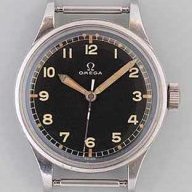
I recently sent a 2254 to Omega directly in Bienne (from the US) for restoration. Upon return, I received a modest bill (about $80) from Fedex. Apparently CBP bills the "importer"; Fedex. Fedex simply pays CBP the import fee, marks it up nominally and charges me.

My question is, is it legitimate for US Customs to charge me an import duty on a watch I already own? I've reached out to them through their on-line "Contact" but the automated response indicates they could take 7-10 days to reply. I'm just wondering if anyone knows how this is going to play out. Given it is the US Government, my expectations are absolutely as low as they can get. Kind of just wondering...
 
Posts
3,554
Likes
7,591
I don´t know the rules/laws in the US but I know how it would work in my homecountry to avoid import VAT on the watch:

I must contact customs before I send out the watch to Switzerland and provide info about the watch and serial-number.
This is registered with the customs and when the watch comes back from Bienne I will only have to pay VAT for the costs of repair.
 
Posts
24,234
Likes
53,968
Hi team. Sorry if this is the wrong thread, but it seems like you folks know this topic well enough to advise.

I recently sent a 2254 to Omega directly in Bienne (from the US) for restoration. Upon return, I received a modest bill (about $80) from Fedex. Apparently CBP bills the "importer"; Fedex. Fedex simply pays CBP the import fee, marks it up nominally and charges me.

My question is, is it legitimate for US Customs to charge me an import duty on a watch I already own? I've reached out to them through their on-line "Contact" but the automated response indicates they could take 7-10 days to reply. I'm just wondering if anyone knows how this is going to play out. Given it is the US Government, my expectations are absolutely as low as they can get. Kind of just wondering...
I researched this at one point, but never actually attempted it because it seems like a huge pain in the neck, and unlikely to work.

In principle, there is a CBP form that must be filed in advance to indicate that the watch is being sent for repair/improvement. Then upon return, the sender must include that form and also fill out a related form indicating the increase in value. If that is done correctly, you should only pay customs duty on the increased value. Without these forms, the CBP obviously has no way to verify that you already own the watch (anyone could claim that), and it is correct for them to charge you duty. I doubt you can fix it retroactively, but let us know if you are able to do so.

P.S. Why didn't you just send the watch to the Swatch service center in the US?
Edited:
 
Posts
29,667
Likes
76,824
If an item is exported for repairs, any duties or taxes owed are on the value added while it was out of the country, so in this case, the value of the service.
 
Posts
2,162
Likes
1,350
Hi team. Sorry if this is the wrong thread, but it seems like you folks know this topic well enough to advise.

I recently sent a 2254 to Omega directly in Bienne (from the US) for restoration. Upon return, I received a modest bill (about $80) from Fedex. Apparently CBP bills the "importer"; Fedex. Fedex simply pays CBP the import fee, marks it up nominally and charges me.

My question is, is it legitimate for US Customs to charge me an import duty on a watch I already own? I've reached out to them through their on-line "Contact" but the automated response indicates they could take 7-10 days to reply. I'm just wondering if anyone knows how this is going to play out. Given it is the US Government, my expectations are absolutely as low as they can get. Kind of just wondering...

If anything shipped out of the country and to be returned. You should always have the sender mark the packages as "USA goods Returned" This way your not being charged for something you own.

You could be charged duties or taxes on the repair cost though
 
Posts
1,451
Likes
6,640
Thanks for all the replies.

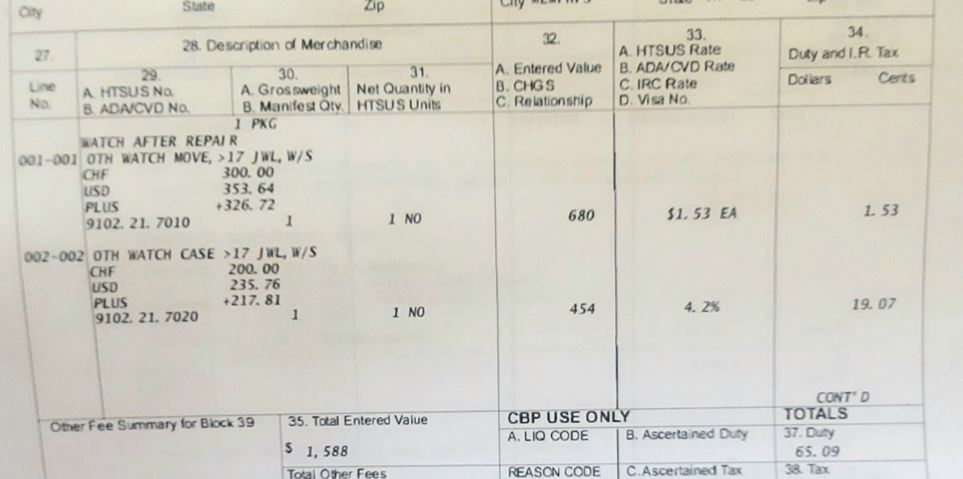
On the CBP Form 7501 (which they assign to Fedex), they actually indicate "watch after repair". Seems like they knew it was sent and was being returned, which makes it a little more infuriating. Here is a snip of the document:


As for why I sent it to Bienne; I had a terrific experience with a vintage piece I sent in and thought the same team would be working on this one. It went to the standard repair crew (which I have no reason to think did anything other than a good job). When that watch was returned, there was no Customs drama. I guess I was just lucky since that watch is more valuable (at least to me).
 
Posts
2,640
Likes
3,093
30% in Turkey, you can't import anything over 150 euros, and half the time, they don't even accept you to pay the 30% and send the items back anyway

The good part is postage has been reliable, no lost packages, it goes back slowly
 
Posts
9,732
Likes
54,420
If you’re importing into the U.S., it can be advantageous to have the seller ship via EMS rather than via FedEx, UPS, DHL, etc. It takes a little longer, but it’s reliable and you avoid the ridiculous administrative and storage fees that the private couriers add to the bill.
 
Posts
13,309
Likes
18,419
If you’re importing into the U.S., it can be advantageous to have the seller ship via EMS rather than via FedEx, UPS, DHL, etc. It takes a little longer, but it’s reliable and you avoid the ridiculous administrative and storage fees that the private couriers add to the bill.
I think that works everywhere except Germany. In Germany, DHL is the German post office, so guess who is going to take it the last mile in the U.S.
gatorcpa
 
Posts
9,732
Likes
54,420
I think that works everywhere except Germany. In Germany, DHL is the German post office, so guess who is going to take it the last mile in the U.S.
gatorcpa
True. I’ve imported from Germany and DHL has it locked up tight.
 
Posts
1,451
Likes
6,640
I've had a couple of DHL snafus from the UK. Their problem where I live is who they get to take it the last leg (it's not DHL). Whoever they use are real scrub leaguers.
 
Posts
1,451
Likes
6,640
Get a load of this bullshite reply from CBP (the cliff notes version is "Shut up and pay taxes when we say so."). Bear in mind, I sent a simple request to have an unwarranted duty rescinded or an explanation for why I was being taxed on an item I already own:

profile_mask2.png
CBP Information Center <[email protected]>
8:27 AM (9 minutes ago)
cleardot.gif
cleardot.gif
cleardot.gif
to me
cleardot.gif


April 4, 2024

Thank you for contacting the U.S. Customs and Border Protection (CBP) Information Center.

Importation can be complicated. CBP highly encourages those interested in importing something or becoming a commercial importer to read the “Importing into the United States” guide, found at https://www.cbp.gov/document/publications/importing-united-states.

The CBP Centers of Excellence and Expertise (CEE) can assist importers with advisory duty rates and U.S. Harmonized Tariff Schedule (HTS) classifications. These centers are strategically located in ports of entry throughout the United States. Contact information for individual CEE offices is available at https://www.cbp.gov/trade/centers-excellence-and-expertise-information/cee-directory.

A CBP officer at the POE can provide advisory duty rates and general information on importing and Form 3299 - Declaration of Free Entry of Unaccompanied Articles | U.S. Customs and Border Protection (cbp.gov).

If you wish to see the complete listing of the HTS, please visit the U.S. International Trade Commission website at https://hts.usitc.gov/current.

One of the first steps to becoming an importer is to file a CBP Form 5106 Create/Update Importer Identity Form. This registers you as the Importer of Record for any shipment you import. The CBP Form 5106 is accessible at https://www.cbp.gov/document/forms/form-5106-importer-id-input-record. Submit the Form 5106 with the Entry Division of the port where you will import goods or at your nearest port of entry.

Bonds are often required to import goods. Importers who are required under regulation to have a bond on file with CBP must first obtain (post) the bond with a U.S. Department of Treasury Approved Surety. Please see https://www.cbp.gov/document/forms/surety-names-and-codes-0 for the CBP listing of approved sureties. The importer must file the bond with CBP after posting with the approved surety.

Filing a bond with CBP requires completing CBP Form 301 Customs Bond and submitting it directly to the CBP Surety Bonds and Accounts Team via email at [email protected]. The CBP Form 301 is accessible at https://www.cbp.gov/document/forms/form-301-customs-bond

For more information, please see our frequently asked questions about bonds at https://help.cbp.gov/s/global-search/bonds.

Most commercial importers use a licensed customs broker, although this is not a requirement. Licensed customs brokers offer services for a fee to file customs entries for shipments imported on the behalf of their clients. These professionals' study for and must pass the Licensed Customs Broker Examination before the CBP Broker Management Division will issue a license. Be aware that the Importer of Record is always ultimately responsible for knowing CBP requirements and for ensuring that importation complies with all federal rules and regulations. The licensed customs broker can save an importer from making costly mistakes by ensuring that all required import documents are properly completed and submitted to CBP timely. A listing of CBP licensed customs brokers is available at https://www.cbp.gov/contact/find-broker-by-port.

Individuals moving to the United States may also need to bring a vehicle. A vehicle must be imported with CBP to register it in the United States. For more information, please visit https://www.cbp.gov/trade/basic-import-export/importing-car.

Importing a vehicle into the United States requires the owner to declare permanent or temporary importation at the time of entry with the vehicle and present the following documentation to a CBP officer:

• Proof of ownership - An original Certificate of Title or a certified copy of the original
• Environmental Protection Agency (EPA) Form 3520-1 Declaration Form - Importation of Motor Vehicles and Motor Vehicle Engines Subject to Federal Air Pollution Standards, which can be downloaded at https://www.epa.gov/importing-vehic...1-declaration-form-importation-motor-vehicles.
• Department of Transportation (DOT) Form HS-7 Declaration Form - Importation of Motor Vehicles and Motor Vehicle Equipment Subject to Federal Motor Vehicle Safety, Bumper and Theft Prevention Standards, which can be downloaded at https://www.nhtsa.gov/sites/nhtsa.dot.gov/files/hs7_r.v.7.pdf.

Vehicles imported to the United States must have proof of compliance with both U.S. EPA and DOT standards (the standards vary based on the age of the vehicle). Proof of EPA compliance is generally the permanent manufacturer’s sticker on the engine of the vehicle stating in English that it complies with EPA standards. If the vehicle is at least 21 years old, there are no EPA compliance requirements upon importation. Proof of DOT compliance is generally the permanent manufacturer’s sticker on the driver's side door stating in English that it complies with DOT standards. A vehicle that is at least 25 years old can be lawfully imported into the United States without regard to whether it complies with all applicable DOT Federal Motor Vehicle Safety Standards. If one or both stickers are missing, the owner must obtain a letter from the manufacturer specifically providing the vehicle identification number, maker, model, year of manufacture and that the vehicle is fully compliant with U.S. EPA and DOT regulations.

Foreign-made vehicles (not including trucks or motorcycles) imported into the United States are generally dutiable at a 2.5 percent duty rate based on the purchase price or current Kelley Blue Book value. Most Canadian-made vehicles are duty-free.

Upon completion of the vehicle import, the importer will receive the signed and stamped CBP Form 7501. This Form 7501 is your proof of legal import into the United States and is generally required for registering and licensing the vehicle in the state where you reside.

A company requiring an update or correction in the Automated Commercial Environment (ACE) database regarding the company name, Internal Revenue Service (IRS) number, or address, must submit an official request to the Entry Division at the CBP port where the company regularly clears goods. The official request must be in writing on company letterhead, and should specify what is incorrect or has changed, and include a completed CBP Form 5106 Create/Update Importer Identity. CBP will update the company record in ACE after the Form 5106 is processed.

Form 5106 can be downloaded at https://www.cbp.gov/document/forms/form-5106-importer-id-input-record.

Further information regarding updates/corrections to company files in ACE is available by contacting the ACE Help Desk toll-free at (866) 530-4172 or by email at either [email protected] or [email protected].

A CBP officer at the POE can provide advisory duty rates and general information on importing and Form 3299.

Regulations and Rulings may, upon request, issue binding advance rulings and other legal decisions in connection with the importation of merchandise into the United States. Information on how to obtain a binding ruling is available at https://www.cbp.gov/trade/rulings

Thank you again for contacting our office.

Regards,

CBP Information Center
NOTE: The answers provided in this forum are for general information purposes only. Utilizing this forum does not constitute reasonable care under the Informed Compliance guidelines.

The CBP Information Center is open Monday through Friday from 8:30 a.m. until 5:00 p.m., Eastern Time. We are closed on U.S. federal holidays. Our toll-free line within the United States is (877) 227-5511. International callers can reach us during our hours of operation by dialing 00+1+202-325-8000.

Edited:
 
Posts
1,451
Likes
6,640
I responded to them (now I'm probably on another list...):

Nothing in this reply indicates you even read my comments.

I am not "an importer". I am a US citizen, who owned a watch and sent it abroad for service. CBP assessed a tax on the item as it (which I already own and paid taxes on) was returned to me.

If your obfuscated answer is "Shut up and continue to pay taxes for things you already paid taxes for." please say so.

This has been a worthless exchange, but it went exactly as I expected it to given the way the government works these days.
 
Posts
29,667
Likes
76,824
I am not "an importer".

You are though - anyone who imports something (brings an item into any country), is an importer.

Looking at the paperwork you posted above, was the final bill for the service what the value was? That is listed at $1,588. If that was the value of the service that Omega performed, then this is the value added while the item was out of the country, and what you would owe on.