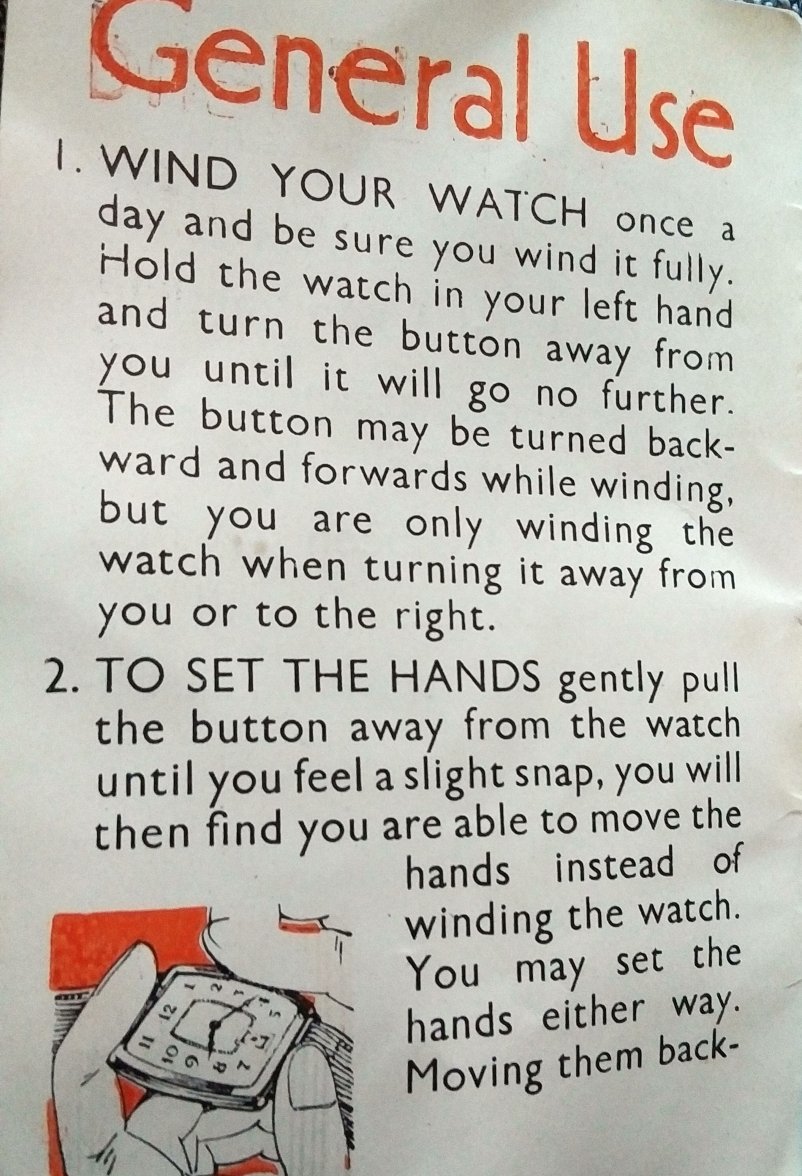
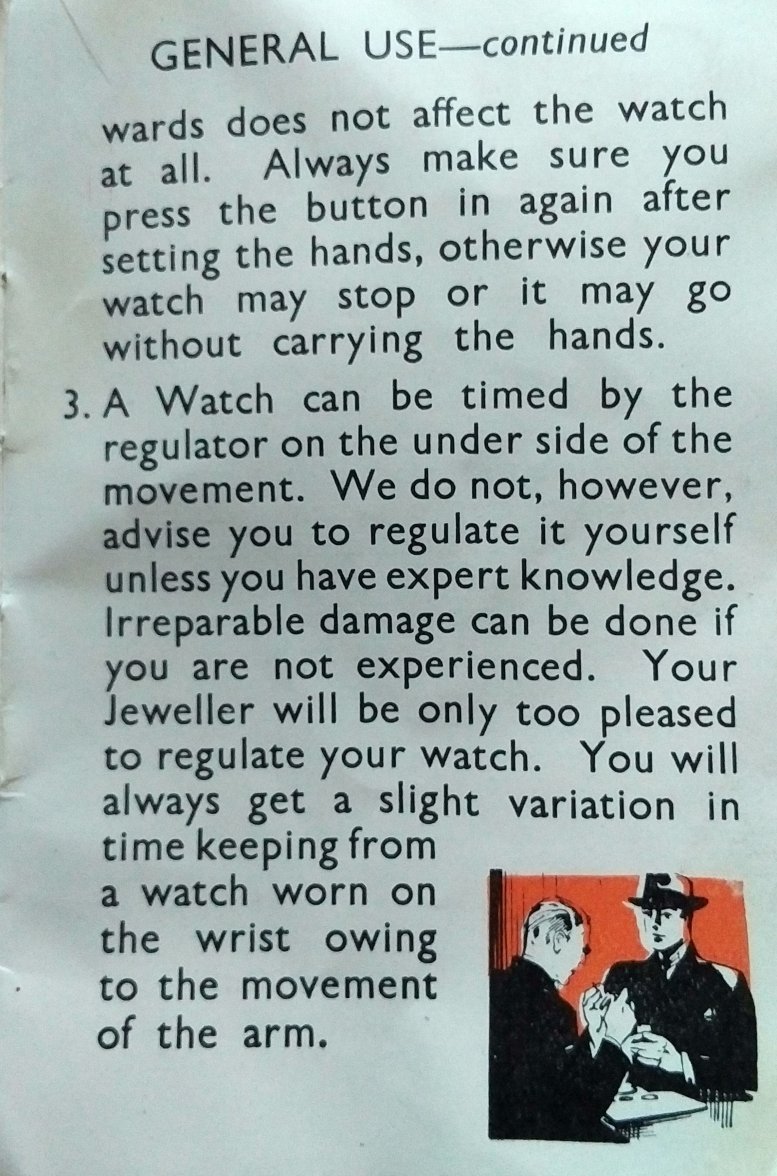
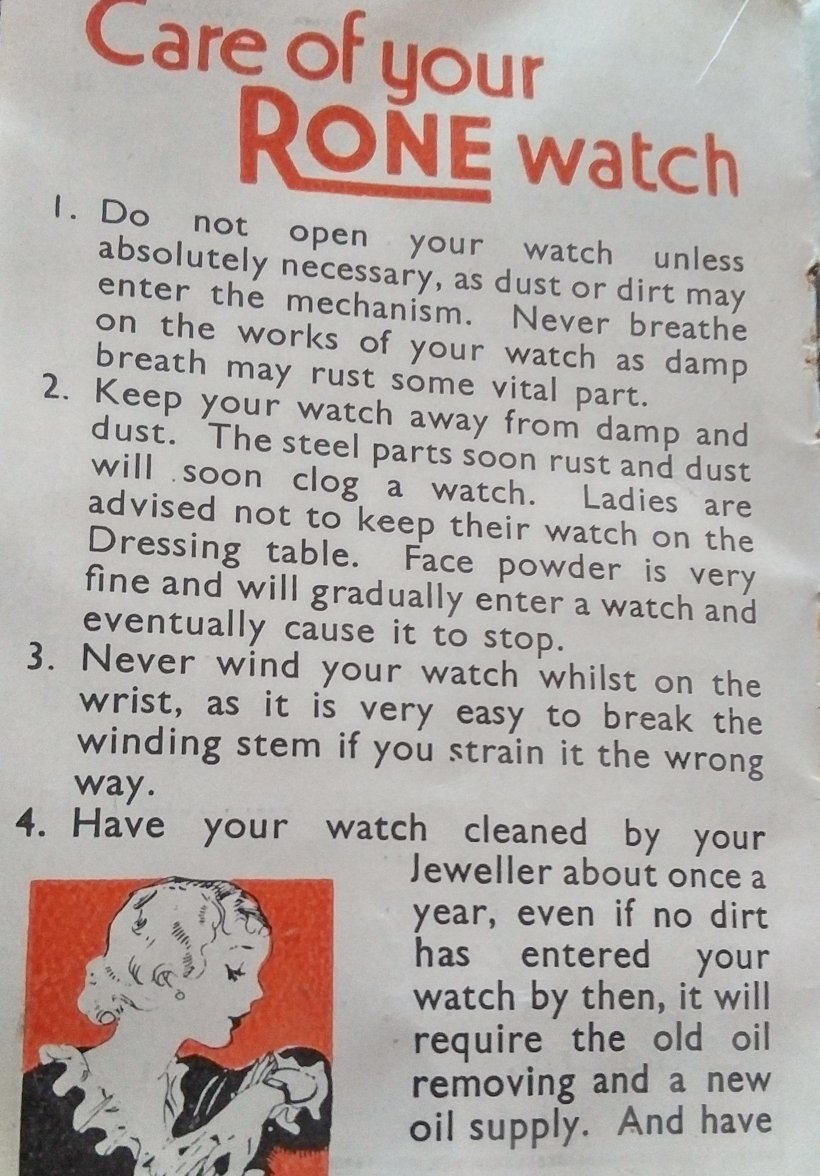
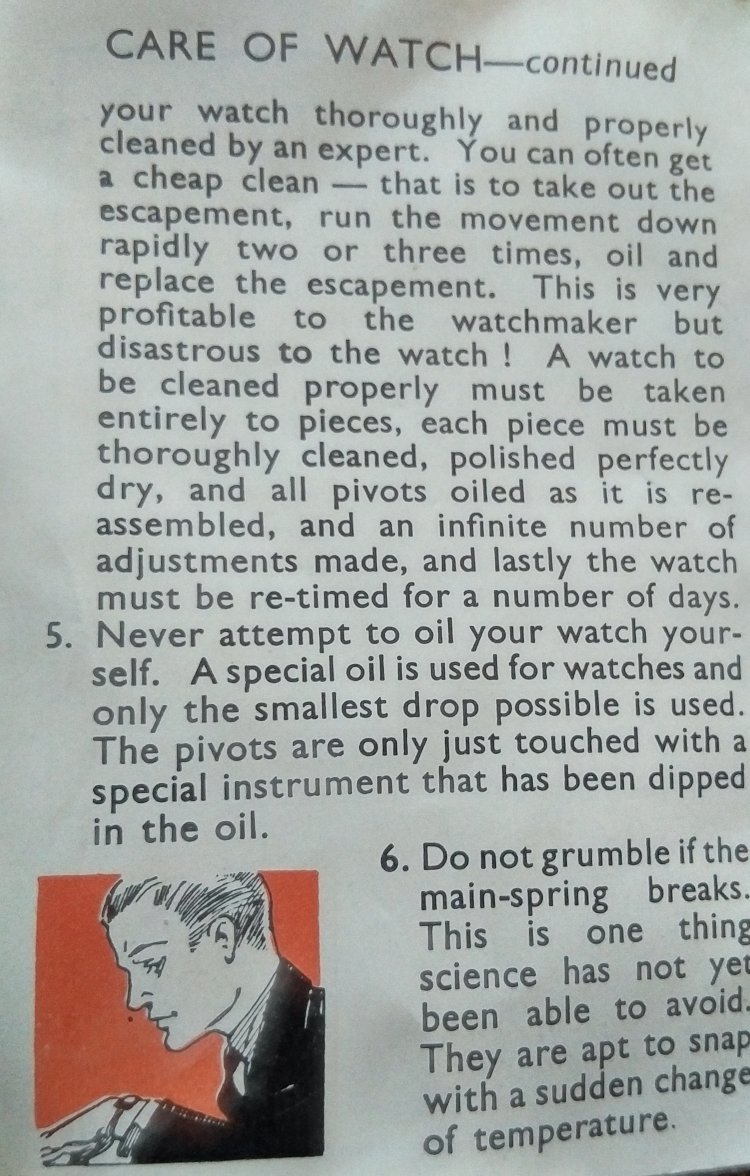
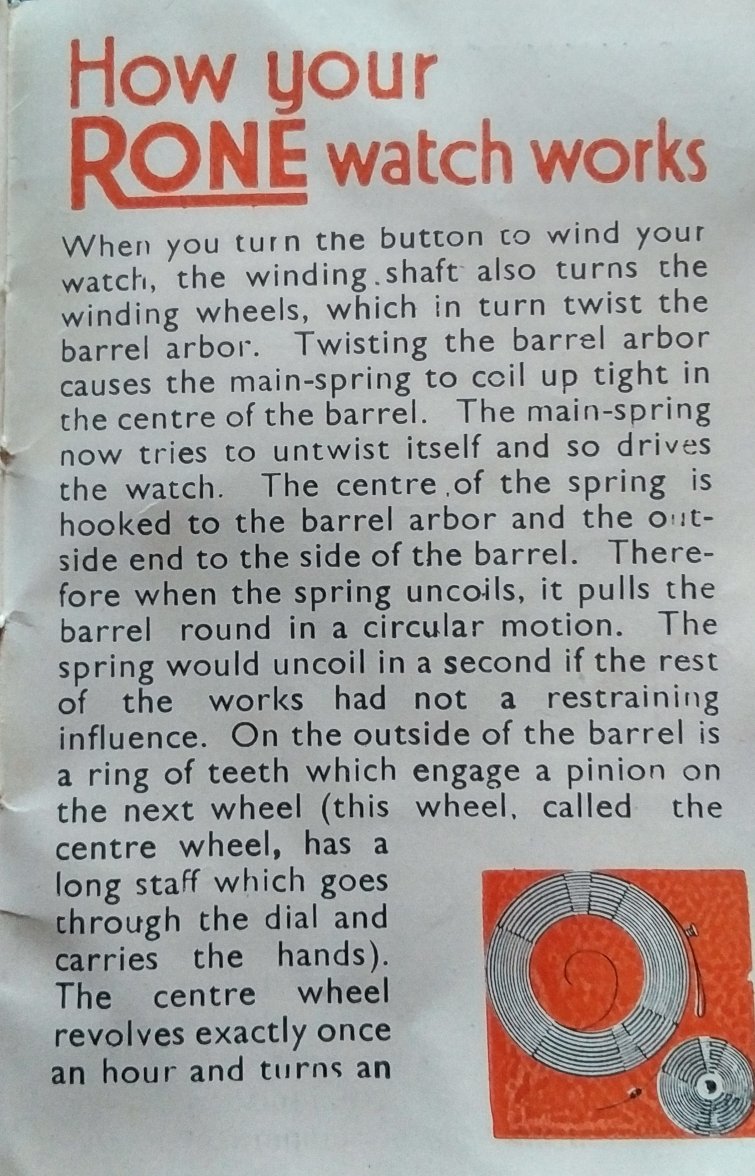
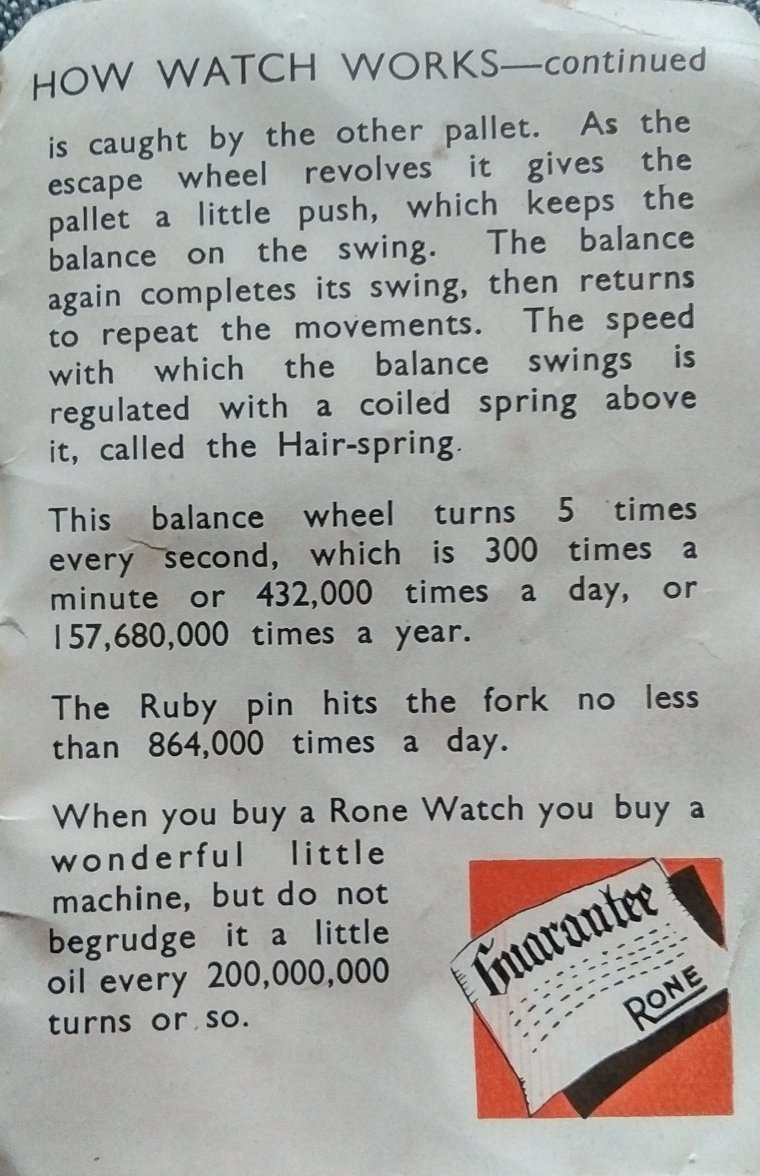
Taking Care of Your Watch

Posts
3,174
Likes
7,326
I can't help reading these things in the voice of Mr. Cholmondey-Warner .... and remember, ladies, face powder is very fine and will eventually enter a watch and cause it to stop. So, don't keep you watch on your dressing table!

 
Posts
17
Likes
42
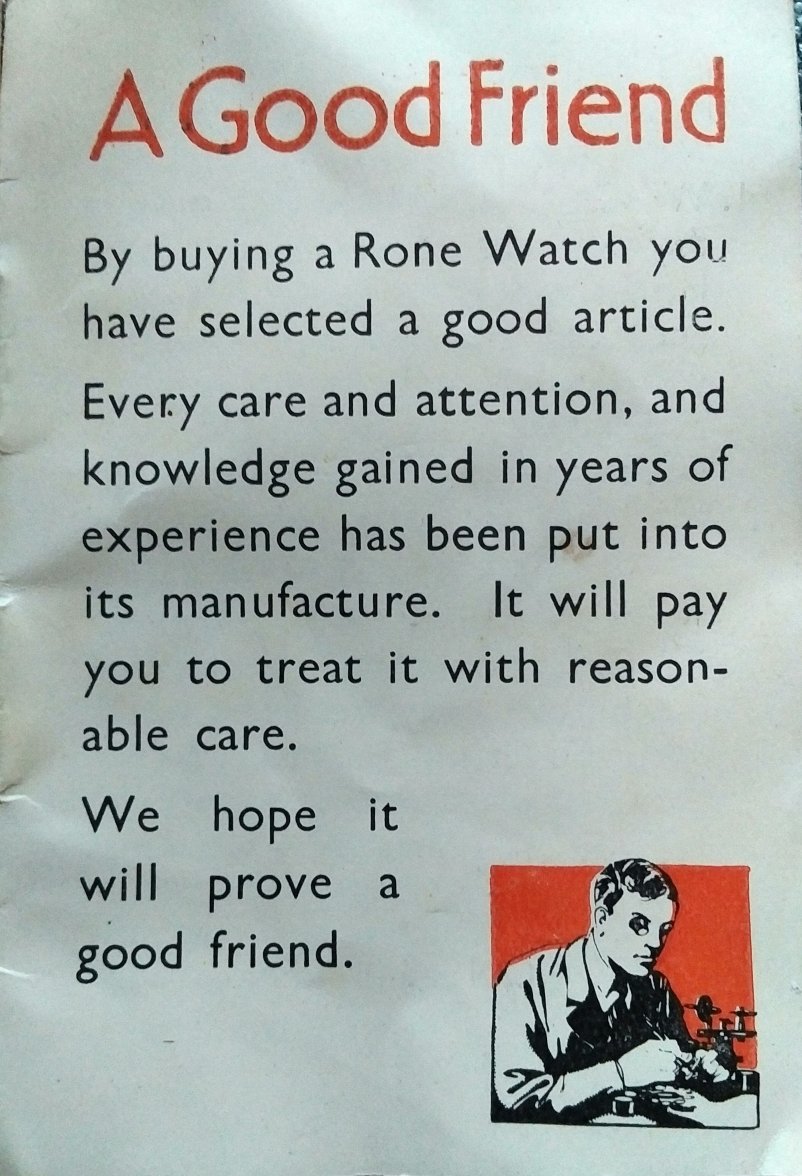
"...a wonderful little machine"
I wish all modern manuals were written in this style 馃榿
 
Posts
3,174
Likes
7,326
"...a wonderful little machine"
I wish all modern manuals were written in this style 馃榿
It's not just that, it's "a good article"
 
Posts
2,165
Likes
5,712
"Do not grumble if the main spring breaks!".... "Face powder is very fine and will enter a watch...!"馃榿
 
Posts
29,233
Likes
75,556
"Do not grumble if the main spring breaks!"

Maybe jimmyd13 can tell us if there is a date on that publication, but my guess is that is was before the advent of white alloy mainsprings. Back when blued steel springs were used, mainsprings breaking was a very regular occurrence as they were brittle. But the new "unbreakable" mainsprings have really made a huge difference with how long these mainsprings last:


Of course they aren't really unbreakable, but compared to the older springs it probably felt that way.

Also noted the advice to get the watch "cleaned" once a year, and they go on the talk about a proper service including full disassembly of the watch, clean, lube, adjusting. The use of natural oils back then meant that when the oil aged it would gum up and stop the watch, and it didn't take long for the oils to fail compared to modern watch oils. Modern oils just sort of dry up and mostly disappear, so they don't add enough drag to stop the watch. The do last longer, but it's a double edged sword because watches will run and run after the oils are gone, leading to pretty severe wear.

Living with mechanical watches was very different back then...

Cheers, Al

 
Posts
3,174
Likes
7,326
I completely agree - it seems a lot more helpful than this early 50s Omega manual (http://www.omega-fanatic.com/pages/omega-box-instructions1953-1954.php), which I'm guessing is around the same date.
I do enjoy reading these old things but I understood the "article" I quoted to refer to the watch, not the booklet. The maker seems to consider the watch a necessary item of wear that everyone must have just like any other "articles" of clothing.
 
Posts
17
Likes
42
I do enjoy reading these old things but I understood the "article" I quoted to refer to the watch, not the booklet. The maker seems to consider the watch a necessary item of wear that everyone must have just like any other "articles" of clothing.

Sorry - I misunderstood! I'm with the author, having something on my wrist just makes me feel...together 馃憤
 
Posts
312
Likes
130
Maybe jimmyd13 can tell us if there is a date on that publication, but my guess is that is was before the advent of white alloy mainsprings. Back when blued steel springs were used, mainsprings breaking was a very regular occurrence as they were brittle. But the new "unbreakable" mainsprings have really made a huge difference with how long these mainsprings last:


Of course they aren't really unbreakable, but compared to the older springs it probably felt that way.

Also noted the advice to get the watch "cleaned" once a year, and they go on the talk about a proper service including full disassembly of the watch, clean, lube, adjusting. The use of natural oils back then meant that when the oil aged it would gum up and stop the watch, and it didn't take long for the oils to fail compared to modern watch oils. Modern oils just sort of dry up and mostly disappear, so they don't add enough drag to stop the watch. The do last longer, but it's a double edged sword because watches will run and run after the oils are gone, leading to pretty severe wear.

Living with mechanical watches was very different back then...

Cheers, Al
I've only had one broken mainspring in my life and that was on a newish Invicta, (go figure.) It's the only one I ever bought.