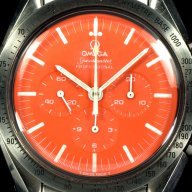
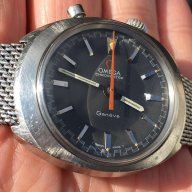
‘What’s that officer? It’s unusual for people to wear 3 watches per limb?’
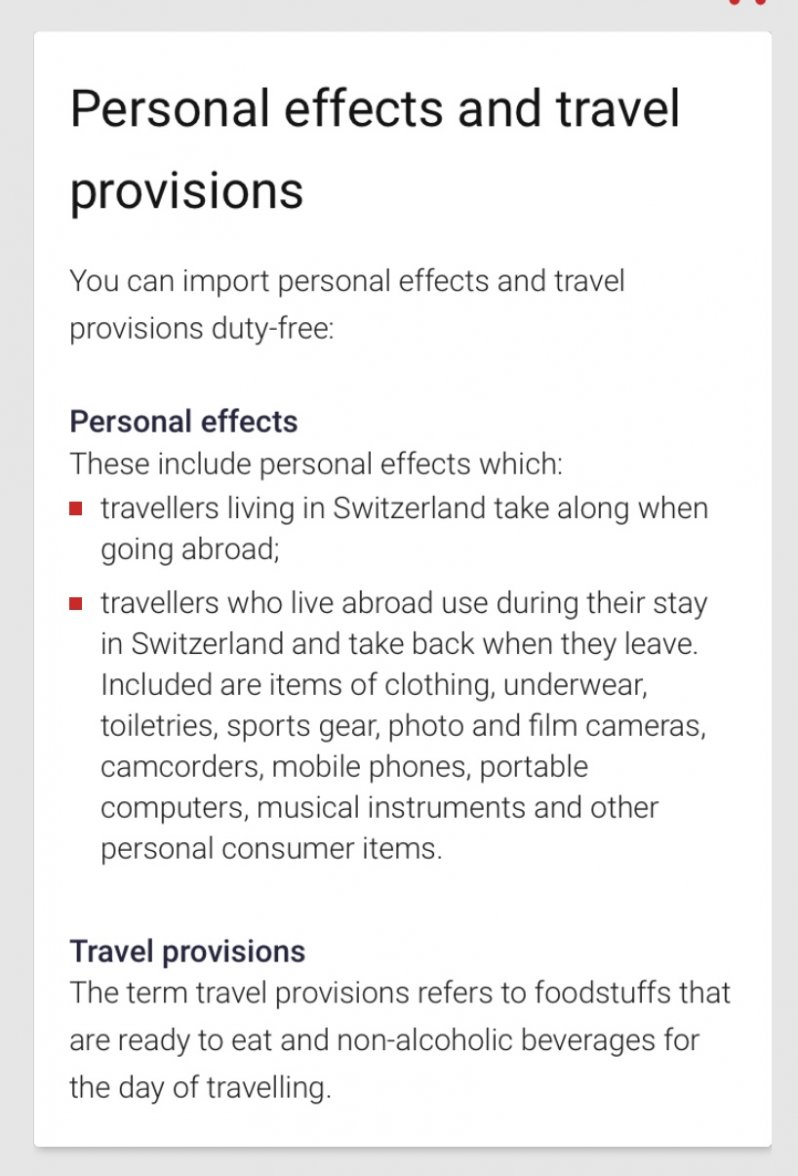
Personal effects are tax free.
But it appears watches are grey and not clearly defined. I would guess most non-WIS people traveling don’t do more than 1 watch. So maybe 2 is pushing it.
Scares me, as I have traveled with a roll before...
I'm sure cheese & tomato will be be fine with most customs officers.😀
Crazy, but I suspect the Swiss watch industry has pushed this idea, they are tired of seeing their product redistributed around the world out of their control. What better way to drive this home by making a few examples out of the watch press? Free publcity.
I used to work in the middle East and actually had a safe deposit box in Zurich, I was always moving my personal watches back and forth. Not once was I ever questioned, in fact the y hardly even glanced at my US passport. But this was 30+ years ago before we all got woke by 9/11.
A watch journalist going to a watch fair with watches. Technically he was on a business trip not a holiday.
Writing about watches hardly counts as dealing or retail (unless you are the 'dink). So next time you do a 'work trip' with your X pairs of underoos, that makes you, what, an underoo dealer liable for full duties ... 😗
This feels stupid and arbitrary to me. Thinking back on the roll Of 6 I took with me to London a few years back. It was bad enough that I kept it in my hotel safe. Never occurred to me I could have been flagged for an expensive lesson.
Switzerland not being part of the EU and also being a hotbed for financial management certainly makes it a risk area when you're traveling across its borders with valuables.
Writing about watches hardly counts as dealing or retail (unless you are the 'dink). So next time you do a 'work trip' with your X pairs of underoos, that makes you, what, an underoo dealer liable for full duties ... 😗
He’s a paid journalist for a watch magazine that has advertising. He gets paid to take pictures and write.
If he had a carnet or documentation he would have been fine.
That's correct. As a journalist it's commercial goods, except if those watches are his personnal watches... Well you know... Laws and interpretation.
So if a musician has to have a carnet for he’s own instruments
A photographer has to have a carnet for his own camera gear
A F1 team has to have a carnet for their own F1 cars
He clearly stated he was going to take pictures at a watch fair and he gets paid for doing so.
I'm sure cheese & tomato will be be fine with most customs officers.😀
Fruits and vegetables are a very serious offense for any Canadian going into the US.
My wife crosses the Canada/US border daily and sees various situations when she is occasionally pulled in on random secondary inspections. The saddest story she tells is of a young family pulled in when planning to drive to Florida for a vacation (approximately 20 hour drive from the border). The agent discovered they had packed vegetables among their meals and they were ordered to pay a significant fine (thousands of USD) and were denied entry into the US. My wife overheard the father sadly tell the children that they would not be able to go on vacation as a result. (As background, it is common for Canadians to go to Florida on holiday for warmer weather, more affluent people usually fly while poorer people are more likely to drive).
He’s a paid journalist for a watch magazine that has advertising. He gets paid to take pictures and write.
If he had a carnet or documentation he would have been fine.
So your wrong 😉
Mike works in the Automotive industry - I think that Watch journalism is more of a hobby. Weren’t the watches from his own personal collection too?
More accurate title for this thread would be “Swiss Customs does their Job”
I could start a thread stating “Watchmaker Targetting Expensive Repairs on Vintage Watches” and outline how my watchmaker seems to be looking for things wrong with my old watches and then daring to charge me for the repairs...
Bottom line, it appears the definition of "commercial goods" is fluid and customs can interpret that phrase as they desire. So if a hobbyist brings over a few personal watches for his own use they can be deemed commercial goods depending if the agent had a good or bad bowl of muesli for breakfast. Thought first world countries like Switzerland were above that.
Those that bleat that the traveller was wrong not declaring his personal watches please confirm that you declare EVERY item in your possession over the limit, that means phones, laptops, tablets, expensive shoes, and high end clothing each time you transit a border, plus your expensive watch(s) of course. Don't think they'll be many confirmations.
As countries become more strapped for cash, they start to put pressure on revenue producing departments.
This can lead to unbalanced outcomes and unintended consequences.
Thailand, one of the worlds most important centres for jewellery and gems, has a couple of trade shows each year. These exhibitions should be absolutely massive, attracting the huge number of local dealers and all the worlds traders and buyers. Instead they can be rather sad, empty affairs, filling only half the large hall at the exhibition centre, and often the corridors are deserted between the booths.
The trouble is, that several years ago the Thai customs started to target all the arriving dealers and confiscating all their stones. True, they were following the law. But as a result, the Thai shows are among the least well attended, in the world, and dwarfed by the Hong Kong shows that happen a week after.
So Thailand loses business and reputation, simply because of lack of government leadership, by not having laws that reflect the world we live in. (As an aside, they have reacted well in the past, by removing all barriers to the import of computer equipment, so Thailand is a hub of connectivity and user ability and even development).
In an attempt to bring back the business to the Thai shows, the government decided to offer an period of freedom from import charges for two weeks before and after the shows. Customs themselves were not too happy about that.
This made little difference as the policy was not well publicized nor uniformly enforced, confusing traders more. They were just too frightened to bring goods in, and instead waited a week and took them to HK. It was just so much easier not to go to a country with Import procedures.
All this should be read and then consider the success of Hong Kong. A free port - no restrictions on movement of goods. This now has so many gem shows per year I cannot attend even half of them regularly.
Governments of Europe, (Or do I mean THE government of Europe) is crushing trade among smaller businesses or individuals.
I am beginning to think it is a deliberate aim.
This customs situation in Europe is outdated and not fit for purpose. The fact that Swiss Customs were " Just doing their job" highlights the problem. Sniffing out watches owned by individuals with blurred purpose, but ultimately unlikely to be avoiding import taxes, (Or if they do, is it really that much and taxes will have already been collected on the sale and production of that watch).
The Just doing their job argument does not make it right, as history has taught us.
With supervision, monitoring, CCTV and data storage becoming cheaper and cheaper, with AI and its unforgiving algorithms being introduced slowly so we accept this invasive and choking, we will wake up soon to find we cant go anywhere, buy anything or do anything without being naked to our superiors who will take a percentage of everything we do, so as to erode our assets as much as possible.
Most of you will read this and go, " Oh that would be awful!"
But then you will go back to scanning your watches and try to forget about it, because there is nothing we can do about it.
So if a musician has to have a carnet for he’s own instruments
A photographer has to have a carnet for his own camera gear
A F1 team has to have a carnet for their own F1 cars
He clearly stated he was going to take pictures at a watch fair and he gets paid for doing so.
Nope, he was going there to take pictures, not selling watches.
I'm a consultant for a medical company, next month I'm going to a convention with medical simulation systems, also with 2 or 3 watches. Do I have to declare my watches as commercial goods since I'm on a business trip ? No.
The fact he's a photographer for a watch magazine means he should declare his camera as commercial goods since it's his primary tool for working. His watches can be completely private possession he's taking along on a business trip, hence the need to declare them is not right...
That's where I'm saying it's based on interpretation from the custom officer.
If you travel with watches, it doesn't mean it's for resale or for work. It can be considered just as your personal possession.
The limit for the value also is not respected there. When I'm travelling with my 5000$ watch (let's say you only have one on your wrist), your 2500$ computer, your 1000$ smartphone, your 3500$ camera with its objective, plus let's say 1500$ in clothes because you wear expensive brands. Where is the 300$ limit ? Where and when does it become personal possession after you have bought something ?
When I go to the US and on my return trip I bring back a 500$ jacket I have bought there, why do I have to pay the tax on it, and when I'm going on another trip 2 months later, I don't declare the jacket and it is considered just as personal possession and not commercial good anymore ?
These aren't laws ... It's just a way for someone to make easy money on your fear of loss and detention. Those of you advocating for this shit are nuts.
Whatever your opinion is, the story is a learning opportunity for those thinking about travelling with more than one watch or if travelling with an expensive one. Knowing what might/might not happen gives the traveller The opportunity to decide what they want to do. This is a great discussion and I’m sure many people here will think twice on their next trip.
The Just doing their job argument does not make it right, as history has taught us.
This is my real problem with this situation.
There is no specific law which states clearly what is considered personal possession you don't need to declare, versus what is considered commercial goods that you need to declare and pay taxes on.
As a government representative, a custom officer should not be able to decide if he's gonna consider the watch of someone "commercial goods" and charge him VAT plus a fine for not declaring it, and the next person in line will pass with his watch that another customs officer will decide is "personal possession".