Hi Rob - I have a few comments on some statements you are relying on for your arguments...
Does number of turns of the rotor alone have the ability to cause extreme wear in the autowinder gearing? When it comes to the rotor, I think everyone will agree that it has a slow velocity and a low energy input, after all it's only a small weight driven by gravity.
This characterization is very misleading in many ways, and no not everyone agrees. Yes the weight is small compared to many things in the world (like a car, or a house) but in the context of a watch movement, it really isn't. Most weights at the low or mid-tier level like Rolex and Omega are brass, but high end watches often use precious metals for the weight portion, so 22k gold in some cases - small but heavy. The rotor in my old Blancpain was solid gold, so not exactly light weight by any means:
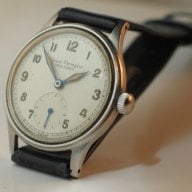
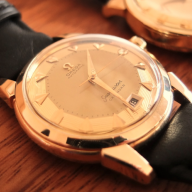
Gratuitous watch shot...
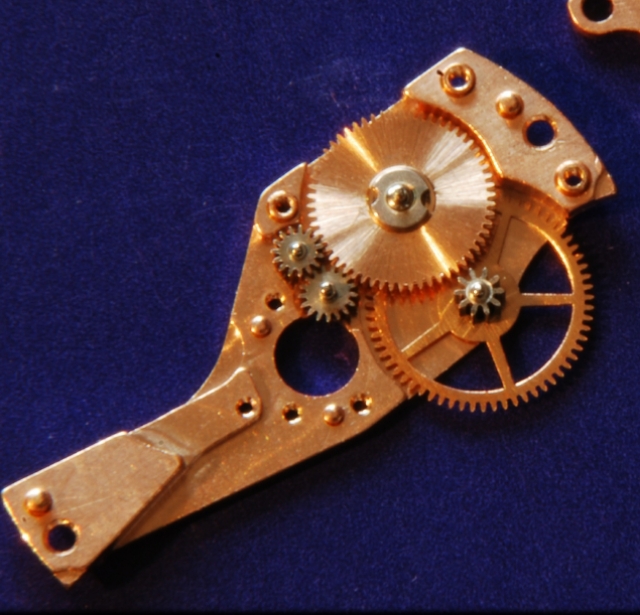
I'm not sure how you can argue it provides a low energy input - for the weight to service it's function, it has to provide enough energy to move all the gearing in the automatic winding system, and right down to the ratchet wheel, turning the barrel arbor and winding the spring. Because watch companies don't want complaints about a watch not winding on someone's wrist, they tends to use more weight than would be necessary in a perfectly functioning watch. In the real world people neglect their watches and don't keep them serviced, yet they still wind and wind as pivots wear, oils dry up, etc. So there is plenty of extra energy to overcome these faults built into these designs in the real world.
And as any watchmaker will tell you, even in it's fully wound state the mainspring will continue to be wound by the automatic, so it has to overcome all the tension in the spring and the braking grease on the barrel wall, and yet it still provides enough force to wind and wind. This is why you watch is fully wound when you take it off at the end of wearing it for a day. The very function of this system would not work if it didn't provide enough torque (which is the important thing here, not "weight"), to power the winding system.
Also the assertion it's powered by gravity is false - yes gravity plays a part but so does inertia. This is why automatic watches work fine in zero gravity. You say it's slow moving, and yes if I placed my watch on a watch winder that turned slowly the weight would be slow moving. But by ignoring inertia you ignore the fast moving that happens of the weight in daily use as you flick your wrist around. Winding speed is highly variable with the movements of your wrist.
Most of the next area really assumes the "low load and low velocity" argument, which I do not believe is the case in the real world, so calculations aside, I believe it's flawed reasoning. The only thing that piqued my attention here is the statement about not finding escape wheel pivot wear...this is not my experience is all I'll say...
With Al mentioning the WOSTEP Theory of Horology manual, I had a read through mine and came across this interesting section:
Section 8.3.6, first para which states in part:
"When the wearer winds his or her self-winding watch using the winding stem, it is important that there is a system which uncouples the reduction gearing train in order to keep it from rotating too quickly, which would cause excessive wear or even the breakage of one or several parts"
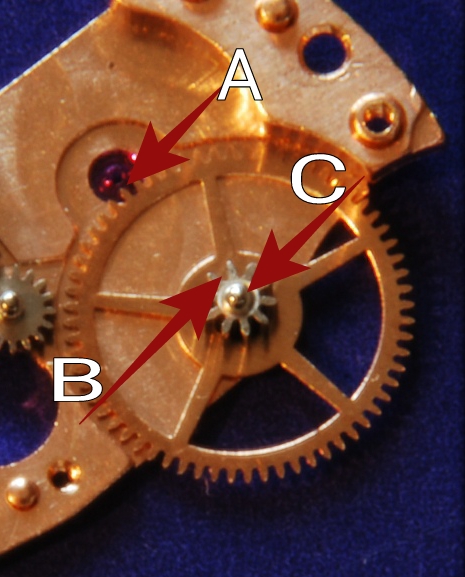
Yes certainly - and you fail to mention the parts that provide this decoupling - the reversing wheels. I know of no modern automatic watch that does not have some way of decoupling such as reversing wheels. They are sometimes called by different names, so known as the "winding wheel" in the 55X, and 56X series this thread was started about, but they serve the purpose of decoupling the system during manual winding.
What this paragraph tells me is what I have been saying all along - in a properly serviced and maintained watch, there is no need to be overly cautious with winding it. Certainly if the parts that do the decoupling are not working, you can damage the watch by manual winding. I've already said and show two videos where that is happening, and as I said then, I advise people not to wind the watch at all when this happens.
You seem to believe from what I read in your arguments that only two positions can exist here. One being that manual winding can never do harm (you have tried to make my argument that "manual winding never wears parts" already once in this thread, which is something I have not ever said), or that it always does damage. The truth is in the middle somewhere. Clearly anything that moves can wear, so if it moves during manual winding it can wear during manual winding - I've never said it could not. What I have said is the concern here is being overblown, and again in a watch that has been properly serviced and has no defect, manual winding is not something that has to be done "very slowly and very gently."
Cheers, Al
PS - edit to add that aside from all this back and forth about the reasons for the wear I've shown, forgetting this thread for a moment if someone asked me what the cause of all the wear in my photos was from, there is a simple, succinct answer...neglect.