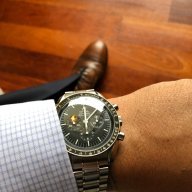
Smp 8800 Loosing seconds

Posts
3,833
Likes
22,917
I always thought a magnetized movement would run abnormally fast?!
 
Posts
261
Likes
201
I always thought a magnetized movement would run abnormally fast?!
It usually does. But it can run very slow as well.
 
Posts
261
Likes
201
It usually does. But it can run very slow as well.
One of the reasons I knew mine wasn’t, but checked to rule it out anyway. My 2254 was magnetized and gained close to 10 min in a day. That amazon demagnetizer was a god send lol
 
Posts
2,326
Likes
1,884
One of the reasons I knew mine wasn’t, but checked to rule it out anyway. My 2254 was magnetized and gained close to 10 min in a day. That amazon demagnetizer was a god send lol

It was my 2254 that introduced me to the issue. This watch gets magnetized just looking at it strangely.

Tom
 
Posts
261
Likes
201
It was my 2254 that introduced me to the issue. This watch gets magnetized just looking at it strangely.

Tom
Haha mine too. Same with my wife’s Deville. I’m always demagnetizing that thing for her.
Edited:
 
Posts
408
Likes
355
Interesting. For those reading, it's still the first thing to suspect.

Tom

Except when you've got a METAS tested movement such as the 8800. While some parts can be magnetized the movement should still remain within specifications. For movements not designed to be highly resistant to the adverse effects of magnetism then I would agree. My old De Ville was magnetized on several occassions but then I do have many items around the house that have strong earth magnets.
 
Posts
792
Likes
918
Yeah, it isn't magnetism. It would be gaining 30 s/d if it were. I've never heard of magnetism slowing down a watch (unless stopping it completely).

Regarding positional variations, a watch typically will run faster in the pendant positions (the ones other than dial up or dial down) but not always. So a watch that's gaining a little time on the wrist benefits from resting dial up or down. It's also possible that it will run slower in one dial position than the other; typically a sign of wear or lubricant problems. A timegrapher is the best tool for finding this stuff out, but even then it will read differently from week to week. Your wrist is the best lab.
 
Posts
389
Likes
569
hi
Another rooky question from me

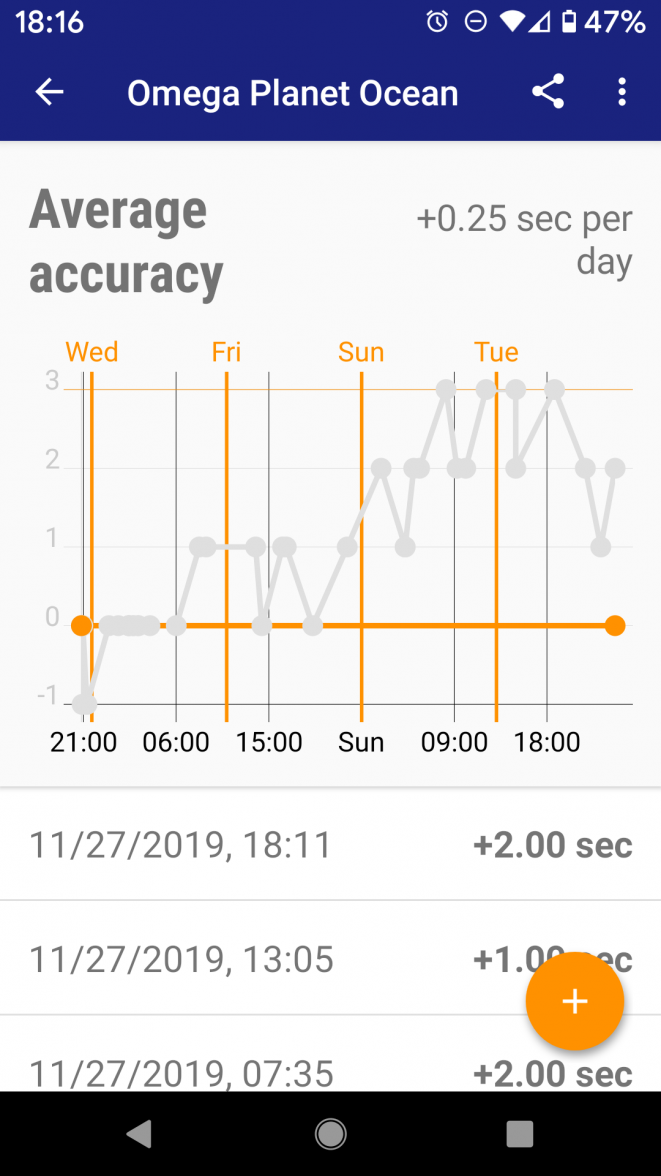
The last couple of days ive started to measure my seamasters accuracy.
Ive found that it seems to loose 2,5-3 seconds each 24h. Is this normal?

This has been measured when the watch has been in use if thats got something to say.

 
Posts
389
Likes
569
I have a PO and noticed it was gaining, I've tried lying it in all 4 positions and find that it almost resets over night if left face up. A great app is the atomic time app that allows you to record your watch and establish if it loosing or gaining.
Generally non quartz will do this, it's part of their quirky nature.
 
Posts
29,672
Likes
76,830
Well, that's the million dollar question. How should it perform? IMO, If its a modern chronometer, then it should keep consistent"chronometer specification" time in most positions and temperatures.

Tolerances for the 8800 are as follows:

6 positions tested

Average daily rate over the 6 tested positions should fall between 0 and +6 seconds per day.

Maximum positional variation at full wind is 14 seconds.

Maximum positional variation at 24 hours after full wind is 16 seconds.

If you read the thread linked above, and keep the tolerances I've just listed in mind it will give you some insight in how this watch is performing - here it is again:

https://omegaforums.net/threads/timing-tolerances-a-guide-to-understand-how-they-work.87293/

Cheers, Al