Should I not wear vintage Speedy before service?

Posts
221
Likes
169
If you have never had or seen this happen, you are incredibly fortunate. I see watches that lack of regular servicing causes problems all the time. How much of a problem varies of course, and it can be minor certainly, but it can also be very bad...a watch that is flooded and rusted into a solid mass because it leaked in the ocean:

A fascinating clip of your restoration....thank you for sharing.
Having just purchased a 3520.50 mark 40 speedmaster, and as a certified newbie, I find myself in a similar position to the original poster, making a service now or run until it plays up decision.
I have no timegraph data, only the daily worn accuracy at about -10s.
Wondering if you might be able to advise on roughly what percentage of the movements you servie end up costing the owner an appreciable lot more due to delay. Apologies for what is of course a highly subjective question.😵‍💫


It required a completely new movement...


If this had been a valuable vintage watch, well the cost would have been even higher. This is a $1,400 movement.

But more along the lines of what the OP has, here's a 1978 Speedmaster that "just" had a leak in the crown...


There is extensive rust damage, requiring many new parts, and a lot of additional labour.

For wear, well that can be easy, or it can be difficult - it really depends on how available parts are for vintage watches. It may also depend on what your standards are for performance. If you don't care about specific things, or your watchmaker doesn't inform you of them, they might be irrelevant to you but still be there. For example wear on the ends of the balance staff from lack of servicing is common. This can sometime be corrected by burnishing the pivot on a Jacot:


To take it from this, where the end has flattened from wear:


To this, where the pivot is properly rounded:


You would only know this is you have positional information from your watchmaker (or had your own timing machine) to see that the balance amplitudes or timing were different dial up and dial down. But if the staff is really worn, then it requires replacement - some staffs are very difficult to find, and when you do, they aren't cheap. Most watch companies don;t sell staff anymore -= I recently bought out the entire supply from one material house of Omega 861 staffs. I also bought some generic staffs for the caliber, but they are not good enough quality to use. One could have a staff made but that would likely cost more than a complete standard service.

If neither of those are options, then a new balance complete would be needed - these can be $500+

If you don't see any value in doing maintenance, so be it. Not here to change your mind, but really just pointing out that shit does happen, and sometimes it's bad.

 
Posts
29,239
Likes
75,608
A fascinating clip of your restoration....thank you for sharing.
Having just purchased a 3520.50 mark 40 speedmaster, and as a certified newbie, I find myself in a similar position to the original poster, making a service now or run until it plays up decision.
I have no timegraph data, only the daily worn accuracy at about -10s.
Wondering if you might be able to advise on roughly what percentage of the movements you servie end up costing the owner an appreciable lot more due to delay. Apologies for what is of course a highly subjective question.

Not something I really track, but most of the watches I get in already have problems - they are either running poorly or completely stopped. I do very little in the way of "preventative" servicing. The most common form of that that I actually do is this very situation, where someone has bought a vintage watch, and has no idea of the service history, so they get a first service done to have a benchmark to start with.

I would say very few of these just need cleaning and lubrication, and no parts at all - in fact that is rare. Most need some new parts, and some need a lot of new parts, or more extensive repairs.
 
Posts
627
Likes
2,095
How closely are you looking? ... In my experience, it's rare to have a watch come in for service that doesn't have at least 1 worn part inside...

Well, wear indeed beginns immediatly from new 😉. Same with car components. As soon as you have fitted new pads, the statement " The brake pads are approaching the wear limit" is ..... absolutely correct 😁.

If I notice marks on pivots like the ones shown, I slightly (!) polish them and thats it. But that is not too often.

P.S.: I may note that I never ever expose a watch, which is part of my collection, to water, not even rain. Or to other adverse environments. In case that I need to work in dusty or wet environments, I simply take off any watch.

P.P.S.: I may also note that my 18 years old Nokia mobile still looks like new (and I do use it for phoning and SMS, I need no smart phone) ...
Edited:
 
Posts
29,239
Likes
75,608
Well, wear indeed beginns immediatly from new 😉.

It really starts when the lubrication breaks down. If you are looking at a Stribeck curve and wondering where watches fall, it would be under boundary lubrication.

If the servicing is kept up, then wear won't occur in most places.

I have in decades never experienced worn or perhaps even bent or broken pivots

Okay, so I guess this means that you have seen it then...

If I notice marks on pivots like the ones shown, I slightly (!) polish them and thats it. But that is not too often.
 
Posts
627
Likes
2,095
Okay, so I guess this means that you have seen it then...

Yes, slight marks like the ones you showed. It is routine to polish marks like that, without any need to do anything more.

But nothing beyond that, or comparable with that in the other post. Such wear would imo seem to have its cause in inferior pivot material. Normally, long before such wear can commence the amplitude will be below 90°. If some funny guy "cures" his by replacing the main spring with a stronger one, so that the movement rather works as a grinder, then I would understand how pivots in that other post can occur.

By the way, I also never had the need to replace a main spring.
 
Posts
439
Likes
753
My experience so different from yours, it's almost hard to comprehend that in all those years of collecting you have never even heard of a single situation where someone had to replace one or multiple expensive and hard-to-find parts.

I'm really not inclined to write up detailed case histories to satisfy your curiosity, but I'll give a general overview. On at least half a dozen occasions, a watch has needed multiple parts replaced, doubling (or more) the cost of a routine service. Many vintage parts cost $50 or more from a supplier, and some can climb as high as $200 (e.g. balances or rare chronograph parts), so the costs can add up. I can recall at least two watches where it was more effective to purchase a parts movement. On one occasion, it was necessary to fabricate a part and replace several other parts. And I can remember at least two watches where it simply wasn't cost effective for me to repair a movement and I abandoned it. Amazing that you have never experienced, or even heard of, any of these scenarios.
My experience so different from yours, it's almost hard to comprehend that in all those years of collecting you have never even heard of a single situation where someone had to replace one or multiple expensive and hard-to-find parts.

I appreciate your examples, but I am not sure that is what I am referring to. Did the problems you encountered result from not servicing the watch? Would the need to replace them been precluded by preventive maintenance? Absent a crystal ball, there is of course no way to know the answer to these questions.
I of course have heard of "situations where someone had to replace one or multiple expensive and hard-to-find parts", but never have seen this attributed to lack of serving.
IMO, for the vast majority of vintage Omegas, the "if it ain't broke don't fix it" approach is prudent. As I have mentioned before, watches that are very valuable (real or sentimental) or ones where part sourcing will be difficult, would be exceptions.
 
Posts
29,239
Likes
75,608
Yes, slight marks like the ones you showed.

Slight marks? Really?


It is routine to polish marks like that, without any need to do anything more.

Not really. The line is drawn when material is missing, so there's a change in pivot diameter. The only one of those that would apply in the examples I've shown, is likely the escape wheel. The others are most certainly in need of replacement.

But nothing beyond that, or comparable with that in the other post. Such wear would imo seem to have its cause in inferior pivot material. Normally, long before such wear can commence the amplitude will be below 90°. If some funny guy "cures" his by replacing the main spring with a stronger one, so that the movement rather works as a grinder, then I would understand how pivots in that other post can occur.

Wear like has been shown is common. Not sure if you are really recognizing it though. More examples - none of these used mainsprings that were extra strong, by the way...new reversing wheel on the left for comparison:


Again, new reversing wheel on the left:


Worn post - this watch was 5 years old:


Worn pivots - you can't polish this sort of wear away:


I could go on for pages withe examples. Pivots aren't the only things that wear - worn main plate:


Worn barrel bridge:


Worn jewels:


Worn cap jewels are very common:


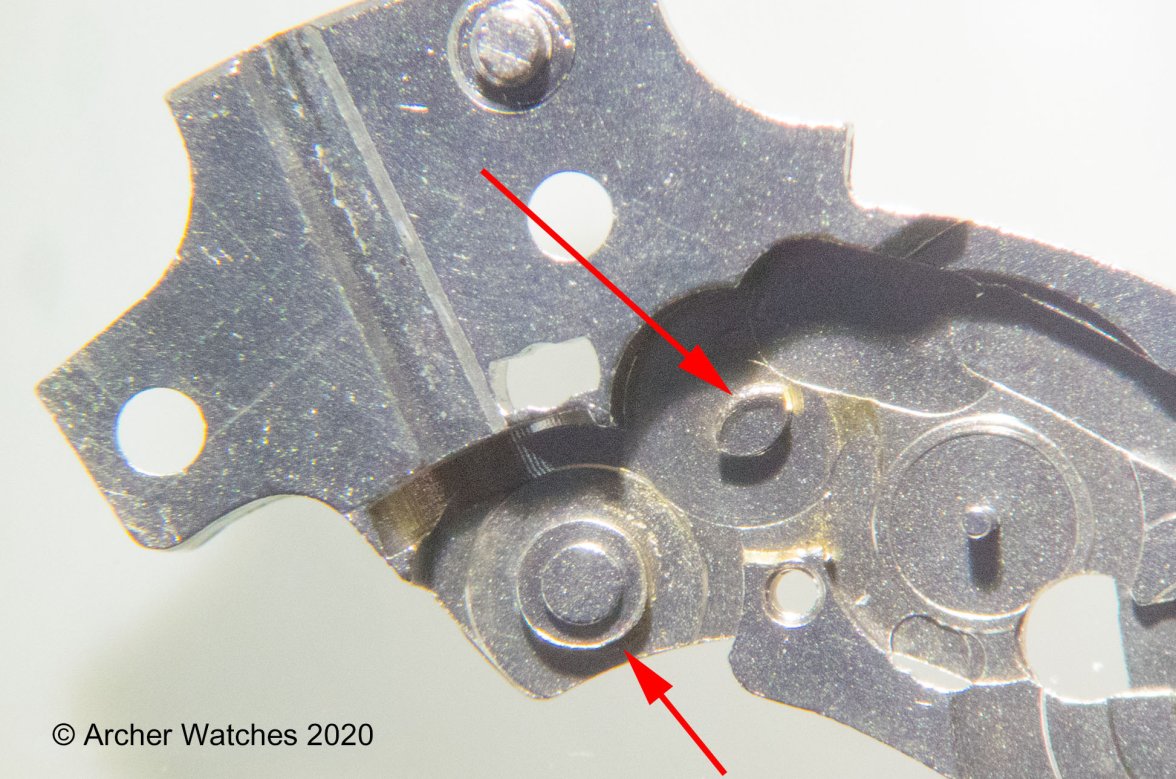
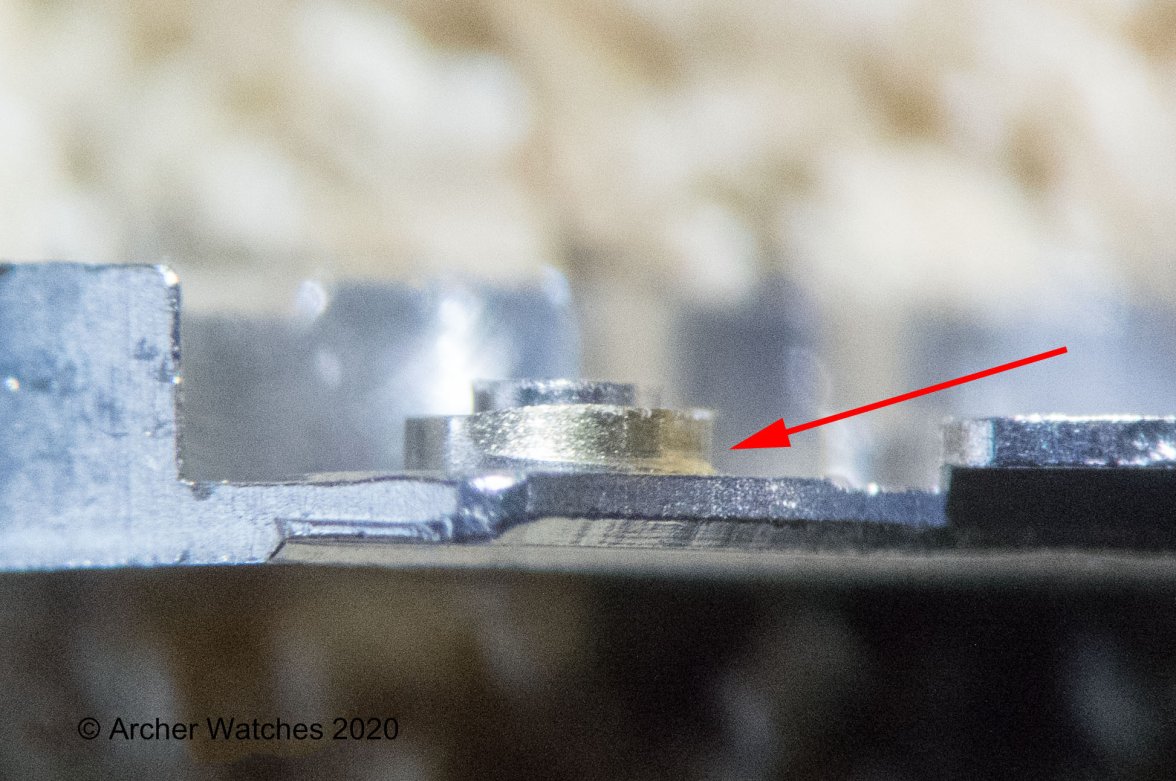
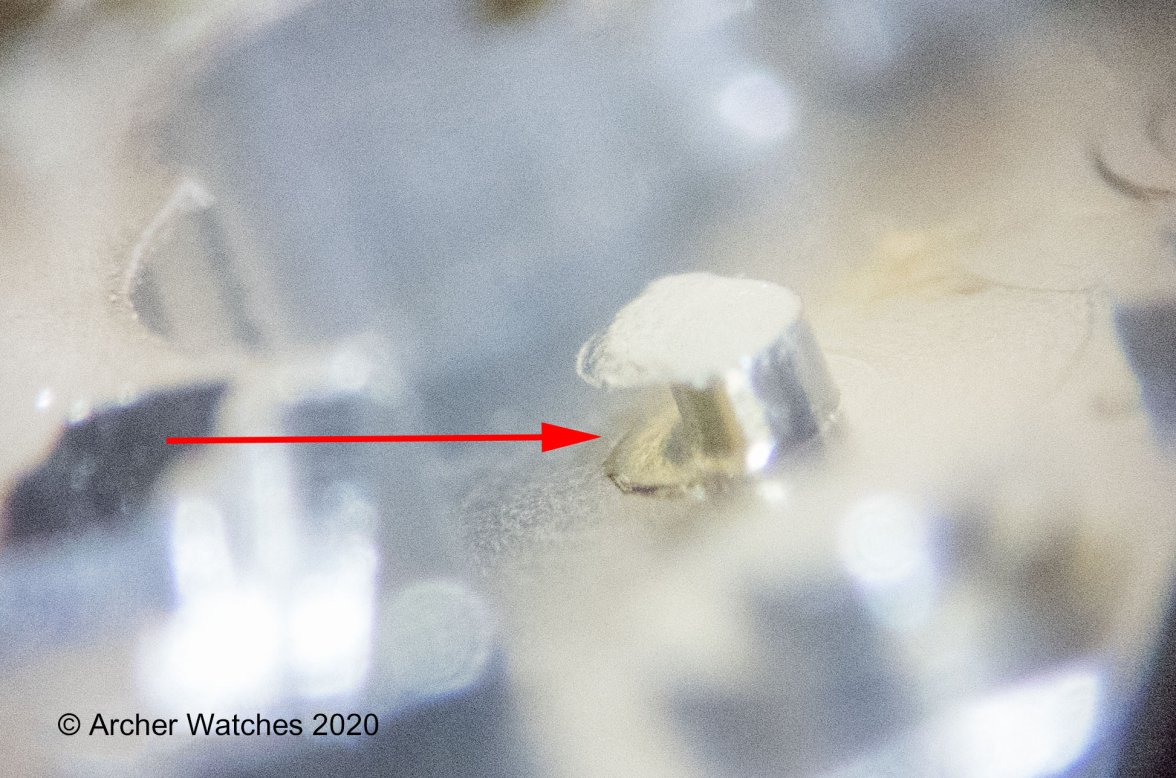
Worn barrel bridge in 2 locations:


Lower arrow:


Upper arrow:


By the way, I also never had the need to replace a main spring.

The entire watch industry disagrees with you, but you do you...

Cheers, Al
 
Posts
4,593
Likes
10,805
Yes, slight marks like the ones you showed. It is routine to polish marks like that, without any need to do anything more.

But nothing beyond that, or comparable with that in the other post. Such wear would imo seem to have its cause in inferior pivot material. Normally, long before such wear can commence the amplitude will be below 90°. If some funny guy "cures" his by replacing the main spring with a stronger one, so that the movement rather works as a grinder, then I would understand how pivots in that other post can occur.

By the way, I also never had the need to replace a main spring.

I'm certainly not calling you out as telling tall tales, but I think there is a big difference between your experiences and those of mine and others, and especially Archer's. There could be many reasons for this. However most active collectors like myself would probably report experiences in line with DanS and Archer. Could be you come across better condition stuff to buy, or are pickier, or just plain lucky. However, arguing with Archer on the nature of servicing watches doesn't make sense. He sees it all. You only see your own.
 
Posts
1,072
Likes
1,482
Back to OP question. If watch running fine I would guess 99% no problem winding and wearing it. And if you have a Timegrapher showing good numbers probably no need for immediate service. But it you don’t have a timegrapher than it just makes good sense to at some point soon just have a watchmaker check it out. These are delicate and complicated (yes, rocket science) machines and a little prevention is prudent.

When you own 50-70 watches, servicing on a strict 5 year cycle can get crazy expensive and I am not convinced it is necessary. Good results on a timer give me some feeling of security that urgent service may not be necessary but I have a trustworthy watchmaker who will sometimes just visually do a check on these to be sure they are not dry. An honest watchmaker will not automatically say that you need a full service.

IMO there is no one right strategy for watch servicing, but NO strategy is a bad choice.

Happy New Year to all!
 
Posts
29,239
Likes
75,608
IMO there is no one right strategy for watch servicing, but NO strategy is a bad choice.

I've been saying this for years...there's no one size fits all solution, as it very much depends on the watch and who is servicing it.
 
Posts
23,462
Likes
52,150
I appreciate your examples, but I am not sure that is what I am referring to. Did the problems you encountered result from not servicing the watch? Would the need to replace them been precluded by preventive maintenance? Absent a crystal ball, there is of course no way to know the answer to these questions.
I of course have heard of "situations where someone had to replace one or multiple expensive and hard-to-find parts", but never have seen this attributed to lack of serving.
IMO, for the vast majority of vintage Omegas, the "if it ain't broke don't fix it" approach is prudent. As I have mentioned before, watches that are very valuable (real or sentimental) or ones where part sourcing will be difficult, would be exceptions.

So now you expect me to prove that worn and/or broken parts are due to lack of regular maintenance? You remind me of a climate change denier. According to your rules, nobody can ever prove that worn or broken parts are due to deferred maintenance, therefore de facto, you will never hear of an example where expensive repairs could have been averted by regular servicing. By this illogical reasoning, you confirm your desired result. If I had known the game you were playing, I'd never have engaged with you. What a waste of time.

You're welcome to choose NOT to have your watches serviced regularly, and pay for repairs at a later date (or let the next owner do it), that's a choice. I don't have every one of my watches serviced either. But to claim that this will not result in greater wear, requiring replacement of parts that otherwise would not need to be replaced, is just a fantasy.

Fortunately, most people reading this thread are capable of logical reasoning, and will understand that the most plausible reason for the vast majority of worn parts needing replacement is deferred maintenance.
Edited:
 
Posts
439
Likes
753
Back to OP question. If watch running fine I would guess 99% no problem winding and wearing it. And if you have a Timegrapher showing good numbers probably no need for immediate service. But it you don’t have a timegrapher than it just makes good sense to at some point soon just have a watchmaker check it out. These are delicate and complicated (yes, rocket science) machines and a little prevention is prudent.

When you own 50-70 watches, servicing on a strict 5 year cycle can get crazy expensive and I am not convinced it is necessary. Good results on a timer give me some feeling of security that urgent service may not be necessary but I have a trustworthy watchmaker who will sometimes just visually do a check on these to be sure they are not dry. An honest watchmaker will not automatically say that you need a full service.

IMO there is no one right strategy for watch servicing, but NO strategy is a bad choice.
Completely agree. And this would apply to not just the OP watch, but the vast majority of watches for which this question is posed.
Happy New Year to all!
 
Posts
439
Likes
753
So now you expect me to prove that worn and/or broken parts are due to lack of regular maintenance? You remind me of a climate change denier. According to your rules, nobody can ever prove that worn or broken parts are due to deferred maintenance, therefore de facto, you will never hear of an example where expensive repairs could have been averted by regular servicing. By this illogical reasoning, you confirm your desired result. If I had known the game you were playing, I'd never have engaged with you. What a waste of time.

You're welcome to choose NOT to have your watches serviced regularly, and pay for repairs at a later date (or let the next owner do it), that's a choice. I don't have every one of my watches serviced either. But to claim that this will not result in greater wear, requiring replacement of parts that otherwise would not need to be replaced, is just a fantasy.

Fortunately, most people reading this thread are capable of logical reasoning, and will understand that the most plausible reason for the vast majority of worn parts needing replacement is deferred maintenance.
You are missing my point. I wouldn't argue that my approach "results in greater wear", and may even require "replacement of parts that otherwise would not need to be replaced". The question is whether or not it is worth spending several hundreds of dollars every three to five years to try to keep that from happening. If you believe it is, why don't you do it for all your watches?
 
Posts
29,239
Likes
75,608
You are missing my point. I wouldn't argue that my approach "results in greater wear", and may even require "replacement of parts that otherwise would not need to be replaced". The question is whether or not it is worth spending several hundreds of dollars every three to five years to try to keep that from happening. If you believe it is, why don't you do it for all your watches?

I went back through this thread - I don't see anyone saying that you should service all watches every 3-5 years.

Remember the initial question is about a watch that has zero service history - it could have been serviced last year, or 20 years ago - we just don't know, which is why I suggested it should be looked at by a watchmaker to determine the condition. Timekeeping is not a reliable indicator of the condition of the movement.
 
Posts
23,462
Likes
52,150
You are missing my point. I wouldn't argue that my approach "results in greater wear", and may even require "replacement of parts that otherwise would not need to be replaced". The question is whether or not it is worth spending several hundreds of dollars every three to five years to try to keep that from happening. If you believe it is, why don't you do it for all your watches?

Troll me once, shame on you. Troll me twice ... shame on me. 🤨
 
Posts
1,175
Likes
4,202
I always wonder how such damage like the one in this post can occur.
Easy: You bring the watch to a "watchmaker" who is a liar and get it "serviced". Then you wear the watch regularly. As the "watchmaker" did not service the watch, the movement is dry and that damage is the result...
 
Posts
197
Likes
255
Well, wear indeed beginns immediatly from new 😉. Same with car components. As soon as you have fitted new pads, the statement " The brake pads are approaching the wear limit" is ..... absolutely correct 😁.

I am not a watchmaker, nor do I play one on TV. However, just based on my limited experience with mechanical watches and less limited experience with cars, I don't think this is the best analogy. Brake pads are designed and intended to be worn down as part of normal usage. The point of lubricated mechanical parts interacting is so that under the vast majority of circumstances, the actual material never touches/wears.
 
Posts
439
Likes
753
Troll me once, shame on you. Troll me twice ... shame on me. 🤨
It is a pretty simple question: Why don't you "routinely service" all your watches?
 
Posts
18,107
Likes
27,413
I struggle to understand your concerns. If watch runs fine - just wear it.
You must be new here...
 
Posts
627
Likes
2,095
Slight marks? Really?


Not really. The line is drawn when material is missing, so there's a change in pivot diameter. The only one of those that would apply in the examples I've shown, is likely the escape wheel. The others are most certainly in need of replacement.


Wear like has been shown is common. Not sure if you are really recognizing it though. More examples - none of these used mainsprings that were extra strong, by the way...new reversing wheel on the left for comparison:


Again, new reversing wheel on the left:


Worn post - this watch was 5 years old:


Worn pivots - you can't polish this sort of wear away:


I could go on for pages withe examples. Pivots aren't the only things that wear - worn main plate:


Worn barrel bridge:


Worn jewels:


Worn cap jewels are very common:


Worn barrel bridge in 2 locations:


Lower arrow:


Upper arrow:


The entire watch industry disagrees with you, but you do you...

Cheers, Al

You are putting my statements in incorrect context, intentionally I suppose. The examples you had shown previously had absolute minimum wear, and that is what I referred to as merely needing a slight polish. The examples you showed now are, of course, beyond polishing.

I will retract from this discussion. I just had intended to note that what is not bad needs not to be repaired/replaced (i.e. the examples with absolute minimum marks, not the ones shown in your response now). I am a private person, attend to my own watches only, and do not need to make a living from repair work, luckily. And I do not mind, if "the entire watch industry" wants to sell new main springs and the related work. If a watch runs down 30h with good amplitude, I will for sure not give it to a professional service person for fitting of a new main spring. Why should I?

Cheers, Bernhard

P.S.: Each time I purchase a watch I of course look into it and service/repair it, if the amplitude is insufficient or something is wrong. And do not use it until serviced, if I find that it needs a service.
Edited: