Question re Omega 30t2 RG SC balance wheel

Posts
7,159
Likes
23,193
I think I understand your point, but was confused because the OP, nor anyone else, mentioned that the question was posed from the perspective of wondering what could work in a non-running watch, vs. simply trying to learn the difference between the two balance wheels.
 
Posts
3,547
Likes
7,576
quote #1 "the balance wheel must be bimetallic and cut - then it is legitimate for a swap/replacement. Later monometallic balances are interchangeable as well but are not correct for the chronometer movement. A bimetallic balance is a must"

With Later monometallic balances I did not mean replacement part 262.1327, just commonly used Glucydur-balances, should have been clear - no?
Maybe I had to be more specific...

BTW: this book was not sold by me! I did not sell any book through ebay or similar
 
Posts
4,601
Likes
9,343
I think I understand your point, but was confused because the OP, nor anyone else, mentioned that the question was posed from the perspective of wondering what could work in a non-running watch, vs. simply trying to learn the difference between the two balance wheels.

Hi @M'Bob

Well that would be Omega perspective... " what works " under the hood so to speak.
I think a broader question...

What is the difference between the 30 mm and a 30 mm chronometre movement... the material lists i posted show what parts were upgraded in the Rg version of the movement...

But keep in mind the 30 mm that were used in competitions were NOT the Rg versions... of the 30 mm...

But I hate to say the word " standard" 30 mm movement was used.. but was specially handled and adjusted by master regulator at Omega... I forget his name.... @mac_omega either knows off the top of his head or I need to read his book... which I have on my desk.

There is a much bigger difference between the 30 mm and a 30 mm Rg... in comparison to the Omega bumper vs bumper Rg movements.

Good Hunting

Bill
 
Posts
4,601
Likes
9,343
With Later monometallic balances I did not mean replacement part 262.1327, just commonly used Glucydur-balances, should have been clear - no?
Maybe I had to be more specific...

BTW: this book was not sold by me! I did not sell any book through ebay or similar

Hi Erich

FYI most of the later monometallic balance complete were for 30 mm with shockproof... wont fit the rg ( unless you get a shoemaker who will "modify" the balance cock... ( very bad).).... I have seen later 262-1327 with mono wheels ... I would buy it for a 30T2 but would not want to use it in a Rg....

Erich , I didnot mean to imply you sold the book at auction... I did not think it was you. But I came up for auction along with a collectors other books... and I thought you would like to know ...

Best
bill
 
Posts
7,651
Likes
21,950
Thanks @Bill Sohne for your explanation. Afraid my small brain cannot process every bit of mechanical info but I’ll just retain that many parts were upgraded including I guess the balance? As it seems to be listed on the 262 sheet?
Also may I ask what part is called the drive train in English? Believe it or not I took a day horology workshop but that was in French.
 
Posts
4,601
Likes
9,343
Thanks @Bill Sohne for your explanation. Afraid my small brain cannot process every bit of mechanical info but I’ll just retain that many parts were upgraded including I guess the balance? As it seems to be listed on the 262 sheet?
Also may I ask what part is called the drive train in English? Believe it or not I took a day horology workshop but that was in French.


Hi @Syrte

its the path of power delivery from the mainspring to the hands.... I hope that makes some sense..
best
bill
 
Posts
1,452
Likes
2,049
At what point during the progression of the chronometer iterations did Omega switch from a bimetallic balance to monometallic? From my understanding this occurred around 1950 which seems to imply that earlier bumper chronometers (eg JUB and 343) utilized a bimetallic balance.

Along this vein, what significant differences existed between the later bumper RG chronometers (eg cal 352) and their non-chronometer counterparts aside from the regulator and the finishing? The non-RG chronometer bumpers vs non-chronometer counterparts?
 
Posts
4,601
Likes
9,343
At what point during the progression of the chronometer iterations did Omega switch from a bimetallic balance to monometallic? From my understanding this occurred around 1950 which seems to imply that earlier bumper chronometers (eg JUB and 343) utilized a bimetallic balance.

Along this vein, what significant differences existed between the later bumper RG chronometers (eg cal 352) and their non-chronometer counterparts aside from the regulator and the finishing? The non-RG chronometer bumpers vs non-chronometer counterparts?


Hi @Rasputin

on the bumperRg vs a bumper nonRg ? Basically finishing only. In comparison to the 30 mm Rg. Vs non Rg . You can do the same type of material list comparison as I did previously. You can see this for yourself . I am not saying the non Rg bumpers are not good time keepers , it’s the opposite . Since basically the only difference between the Rg bumpers and the non Rg bumpers ..... are fancy finish and Rg regulator .... So all the timing parts are the same between the chronometre and non chronometre grade no bumpers ..... as you go forward this become more and more the standard ..... quality of all Omega movements are increased in base quality ... heck look at a 1040 vs a 1041 it’s like one or two parts and it’s the movement plate that says adjusted in 5 position and temp !!

good hunting

bill
 
Posts
7,651
Likes
21,950
Hi @Syrte

its the path of power delivery from the mainspring to the hands.... I hope that makes some sense..
best
bill
Yes, that is, thank you so much! It’s interesting that for increased precision the part that’s being beefed up is the one bringing power!
All best
 
Posts
3,547
Likes
7,576
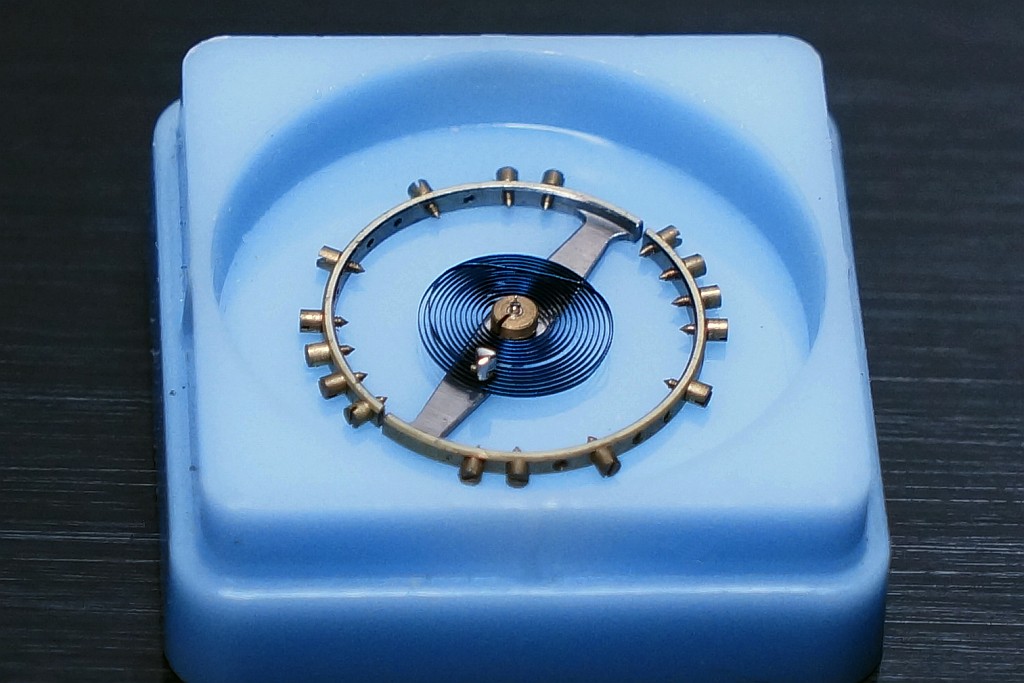
No picture so far - is this the real one?

At least it looks so, it is a bimetalllic cut balance and has the deep blue Breguet hairspring... if the package says 30T2 you can at least use it. It cannot be told by the photo if it has a chronometre qualified staff and roller or not...