Proof that the Speedmaster is superior to the Daytona

Posts
3,669
Likes
24,858
Can you add this one to your analysis?

Add an actual GMT hand to it and it would be perfect.
 
Posts
961
Likes
517
Depth ratings for watches are pretty useless beyond a certain point. The watch may be able to tolerate the water pressure, but YOU can’t. The vast majority of individuals who wear dive watches are confined to desk diving only.

Of course this matter comes up time and again with some interesting rationale that is applied right across the spectrum.

The industry tests to varying pressures which are specific in accordance with the design of the watch and what is stipulated by the manufacturer.
The tests are deemed to be absolute regardless of methodology even if the results may occassionally be inconclusive.
This gives the person performing the tests clear pass or fail parameters.

There is a disconnect between the depth rating and what a watch is deemed to be suitable for by the manufacturers.
Every manufacturer states(with a high degree of consistency) what the practical application is with regard to water resistance ratings.
Most manufacturers state that a 30 m rated watch is only suitable for a bit of careful hand washing or the occassional sprinkle of rain.
They nearly all state that a 50 m watch is only suitable for swimming or a bit of snorkelling.
A 100 m watch is fine for water sports such as surfing, jet skiing or water skiing.
A 200 m watch is fine for Scuba diving.
The rest is fairly obvious without getting into saturation diving or whether there is a mechanism to lock a pusher or crown down.😉

The stated application(which is often depicted by a pictorgrame for the benefit of the unitiated) is what the manufacturer will go by unless they need to quantify or establish water resistance in the event of a failure.

I wouldn't like to bump a Speedy pusher hard enough or at the wrong angle at any depth greater than when swimming on the surface👎

 
Posts
10,134
Likes
58,070
Of course this matter comes up time and again with some interesting rationale that is applied right across the spectrum.

The industry tests to varying pressures which are specific in accordance with the design of the watch and what is stipulated by the manufacturer.
The tests are deemed to be absolute regardless of methodology even if the results may occassionally be inconclusive.
This gives the person performing the tests clear pass or fail parameters.

There is a disconnect between the depth rating and what a watch is deemed to be suitable for by the manufacturers.
Every manufacturer states(with a high degree of consistency) what the practical application is with regard to water resistance ratings.
Most manufacturers state that a 30 m rated watch is only suitable for a bit of careful hand washing or the occassional sprinkle of rain.
They nearly all state that a 50 m watch is only suitable for swimming or a bit of snorkelling.
A 100 m watch is fine for water sports such as surfing, jet skiing or water skiing.
A 200 m watch is fine for Scuba diving.
The rest is fairly obvious without getting into saturation diving or whether there is a mechanism to lock a pusher or crown down.😉

The stated application(which is often depicted by a pictorgrame for the benefit of the unitiated) is what the manufacturer will go by unless they need to quantify or establish water resistance in the event of a failure.

I wouldn't like to bump a Speedy pusher hard enough or at the wrong angle at any depth greater than when swimming on the surface👎
Understood. My point was simply that beyond a rating of 200m-300m, it doesn't make much difference. In my opinion, it's just marketing beyond that point.
 
Posts
2,781
Likes
4,707
Of course manufacturers are usually quite cautious in regards to their water resistance claims, due to legal liabilities, so when they say a watch that is rated to 30 meters is only safe for handwashing, they’re looking at the worst case scenario.
They’re keeping their arses covered in a litigious world.
You could most likely take a watch in good condition and regularly serviced with a 30 meter rating as good to 3 meters, that still leaves you with a good safety margin.
Now I personally have no intention of going as deep as 3 meters.
Quite often I ended up in the drink whilst sailing or working on boats, at no time did my speedie let me down.
 
Posts
961
Likes
517
I agree about the water resistance. It's more important for others than myself and the Daytona is certainly superior in that regard.

The "proof" title was meant to be tongue in cheek since none of this can be proven in a strict sense and much of it is absolutely subjective. Didn't mean to ruffle too many feathers. Honestly, kinda thought I'd be preaching to the choir since this is in fact the OmegaForums. It's not like I posted this on the Rolex forums. Heavens to Betsy, one can only imagine the clutching of pearls as I dare to question the almighty Daytona!
Clutching at pearls.
I like that👍
When all is said and done, I believe Rolex water resistance is never questioned in the mind of the consumer and the industry with 100 m being a rather conclusive rating for the regular day to day life of a watch😉
That is unless taking the odd shower whilst wearing the watch is a possibility, then that can be a confusing concept for some🙁

So is it OK to take a shower with a Speedy?
Which watch would one trust more to maintain the integrity of the case?
Assuming all things being as intended, the Daytona or the Speedy Pro?

I appreciate the inherant virtues of the Omega a whole lot more regardless and don't miss the extra 50 metres one little bit😀
 
Posts
483
Likes
712
Do you regularly go to depths greater than 50m?
I don't go to those depths but I have had 2 Speedmasters with water damage.
Its when on holidays and I've dived in the pool.
One was a brand new Trilogy.
I don't want to take my watch off when on holidays or leave it in the hotel room.

 
Posts
961
Likes
517
Understood. My point was simply that beyond a rating of 200m-300m, it doesn't make much difference. In my opinion, it's just marketing beyond that point.

Agreed👍
The marketing machine got me when I bought my DSSD🤦
And loving it😀
 
Posts
961
Likes
517
I don't go to those depths but I have had 2 Speedmasters with water damage.
Its when on holidays and I've dived in the pool.
One was a brand new Trilogy.
I don't want to take my watch off when on holidays or leave it in the hotel room.

Oh dear🙁
Did they fix it and make it all right?👎
 
Posts
30,327
Likes
78,262
There is a disconnect between the depth rating and what a watch is deemed to be suitable for by the manufacturers.

Not with Omega. The depth is the depth - that's all you need to know.

I wouldn't like to bump a Speedy pusher hard enough or at the wrong angle at any depth greater than when swimming on the surface👎

I wear a Speedmaster daily - like 90% of the time that is the watch that's on my wrist, as I use it regularly for work. In the last 10 years, I cannot recall once ever looking down and finding my chronograph had been started by some inadvertent push of the pusher. So the first thing is, I think the "risk" of accidentally pressing a pusher in is often greatly overstated in these threads.

Second, if that does by some chance happen, and a Speedmaster pusher is depressed while under water, people often equate this in their minds with opening a giant hole in the case. Nothing could be further from the truth. I'm not encouraging people to press pushers under water, but should it happen the most likely result would be...nothing.

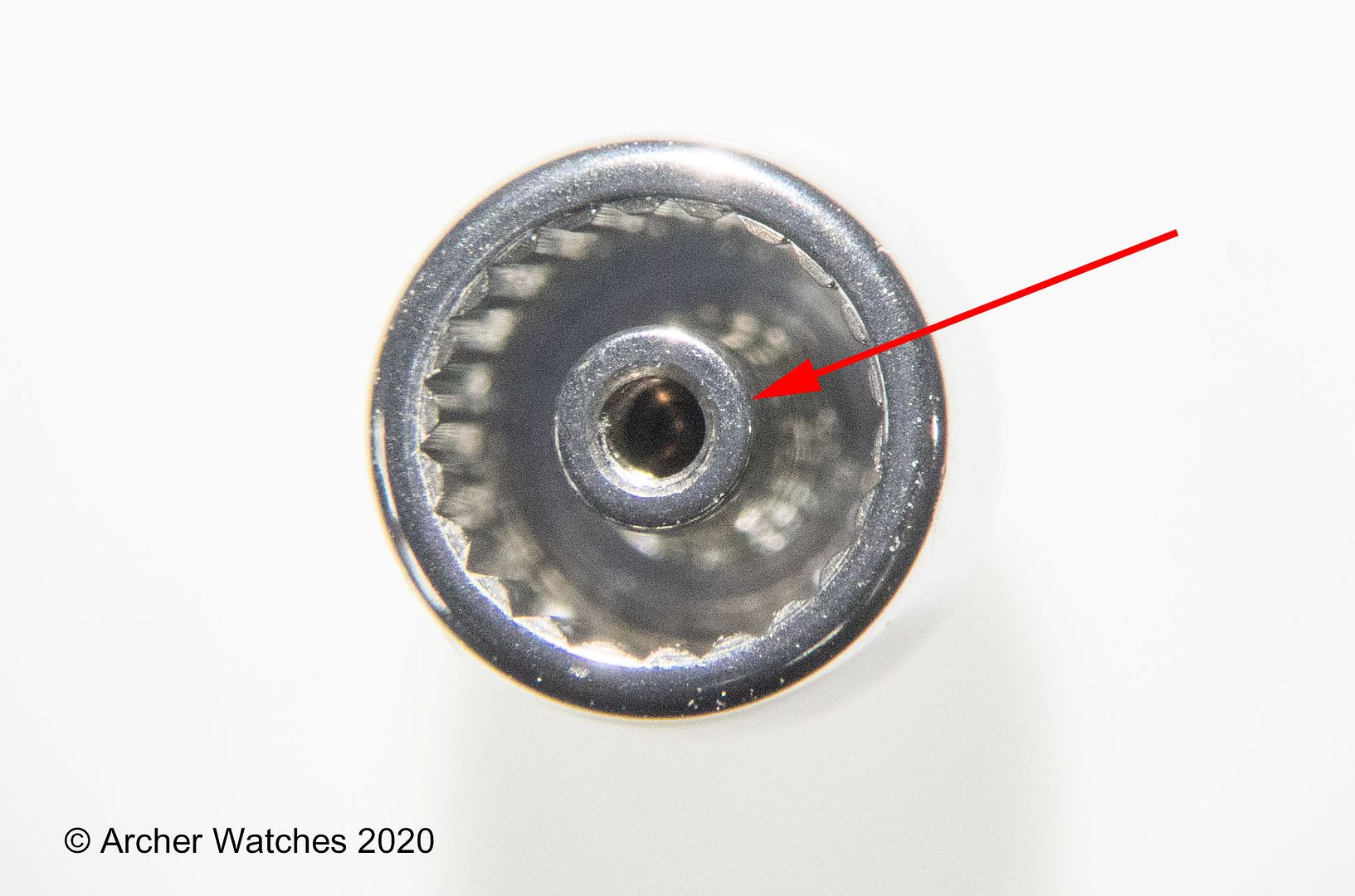
If we look at the standard pusher used on the 861/1861 era of Speedmasters (the new ones are slightly different) from the underside, this is what you see:


The red arrow points to the only gap there is for water to enter the pusher, between the splined pusher tube and the cap. Inside the pusher tube, there are 2 O-rings:


The post on the pusher cap goes inside those O-rings - the post never breaks contact with the O-rings:


So the only way water is going to enter the case when the pusher is pressed down, is if the cap is able to "pump" it past the 2 O-rings. While that is possible, since fluids under pressure will take the path of least resistance, it's likely in my view that it would get pushed right back out the gap between the pusher tube and cap, rather than be forced past 2 O-rings.

So again, the risks here are typically overstated in these threads...
 
Posts
30,327
Likes
78,262
I don't go to those depths but I have had 2 Speedmasters with water damage.
Its when on holidays and I've dived in the pool.
One was a brand new Trilogy.
I don't want to take my watch off when on holidays or leave it in the hotel room.

Unfortunate, but that failure is unlikely to be because of the depth rating or you diving into a pool. It's some sort of manufacturing defect.
 
Posts
97
Likes
144
I like a lot of Rolex offerings, especially in comparison to the Omega "counterparts", but between the two of these, if offered both for the same price I'd pick the Speedmaster every time. Aside from the history, the aesthetics and legibility are far better with the Speedy.
 
Posts
961
Likes
517
Not with Omega. The depth is the depth - that's all you need to know.


I wear a Speedmaster daily - like 90% of the time that is the watch that's on my wrist, as I use it regularly for work. In the last 10 years, I cannot recall once ever looking down and finding my chronograph had been started by some inadvertent push of the pusher. So the first thing is, I think the "risk" of accidentally pressing a pusher in is often greatly overstated in these threads.

Second, if that does by some chance happen, and a Speedmaster pusher is depressed while under water, people often equate this in their minds with opening a giant hole in the case. Nothing could be further from the truth. I'm not encouraging people to press pushers under water, but should it happen the most likely result would be...nothing.

If we look at the standard pusher used on the 861/1861 era of Speedmasters (the new ones are slightly different) from the underside, this is what you see:


The red arrow points to the only gap there is for water to enter the pusher, between the splined pusher tube and the cap. Inside the pusher tube, there are 2 O-rings:


The post on the pusher cap goes inside those O-rings - the post never breaks contact with the O-rings:


So the only way water is going to enter the case when the pusher is pressed down, is if the cap is able to "pump" it past the 2 O-rings. While that is possible, since fluids under pressure will take the path of least resistance, it's likely in my view that it would get pushed right back out the gap between the pusher tube and cap, rather than be forced past 2 O-rings.

So again, the risks here are typically overstated in these threads...

Thanks for that Al and much appreciate you going to the trouble on this one👍
I fully acknowledge the existence of the depth rating. Especially for establishing clear parameters for a static test which can be replicated with ease in a workshop and is crucial as a benchmark.

I still can't get past the pictogramme which is issued with every new Omega watch and the standard which the industry has fully adopted as i loosely explained above.
Now I'm not saying there is a disconnect and I appreciate there is a direct relationship between the depth rating for the purposes of a static test and the pictogramme for the consumer as a clear guide in practical terms.

I can say that there is a profound difference between a 30 m depth rating and the practical day to day life of a watch that occasionally takes a dip in the pool. Especially when one takes a 30 m rating at face value where even a relatively new watch will not survive repeated dunkings or the odd quick shower. As I learned the hard way back when I was much younger and dumber.
I also acknowledge that a 50 m depth rating provides a higher margin for error over 30 m and likewise with 100 m and so on it goes exponentially.

The reality is when we get down into the bottom end of the ratings(50 m or less) the margin for operator error diminishes greatly when one doesn't take the pictogrammes as a clearer guide.

Naturally, the test pressures are based upon a threshold for a mechanically sound watch.
Meaning the seals haven't been naturally degraded by the rigors of time, wear and tear or potentially exposed to vapours from solvents and petro chemicals.
Enter proper maintenance and servicing carried out by someone like yourself👍
As we all know there are more seals and gaskets than those housed within pushers and winding crown assemblies and an unconscious knock of the Crystal or bezel of a watch against something from the just the right angle can unravel a pressure rating.

I'll be sticking to the pictogramme as a good layman's guide so people like yourself aren't bothered unnecessarily with the effects of careless/reckless ownership practices from people like myself😀
I don't subscribe to notions around the manufacturers covering their backsides like some may be inclined to do. That's bordering on being a little obtuse. It lacks an understanding of the nuances of aspects of practical realities of life and competing priorities.

Thank you so much for taking the time with posting pics and your clear and concise explainations.
Much appreciated😀
Edited:
 
Posts
30,327
Likes
78,262
Thanks for that Al and much appreciate you going to the trouble on this one👍
I fully acknowledge the existence of the depth rating. Especially for establishing clear parameters for a static test which can be replicated with ease in a workshop and is crucial as a benchmark.

I still can't get past the pictogramme which is issued with every new Omega watch and the standard which the industry has fully adopted as i loosely explained above.

Just to clarify...


Omega does not put limits on what activities can be done with the watches - they are fully rated for submersion up to their specified depth, as Omega says clearly on this chart.

People often confuse what the pictograms state as being related to the water resistance of the watch, but that is not necessarily so. For example, dive watches have very defined features that are required to call them dive watches. So Omega will not say a watch is good for diving if it doesn't have those features, even though the watch may be perfectly capable of going to the depths for diving.

It's not necessarily the lack of water resistance, but the lack of features on the watch (rotating bezel, etc.) that limit what they can be used for.

088NS5140 | SEAL O-RING D34.5 D36.5 Ø1

The above seal is the case back seal for the Speedmaster Pro, rated to 50 m. This exact same seal (same part number and dimensions) is used in 377 different Omega reference numbers, ranging from the 50 m rated Speedy Pro, through a bunch of 150 m rated Aqua Terras, and also a pile of 300 m rated divers.

I can say that there is a profound difference between a 30 m depth rating and the practical day to day life of a watch that occasionally takes a dip in the pool. Especially when one takes a 30 m rating at face value where even a relatively new watch will not survive repeated dunkings or the odd quick shower. As I learned the hard way back when I was much younger and dumber.

Not all brands treat water resistance in the same way, and that is a shame. This, plus charts that you find on various reseller sites that are geared to reduce their liability, add a lot of confusion to this issue. Omega is one of the good guys in this regard, because they have clearly defined that if it's rated to a particular depth, it can go to that depth - period. No loose interpretations from silly diagrams needed.

Enter proper maintenance and servicing carried out by someone like yourself👍
As we all know there are more seals and gaskets than those housed within pushers and winding crown assemblies and an unconscious knock of the Crystal against something from the just the right angle can unravel a pressure rating.

Of course watches need to be maintained, regardless of what the depth rating is. Most of the flooded watches I get in for servicing, are rated for 300 m or more, have screw down crowns, etc. These things are no guarantee if the watch isn't maintained.
 
Posts
238
Likes
216
Great post Archer - especially interesting callout about how the Speedy shares the same case back seal as so many other references that have a higher water resistance rating.

I’d like to see a special edition Speedmaster with screw-down crowns one day, as I worry I’ll accidentally engage a pusher in the pool/ocean.
 
Posts
6,609
Likes
26,784
I worry I’ll accidentally engage a pusher in the pool/ocean.
Just in case you missed it 👍
I wear a Speedmaster daily - like 90% of the time that is the watch that's on my wrist, as I use it regularly for work. In the last 10 years, I cannot recall once ever looking down and finding my chronograph had been started by some inadvertent push of the pusher. So the first thing is, I think the "risk" of accidentally pressing a pusher in is often greatly overstated in these threads.

Second, if that does by some chance happen, and a Speedmaster pusher is depressed while under water, people often equate this in their minds with opening a giant hole in the case. Nothing could be further from the truth. I'm not encouraging people to press pushers under water, but should it happen the most likely result would be...nothing.

If we look at the standard pusher used on the 861/1861 era of Speedmasters (the new ones are slightly different) from the underside, this is what you see:


The red arrow points to the only gap there is for water to enter the pusher, between the splined pusher tube and the cap. Inside the pusher tube, there are 2 O-rings:


The post on the pusher cap goes inside those O-rings - the post never breaks contact with the O-rings:


So the only way water is going to enter the case when the pusher is pressed down, is if the cap is able to "pump" it past the 2 O-rings. While that is possible, since fluids under pressure will take the path of least resistance, it's likely in my view that it would get pushed right back out the gap between the pusher tube and cap, rather than be forced past 2 O-rings.

 
Posts
16,920
Likes
48,155
I would take a Speedy over a Daytona
But
A Sub over a Seamaster (HE valve🤮)
 
Posts
718
Likes
731
I'm not surprised that this thread resulting in more talking about the Speedy's WR, but I am surprised it has not ignited more entertaining fanboyism of Rolex v Omega.

Probably would get that result if this same thread was posted somewhere like WUS I guess.
 
Posts
1,419
Likes
764
A test and enjoy. On the beach it's funny to see a scared guy with a submariner date in steel and gold having a look at your speedmaster with a nato 😁
 
Posts
267
Likes
726
I like both but lean towards the Speedy as an everyday watch but certainly wouldn't wear it while doing any water sports such as jet skiing or diving. I don't own a Daytona but I would wear one when doing the same said water sports as I did with my Hulk for many years. With that said though, good luck getting my hands on a Daytona these days without paying an exorbitant price. Whereas its pretty easy to get your hands on a Speedmaster.

I just looked at the time on Speedmaster and it stopped over 2 hours ago. My heart sunk until I realized I forgot to wind this morning. +1 for the Daytona there.