I wish I could have been in there as well. It would have been very interesting.
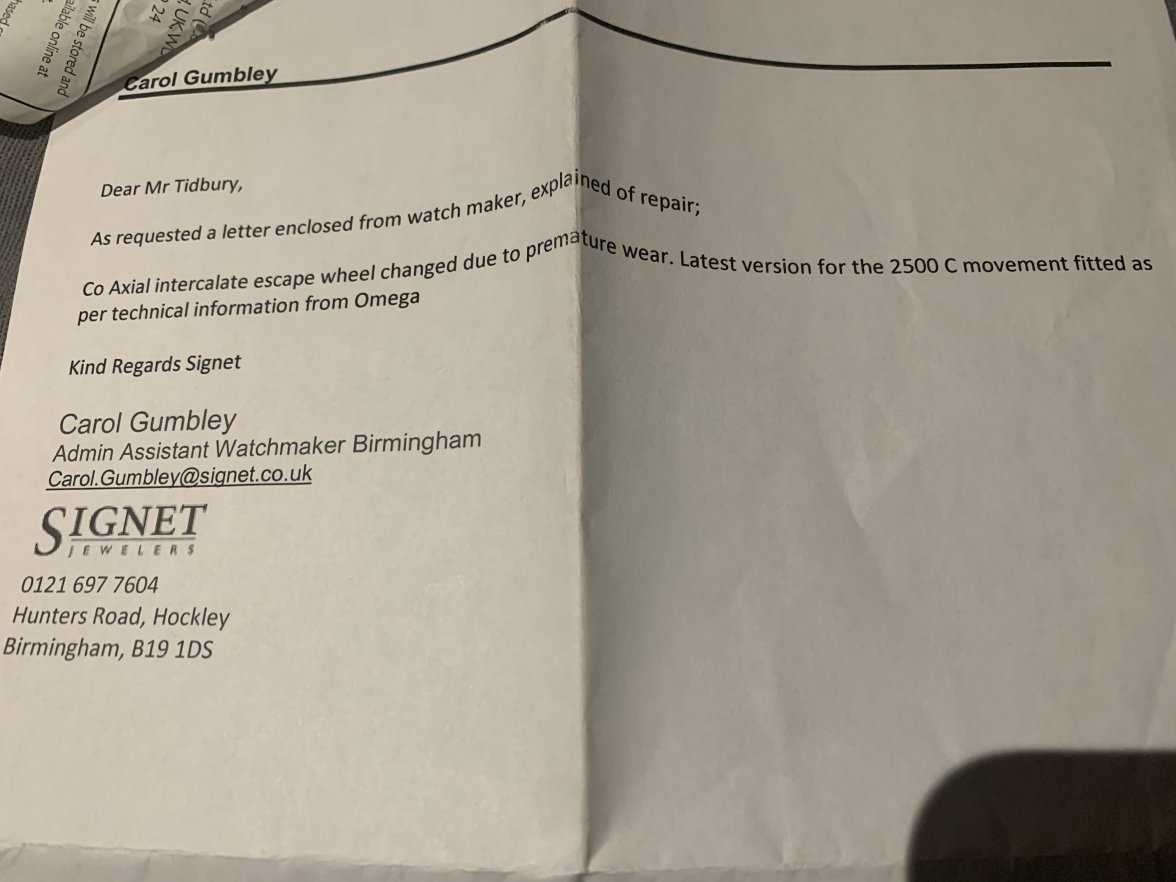
I should have worded my statement better, for sure, but I meant that the 2500C (after Omega servicing) is a very reliable movement. If that's incorrect I'd like to know. When I was shopping around for a 2500 version of a PO in the 42mm size I was told by two of your colleagues that I shouldn't put too much into the C vs. D argument if the watch has been serviced.
Here is the upgrade kit for the 3313 so you know what an upgrade would actually look like:

It includes a new base plate with the new caliber designation under the balance, a new co-axial wheel, and a new intermediate wheel:

There is no kit like this for the 2500. There are 4 variations of the 2500, so the A, B, C, and D. A through C are the 2-level escapement design, and D is the 3-level. So the D doesn't need upgrading, and that leaves the other three.
The 2-level design tries to incorporate two functions into the teeth of the intermediate escape wheel, and the upper co-axial wheel teeth. This results in a very odd shape for the teeth, and it is this shape that caused the sticky black residue to accumulate, and this residue would stop the watches prematurely.
This is what that residue looks like:

Omega tried a lot of different things to solve this, including varying lubrication changes, and for one of the three 2-level variants (the C) they changed the coating that was on the intermediate escape wheel. But they didn't change it on the other 2, and that tells me that the coating wasn't really the solution or they would have made the same change on the A and B. There aren't many A's out there, but there are a ton of B's, mostly in Aqua Terra models.
So the "final" result of all their efforts is to the intermediate escape wheel treated with epilame, and every single tooth on that wheel is oiled with an oil that I don't use for any other application. So the escapement that doesn't need oil, has a total of 20 teeth on the intermediate escape wheel that get oiled, plus 10 more on the co-axial wheel (all 8 lower teeth, and 2 of the upper teeth).
So did this "solve" the problem? IMO no it didn't, because even after this the wheels still have residue on them, and this is a problem of geometry. But it appears to have delayed this from causing an issue during a normal service interval, so practically you can say it does I guess. The 2-level was initially chosen because it takes up less space (height), but Omega has abandoned it completely due to this problem, and all current escapements are the 3-level design.
So asking if it is "reliable or unreliable" isn't the right question in my view. The question is, is it more or less reliable than the current 3-level co-axial escapement - in my view it is less reliable than the 3-level designs. The issue was mitigated by the changes Omega made to the lubrication on the 2-level escapements, but it was eliminated by changing to the 3-level design.
Cheers, Al