Omega Geneve pie pan

Posts
2,876
Likes
1,962
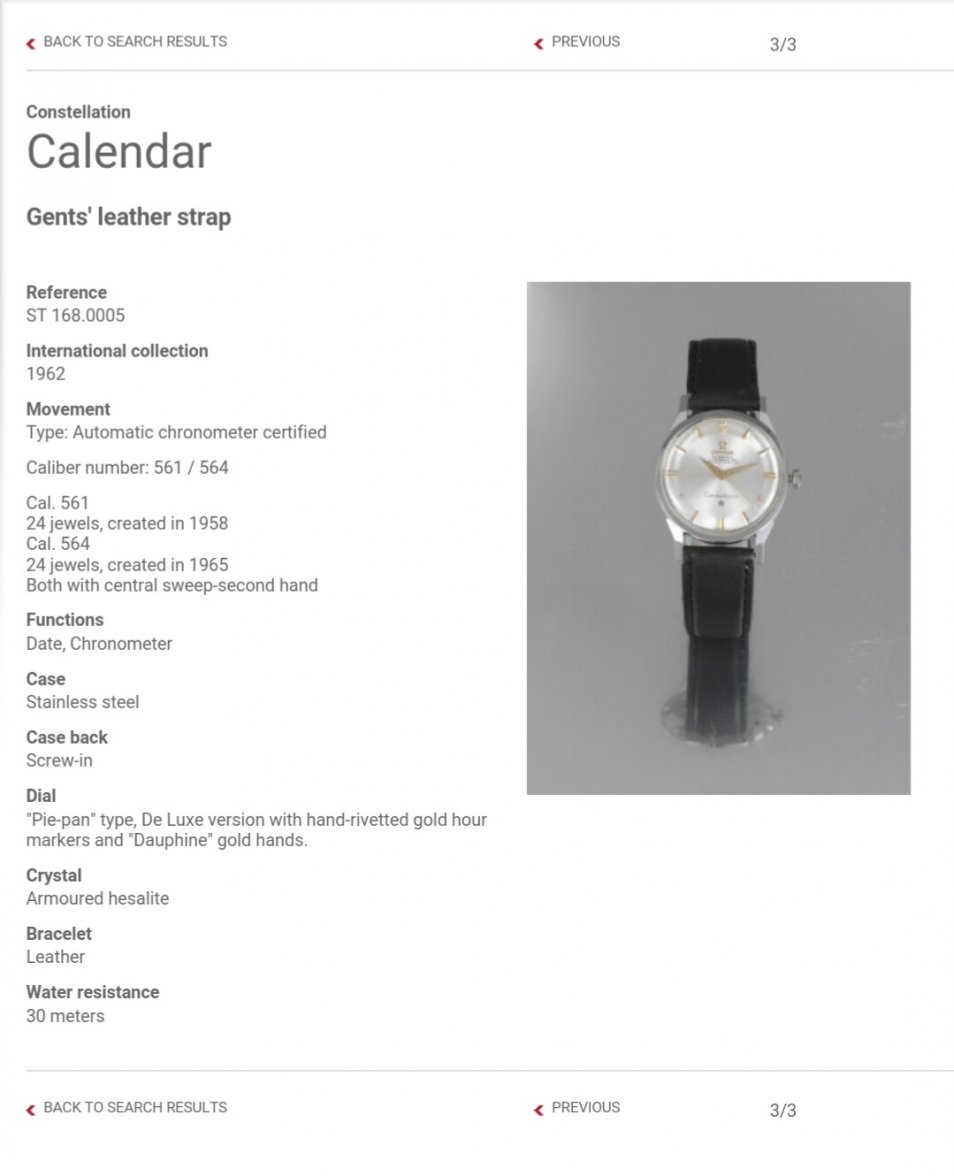
Bottom line is that Omega referred to these dials as "Pie-pan" back to the very first Constellation reference:

Ref. 2648: http://www.omegawatches.com/planet-omega/heritage/vintage-watches-database?ref=14814
"Dial:
'Pie-pan' type, with "Dauphine" hands."
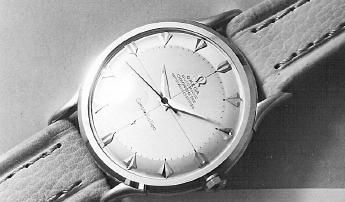


Not sure how this particular style obtained the name "Pie-pan" from Omega, but there you are.

Well well, doesn't this presumably original and accurate catalogue depiction raise questions about the "only 12-sided Connies are true pie-pans", and "domed dials are not pie-pans" arguments?

Thanks Gator!
Not so soon. OVDB also calls the 12 sided dial as "pie pan". In other words, they call everything under their sun as "pie pan".


OVDB is not exactly the bible to rely on, with countless errors and inaccuracies. Evan surely knows this more than most. The above screenshot has one of those major errors.

FWIW, AJTT doesn't mention "pie pan", but refers to dome dials and specifically 12 sided and 12 facets dials.
Edited:

 
Posts
8,152
Likes
28,762
Not so soon. OVDB also calls the 12 sided dial as "pie pan". In other words, they call everything under their sun as "pie pan".

No, not everything under the sun - only the dials that might reasonably be considered to be pie-pans.

In any case, the original catalogue reference that Gator posted should put to rest the claim that only the 12-sided Connies are 'true' pie-pans.
 
Posts
2,876
Likes
1,962
No, not everything under the sun - only the dials that might reasonably be considered to be pie-pans.

In any case, the original catalogue reference that Gator posted should put to rest the claim that only the 12-sided Connies are 'true' pie-pans.
You're mistaken. It's not a catalogue or original. And Gator just said true "pie pan" is the 12 sided one.

Also the dome dial on ref. 2648 does not meet your own criteria for a pie-pan dial. Will you tell Omega that they're wrong and stop going against your idea of industry standards? 😉 😁
Edited:
 
Posts
2,876
Likes
1,962
No, not everything under the sun - only the dials that might reasonably be considered to be pie-pans.
If OVDB is your bible, they don't call the dial of OP's watch a "pie pan" one. Will you stop calling it "pie pan"? 😉

 
Posts
8,152
Likes
28,762
You're mistaken. It's not a catalogue or original. And Gator just said true "pie pan" is the 12 sided one.

Also the dome dial on 2648 does not meet your own criteria for a pie-pan dial.

a) It's an image and reference taken from the Omega Vintage Watch database. Where do you think that they sourced that image? It is clearly an early Omega reference image, and almost certainly appeared in a catalogue.

b) The OVDB is inconsistent? So what? That hardly supports your narrow position.

c) I never stated that a domed dial isn't consistent with a pie-pan designation. I merely pointed out that there is a distinction to be made.

When you boil it down to its essence, this issue is not really about opinions. The expression "pie-pan" is used widely in vintage watch communities, and it's derivation is easy to understand. The basic configuration of a pie pan (as in baking) is that it has a large, flat base, and sides that rise up evenly in an outer ring. There are some that rise sharply, and others that do so at a more shallow angle.

There are no strict criteria for watch dials that are called pie-pans, beyond the primary characteristics that I have mentioned. As long as the base of the dial is flat (which is the case with most domed dials as well), and the outer rim slopes down, it can reasonably be considered a pie-pan dial.

Now, I have never disputed that Omega collectors have a more limited usage of the expression, but that doesn't mean that watches other than the 12-sided Connies are, by definition, not pie-pans.
Edited:
 
Posts
2,876
Likes
1,962
a) It's an image and reference taken from the Omega Vintage Watch database. Where do you think that they sourced that image? It is clearly an early Omega reference image, and almost certainly appeared in a catalogue.
The image of the watch may be from an old catalogue, that doesn't mean the term "pie pan" was from an "original catalogue" like you alluded to.

b) The OVDB is inconsistent? So what? That hardly supports your narrow position.
It does support my position that not everything on it is true, including what exactly "pie pan" is. I have no position in what is a "pie pan" for me personally. I just describe the norm nowadays.

c) I never stated that a domed dial isn't consistent with a pie-pan designation. I merely pointed out that there is a distinction to be made
Your distinction and your posted images of other brands' pie-pans exclude the dome dial of the ref. 2648 posted above. If dome is the same as pie-pan then what is a dome and what is a pie-pan? Why differentiate the two?

d) Gator has his opinion, and I have mine.
I'm fine with your opinion. IF your opinion could become the norm one day, good for you. But opinions of more seasoned collectors like Gator, Desmond and the like just take precedence of yours these days. Your opinion may be "technically" true because of your taking the likeness to a frying pan as the main criteria, may be true somewhere else, but language evolves and your term is not true for vintage Omega dials at the present. 😀
 
Posts
8,152
Likes
28,762
/...anguage evolves and your term is not true for vintage Omega dials at the present. 😀

I have never disputed that the expression is used narrowly by Omega collectors. 😉

Seriously, I have no problem with Omega collectors reserving the expression for 12-sided Connies. I'm simply pointing out that there are other models that fit the generally (and more broadly) accepted definition.
 
Posts
13,426
Likes
18,635
In any case, the original catalogue reference that Gator posted should put to rest the claim that only the 12-sided Connies are 'true' pie-pans
To be fair, I really have no clue what Omega considered to be a pie-pan dial and what they didn't.

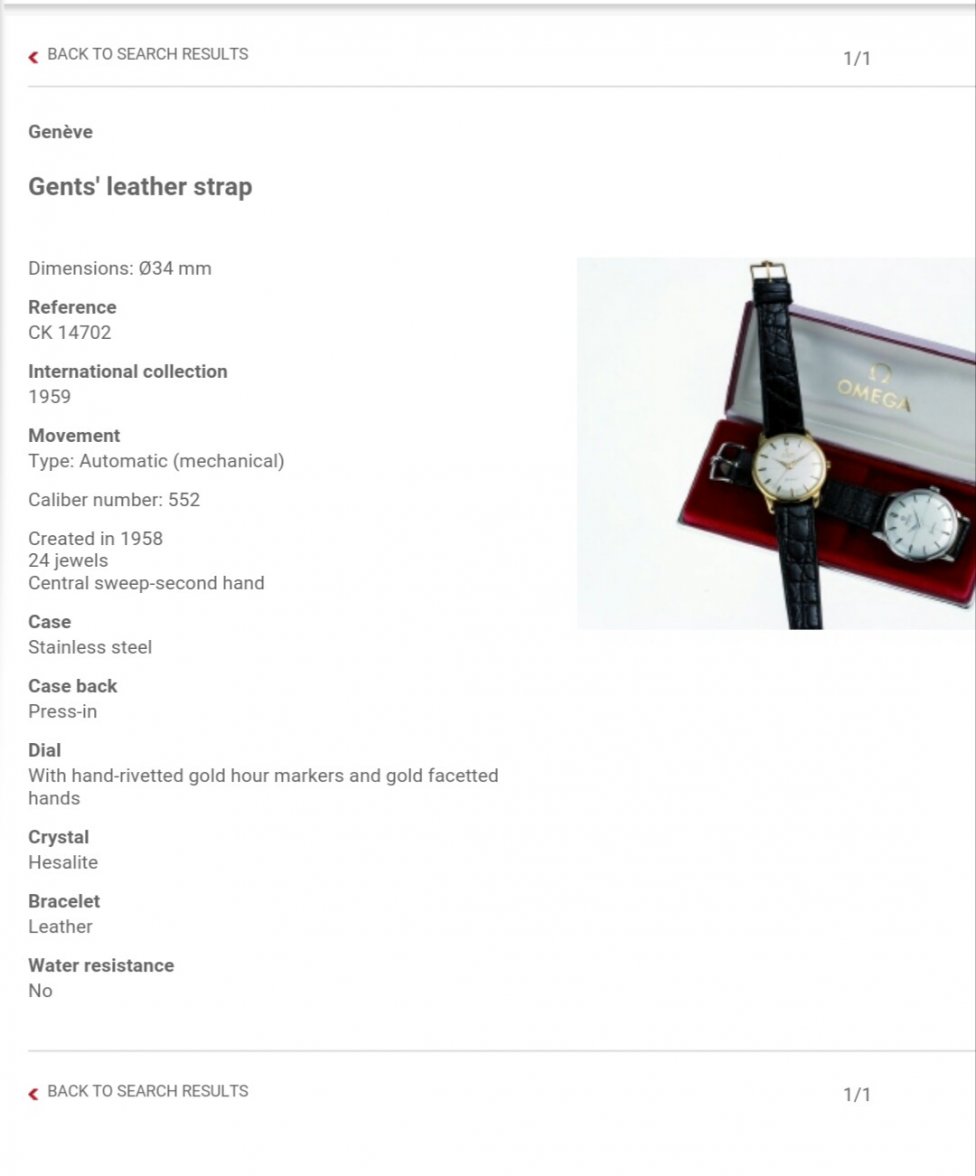
In my original post I mentioned that all of the entries in the current version of the database are missing a disclaimer that told us that other dial styles existed. So any OVDB entry has to be taken with the proverbial grain of salt, since the pictures and descriptions don't always match.

In my admittedly narrow view, only watches with multi-plane dials should be considered pie-pans. That would include circular facets, like the IWC above or the standard 12-sided Omega dials (and plenty of others). The confusing part is that there are dozens of two-tone Omega dials that get called "pie-pan" in on the OVDB and auction descriptions that in my view, aren't.

In other words, I agree with Kyle.
gatorcpa
 
Posts
8,152
Likes
28,762
To be fair, I really have no clue what Omega considered to be a pie-pan dial and what they didn't.

In my original post I mentioned that all of the entries in the current version of the database are missing a disclaimer that told us that other dial styles existed. So any OVDB entry has to be taken with the proverbial grain of salt, since the pictures and descriptions don't always match.

In my admittedly narrow view, only watches with multi-plane dials should be considered pie-pans. That would include circular facets, like the IWC above or the standard 12-sided Omega dials (and plenty of others). The confusing part is that there are dozens of two-tone Omega dials that get called "pie-pan" in on the OVDB and auction descriptions that in my view, aren't.

In other words, I agree with Kyle.
gatorcpa

When you say "multi-plane", presumably you mean a clear demarcation between the two aspects of the dial, and a fairly sharp drop-off. If so, I understand your position, and admit that there is no clear standard. The problem that I have with it is that some dials that feature more gentle roll-offs still give a basic pie-pan impression.

At the end of the day, it probably boils down to whether one believes that pie-pan dials must resemble the most common type of actual pie pan, or whether a looser standard is applied.
 
Posts
1,325
Likes
1,870
This sort of discussion is what makes this forum, in particular, such a great place to hang out

My only regret is that the discussion above, wasn't held in a good old fashioned oak pannelled, English boozer, with a few dark brown, warm IPAs on the table, a sleeping dog under it, and a few bags of crisps and pickled eggs lying around to snack on.

What a great Friday night that would make 😀
 
Posts
49
Likes
8
Well, it's not a pie pan! If you look closely the dial is curved, and not 12 sided as in true pie pan constellations?

However, the dial is a nice one, with some signs of gentle patina, and it's a nice old 1960s Geneva

I would give it a service, change the crystal ( or clean it with poly watch) , and wear on a nice lizard brown leather strap

Enjoy
There is a slight curve away at the seconds markers on my 601 movement GENEVE I think is that still known as a pie pan
 
Posts
6,445
Likes
9,966
There is a slight curve away at the seconds markers on my 601 movement GENEVE I think is that still known as a pie pan
Pics would help - but I’m going to guess no.

A pie pan has a distinct edge between the centre flat centre plane and the outer portion of the dial.

In the Omega world a pie pan dial has 12 flat faceted panels around the outer edge of the dial.

What you describe sounds like a dome dial - which has a flat centre with a gentle then steepening curve to the edge of the dial - often painted with a trompe l’oeil effect to replicate a distinct edge to the centre plane.
 
Posts
9,883
Likes
55,862
Pics would help - but I’m going to guess no.

A pie pan has a distinct edge between the centre flat centre plane and the outer portion of the dial.

In the Omega world a pie pan dial has 12 flat faceted panels around the outer edge of the dial.

What you describe sounds like a dome dial - which has a flat centre with a gentle then steepening curve to the edge of the dial - often painted with a trompe l’oeil effect to replicate a distinct edge to the centre plane.
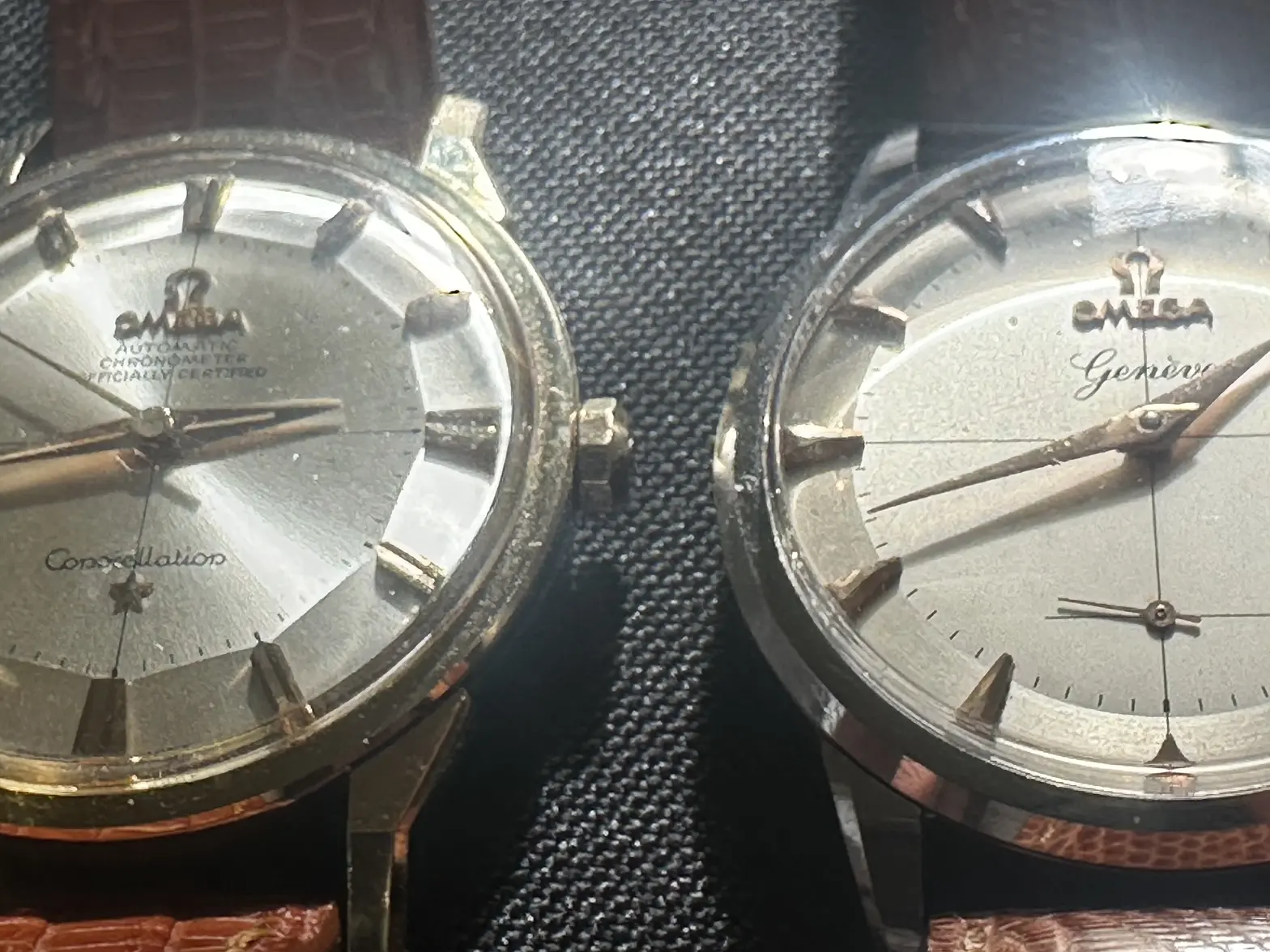
Peemacgee has it correct. On my left is a “genuine” pie pan on a Constellation. On my right is a dome dial on a Geneve with an effect to replicate a distinct edge to the central plane. The difference between the two is easily seen when the dials are shown in bright sun.
Edited: