Is a "cheap" time-only JLC Atmos clock worth owning?

Posts
2,406
Likes
6,949
When mine stopped running a couple of years ago, I was able to find a retired clockmaker with a pretty good knowledge of these. He tested the bellows and said there were no problems there. He recommended a manual winding of the mainspring for $75 and said I need to leave it outside occasionally. That will cause the bellows to contract more than it normally would indoors.
Is it because your house maintains a very uniform temperature throughout the day and night?
 
Posts
13,121
Likes
17,993
Yeah. I have a programable thermostat.

In the summer, I have it turn off the A/C in the afternoon when I'm not home. Temperature goes up and down every day.

Temps are more stable here in the winter and even if the A/C turns off, it doesn't get that hot and temperature doesn't vary much.

This is death to an Atmos. It works best in a drafty old European castle. They don't do well in museums where temperature is well regulated.
gatorcpa
 
Posts
2,406
Likes
6,949
This is death to an Atmos. It works best in a drafty old European castle.
gatorcpa
Time to upgrade your place to an old European castle. 😎
This reminds me: a few years ago my wife and I had the privilege of staying a week at Moyvannan Castle, near Athlone, Ireland. We were fortunate to have stayed here a week. We had the castle all to ourselves! 😀
 
Posts
3,719
Likes
4,203
Well resurrecting this thread. I have been eyeing to get myself one for months now. Will probably get the opportunity to pick one up shortly. I love clocks. All the rooms in my house has one.
 
Posts
15,230
Likes
44,722
I wonder if anybody following this thread has an Atmos owner's manual? If so, does it actually say that temperature change contributes to the winding of these clocks? Considering the brutally strong steel coil spring that the bellows has to expand against when atmospheric pressure falls, I would be very surprised if one or two degrees variation in temperature would contribute to winding. A lot of these clocks offered for sale have quit on the previous owner. After having difficulty a/ finding someone who will work on one, or b/ finding the cost of repair unpalatable, they dump it on an unwary buyer. Caveat emptor.
 
Posts
13,121
Likes
17,993
I wonder if anybody following this thread has an Atmos owner's manual? If so, does it actually say that temperature change contributes to the winding of these clocks? Considering the brutally strong steel coil spring that the bellows has to expand against when atmospheric pressure falls, I would be very surprised if one or two degrees variation in temperature would contribute to winding.

https://www.manualslib.com/manual/838748/Jaeger-Lecoultre-Atmos-Classique.html?page=2#manual
Temperature variations are its source of power. Its balance will oscillate as long as the sun shines. Rises in temperature dilate the gaseous mixture trapped in the expansion chamber which then compresses the winding spring. In the event of a fall in temperature, the reverse occurs. The gas contracts and the spring relaxes. This imperceptible back-and-forth motion is sufficient to wind the Atmos clock.
My clockmaker recommends two methods of keeping these going:

1. Make sure that the clock gets some direct sunshine. That is, keep it near a window where the sun will warm it up every day. I used to have mine in a location like that. It lasted 9 years out of the box after not being used for years before that. Unfortunately, I purchased a large screen TV that forced me to find another place for the Atmos.

2. Use a hair dryer to gently heat up the case every 3 months or so. Do this once an hour for a minute or so. Then repeat every hour for 5-6 hours. So far, so good.
gatorcpa
 
Posts
2,406
Likes
6,949
I wonder if anybody following this thread has an Atmos owner's manual? If so, does it actually say that temperature change contributes to the winding of these clocks? Considering the brutally strong steel coil spring that the bellows has to expand against when atmospheric pressure falls, I would be very surprised if one or two degrees variation in temperature would contribute to winding.

See my previous post on effects of temperature on the pressure of the gas used in the clock.
 
Posts
4,512
Likes
9,329
To answer OP , just about every watchmaker I have met own at lest one Atmos.
that is good enough for me ....


Bill

Yes, Ash I have one.....
 
Posts
15,230
Likes
44,722
Well, this all is news to me. I have long been under the impression that it was change in atmospheric pressure that wound these.
 
Posts
18,098
Likes
27,413
Well, this all is news to me. I have long been under the impression that it was change in atmospheric pressure that wound these.

Local temp variation is enough and surprisingly strong.

Take an empty water bottle on a hot day and put it in front of a car AC vent. You would be amazed how fast and how much you can shrink the bottle.
 
Posts
3,719
Likes
4,203
I try to avoid central air and do passive heating and cooling (by opening and closing windows). I figure theres 10 degrees of temperature variation every day here indoors. It's worse outdoors!
 
Posts
13,121
Likes
17,993
I have long been under the impression that it was change in atmospheric pressure that wound these.
That was true of the original design, which ran off the movements of mercury (like a barometer).

With the discovery of how toxic mercury really was (and they needed a lot of it to run the Atmos), JLC and Reutter designed a different winding system based on boiling of ethyl chloride at roughly room temperature.
gatorcpa
 
Posts
2,510
Likes
3,732
Even then scientists knew how dangerous mercury was in the quantities needed to run an Atmos.

In my high school chemistry lab (not locked regularly, and pretty much open to anyone) they had a 5lb bottle of mercury setting on the shelf. Surprising how small it was for the weight of course. The other thing of interest was a bottle of pure extract of nicotine, which could have been very bad if someone had wanted to poison the whole school. This was about 25 years ago now.
 
Posts
4,512
Likes
9,329
That was true of the original design, which ran off the movements of mercury (like a barometer).

With the discovery of how toxic mercury really was (and they needed a lot of it to run the Atmos), JLC and Reutter designed a different winding system based on boiling of ethyl chloride at roughly room temperature.
gatorcpa
Hi guys

I have to disagree. Many years ago I turned a friend on to atmos clocks ... he went nutz... he basically cornered the market of them at every NAWCC regional and national Mart ...

I am not joking about this . Then he got into buying the early Reutter models with the mecury tube.... the mecury tube was shaped like an "s" with a rod in the center as the temp went up the tube it would shift the center of gravity of the entire assembly and it would turn to the right like 1/4 to 1/3 turn , winding the main spring , then when it got cooler the mecury would draw back and shift the center of gravity back and it would back to the original position .. so it was winding by Change in temperature ...


Will look for drawing etc


Best

Bill
 
Posts
3,040
Likes
14,175
I have researched these for a couple years and finally bought one recently. My experiences factor into the responses below under the underlined questions...

Im not normally into clocks but the JLC Atmos is something rather unique and special being what it is. There are numerous cheap (sub $1000) two hand variants on eBay that all seem serviceable but I'm wondering a few things:

Are these cool enough to be worth owning?

Very cool. Closest you'll get to a perpetual machine, and when you tell people it never needs winding, no battery..that's cool too.

They MUST be placed on a steady solid surface with no movement whatsoever. That's why they even sold a wall shelf years ago. Mount it to a wall to avoid movement. I believe they were designed as a mantle clock, a mantle usually being the most secure placement in the home, as long as you don't use the fireplace underneath. They are incredibly sensitive to their environment. 1W of energy could power 30million Atmos clocks(yes million). The balance twists on a long and very very fine wire (hangs like a pendulum but twists instead of swinging). They are very easy to stop, and I believe that is the most common issue.

A full winding of the mainspring will run the clock for just over two years without rewinding.

The pendulum only consumes 15% of the mainspring energy, with the gear train and escapement consuming the rest.

It only takes 1 degrees of temp variation to run the clock for two days. That's way within normal variation in a house from day to night. I fact it only takes 0.25deg F to advance the mainspring by one click.

Re temp vs pressure on winding, temp variation is 90% of the winding, and pressure changes contribute the remaining 10%. Pressure changes are quite small day to day, and only serve to "shift the curve" on how temp changes contribute. So temp and pressure work together, with Temp being the major factor, and Pressure being the minor factor.


Are they reasonably accurate enough long term?

A well cared for and adjusted Atmos will run seconds/month. Yes, seconds.

Are they a big risk of damage in shipping?

Yes, because you ship with the glass case as well to protect the movement. There is a lever on the bottom of case to lock the balance in place for movement and shipping.They must be double boxed. The JLC box is the best box to use but I don't have one so I used the advice of the watchmaker I'm sending it to. Its bubble wrapped around the sides, then around the top and bottom, then in a sturdy box with peanuts packing to fill in gaps, and that box then goes into a larger box filled with peanut packing on all sides. Its a big box. The greatest risk in its whole life will be in general movement and shipping.

Are they expensive to maintain or difficult to find a clockmaker to work on them?

It's a talent for sure and few have it, plus it CAN be expensive. JLC will only supply certain watchmakers, so there are very few qualified in the first place, and parts are expensive. Generally I have been told its about every ten years for a service, in a clean home. As there is virtually no lubrication and the case is open to atmosphere, mere dust can slow the movement.

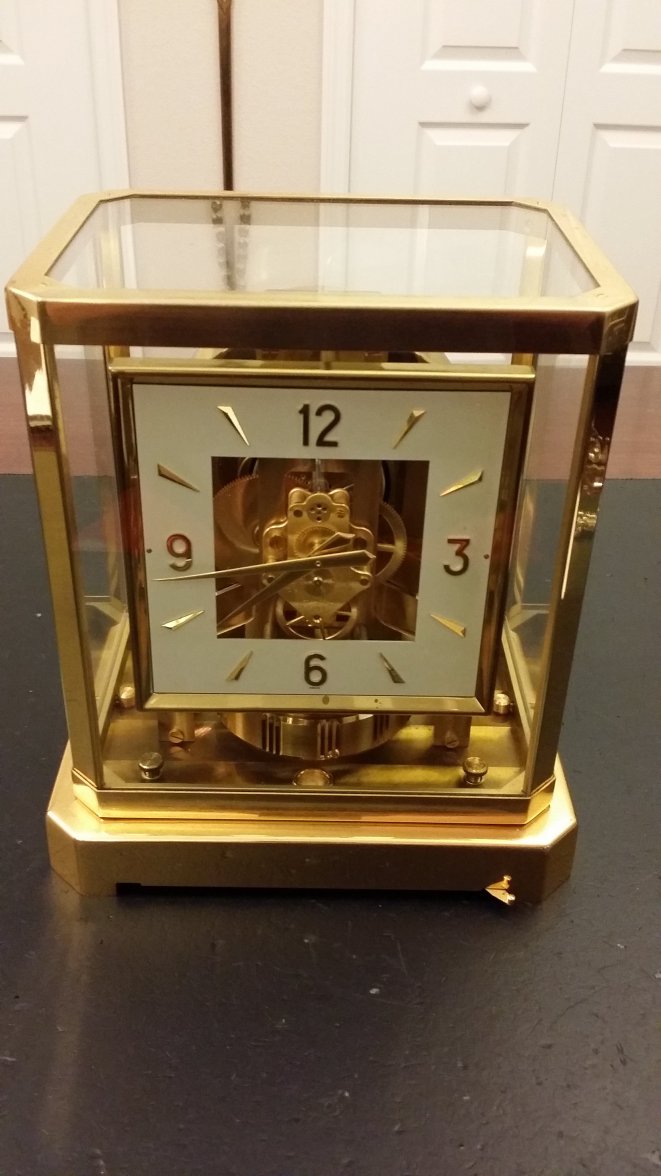
There are alot of crap Atmos out there. Like any fine timepiece, history matters. That's why it has taken me almost three years to find a good one. Even if it looks perfect, assume it will need a cleaning just to run. Its not a like a watch where they can be in poor condition but still run. An Atmos has to be in virtually perfect state to run.This is the one I found(below), and actually found it locally at an estate sale for $450. Virtually perfect condition, 1962 model square face with matching gold wall shelf (a $1000 accessory back in the day). The shelf alone is worth ~$250 (and currently for sale as I don't need it)so I basically have $200 in the clock. Well worth the additional cost to clean. When I got it home it took several days to adjust to the new environment and It still only runs a couple hours and stops, classic need for cleaning. The cleaning will probably be $400 plus $100 shipping for both ways, so $500 total. All told I expect the clock to be in for $700 total when I'm done, assuming no parts replacement. For comparison, they are ~$7000 new.


Do they turn off watchmakers as much as normal clocks do?

99% of watchmakers won't touch one because of the talent and knowledge required, and that they can't get parts.

If your interested I'll post some good websites and information on Atmos, or just PM me. I even have a Clemson U research paper on the operation of the Atmos. Fascinating.
Edited:
 
Posts
33,462
Likes
38,164
Hi all

Take a look a this site.. .they have some really uncommon examples...


http://www.atmosadam.com/atmos.html

its not the easiest site to navigate but some really killer stuff!!

Bill
I love the moonphase on the homepage and the three cone stand that's just epic stuff... I'm guessing that's on the uber expensive side of things though.
 
Posts
2,406
Likes
6,949
I have to disagree.
Hey Bill, what are disagreeing to? I reread you text twice and can't figure out what... 😵‍💫
 
Posts
4,512
Likes
9,329
Hey Bill, what are disagreeing to? I reread you text twice and can't figure out what... 😵‍💫
Hi

The early mecury tubes atmos also used change in temp to wind the clock... not pressure change..

Bill