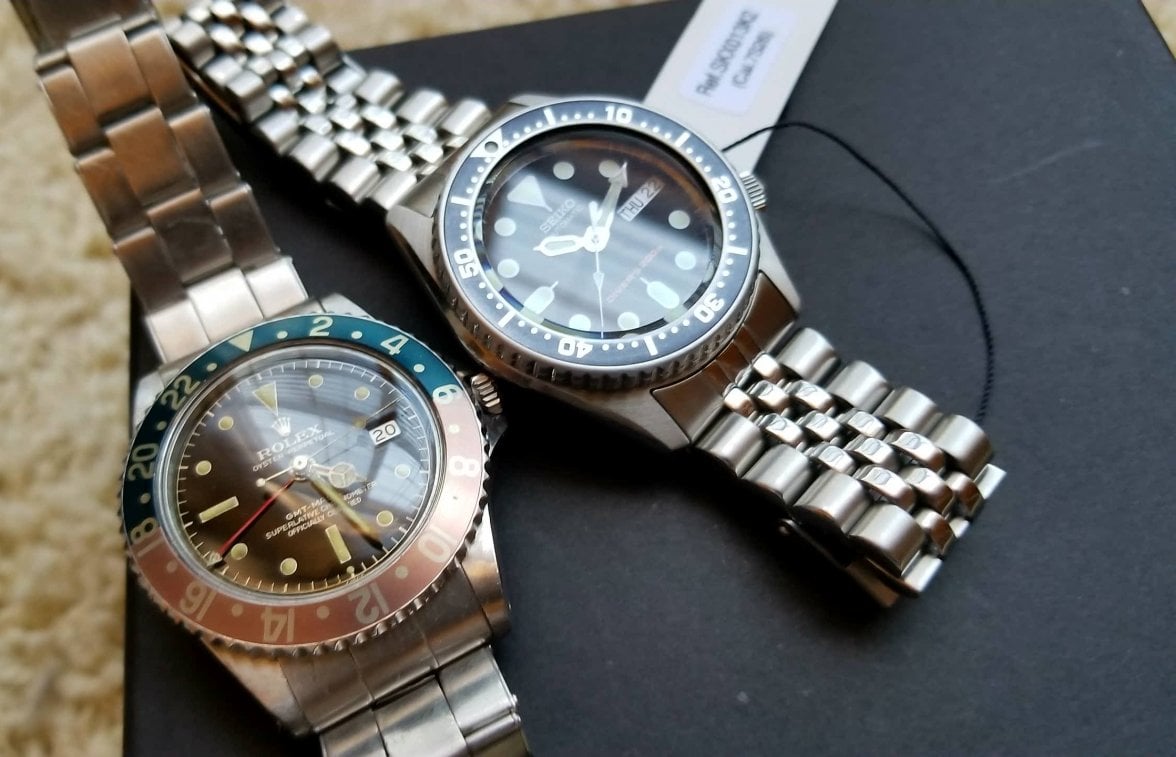
I'm dumbfounded. How in the hell does Seiko pull it off?

Posts
29,219
Likes
75,511
Unbelievable quality in Seiko and the finishing on their mid and higher tier watches is definitely on the same playing field as Omega and Rolex in my experience.

The accuracy does vary quite a bit for the less expensive models but usually can be regulated to within a few seconds in 4 or 5 positions. The higher priced GS movements and 8L movements that make it into their professional dive watches are oftentimes just flat on my timegrapher. I've had several 60s and 70s GS hi-beat models ... all of them still running at a few seconds off 0 while flat. Don't get me started on spring drive. I have a 5 year old snowflake that's 1.5 seconds off per MONTH!

Pretty good watches those Seikos.

I have a different perspective...

Finishing on lower end stuff is pretty much non-existent, but yes the high end watches are on par with mid-tier Swiss brands like Rolex and Omega.

If you are "regulating" these to within a "few seconds in 4 or 5 positions" can you explain exactly what that means? If you mean getting positional variation (Delta) of a few seconds over 5 positions on a consistent basis, well I would love to know your secret, because that is not my experience at all.

Pretty much any watch can be made to run at zero gain or loss "while flat" - I take this to mean in one position. And of course spring drive is a quartz watch, so although it's an awkward quartz watch, the accuracy is not bad for quartz but certainly not the best.

When I think of Seiko I think of cheap materials, soft screws, low amplitude, and poor timekeeping on the lower end. On the high end I think of better finishing but still low amplitude, better timekeeping, but often overly complex ways of doing what should be simple things.

How do they do it? Offshore production in low wage countries and volume mostly, along with controlling the supply chain by being vertically integrated. Also they don't spend a lot on supporting the products far into the future like other brands do, so they don't spend money keeping parts around for decades.

Cheers, Al

 
Posts
1,320
Likes
10,694
I have a different perspective...

Finishing on lower end stuff is pretty much non-existent, but yes the high end watches are on par with mid-tier Swiss brands like Rolex and Omega.

If you are "regulating" these to within a "few seconds in 4 or 5 positions" can you explain exactly what that means? If you mean getting positional variation (Delta) of a few seconds over 5 positions on a consistent basis, well I would love to know your secret, because that is not my experience at all.

Pretty much any watch can be made to run at zero gain or loss "while flat" - I take this to mean in one position. And of course spring drive is a quartz watch, so although it's an awkward quartz watch, the accuracy is not bad for quartz but certainly not the best.

When I think of Seiko I think of cheap materials, soft screws, low amplitude, and poor timekeeping on the lower end. On the high end I think of better finishing but still low amplitude, better timekeeping, but often overly complex ways of doing what should be simple things.

How do they do it? Offshore production in low wage countries and volume mostly, along with controlling the supply chain by being vertically integrated. Also they don't spend a lot on supporting the products far into the future like other brands do, so they don't spend money keeping parts around for decades.

Cheers, Al

馃憤馃憤馃憤
 
Posts
3,801
Likes
22,740
I have a different perspective...

Finishing on lower end stuff is pretty much non-existent, but yes the high end watches are on par with mid-tier Swiss brands like Rolex and Omega.

If you are "regulating" these to within a "few seconds in 4 or 5 positions" can you explain exactly what that means? If you mean getting positional variation (Delta) of a few seconds over 5 positions on a consistent basis, well I would love to know your secret, because that is not my experience at all.

Pretty much any watch can be made to run at zero gain or loss "while flat" - I take this to mean in one position. And of course spring drive is a quartz watch, so although it's an awkward quartz watch, the accuracy is not bad for quartz but certainly not the best.

When I think of Seiko I think of cheap materials, soft screws, low amplitude, and poor timekeeping on the lower end. On the high end I think of better finishing but still low amplitude, better timekeeping, but often overly complex ways of doing what should be simple things.

How do they do it? Offshore production in low wage countries and volume mostly, along with controlling the supply chain by being vertically integrated. Also they don't spend a lot on supporting the products far into the future like other brands do, so they don't spend money keeping parts around for decades.

Cheers, Al

Hey Al,

Puts things in perspective. Do you think that it's $ 200 well spent. I have a feeling I'm getting quite a bit for the money despite your eloquent critique. Thoughts?

Cheers
 
Posts
29,219
Likes
75,511
Hey Al,

Puts things in perspective. Do you think that it's $ 200 well spent. I have a feeling I'm getting quite a bit for the money despite your eloquent critique. Thoughts?

Cheers

Are they good value for the money? I don't think too many people would argue that they are not. But I guess it depends a lot on what you are after from a watch.

As much as I'd like to have a pristine vintage 62MAS on my wrist, that is the exception for me. I know that if I bought one of the model you have, or a Monster, or whatever flavor of the day Seiko is popular, it would likely not get much/any wrist time. I think it makes a great beater for the road for you, and if it breaks you can just get a new one - service would cost more than the watch is worth. For me I use a Watchco SM300 as my beater, so I really don't need another one. The Grand Seiko aesthetic just doesn't appeal to me on several levels, so as a brand I don't find them appealing for the most part. Believe me I've tried!

It really has nothing to do with it being Japanese or being cheap - I pretty much feel the same way about Patek, or modern Rolex - very few modern offerings are appealing to me from both those companies. You could actually include Omega in that bunch as well...

Cheers, Al
 
Posts
18,099
Likes
27,413
Hey Al,

Puts things in perspective. Do you think that it's $ 200 well spent. I have a feeling I'm getting quite a bit for the money despite your eloquent critique. Thoughts?

Cheers

I think he鈥檚 more saying they are more throw away watches then pieces designed to be serviced.

Considering the closest thing the Swiss have is the mostly plastic sistem 51 at that price point, they are not horrible values.

@Archer are you referring to the magic lever system as being overly complex? Or is their something else? Could the overly complex part be due to the largely automated manufacturing process on the lower end movements? I was under the impression that movements like the 7s26 are mostly built with no human interaction. Hence perhaps some of the design is due to restrictions of this way of building the movement.
 
Posts
1,231
Likes
3,796
@Larry S if you'd like some enabling, here are a few, modern and vintage.

Dude. Your Seiko collection is unbelievable. Jealous!
 
Posts
29,219
Likes
75,511
@Archer are you referring to the magic lever system as being overly complex? Or is their something else? Could the overly complex part be due to the largely automated manufacturing process on the lower end movements? I was under the impression that movements like the 7s26 are mostly built with no human interaction. Hence perhaps some of the design is due to restrictions of this way of building the movement.

No, not the magic lever - the magic lever/pellaton winding systems are very simple actually. I'm more referring to the way things like date mechanisms or hacking are done. I'm a fan of keeping designs simple with the fewest number of parts to do the job as possible. In this thread I described various hacking mechanisms, and as you can see the vintage Grand Seiko system is far more complicated than one the other movements:

https://omegaforums.net/threads/weekend-waffle-and-some-wis-questions.69523/#post-875334

The date change on this same movement is also very complex - there are many ways to accomplish this and the way it's done here certainly works, but involved more parts than most to make the date finger move around the tooth of the date indicator wheel, and then snap the date forward. I created this little animation to show what it looks like...


Now the 7S26 is actually much more simple, using a simple date driving wheel and jumper much like the Swiss tend to do, so minimal moving parts involved.

Even some of their quartz movements are complicated more than necessary - for example on this King Seiko, you can see that when you pull the crown out to hack the movement, it automatically moves the seconds hand forward to the nearest 10 second mark:


No why someone would need such a feature I can't say, but it certainly adds complexity to the movement that really isn't warranted IMO. It's not like this feature has caught on in any significant way for quartz watches or mechanical watches, although a few mechanicals do this sort of thing but reset to 12, which makes a lot more sense.

Anyway, I'm not here to bash Seiko, just saying that their approach can be a bit unorthodox at times.

Cheers, Al
 
Posts
18,099
Likes
27,413
No, not the magic lever - the magic lever/pellaton winding systems are very simple actually. I'm more referring to the way things like date mechanisms or hacking are done. I'm a fan of keeping designs simple with the fewest number of parts to do the job as possible. In this thread I described various hacking mechanisms, and as you can see the vintage Grand Seiko system is far more complicated than one the other movements:

https://omegaforums.net/threads/weekend-waffle-and-some-wis-questions.69523/#post-875334

The date change on this same movement is also very complex - there are many ways to accomplish this and the way it's done here certainly works, but involved more parts than most to make the date finger move around the tooth of the date indicator wheel, and then snap the date forward. I created this little animation to show what it looks like...


Now the 7S26 is actually much more simple, using a simple date driving wheel and jumper much like the Swiss tend to do, so minimal moving parts involved.

Even some of their quartz movements are complicated more than necessary - for example on this King Seiko, you can see that when you pull the crown out to hack the movement, it automatically moves the seconds hand forward to the nearest 10 second mark:


No why someone would need such a feature I can't say, but it certainly adds complexity to the movement that really isn't warranted IMO. It's not like this feature has caught on in any significant way for quartz watches or mechanical watches, although a few mechanicals do this sort of thing but reset to 12, which makes a lot more sense.

Anyway, I'm not here to bash Seiko, just saying that their approach can be a bit unorthodox at times.

Cheers, Al

I know your not bashing them, just curious. I agree the Japanese watch mentality is a bit different then the European ethos. I was not sure how far it went in mechanical mechanisms. I agree that some of the designs are a little off putting as you mentioned earlier. I did read something somewhere that explained some of the movement choices they do. Something along the lines of "They strive to have watches that are as little input needed from the user hence things like the spring drive are very Japanese in ethos while making little sense from a classical watch making standpoint, but from the Japanese standpoint, its an elegant solution to get an accurate no user input watch with a smooth seconds hand"
 
Posts
13,123
Likes
17,997
Something along the lines of "They strive to have watches that are as little input needed from the user hence things like the spring drive are very Japanese in ethos while making little sense from a classical watch making standpoint, but from the Japanese standpoint, its an elegant solution to get an accurate no user input watch with a smooth seconds hand"
Something like the answer to a question that no one has ever asked. 馃榾
gatorcpa
 
Posts
299
Likes
585
I have a soft spot for Seiko as it was the first watch given to my by my mother. As my tastes have matured I have slowly started to care less and less about movements/accuracy and more aesthetics and value(yeah I know movement can have a role in the value equation). Seiko has a lot of interesting designs and almost always tick the value box.

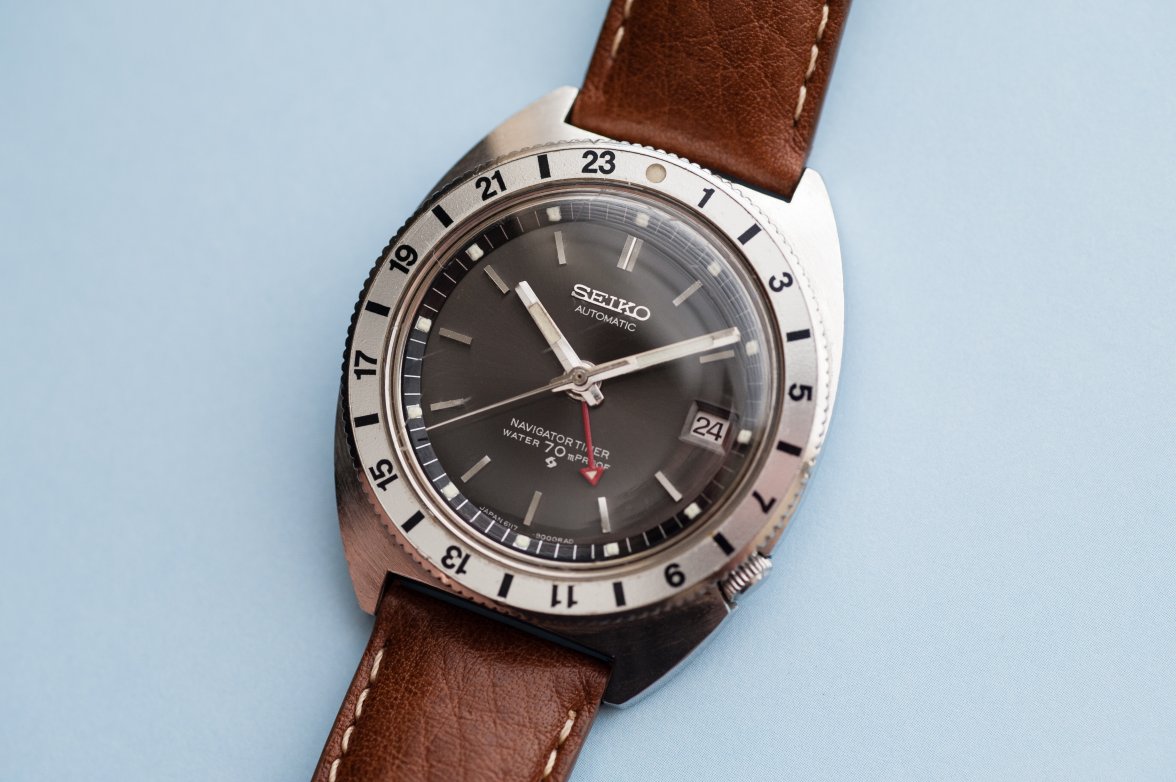
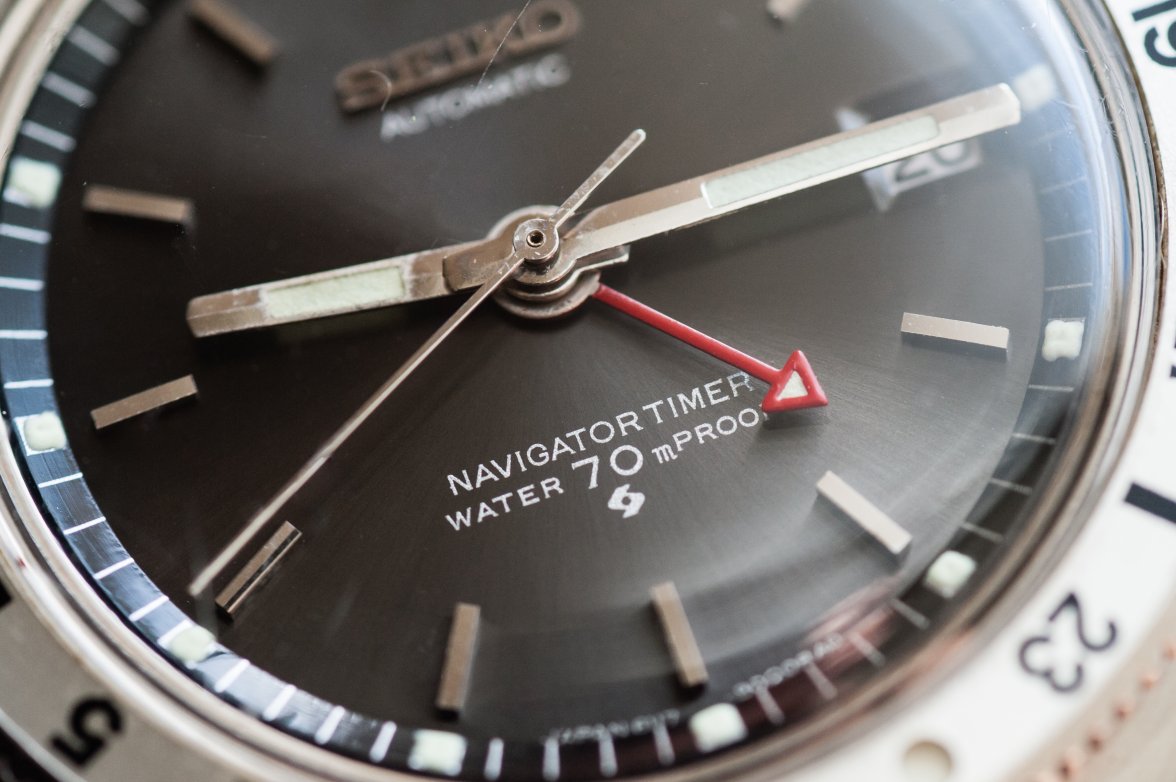
Figured I would add a picture of my most recent seiko pickup, a late 60's Seiko Navigator Timer ref 6117-8000...one of the 3 blue dialed versions I have come across.

RF7k7QR.jpg
 
Posts
1,231
Likes
3,796
@bloomy Very funky and cool! Waterproof to 70m is not something you typically see. Is that a GMT hand or a 24 hour hand?
 
Posts
1,320
Likes
10,694
@bloomy that's great with the blue dial. Here's my 6117-8000 with more standard gray sunburst. Currently +4s dial up, -2s crown down and +7s crown up.

@Kmart it's a 24h hand and the bezel rotates to line up for your second time zone.
 
Posts
18,099
Likes
27,413
I have a soft spot for Seiko as it was the first watch given to my by my mother. As my tastes have matured I have slowly started to care less and less about movements/accuracy and more aesthetics and value(yeah I know movement can have a role in the value equation). Seiko has a lot of interesting designs and almost always tick the value box.

Figured I would add a picture of my most recent seiko pickup, a late 60's Seiko Navigator Timer ref 6117-8000...one of the 3 blue dialed versions I have come across.

RF7k7QR.jpg
@bloomy Very funky and cool! Waterproof to 70m is not something you typically see. Is that a GMT hand or a 24 hour hand?
Wow I鈥檝e got the grey dial, never seen a blue one.

It鈥檚 not a true GMT, it鈥檚 a 24 hour date hand tied to the hour hand.
 
Posts
3,801
Likes
22,740
I'm glad this thread evolved the way it did. It's extremely interesting to get a seasoned watchmakers' perspective along with the enthusiasm of the brand's fans. I think it's safe to say that the product does offer a lot of fun and satisfaction at a price point that is hard to beat.

As far as I'm concerned, I was surprised at how the watch presented itself and felt right out of the box. At least, it gave me the impression that I got a lot of watch for the money I spent. Thanks to Al who answered my question with great pertinence as to " how" Seiko pulls it off! Still quite impressive!
 
Posts
338
Likes
3,921
Would be a snob to underappreciate a Seiko

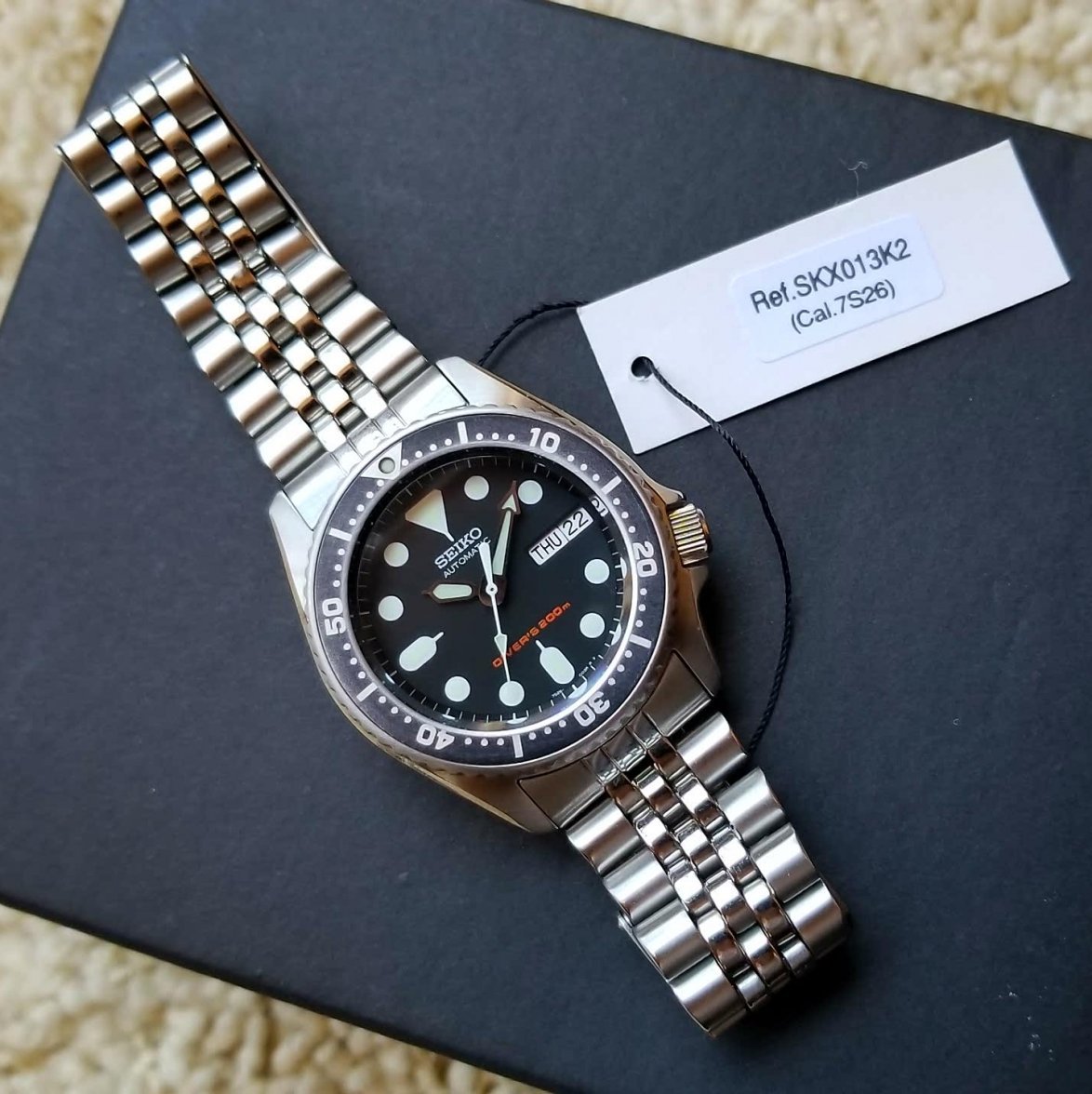
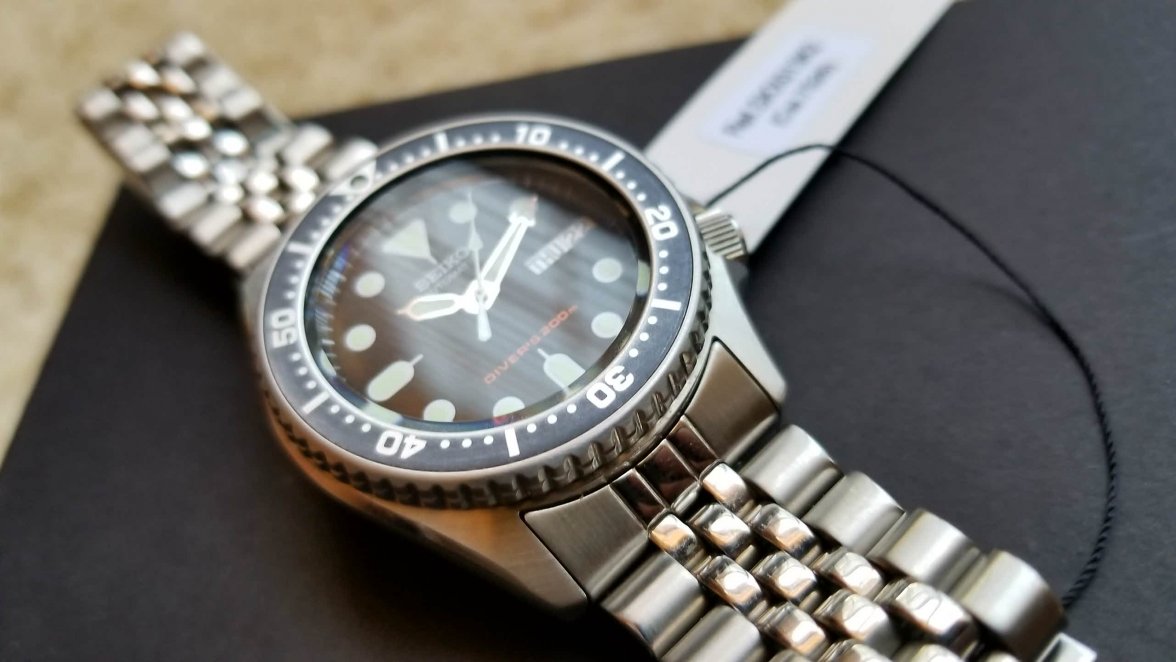
I love my SKX013 myself, faded insert makes it better too, proudly sits on the same rotation line with any Swiss Made pieces 馃槑

Some Hodinkee/JPM straps are more expensive than the SKX013 馃槈

 
Posts
2,502
Likes
7,579
When I started my watch hobby, I bought a 6309-7040 vintage. Paid a premium for it and it had wrong hands, wasn't running well... Brought it for repairs, had it repaired, still losing a minute a day. Sold it and I guess that's where the stigma just got imprinted in me.

I bought the 62mas reissue and I thought it was really nice work...but when I tested it, it was running +- 14 secs. I was thinking 'wasnt this suppose to be a grand seiko movement?' I didn't bring it to get regulated since it's brand new.

Before the 62mas, I had a mm300 (same movement as 62mas and yet was running +-10 secs) I had a skx007 and currently own a 6319 'aqua timer'. Funny enough the aqua timer runs fantastic and hasn't been serviced.

Would I buy a seiko any time soon? No. Do they look great and generally bang for the buck? Sure. But my past experiences with the brand has let me down a couple of times (not the brand directly but if I'm paying 3-4k for a watch I would expect the watch to be running super great +-3-4 secs) without having to go down to my watch maker to regulate it.

I know I sound pretty biased but maybe I'm spoilt by Rolex's accuracy.
 
Posts
2,152
Likes
3,810
And of course spring drive is a quartz watch, so although it's an awkward quartz watch, the accuracy is not bad for quartz but certainly not the best.

You raise some good points about the lower end Seikos, clearly based on your personal experience, but I believe your Spring Drive comment could easily be misunderstood by those not fully aware of what Seiko have achieved with the Spring Drive movements.

Based on previous discussions on the OF my understanding of your POV is that you choose to call a Spring Drive movement a quartz watch, because the escapement wheel mechanism is regulated by a quartz crystal. Fair enough, but (as you well know) all the other components of the watch function similar to a mechanical watch (e.g. energy capture / storage). Some prefer to call the Spring Drive a hybrid quartz-mechanical watch. I personally really don't care what it is called, but for me it clearly has sufficient technical deviation from a pure quartz architecture to not be called a "quartz only architecture watch".

Ref. your comments on the SD quartz accuracy, clearly Seiko were not aiming to reproduce the precision of a HAQ in the Spring Drive movement but blend together the advantages of a quartz regulated escapement with the aesthetics of a mechanical movement, as well as the continuous movement of the seconds hand as an alternative to the jumping seconds of a normal pure quartz watch or the stuttering movement of a pure mechanical watch (the stuttering less observable in Hi-Beat movements).

As for the finishing on the Grand Seiko dials, cases and hands, many have commented that they consider the finishing for these components to be superior to Rolex and Omega equivalents at the same price point.

Perhaps influenced by the recent watch media Grand Seiko "hype", my expectations were too high, so I was slightly disappointed when I saw some of the modern Grand Seikos in the New York Seiko boutique. I think the biggest let down was the case design / thickness, bracelet and overall feel on the wrist. The GS finishing does look very good for the price point offered at retail, but I have yet to find a Grand Seiko that I have fallen truly in love with after seeing it in the flesh.
 
Posts
1,231
Likes
3,796
When I started my watch hobby, I bought a 6309-7040 vintage. Paid a premium for it and it had wrong hands, wasn't running well... Brought it for repairs, had it repaired, still losing a minute a day. Sold it and I guess that's where the stigma just got imprinted in me.

I bought the 62mas reissue and I thought it was really nice work...but when I tested it, it was running +- 14 secs. I was thinking 'wasnt this suppose to be a grand seiko movement?' I didn't bring it to get regulated since it's brand new.

Before the 62mas, I had a mm300 (same movement as 62mas and yet was running +-10 secs) I had a skx007 and currently own a 6319 'aqua timer'. Funny enough the aqua timer runs fantastic and hasn't been serviced.

Would I buy a seiko any time soon? No. Do they look great and generally bang for the buck? Sure. But my past experiences with the brand has let me down a couple of times (not the brand directly but if I'm paying 3-4k for a watch I would expect the watch to be running super great +-3-4 secs) without having to go down to my watch maker to regulate it.

I know I sound pretty biased but maybe I'm spoilt by Rolex's accuracy.

You had your 6309 repaired and it was still losing a minute a day? I would have asked for my money back... and/or gone to a different watchmaker.

As a counterpoint to this, I owned an original 62mas for a while this summer, had it serviced, and it was running consistently at +4 seconds a day after that. You can buy a vintage 62mas for ~$2500 nowadays. A vintage Rolex 5513 or 1680 is going to run you in the neighborhood of $10k or higher. I think you'd be hard pressed to find one of those that runs within +/- 4 seconds per day.

Point is that Seiko makes great watches that are pretty affordable in the grand scheme of things. Are they perfect? No. But they're a great value in today's watch world where companies are charging nearly 5 figures for basic stainless steel dive watches.
 
Posts
29,219
Likes
75,511
Based on previous discussions on the OF my understanding of your POV is that you choose to call a Spring Drive movement a quartz watch, because the escapement wheel mechanism is regulated by a quartz crystal. Fair enough, but (as you well know) all the other components of the watch function similar to a mechanical watch (e.g. energy capture / storage).

I choose to call it a quartz watch because that's what it is. The fact that it is powered by a mainspring doesn't change that fact - it still has an electronic circuit and quartz crystal doing the timekeeping. As I've pointed out before, quartz watches can be powered different ways - pure battery operated, solar, and kinetic. The spring drive is a version of a kinetic quartz watch, but instead of charging a capacitor the rotor charges the mainspring.

Of course the primary appeal of the spring drive that I see people talk about is the smooth travel of the seconds hand. Previously only a tuning fork watch would give you that sort of smooth sweep of the hand, but now Citizen/Bulova have their Sweeping quartz watch.

As a counterpoint to this, I owned an original 62mas for a while this summer, had it serviced, and it was running consistently at +4 seconds a day after that. You can buy a vintage 62mas for ~$2500 nowadays. A vintage Rolex 5513 or 1680 is going to run you in the neighborhood of $10k or higher. I think you'd be hard pressed to find one of those that runs within +/- 4 seconds per day.

Good result on the 62MAS you had. I had a friend who had the best looking one I've ever seen - everything on it was perfect. I'll see if I can dig up a photo or two of it. Unfortunately he sold it without checking with me first!

Regarding vintage Rolex, not sure why you think someone would be hard pressed to find one that had good positional variation? Here's my 1680...


And although this is before final regulation, the Delta was quite good at about 6 seconds:


I think to argue that on average a vintage Seiko is going to outperform a vintage Rolex is probably stretching it a bit. But of course condition of the movement is key, and since both brands have a reputation of being able to "run for decades without service" they both tend to have damage by the time they get to the watchmaker.

Cheers, Al
 
Posts
2,559
Likes
7,064
HQ Milton sell most of their Vintage Rolex running at COSC specification.

Still love my Seikos and with so many watches in rotation any deviation nearly does not matter to me, though I want my watches purring along
馃槑