Hodinkee LE Leica

Posts
177
Likes
147
Sorry , what I meant was the early Leicas screw mount and up Leica M6's . I was referring to the generation of full machanical cameras. as far as I know the viewing that you have in rangefinder on the early leica M was always superior to any others , Zeiss Contax, Kodak retina's, Nikon Sp's , Canon 7's , etc. Also, I was referring only to the camera itself, because I can't say that the quality of Leitz lenses were superior to Zeiss or Canon.
on the other hand to overhaul a Leica M is way more expensive than others, you need to have Leitz tools to fix them properly
Edited:

 
Posts
1,708
Likes
5,699
I was amazed about the number of dislikes on this video ... never happened before I believe
😲
.

He’s... not everyone’s cup of tea...
 
Posts
177
Likes
147
Thats because nobody cares about this guy and his Leica - why should people do it? There are literally thousands of videos like this 😀
In architectural photography you can use any 35mm slr or rf to shoot details only, but when comes to shoot the entire building a 4x5", 5x7", 8x10" view cameras are mandatory. Stoller, Shulman, Guerrero, etc. never had a 35mm when they were shooting buildings, it would be unthinkable. Large Format cameras is the only way to shoot architectural, is a "law", no matter how many videos they post on the internet about leica, sorry but pics done 35mm format will never represent in full the building on a fine print
 
Posts
2,457
Likes
7,060
In architectural photography you can use any 35mm slr or rf to shoot details only, but when comes to shoot the entire building a 4x5", 5x7", 8x10" view cameras are mandatory. Stoller, Shulman, Guerrero, etc. never had a 35mm when they were shooting buildings, it would be unthinkable. Large Format cameras is the only way to shoot architectural, is a "law", no matter how many videos they post on the internet about leica, sorry but pics done 35mm format will never represent in full the building on a fine print

My impression the main advantage of the view camera today is its capability of adjusting focus plane by tilting the film and lens planes. I'm not a professional photographer but me thinks current small or medium digital technology is superior to film-based large format in terms of resolution. I think Ansel Adams would have loved to use today's smaller format digital cameras than the behemoths he used.

ansel-adams-1.jpg
 
Posts
16,305
Likes
45,005
In architectural photography you can use any 35mm slr or rf to shoot details only, but when comes to shoot the entire building a 4x5", 5x7", 8x10" view cameras are mandatory. Stoller, Shulman, Guerrero, etc. never had a 35mm when they were shooting buildings, it would be unthinkable. Large Format cameras is the only way to shoot architectural, is a "law", no matter how many videos they post on the internet about leica, sorry but pics done 35mm format will never represent in full the building on a fine print
+10000
 
Posts
16,305
Likes
45,005
My impression the main advantage of the view camera today is its capability of adjusting focus plane by tilting the film and lens planes. I'm not a professional photographer but me thinks current small or medium digital technology is superior to film-based large format in terms of resolution. I think Ansel Adams would have loved to use today's smaller format digital cameras than the behemoths he used.

ansel-adams-1.jpg
Perspective correction is actually even more important than the focal plane control. In terms of resolution, yes- digital has surpassed 35/120 films, but a scanned 4x5, 5x7, 8x10 still contains more “data” and can be drilled into further before losing resolution. And scanned film still looks like film and not digity. The difference for me between film and digital is exactly the same debate in audio between analog and digital- both have their supporters and rarely will both sides agree.
 
Posts
2,457
Likes
7,060
Perspective correction is actually even more important than the focal plane control.
True, but one can argue perspective can be corrected via software. Focal plane control can only be done in camera.
 
Posts
16,305
Likes
45,005
True, but one can argue perspective can be corrected via software. Focal plane control can only be done in camera.
Not really- perspective correction in software is actually stretching pixels and not optically correcting. If you photograph a brick building and correct using software- the bricks will actually appear larger at the top than at the bottom as they have been stretched to make it “look” correct. The software PC doesn’t actually correct for optical distortion.
But I do agree that the control of focal plane is one of the features that shift tilt lenses or LF accel in a way no software can replicate
 
Posts
2,457
Likes
7,060
Not really- perspective correction in software is actually stretching pixels and not optically correcting. If you photograph a brick building and correct using software- the bricks will actually appear larger at the top than at the bottom as they have been stretched to make it “look” correct. The software PC doesn’t actually correct for optical distortion.

I'm not sure I understand your point. Perspective control is not the same as correcting for optical distortion of the lens. You'll end up with similar results correcting for perspective in-camera or post-processing. The main disadvantages of the software method is the trapezoid shape of the frame that will require some cropping and some loss of resolution. Do you have an example of the "bricks that appear larger" effect that you refer too?

Thread drift...
 
Posts
16,305
Likes
45,005
I'm not sure I understand your point. Perspective control is not the same as correcting for optical distortion of the lens. You'll end up with similar results correcting for perspective in-camera or post-processing. The main disadvantages of the software method is the trapezoid shape of the frame that will require some cropping and some loss of resolution. Do you have an example of the "bricks that appear larger" effect that you refer too?

Thread drift...
Yes- thread drift.
The optical distortion I am taking about is keystoning (not lens distortion). When you tilt a camera up, the bottom part of the building is closer to the bottom of the lens than the top is to the top of the lens, hence the building looks like it’s getting smaller at the top or falling over (this also happens to our eyes but our brains correct for it- we know the building isn’t falling over- we hope). By shifting the lens upward (or film plane down) you are keeping the film plane parallel to the subject and moving the film/sensor within the image circle that is being projected, hence no keystoning. This is a gross over simplification but am trying to keep it brief for the forum.
I don’t have an example of the stretch because I only shoot architecture with optical perspective correction. We did studies on this problem with the prints and photographs division of the Library of Congress when the mass migration from film to digital was happening at the beginning of the century and determined that a digitally manipulated perspective correction actually caused data corruption (pixel stretch and interpolation) as opposed to a scanned negative with the correction done optically and not manipulated after scanning.
 
Posts
177
Likes
147
My impression the main advantage of the view camera today is its capability of adjusting focus plane by tilting the film and lens planes. I'm not a professional photographer but me thinks current small or medium digital technology is superior to film-based large format in terms of resolution. I think Ansel Adams would have loved to use today's smaller format digital cameras than the behemoths he used.

ansel-adams-1.jpg

"behemoths" ?? well thanks to those behemoths used by "hard working" great photographers of the past , we inherited so many great images , great testimonials of US landscapes, history, sport events, and more . digital can't even come close to what LF view cameras or press cameras were able to capture on film. film has layers, has character, is tri-dimensional has depth, and digital has sensors, we can't compare it. General speaking digital is always appreciated for the sharpness , but sharpness is not everything, the image taken on an 8x10" has a total different visual impact than another image taken on 35mm film or digital full frame. The depth of field is different. when you use a normal lens with with an 8x10" camera it's a 300mm, on the other hand on a 35mm camera (24x36mm frame) the normal lens is a tiny 50mm. we take a picture of the same subject with the two cameras , results are different, plus you have always the great benefit of the greater image circle of the large format lens.
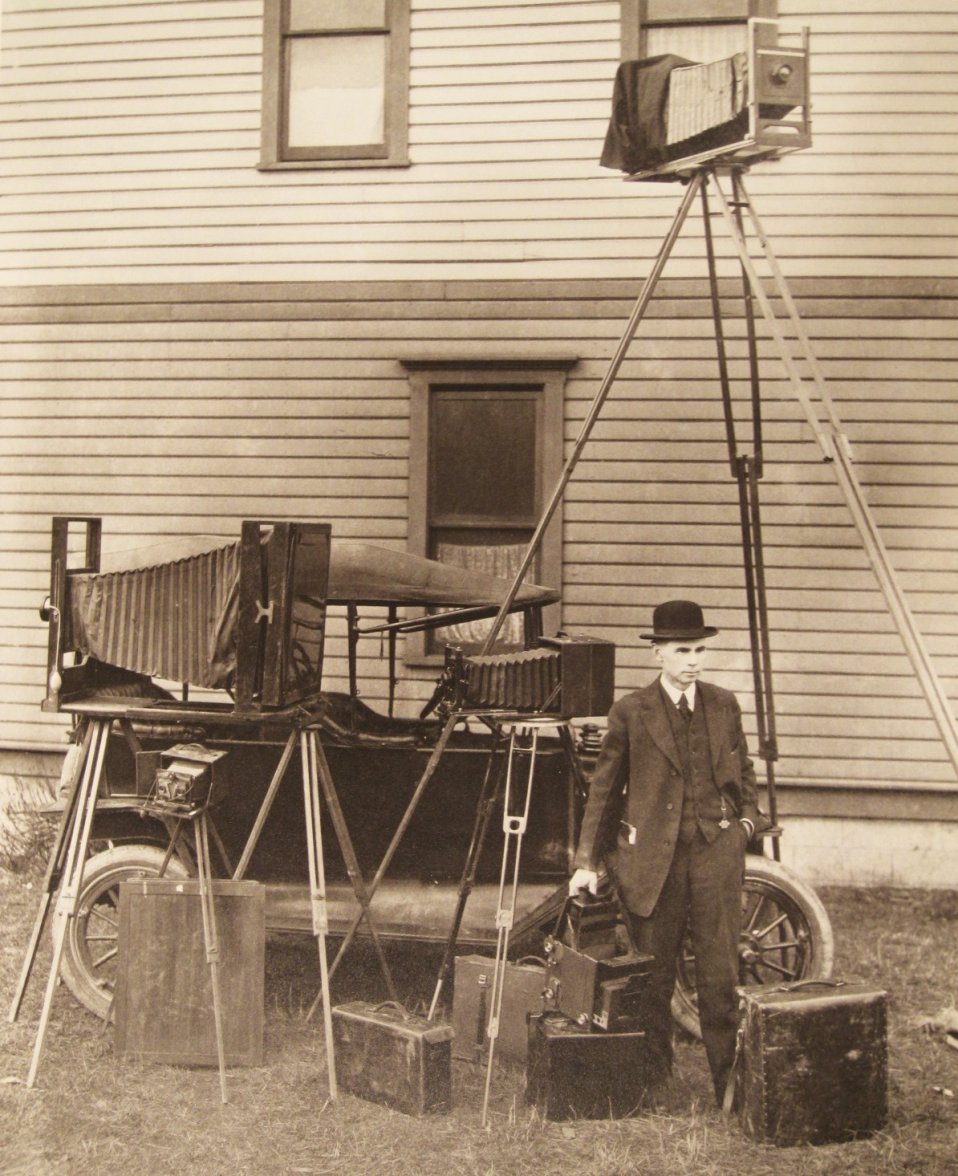
behemoths could be considered 11x14" up to 20X24" negative size , these are heavy gear !
below is a pic of a commercial photographer of last century , you can see behemoth on the left, probably a 16x20"😀
Edited:
 
Posts
16,305
Likes
45,005
My boss used to call 4x5 “miniature format”, and anything under as toy. We used 4x5 for aerial, 5x7 for field work (half plate for you really old guys), and 8x10 for studio... and this was up until 2012 when I left the organization (they still use it).
I would photograph a street-scape and be able to read liscense plates 3 blocks away sharply under the grain focuser. We currently have am100mp Phase one back in the office which we use with an Arca Swiss Tech camera or on a Baby Linhof rail camera. Yeah, it’s sharp and the detail is insane- but 3 blocks away...starts to get a little fuzzy.

And then we get into to the issue of lens coverage. Modern digital large format lenses are designed to strike the sensor at a strait array of light, it’s why older wide angle
Lenses don’t work on modern digital backs properly- the light comes in on an angle. Film was much more forgiving with angle of light and you could get fallof if you were pushing the edges of the image circle but you generally knew where that was (I used 8x10 lenses on my 5x7 for the extra coverage).
Digital is a spectacular tool which I use daily, but it’s important to acknowledge the inherent shortcomings with every technology and sometimes newer is not better. There are things that view cameras can do that the best of digital just can’t- I know beucase I use this gear daily. A 72mm Schneider Super Angiulon XL on a 5x7 Linhof have a field of view approximate to a 9mm lens on a 35mm camera, with some movement and absolutely rectilinear. We have nothing on our tool box that can do that without having to resort to stitching and manipulation in Ps.
Edited:
 
Posts
177
Likes
147
My boss used to call 4x5 “miniature format”, and anything under as toy. We used 4x5 for aerial, 5x7 for field work (half plate for you really old guys), and 8x10 for studio... and this was up until 2012 when I left the organization (they still use it).
I would photograph a street-scape and be able to read liscense plates 3 blocks away sharply under the grain focuser. We currently have am100mp Phase one back in the office which we use with an Arca Swiss Tech camera or on a Baby Linhof rail camera. Yeah, it’s sharp and the detail is insane- but 3 blocks away...starts to get a little fuzzy.

yes, definetely a 4x5" could be considered a miniature format.
with an 8x10" camera and with a 24inch Goerz Red Dot Artar, at infinty we can almost read anything! and the funny thing is we can put together and old 8x10" wooden camera and a Goerz lens for less than 1500 bucks!
.....of course , if we if jump in Deardorff it gets a little more expensive , but nothing that will break the piggy bank!
 
Posts
16,305
Likes
45,005
I used to set up students with LF kits- Calumet or Toyo body, a few older Schieder or Fujinon lenses,(90,150,210) a decent tripod, a dozen used film holders and a changing bag as they were ready to roll.
Daylight tank and changing bag/tent on the kitchen table and you have a wet lab. Hand dry on coat hangers with clothes pins and sleeve-
Then scan on an Epson V700. Whole kit under $1k if you shop smart and have connections.
The joy of the process was what really got the kids into it- far more than the product. Which is what the love of the craft is all about to me-
Process.
 
Posts
2,457
Likes
7,060
but nothing that will break the piggy bank!
an 8x10 camera with tripod and half dozen film holders would break your back though. 😜
 
Posts
16,305
Likes
45,005
an 8x10 camera with tripod and half dozen film holders would break your back though. 😜
An 8x10 can be a bit cumbersome (although wood field cameras like the Deardorffs are surprisingly light) which is why we carried 5x7 in the field- a happy compromise. My Linhof 5x7 monorail with my heaviest lens on an aluminum (not carbon fiber- you want it bottom heavy) Gitzo 4 series with geared column and head weighed in at around 45lbs, but balanced perfectly on the shoulder when carrying. Bag of 8 or so 5x7 film holder and 2 lenses, meter, etc in a bag on the other shoulder balanced you out with a other 20+ lbs. I could trek with that rig in rough terrain for about 2 miles with breaks to rest but the end results were always worth the effort- and if I needed to bring more (lighting, more holders & lenses etc) I always recruit help. Always had my Jeep or a Park vehicle available so rarely did I need to be farther than a mile or two from the bulk of my equipment.

That said, I just had a spinal fusion of my L5-S1 due to a long slow creep of pain over time- so I guess it literally broke my back.
 
Posts
1,708
Likes
5,699
Absolutely nothing that will justify the $15K. we can buy other cameras and lenses for a fraction and offering same features

And a $10 watch from the corner store will keep better time than a $500K vintage Rolex... and so begins the cycle of this entire thread again...
 
Posts
16,305
Likes
45,005
And a $10 watch from the corner store will keep better time than a $500K vintage Rolex... and so begins the cycle of this entire thread again...
Agreed- you buy one because you “want” one, not because you “need” one.
 
Posts
1,708
Likes
5,699
Agreed- you buy one because you “want” one, not because you “need” one.

Absolutely. And because of the history, the unique look and feel of the camera and the pictures, and heck, because of the way it makes you feel. “Need” so rarely factors in to high end purchases. There are almost always lower priced options.