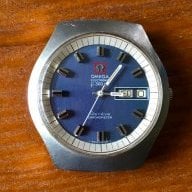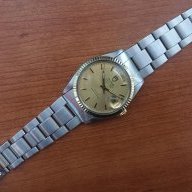
Costellation Seamaster and Geneve main differences

Posts
71
Likes
48
Maybe a dumb question but I am trying to learn more about Omega vintage watches. I am quite confused by Geneve Constellation and Seamaster differences. Many watches seem very similar. Can someone explain to me the main difference between these 3 main lineup?
Thank you
Andrea
 
Posts
9,537
Likes
52,542
Yours is a very open ended question, but I'll do my best to answer it with some general observations. If memory serves, the Seamaster line was introduced in 1948, the Constellation line in 1952 and the Geneve line in 1953. The Seamaster and Constellation lines are still manufactured. The Geneve line was discontinued in 1979.

The Seamaster was introduced to celebrate Omega's 100th anniversary and is currently the oldest Omega line still in production. The first Seamasters were loosely modeled after the waterproof watches made for and worn by the British military during World War II. The feature that set the Seamaster apart from other dive watches of the period was its O-ring rubber gasket which improved its water-resistance. Prior to the introduction of the Seamaster, manufacturers relied on lead or shellac gaskets which were easily affected by temperature changes like those a diver would experience at various depths. Omega's O-ring design allowed the case to remain impervious to water at depths up to 60 meters and temperature ranges between -40 degrees and +50 degrees Celsius. Today, the Seamaster line is generally regarded as a sports watch, but in the past there have been many Seamaster models that straddled the line between sports and dress watches.

Loosely based on the Centenary model released in 1948, Omega debuted the Constellation line in 1952. The line was originally intended for men and was initially fitted with the caliber 354 "bumper" movement and later evolved to automatic calibers using a rotor. Two distinguishing features of the Constellation have always been the star on the dial and a caseback with a medallion featuring the Observatory of Geneva crowned by a constellation of eight stars. The eight stars represent the eight world precision records that Omega set in 1933 and 1936 at Kew-Teddington and the Geneva Observatory. The Constellation has always been a dress watch and during the heyday of Swiss watchmaking in the 1950s and 1960s it was regarded as one of the best watches that one could purchase. It is also one of the first Swiss chronometer certified watches and many of the caliber 500 series models, particularly the 550 and 560 series, are regarded as some of the best mass produced movements ever made. Many of the Constellation references from that period are highly sought after by collectors, particularly those with "pie pan" style dials.

The Geneve line was introduced in 1953 as a homage to Omega workshops in Geneva where the best regulators were then working. At the time, it was second only to the Constellation line in Omega's stable of dress watches. The two lines differed in that the Constellation line was more focused on using automatic chronometer certified movements whereas the Geneve line used high grade 30mm manual movements, although there were exceptions made in both lines. Over time, the Geneve was transitioned into a lower end model in Omega's lineup, but represented up to 60% of the company's sales during the quartz crisis in the 1970s. All three lines produced many dial, case and movement variations which is part of what makes them so collectible. You can Google the history of each line for more detailed information, but I hope that this very brief overview helps to get you started. Welcome to OF.
Edited:
 
Posts
10,304
Likes
16,125
Very good content but a few paragraph breaks would be welcome! I don’t think I’ve seen that topic attempted in one hit before so bravo for that.
 
Posts
9,596
Likes
27,692
Yours is a very open ended question, but I'll do my best to answer it with some general observations. If memory serves...

*continues to write essay*

Bravo!
 
Posts
9,537
Likes
52,542
Thank you, gentlemen. Apologies for the lack of paragraphs. It was a stream of consciousness response as best I could put together from memory. Please feel free to add to it or correct any errors that I may have made.
 
Posts
71
Likes
48
You can Google the history of each line for more detailed information, but I hope that this very brief overview helps to get you started. Welcome to OF.

THANK YOU very much for taking time for answering my question.
 
Posts
9,537
Likes
52,542
Very good content but a few paragraph breaks would be welcome! I don’t think I’ve seen that topic attempted in one hit before so bravo for that.
Paragraph breaks now added! 😀
 
Posts
42
Likes
59
Didn't expect an answer like that .. Bravo!!A lot of informations!!
 
Posts
7,995
Likes
28,030
At the time, it was second only to the Constellation line in Omega's stable of dress watches

A couple of pedantic points relating to your comprehensive reply. First, I would say that it would be more accurate to characterize the
Genève as being at the top of Omega's high-production, manual-wind model line from its inception until around 1960. The Constellation was obviously at the top of the automatic model line, and the chronometer ratings gave them additional value, but I expect that in most cases buyers were either seeking a manual-wind or automatic watch, rather than choosing between them based on other criteria.

Having said that, the 30T2rg Chronometres would have sat atop the manual-wind line, but of course they were quite low production.
 
Posts
9,537
Likes
52,542
A couple of pedantic points relating to your comprehensive reply. First, I would say that it would be more accurate to characterize the
Genève as being at the top of Omega's high-production, manual-wind model line from its inception until around 1960. The Constellation was obviously at the top of the automatic model line, and the chronometer ratings gave them additional value, but I expect that in most cases buyers were either seeking a manual-wind or automatic watch, rather than choosing between them based on other criteria.

Having said that, the 30T2rg Chronometres would have sat atop the manual-wind line, but of course they were quite low production.
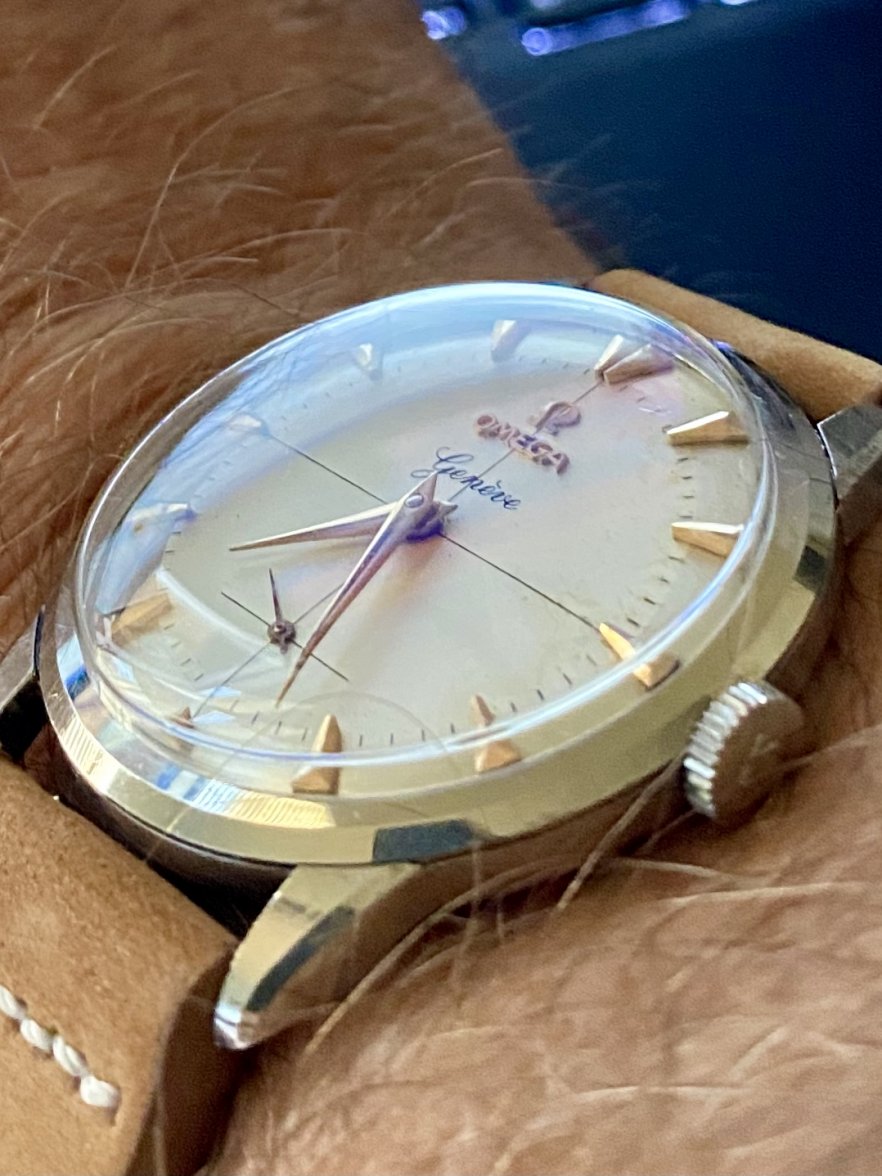
I would agree with all of that. I’m a huge fan of the early Geneves. Beautiful watches and not easy to find in excellent condition. Here’s my 1959 reference 2903-12 with a caliber 268.