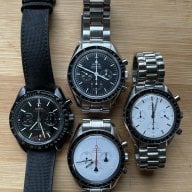
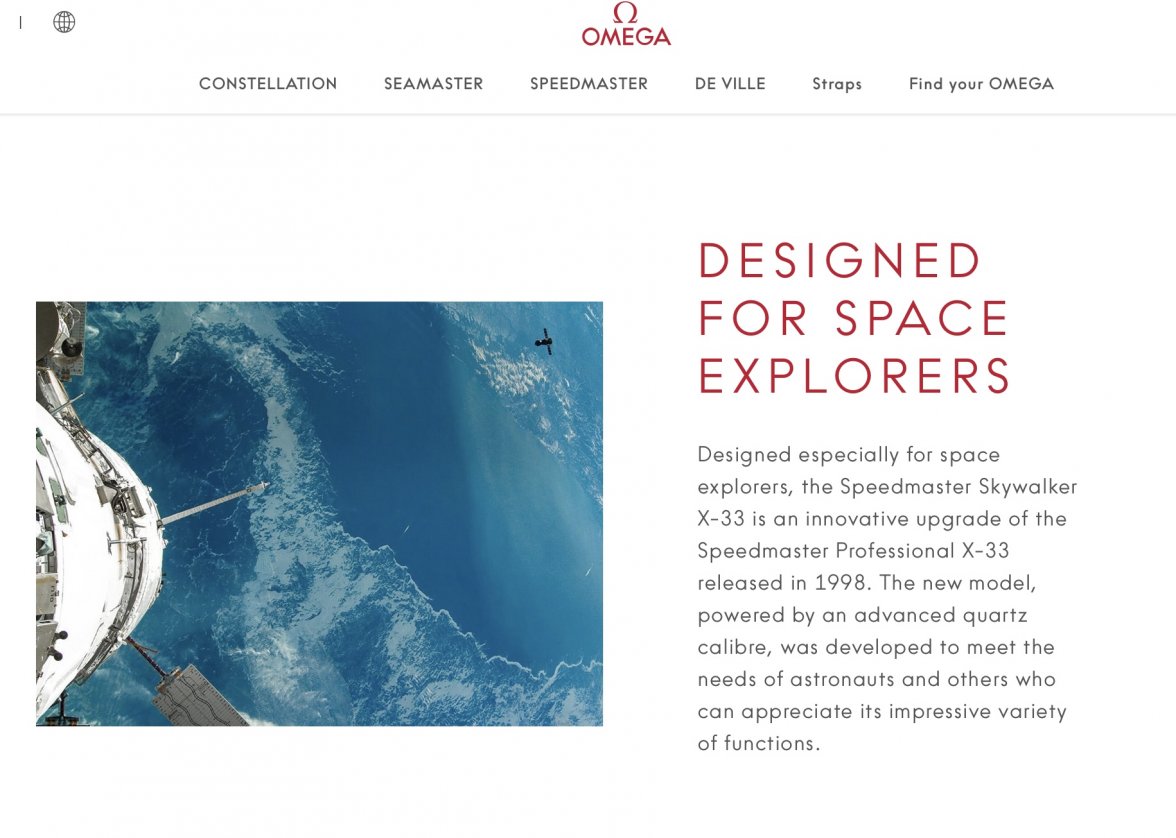
Can The 2021 Omega Speedmaster Moonwatch Professional Still Be Considered A Moonwatch?

Posts
922
Likes
493
Ok, after listening to Eric Wind’s @georgetownhoya Significant Watches podcast episode #6, and more specifically his comments on the missing Speedies that were tested by NASA (the segment on this story starts at around 17’35”) at the 19’23” mark, I now need to revive this thread!

Specifically, Eric is stating that the soft iron cover present in the Ed White watches tested by NASA, did play a role in the final result as he states (not sure if proven) that that soft iron cover would have helped distribute shockwaves around/away from the movement (and I am NOT talking about the magnetic waves in this particular case) during impact testing.
Even more specifically, he was referring to that little dimple in the center of the soft iron cover that would be pressed again the case back.

What is your take on this one guys?

Asking, because that would mean that the new 3861 would have strayed to far away from the initial design, despite the fact that the 3861 cal. is resistant to magnetic fields.

Thoughts!?

It's the result of the tests that matters.
There's no stipulation as to how they meet or even exceed the standard👎
With the new movement design all other measures are redundant really if anti-magnetic properties are required.
 
Posts
922
Likes
493
While Hesalite may have some beneficial failure mode characteristics, it was a lucky coincidence and not part of the selection or test criteria for the Speedmaster.

https://omegaforums.net/threads/sha...nasa-selection-myth-maybe.91611/#post-1187635

I disagree.
When the requirements are taken into full consideration, it would seem that anything other than a plastic Crystal would be precluded.
I think there was one Apollo mission where the glass cover over the dial of an instrument which broke and they spent an outrageous amount of time trying to vacuum up all the bits to a satisfactory standard.
In that case plastic would be superior anytime👎
 
Posts
922
Likes
493
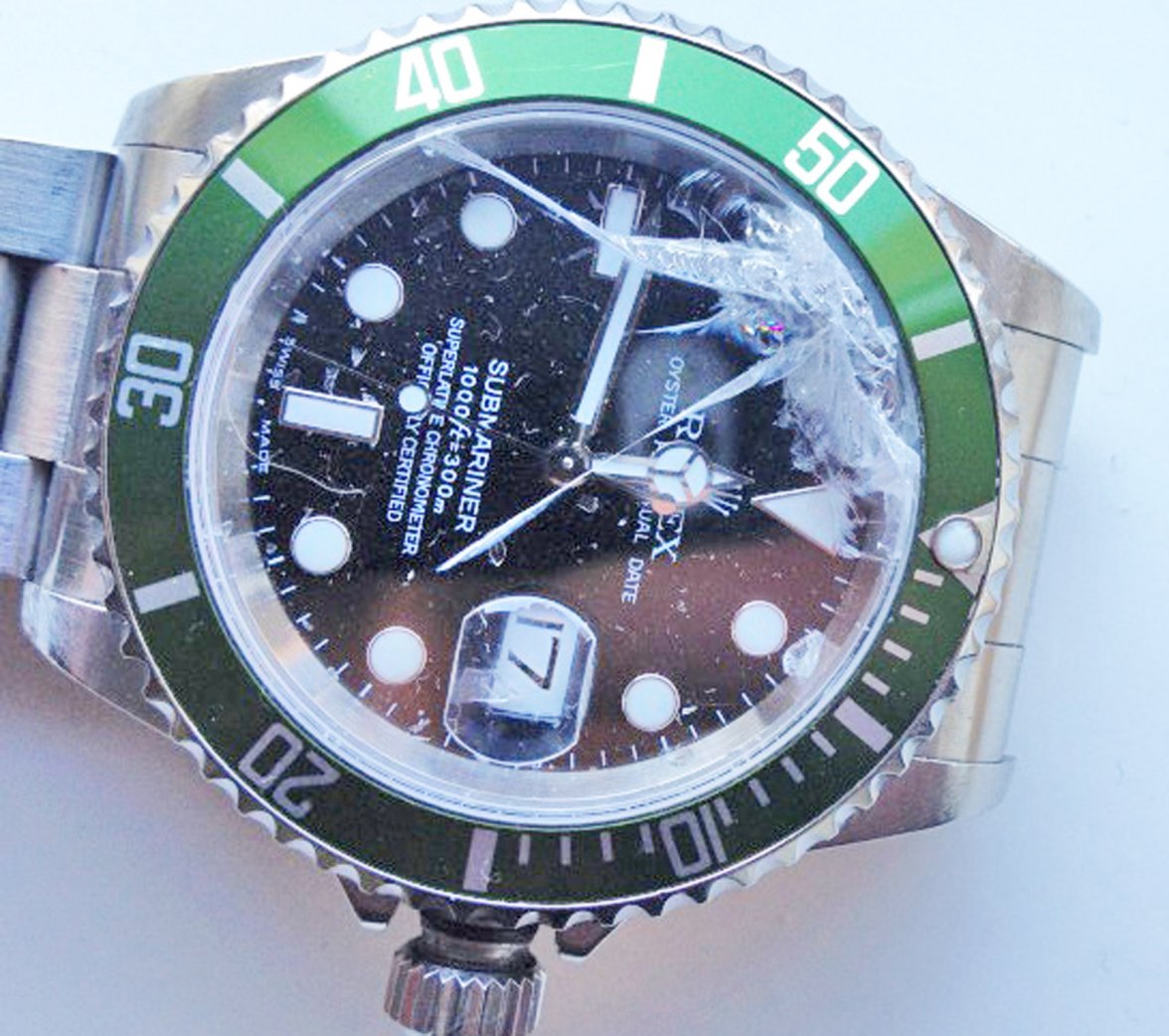
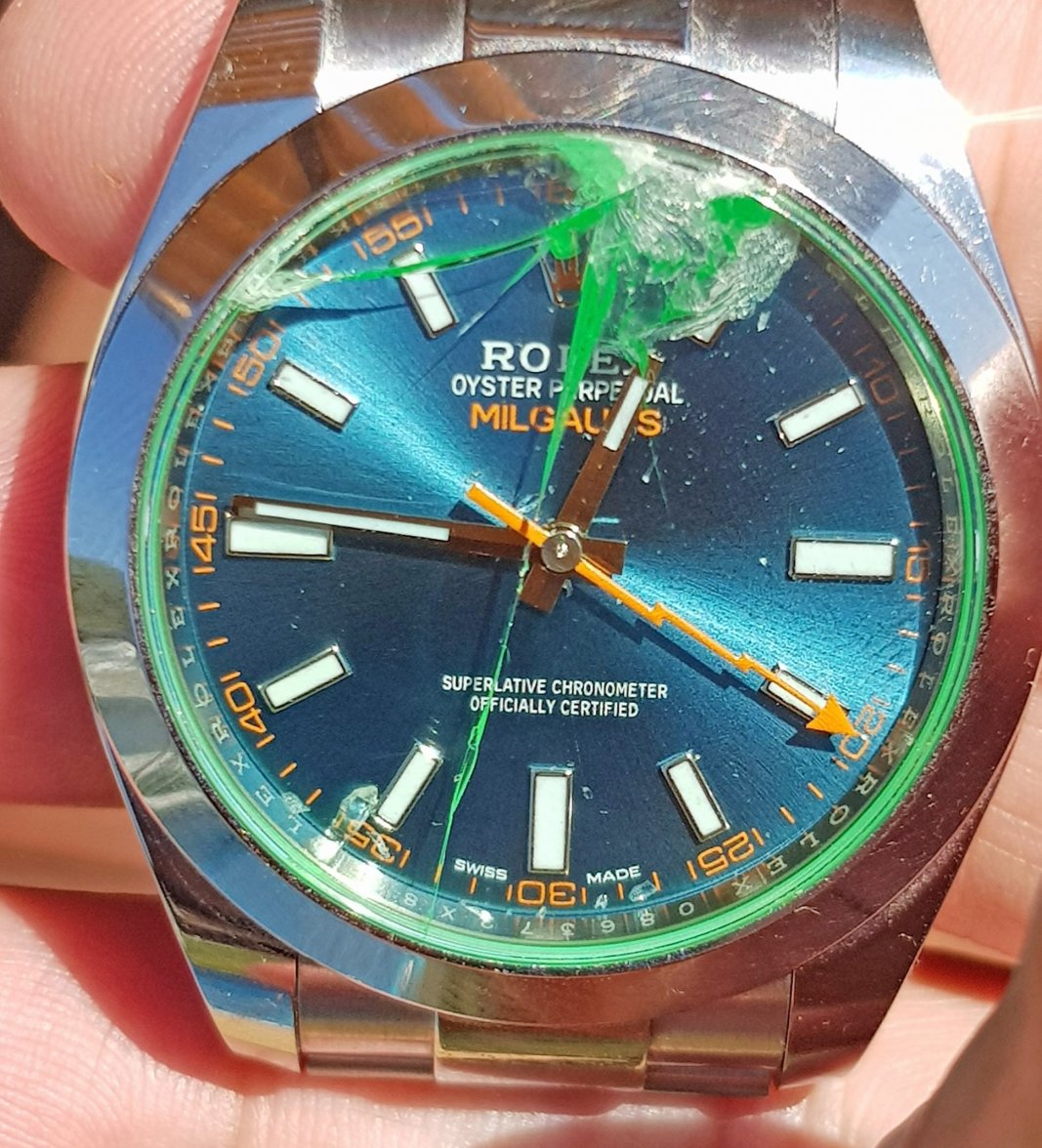
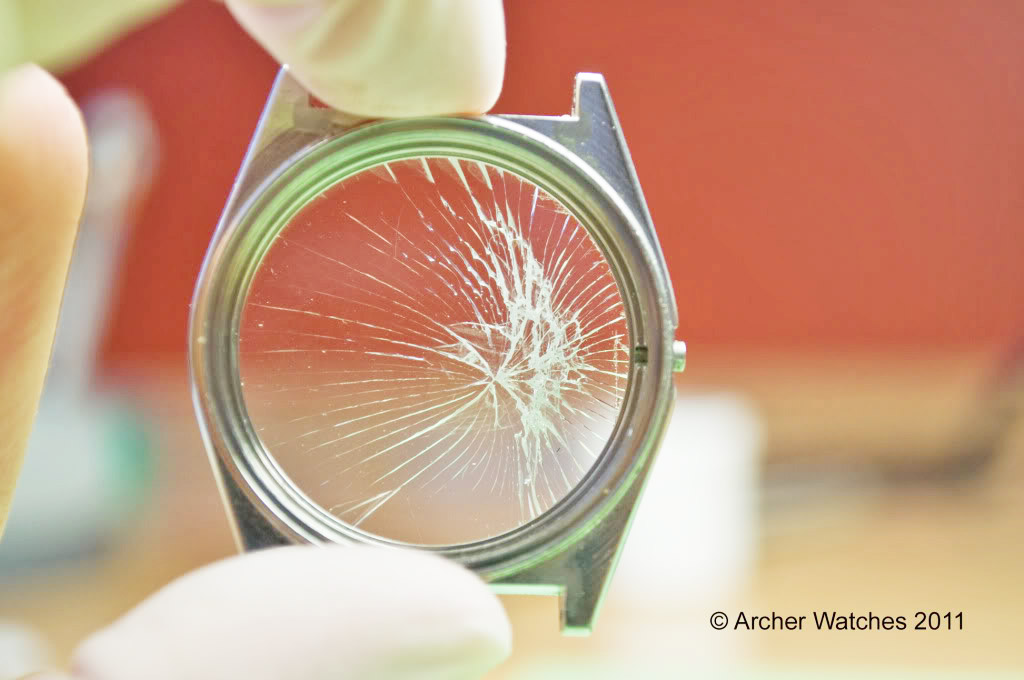
Sapphire would present less of a problem for EVA if smashed and more of a problem inside the vehicle in microgravity. Outside it would just float off, inside some tiny shards might float around just waiting to be inhaled by someone.

It's the eyes that are a bigger problem.
Shards of glass floating around and getting into eyes can be debilitating and on the balance of probability more of a risk.
Inhalation is somewhat secondary by comparison.
Also glass perforating a space suite could be highly problematic as well I suppose🙁
 
Posts
4,698
Likes
17,795
I disagree.
When the requirements are taken into full consideration, it would seem that anything other than a plastic Crystal would be precluded.
I think there was one Apollo mission where the glass cover over the dial of an instrument which broke and they spent an outrageous amount of time trying to vacuum up all the bits to a satisfactory standard.
In that case plastic would be superior anytime👎

Exactly- so they would have used a different cover for the large instrument panels / not glass if it was a strong requirement from the get go. The evidence does not point to a specification request for plexiglass etc on the watches. if you read the whole linked thread there is no written evidence to show it was a specified need or indeed part of the selection process.
 
Posts
469
Likes
999
Exactly- so they would have used a different cover for the large instrument panels / not glass if it was a strong requirement from the get go. The evidence does not point to a specification request for plexiglass etc on the watches. if you read the whole linked thread there is no written evidence to show it was a specified need or indeed part of the selection process.


Was the sapphire glass even an option in 60ties??
 
Posts
3,998
Likes
9,018
The evidence does not point to a specification request for plexiglass etc on the watches. if you read the whole linked thread there is no written evidence to show it was a specified need or indeed part of the selection process.

Isn’t there a conflation here between the testing vs the specifications?

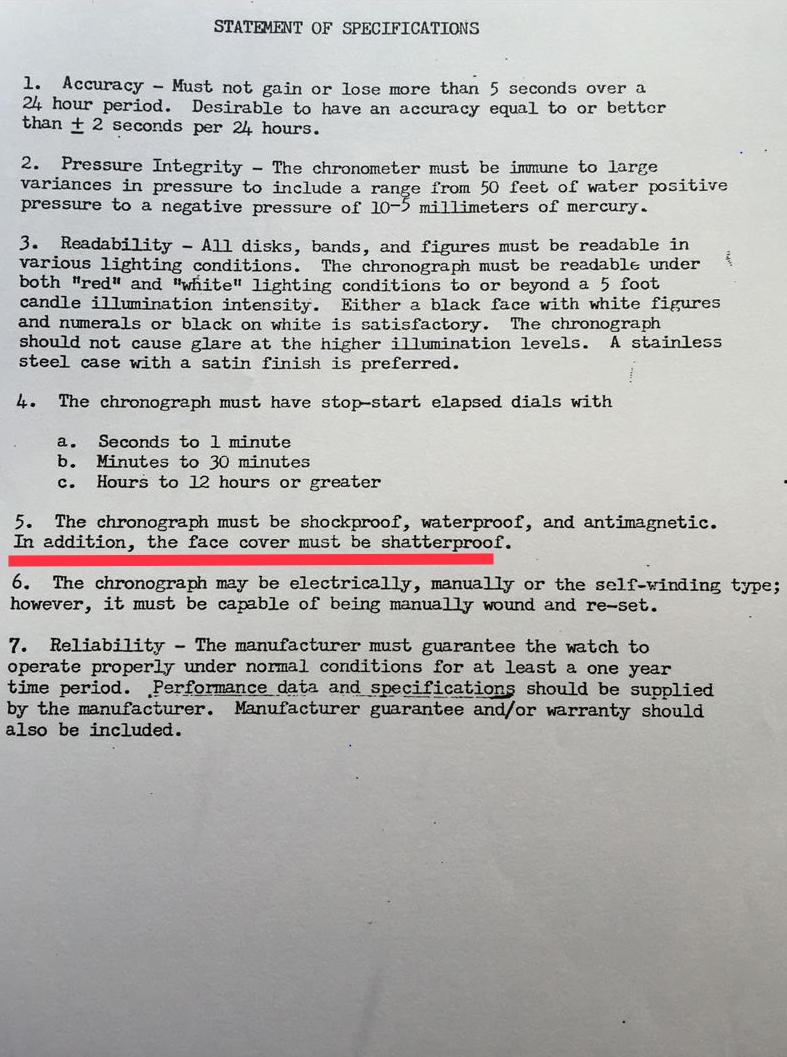
As for specifications, while not specifying “plexiglass,” I believe the assumption is that the materials ‘requirement’ argument comes from the bold and italicized language in regarding a “shatterproof” crystal? Particularly, hard to say what may have been in the engineer’s minds as the relevant definition of “shatterproof” - obviously, plexi can be “shattered” but I thought it pretty well settled that the average plexi material it’s materially less prone to breaking than the average sapphire material. Presumably the engineers knew there was no such thing as literally shatter-proof.

Contrary facts surely exist (did Omega even produce a sapphire crystal for the speedy in the 1960s?).

But the broader point is that it seems at least indeterminate given the bold/italicized language below whether there was “no written evidence to show it was a specified need or indeed part of the selection process”

STATEMENT OF SPECIFICATIONS:

  1. Accuracy - Must not gain or lose more than 5 seconds over a 24 hour period. Desirable to have an accuracy equal to or better than 2 seconds per 24 hours.
  2. Pressure Integrity - The chronometer must be immune to large variances in pressure to include a range from 50 feet of water positive pressure to a negative pressure of 10 millimeters of mercury.
  3. Readability - All disks, bands, and figures must be readable in various lighting conditions. The chronograph must be readable under both “red” and “white” lighting conditions to or beyond a 5 foot candle illumination intensity. Either a black face with white figures and numerals or black on white is satisfactory. The chronograph should not cause glare at the high illumination levels. A stainless steel case with a satin finish is preferred.
  4. The chronograph must have stop-start elapsed dials with
    1. Seconds to 1 minute
    2. Minutes to 30 minutes
    3. Hours to 12 hours or greater.
  5. The chronograph must be shockproof, waterproof, and anti-magnetic. In addition, the face cover must be shatterproof.
  6. The chronograph may be powered electrically, manually or the self-winding type; however, it must be capable of being manually wound and re-set.
  7. Reliability - the Manufacturer must guarantee the watch to operate properly under normal conditions for at least one year time period. Performance data and specifications should be supplied by the manufacturer. Manufacturer guarantee and/or warranty should also be included.
 
Posts
6,832
Likes
13,797
The answer is within the definition of Shatter:

"Break or cause to break suddenly and violently into pieces."

The issue is not to have an unbreakable cover, but one that, when broken, will not shatter into pieces (shards) that can be harmful to the astronauts or equipment.

Plexi cracks but doesn't shatter as much because of its softer qualities. I suppose modern saphire /shock proof, Crystals tend to do the same thing and not shatter away but rather crack and stay in place. (?)

Crystal shatters.
Edited:
 
Posts
29,664
Likes
76,816
I suppose modern saphire /shock proof, Crystals tend to do the same thing and not shatter away but rather crack and stay in place.

Well, if they stay in place is really not a function of the material, but the design of the case and to a larger extent, the type and severity of the impact. But they do shatter into many small pieces...


You wouldn't want to inhale or get in your eyes any of the small razor sharp shards that are formed when sapphire is broken...
 
Posts
233
Likes
382
not for me so... the "original" movement makes the moonwatch, the moonwatch! but the new is an as beautifull watch though 😉
 
Posts
922
Likes
493
Was the sapphire glass even an option in 60ties??

I can't quite recall but I believe it was possible to have a Sapphire crystal back then but it was considered to be highly exotic and expensive.
Mineral crystals were more common but I think they were more commonly found on divers watches. Seiko comes to mind with their Hardlex crystals.
 
Posts
4,698
Likes
17,795
I would like to see an original copy of the statement of specification - does anyone have that?
Typically the tests are developed to assess conformance to the specifications - and there was no impact or shatter test.
Is that because all watches were considered identical in that regard (an unusual level of assumption for engineers) or is it more likely that was not a strong need due to the small size of the instrument?
It might be we can never know the answer - but I think we can say nothing has precluded Sapphire crystal watches from flight.
Glass was also clearly being used for instruments etc in Apollo and the shuttle.
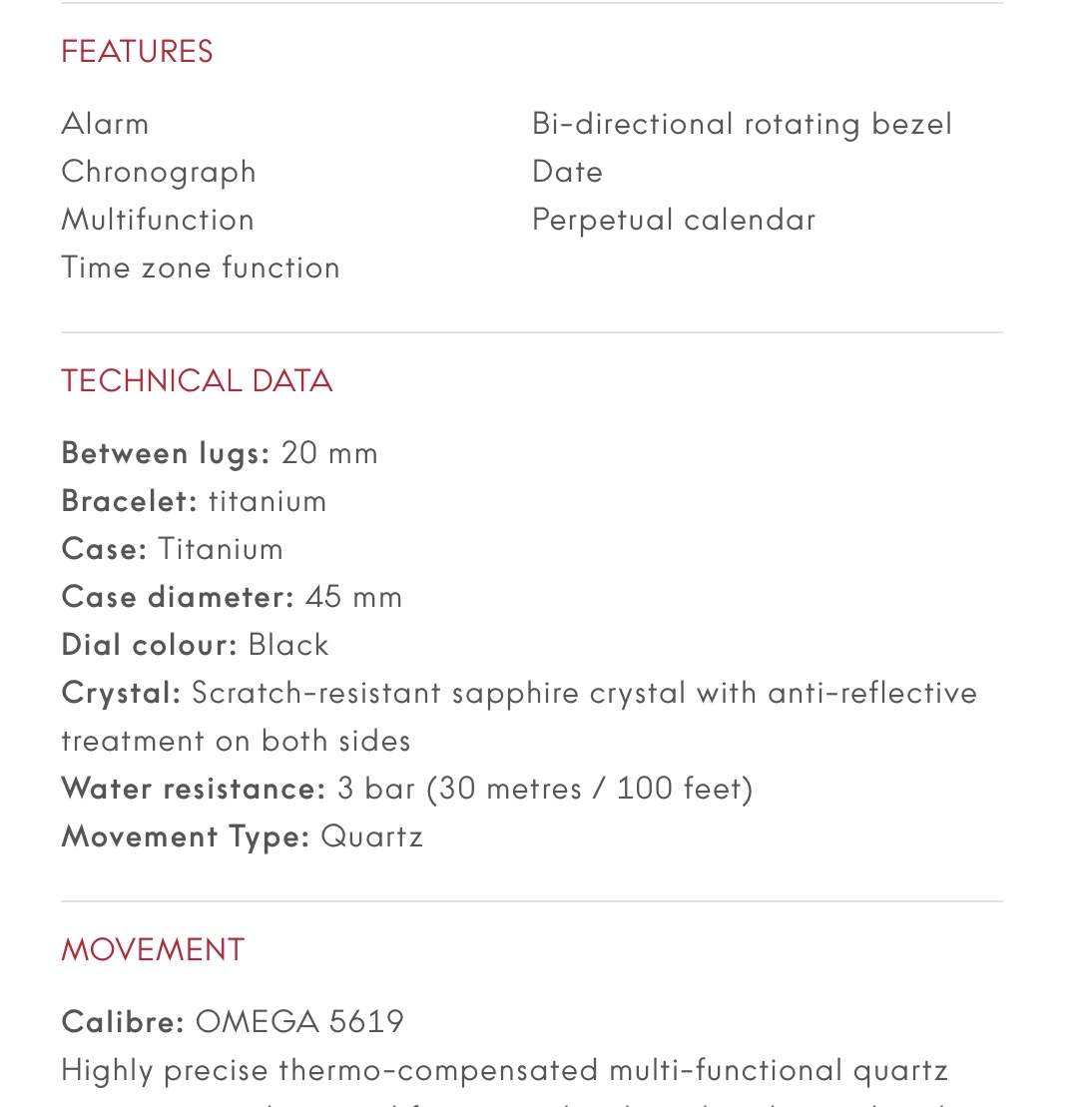
Sapphire glass was available in the sixties but I do not know how many chronograph watches in the price range would have been around with anything other than plastic crystals when they made the equipment selection. As sapphire glass has become the de facto high end watch crystal there has been nothing to preclude or prevent there use in space (the X33 being the obvious example). Many personal preference watches have also flown with Sapphire crystals (I don’t know the spec of the Panerai which was recently used on a space walk?)
Of course the shape and design of crystal will make some less prone to breakage, but I have not seen or heard of any qualification tests to check those for flight approval. COTS parts are being used more and more in space flight to reduce unnecessary costs. The Speedmaster was unmodified and commercial off the shelf. I still do not think on all known data the crystal material was or is part of the selection criteria and it is not reviewed to to same standards as the structural design.
 
Posts
922
Likes
493
I would like to see an original copy of the statement of specification - does anyone have that?
Typically the tests are developed to assess conformance to the specifications - and there was no impact or shatter test.
Is that because all watches were considered identical in that regard (an unusual level of assumption for engineers) or is it more likely that was not a strong need due to the small size of the instrument?
It might be we can never know the answer - but I think we can say nothing has precluded Sapphire crystal watches from flight.
Glass was also clearly being used for instruments etc in Apollo and the shuttle.
Sapphire glass was available in the sixties but I do not know how many chronograph watches in the price range would have been around with anything other than plastic crystals when they made the equipment selection. As sapphire glass has become the de facto high end watch crystal there has been nothing to preclude or prevent there use in space (the X33 being the obvious example). Many personal preference watches have also flown with Sapphire crystals (I don’t know the spec of the Panerai which was recently used on a space walk?)
Of course the shape and design of crystal will make some less prone to breakage, but I have not seen or heard of any qualification tests to check those for flight approval. COTS parts are being used more and more in space flight to reduce unnecessary costs. The Speedmaster was unmodified and commercial off the shelf. I still do not think on all known data the crystal material was or is part of the selection criteria and it is not reviewed to to same standards as the structural design.

Setting the Omega propaganda aside and keeping the original specifications in front of mind.
Given the question posed as the thread heading, I put it to you that only a Hesalite version can be considered a true Moonwatch.

Then again, if Omega wants to call something a Moonwatch just because they can then so be it as it appears they were the ones that started to label the only variant of the Speedy which was available at the time and happens to have a Hesalite crystal "The Moonwatch" then so be it i suppose👎
Just providing some context👍
 
Posts
4,698
Likes
17,795
Setting the Omega propaganda aside and keeping the original specifications in front of mind.
Given the question posed as the thread heading, I put it to you that only a Hesalite version can be considered a true Moonwatch.

Then again, if Omega wants to call something a Moonwatch just because they can then so be it as it appears they were the ones that started to label the only variant of the Speedy which was available at the time and happens to have a Hesalite crystal "The Moonwatch" then so be it i suppose👎
Just providing some context👍

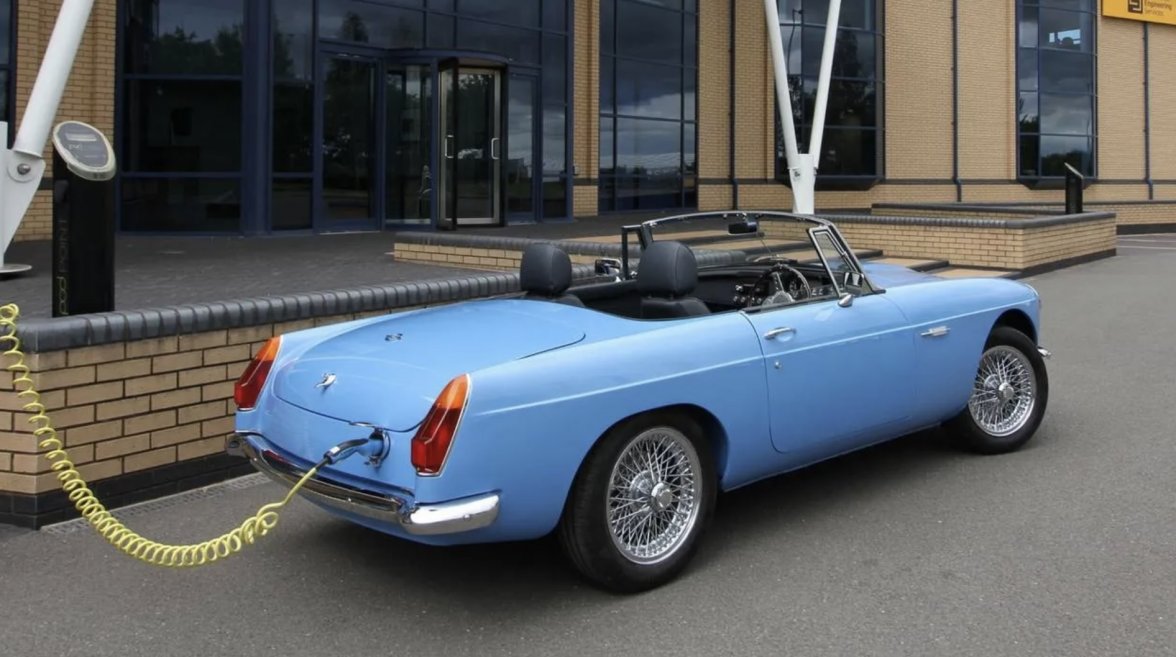
On that basis it is subjective and each individual will draw their own line. It also makes sense for Omega to push a reasonable amount of branding extension to accommodate modern design enhancements which for reasons stated above should not preclude its use in Space. Would a purist accept a Speedmaster 2021 3861 with hesalite as a Moonwatch and does fitting a Sapphire crystal make much difference considering the other changes and movement enhancements. For an extreme example is this MG still an MG? it has the form and DNA but of course is now electric to match modern technology and environmental concerns. I bet it has faster acceleration as well :0)
.
 
Posts
3,998
Likes
9,018
I would like to see an original copy of the statement of specification - does anyone have that?

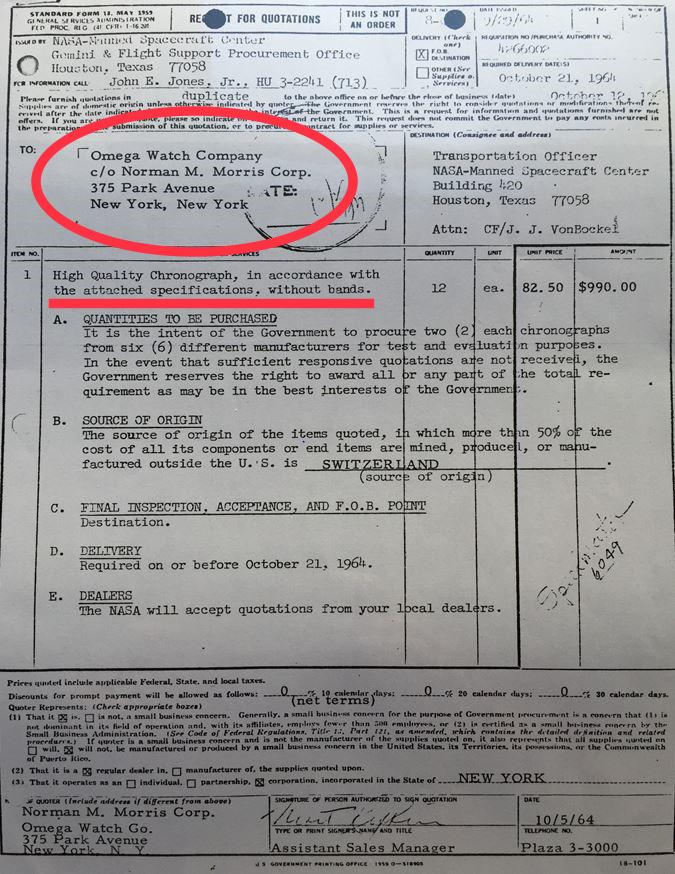
added to your other thread, and for completeness will post here as well - the rest of the memorandum with suggested manufacturers, the tests to be conducted, etc. (Posting also the Omega responsive invoice just because it’s fun.)

I believe you have previously posted the testing to be conducted which also comes from this same memorandum


Edited:
 
Posts
922
Likes
493
On that basis it is subjective and each individual will draw their own line. It also makes sense for Omega to push a reasonable amount of branding extension to accommodate modern design enhancements which for reasons stated above should not preclude its use in Space. Would a purist accept a Speedmaster 2021 3861 with hesalite as a Moonwatch and does fitting a Sapphire crystal make much difference considering the other changes and movement enhancements. For an extreme example is this MG still an MG? it has the form and DNA but of course is now electric to match modern technology and environmental concerns. I bet it has faster acceleration as well :0)
.

I have to agree in part👍
But let's leave the car analogies out of it because it never really works. Setting the acceleration factor aside, the old school MG's were generally lighter and considered sports cars in their day. Also if a fellow was driving an MG like the one pictured back in the day he would be able to pull the birds like anything😉
Those modern reserected electric MG jobs don't rate in this day and age unless one is buying on price🙁

As far as acceptance of the Moonwatch type goes, a Hesalite crystal is a part of the DNA as it formed an integral part of the original type approval, as it were.
If a modern 3861 has a Hesalite crystal it's within shooting range of being a "Moonwatch" but until it's been through the suite of tests it's only a Moonwatch in name.

Getting back to the question posed in the thread title. I wonder if the 3861 would rate very highly if it was around back in the day?
After all there is currently a bit of a problem with some of these modern watches stopping altogether at some point when the chrono function is started🙁
Imagine trying to reliably time anything with the chrono function on one of these new jobs😉
Edited:
 
Posts
922
Likes
493
added to your other thread, and for completeness will post here as well - the rest of the memorandum with suggested manufacturers, the tests to be conducted, etc., can be found with some diligent searching. (Posting also the Omega responsive invoice just because it’s fun.)

I believe you yourself have previously posted the testing to be conducted which also comes from this same memorandum, so I’m unsure of the source of your seeming skepticism


Excellent find👍
I had never seen that before outside the set criterior😉
Thanks for sharing as it fully acknowledges the suppliers recognition of the criterior down to the letter.

I have a theory for the group.
I wonder if the criterior was written because of the key features of the Speedy back in the day as if it was indeed the preferred model.
For context, the Speedy was generally regarded as the preferred watch by the Astronaughts because of it's functionality and reliability prior to formalisation.
The watch had even been modified and had evolved in acknowledgement of flaws found with the earlier designs through the space program. Specifically the asimetrical case with the Crown guards, Pushers and larger Winding crown.
That's how we ended up with the standard design which was fully realised in the last of the 1861's👎
we know the suite of tests were requested by the Astronaughts out of a desire to formalise the standard of the issued equipment regardless of manufacturer. That's probably why it was thrown open for anybody to try and meet the standard so the cream of the crop would emerge.
The Hesalite Speedy won by passing.
Edited:
 
Posts
4,698
Likes
17,795
added to your other thread, and for completeness will post here as well - the rest of the memorandum with suggested manufacturers, the tests to be conducted, etc., can be found with some diligent searching. (Posting also the Omega responsive invoice just because it’s fun.)

I believe you yourself have previously posted the testing to be conducted which also comes from this same memorandum, so I’m unsure of the source of your seeming skepticism


Thanks for the info - I think we have covered this on the other thread. I don’t recall my post so I can’t immediately comment on the source.
The test criteria / data is fairly well known. I had missed the earlier post from @Dan S regarding the statement of specification. I also always like to see original reference / source data when possible - I think that is best practice. I was not aware of the SOS or the full procurement process which I know you are now still digging into. I look forward to any new reveals.
 
Posts
3,998
Likes
9,018
Thanks for the info - I think we have covered this on the other thread.

yea, sorry, I’d misunderstood the timing of the respective posts - apologies 👍
 
Posts
6,832
Likes
13,797
Well, if they stay in place is really not a function of the material, but the design of the case and to a larger extent, the type and severity of the impact. But they do shatter into many small pieces...


You wouldn't want to inhale or get in your eyes any of the small razor-sharp shards that are formed when a sapphire is broken...
So then that would support the idea of non-sapphire specifications (I suppose?)