Cam vs column wheel.

Posts
531
Likes
3,220
Please excuse me . . .

I have read most of the content of this thread, but I may have missed what I feel to be a very important distinction between the the cam-switched actuated chrono movement and the column wheel or castle wheel activated chrono movements . . .

And there can be no counter argument to what I am about to assert:

Column wheel activated chrono movements are far sexier in appearance when compared with the more pedestrian cam-switched movements.

All the other considerations hardly matter. As Gulliver may have put it, it's a bit like arguing over which end of the egg is the correct end upon which to strike the first blow to crack it!

Cheers,

Joe

 
Posts
29,671
Likes
76,828
Column wheel activated chrono movements are far sexier in appearance when compared with the more pedestrian cam-switched movements.

Hang on...the 30CH column wheel has been described as pedestrian here, so these are dangerous waters...😉
 
Posts
5,986
Likes
28,631
As Gulliver may have put it, it's a bit like arguing over which end of the egg is the correct end upon which to strike the first blow to crack it!
It depends if it's a white or brown egg: white pointy end, brown round end.😝
 
Posts
7,177
Likes
23,253
It seems we all recognize why the 321 is so revered, and hence the column wheel - glad we could sort all that out.

Yes. Just in time, as I was advised that a cat photo was imminent…
 
Posts
2,842
Likes
4,537
All the other considerations hardly matter. As Gulliver may have put it, it's a bit like arguing over which end of the egg is the correct end upon which to strike the first blow to crack it!
Time I guess to watch Doctor Strangelove. The savvy will notice they attack the missile complex at Laputa.

The egg wars live on in computer terminology. Mac is one Endian, Windows the other. Although most modern risk processors do not care what order the bytes are placed.

There is a lot more to the travels than a bunch of little people.
 
Posts
288
Likes
210
Maybe too late to chime in here, but along the lines of Archer's preference for repeatable and predictable chronograph actuation points, what irks me is the relatively large differences in start and stop actuation forces. This deficiency seems to afflict both cam and column wheel operated chronographs. The difference often is smaller for subsequent restarts and stops, but the first start always seems to require a significantly higher pusher force.
In my opinion this affects timing precision negatively, beyond the inherent limitations of a mechanical watch.
 
Posts
29,671
Likes
76,828
The difference often is smaller for subsequent restarts and stops, but the first start always seems to require a significantly higher pusher force.

This is because when you start the chronograph, you have to swing the large hammer that contacts the chronograph seconds and minute recording wheels out of the way. Once the watch is started, it can be stopped and restarted without the hammer moving again - it only moves again on reset.

That hammer is spring loaded, so that when you reset the spring slams it down onto the cams of those two wheels to reset the hands. So you also have to overcome the tension in the spring when you start the chronograph, as well as move the mass of the hammer itself. The hammer pivots around a post, and the cam or column wheel is pushing on the smaller end of a sort of lop sided see saw if you will, so the forces needed can be quite high.

 
Posts
288
Likes
210
It should be possible to solve this by better engineering (change lever arm lengths), no? A $40k+ Lange seemed more even, at least subjectively, but I didn't carry my kitchen scale with me to actually measure the forces. ;-)
 
Posts
29,671
Likes
76,828
It should be possible to solve this by better engineering (change lever arm lengths), no? A $40k+ Lange seemed more even, at least subjectively, but I didn't carry my kitchen scale with me to actually measure the forces. ;-)

"Solve" it? Not sure what that means specifically. The longer the levers, the larger the mass, and likely stronger spring will be required.
 
Posts
288
Likes
210
By solve I mean to equalize start and stop forces, in order to minimize systematic offset in timing. As I said, the Lange seemed closer.
 
Posts
29,671
Likes
76,828
By solve I mean to equalize start and stop forces, in order to minimize systematic offset in timing. As I said, the Lange seemed closer.

As I mentioned above, longer levers will require other adjustments - it's all a compromise, so nothing happens without affecting other things. Off the top of my head, it seems like it would be a tail chasing exercise to get everything perfectly balanced, and still have proper operation of the chronograph.

I can only suggest that either no one has been able to come up with a design that does this so far, or they have and they found it's just not worth pursuing, because most people don't care. If you feel it's the former, maybe it's something you can work on the design and see if any watch companies bite?
 
Posts
2,842
Likes
4,537


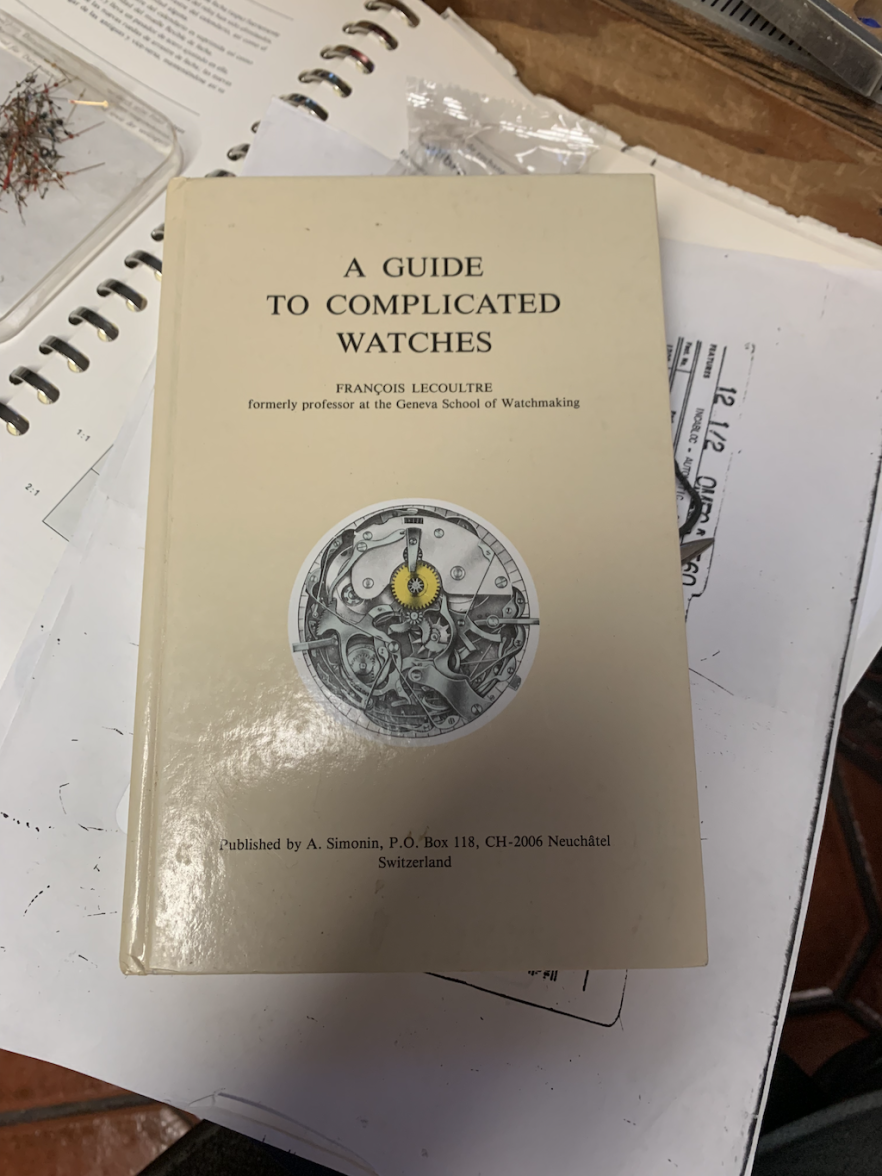
It is all in there. 200 years worth of study an analysis. This is the book everyone learns from. Any computer models are taken from the illustrations within. Often imitated never duplicated.