- Posts
- 6,999
- Likes
- 12,897
SpeedyPhill
·Prof Johannes Geiss played an important role in designing the Apollo Solar Wind Composition (SWC) experiment, which was used to measure elemental and isotopic abundances of the light noble gases in the solar wind, and to investigate time variations in the solar-wind composition.
The experiment was deployed on the first five Apollo lunar landing missions, Apollo 11, 12, 14, 15 and 16. The Moonwalkers on each mission exposed a SWC foil at each of the five landing sites, and solar wind particles were collected for time periods ranging from 77 minutes in July 1969 (Apollo 11) to 45:05 hours in April 1972 (Apollo 16).
These foils were returned to Earth, to analyse collected noble gas particles in ultra-high vacuum mass spectrometers.
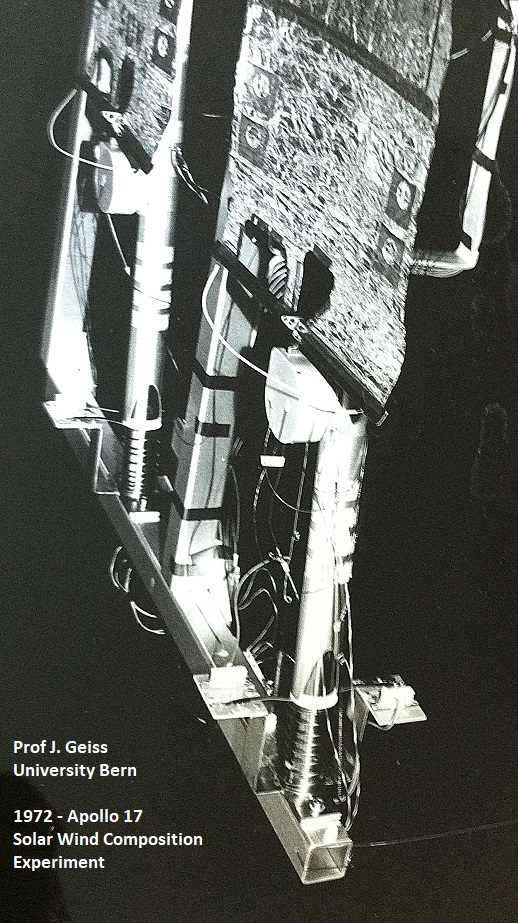
However, as timing the solar wind was important a more elaborate SWC was planned to fly on Apollo 17 and Prof Geiss (University of Bern - Switzerland) developed a setup which had two Omega chronograph mechanisms for timing purposes. At the last minute, this experiment was not flown but we would like to find out if which chronographs were exactly provided by Omega... not 861 Speedmasters !?
😕
.
The experiment was deployed on the first five Apollo lunar landing missions, Apollo 11, 12, 14, 15 and 16. The Moonwalkers on each mission exposed a SWC foil at each of the five landing sites, and solar wind particles were collected for time periods ranging from 77 minutes in July 1969 (Apollo 11) to 45:05 hours in April 1972 (Apollo 16).
These foils were returned to Earth, to analyse collected noble gas particles in ultra-high vacuum mass spectrometers.
However, as timing the solar wind was important a more elaborate SWC was planned to fly on Apollo 17 and Prof Geiss (University of Bern - Switzerland) developed a setup which had two Omega chronograph mechanisms for timing purposes. At the last minute, this experiment was not flown but we would like to find out if which chronographs were exactly provided by Omega... not 861 Speedmasters !?
😕
.