anyone know how the antiquorum auction went today ?

Posts
8,162
Likes
28,792
Most people would expect the vintage market to have some collapse through a downturn but that historically has never been the case.

I think in this instance we’ve seen such a dramatic decline that the bottom end of the market will temporarily drop out of the market as they wait for things to improve. But in general, those who are liquid in excess will not slow down. So we might see a brief drop in prices for some models (and certainly a drop with the unrealistic market for the recent ‘hype’ watches), the vintage market as a whole will remain strong. *In my opinion*
Well, I disagree. I once did some work over several years for a billionaire, and when the '08 crisis hit, his belt-tightening was palpable. My broader experience in the Thoroughbred racing business over several decades echoed that experience. Of course those with big money/incomes will, as a group, remain somewhat active in luxury spheres such as collecting, but outside of the very best and most desirable vintage watches, I expect that nearly everything will face serious downward price pressure.

This economic crisis is just beginning to unfold, and its repercussions are, in my view, certain to be long and deep. Markets are likely to spike when the COVID-19 impact begins to recede, but the real economy will take years to recover. No luxury asset class will be spared, including watches, as demand slackens significantly, and supply increases. I do agree that broadly speaking asking prices will not drop rapidly, but that always happens when bubbles burst, as sellers are typically slow to accept that there won't be a quick rebound.

Also consider that many vintage watch collectors have never experienced a down market, and that is sure to produce many serious cases of normalcy bias. My advice to sellers would be to price aggressively, unless you are prepared to hold for a long time. Buyers, in contrast, will enjoy increasing advantages as time goes on, and those who are patient will surely be rewarded.
 
Posts
511
Likes
2,180
i saw some allusions to it going well on IG but can't actually find the results. . .

would be a good barometer of where the world is and what people think of watches vis a vis cash i think. . .
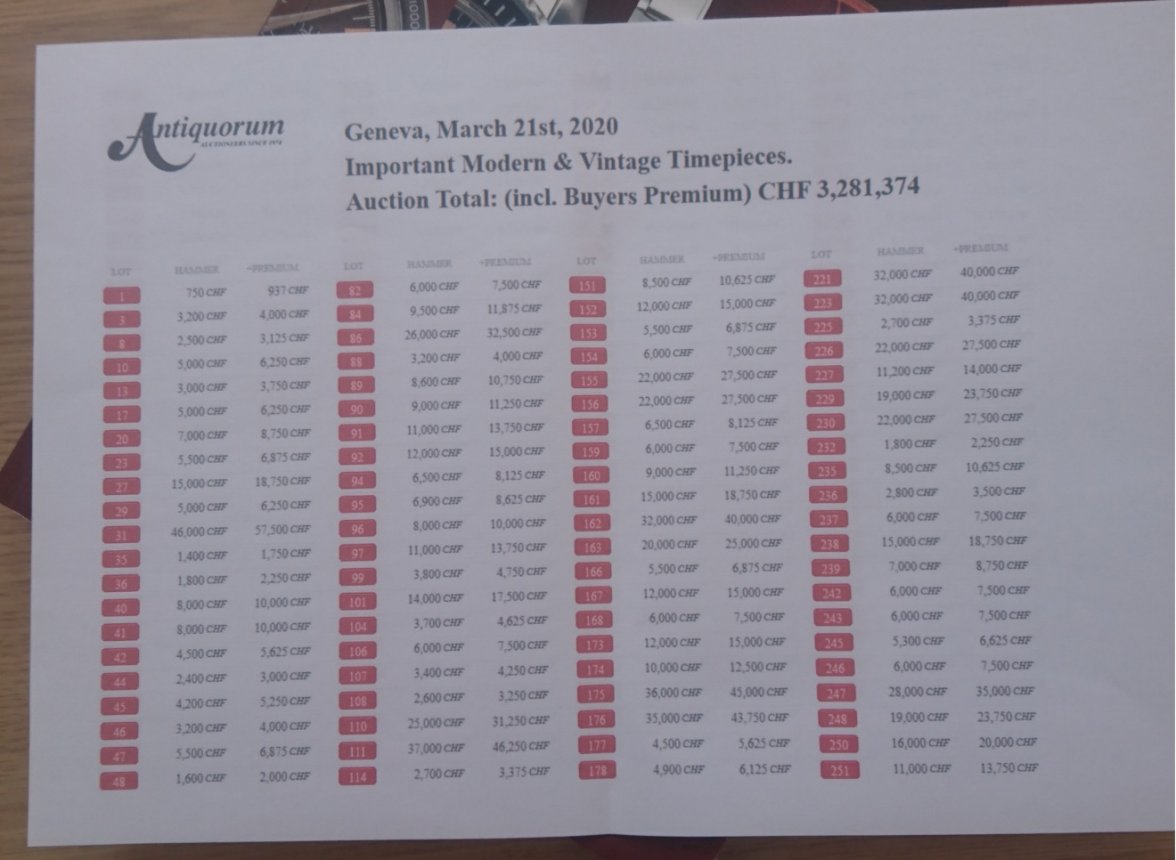
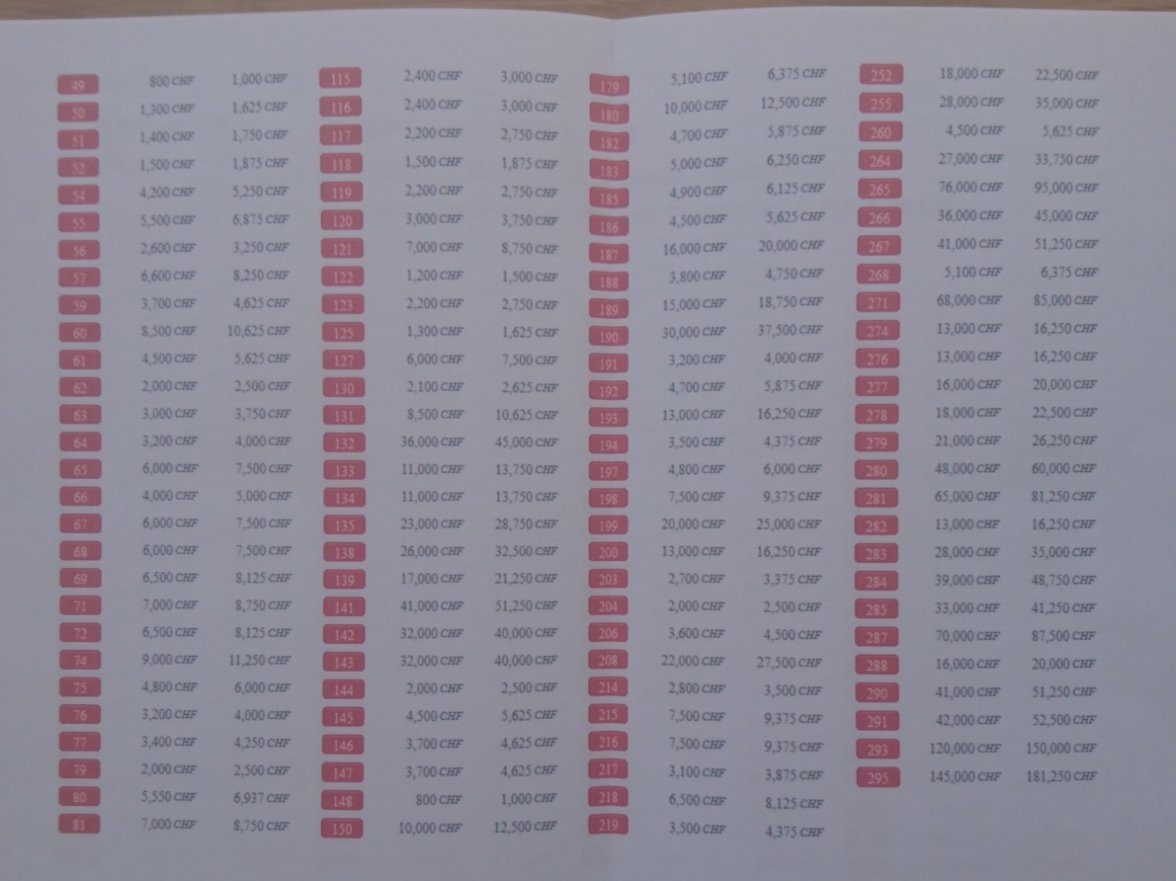
Results were published on Tuesday.
I printed them off to save with the catalogue, apologies for the poor quality pics in part due to my photographic skills (or lack of) and partly due to my printer quality, anyway here they are:

Lots that do not appear on the list were not sold/passed.
Edited:
 
Posts
1,069
Likes
2,166
Dang, they made nearly CHF 1MM in fees? Yeah, they need to add free shipping.
 
Posts
189
Likes
178
Well, I disagree. I once did some work over several years for a billionaire, and when the '08 crisis hit, his belt-tightening was palpable. My broader experience in the Thoroughbred racing business over several decades echoed that experience. Of course those with big money/incomes will, as a group, remain somewhat active in luxury spheres such as collecting, but outside of the very best and most desirable vintage watches, I expect that nearly everything will face serious downward price pressure.

This economic crisis is just beginning to unfold, and its repercussions are, in my view, certain to be long and deep. Markets are likely to spike when the COVID-19 impact begins to recede, but the real economy will take years to recover. No luxury asset class will be spared, including watches, as demand slackens significantly, and supply increases. I do agree that broadly speaking asking prices will not drop rapidly, but that always happens when bubbles burst, as sellers are typically slow to accept that there won't be a quick rebound.

Also consider that many vintage watch collectors have never experienced a down market, and that is sure to produce many serious cases of normalcy bias. My advice to sellers would be to price aggressively, unless you are prepared to hold for a long time. Buyers, in contrast, will enjoy increasing advantages as time goes on, and those who are patient will surely be rewarded.


There will be a few articles that come out in the coming days from some good friends who can be more articulate than myself.. So I’ll post them here when they get posted.

One that’s good to check now from a friend is John Reardon’s article from Collectability.
https://collectability.com/learn/world-in-crisis-and-watch-market/

But in general, the vintage watch market has historically remained strong throughout economic downturns and that’s evident from the success of the auction houses even through the ‘08 recession. I agree that the bottom end of the market will suffer, but the majority of vintage pieces (as Rolex and Patek take more than 50% of the market!) won’t see a huge change as they haven’t in years past.

I’m not sure if this will be different and hope that we do not see a full blown depression, but I remain optimistic that we can control the spread of the virus and get to a point where people can begin working again.
 
Posts
905
Likes
2,488
There will be a few articles that come out in the coming days from some good friends who can be more articulate than myself.. So I’ll post them here when they get posted.

One that’s good to check now from a friend is John Reardon’s article from Collectability.
https://collectability.com/learn/world-in-crisis-and-watch-market/

But in general, the vintage watch market has historically remained strong throughout economic downturns and that’s evident from the success of the auction houses even through the ‘08 recession. I agree that the bottom end of the market will suffer, but the majority of vintage pieces (as Rolex and Patek take more than 50% of the market!) won’t see a huge change as they haven’t in years past.

I’m not sure if this will be different and hope that we do not see a full blown depression, but I remain optimistic that we can control the spread of the virus and get to a point where people can begin working again.
Well, my take on this is that the really rare and collectible pieces will always sell and find a new home for a “market price” paid by devoted collectors with money to spare to grow their collections even during hard times.

This calibre of high grade collectors even on a global scale are scarce compared to the “general” vintage watch buyers that have fed the market until now, that mostly gather their income from their own run businesses or high paid jobs.

It’s especially their buying power that will be hit in the aftermath of this pandemic, and no longer can / will channel their income into luxury “off-beat” items like vintage watches in the same extent they where used to the last years.

Looking at the shear volume of vintage watches in rotation and currently for sale on a global scale is massive, i mean massive!

You can’t buy all the watches available on the market right now, there’s just such great numbers available in different conditions everywhere so there will be a true excess of offering and dealers in need of cash flow that will need to feed their sales.

So expect every dealer to do everything in their power to try to steady the market and try to keep the price points on their assets as high as possible, as this is the only thing they can try to do for a short while until someone breaks and sets off a spree of offering in need of cash, whilst most likely still there won’t be as many buyers in the next years to come.

Like every second business article prior to a crash recommending consumers that now is the time to buy stocks, (when everyone else is jumping ship).

Additionally in the same time the “general” watch buyers will probably also need to sell some of their pieces to cover other costs, adding to the vast offering already out there, thus affecting price and availability even more.

But this whole topic is something that i’ve found that people even in this forum don’t want to discuss or touch that much as it affects their own collections as well.

I don’t want to be over pessimistic but still recommend to keep your mind open and follow all the signals that we’re getting already today from everywhere in the world. I would love to be completely wrong in my observations and views, would just love to be...

Last recession was a financial recession with banks mostly struggling thus affecting consumers. This recession WILL BE a consumption recession, and that is a whole other ball game as it FIRST will affect consumers and the banks following.

And the banks won’t be there to bail us out, like we did for them the last time....
 
Posts
1,555
Likes
1,978
No you still have to pay to get them posted, but Maud is a very comprehensive person , will get my new watch tomorrow .
 
Posts
8,162
Likes
28,792
There will be a few articles that come out in the coming days from some good friends who can be more articulate than myself.. So I’ll post them here when they get posted.

One that’s good to check now from a friend is John Reardon’s article from Collectability.
https://collectability.com/learn/world-in-crisis-and-watch-market/

The value of an article entitled:

THE WORLD IN CRISIS AND THE WATCH MARKET
5 things to consider with your Patek Philippe collection

isn't likely to be relevant to the broader market, and for obvious reasons.

But in general, the vintage watch market has historically remained strong throughout economic downturns and that’s evident from the success of the auction houses even through the ‘08 recession. I agree that the bottom end of the market will suffer, but the majority of vintage pieces (as Rolex and Patek take more than 50% of the market!) won’t see a huge change as they haven’t in years past.

I think that you are misunderstanding several things. First, do you have any evidence that other than high-end vintage watches sold well through auction houses during and soon after the '08 crisis? I'm skeptical that such data exists.

Secondly, the vintage watch market was growing heading into that crisis, and has since experienced its greatest appreciation phase ever. In fact, it was in a bubble, which is now deflating. So expecting the market to react as it did in '08 is dubious, as it is based on a faulty premise.

Furthermore, it's not merely the bottom end of the market that will suffer, but virtually the entire market! Perhaps you haven't been paying attention, but all but the best and most desirable models were beginning to decline in value even before the crisis erupted. I've been very active in the market for 20+ years, and especially over the past 10. I was much more of a buyer than seller until about two years ago. I have not only sold many watches privately, but also to dealers (in particular from Japan). I have sold a wide variety of models ranging from a few hundred dollars to the (very) low five figures, and can tell you from experience that there was a bubble that had already begun to deflate before the current crisis began. I am also absolutely certain that the values of most watches will decline further, and probably significantly.

The exceptions will be the very best and most desirable, and, quite possibly, those cased in gold, for reasons having nothing to do with horology.

Bear in mind, though, that my outlook is based in part on what I perceive as being the near certainty that the unfolding financial crisis will eclipse the '08 crisis in severity.
Edited:
 
Posts
189
Likes
178
I think that you are misunderstanding several things. First, do you have any evidence that other than high-end vintage watches sold well through auction houses during and soon after the '08 crisis? I'm skeptical that such data exists.

Secondly, the vintage watch market was growing heading into that crisis, and has since experienced its greatest appreciation phase ever. In fact, it was in a bubble, which is now deflating. So expecting the market to react as it did in '08 is dubious, as it is based on a faulty premise.

On the first, you can look at CollectorSquare.com or RoundtableVintage.com/Analytics to see that vintage watch values stayed steady and even grew in value during and post 08’ crisis.

On to the second, I believe you’re misconstruing the vintage watch market with the entire secondary watch market as a whole. As I’ve stated numerous times on this site, all new watches that were hyped and were valued above retail before COVID hit will suffer. Even still, those same watches are selling today as we speak for higher than retail (albeit anywhere from 20-35% lower than what they were before).

Looking solely at the vintage watch market constitutes watches that were produced prior to the late 80s (some say early 90s now?). Looking at at historical data of this vintage market, it is carried in a majority by Patek and Rolex (over 50%). Since 1997, the average price of any Rolex sold at auction has been $30,954 and the average price of a Patek Philippe at auction has been $57,998. The majority of the vintage watch market is sustained not by small transactions, but by $30,000+ transactions from individuals who typically have an excess of available funds and who are diversified in many different ways.

I understand your pessimism toward the current situation, but I would challenge your thinking that the vintage market (Not the secondary watch market as a whole) will fair negatively. Now, if this situation draws on for 6-12 months and government assistance begins to run dry, then it won’t just be watches that will suffer. That’s a catastrophic situation that I don’t believe we’ve hit yet and frankly am not sure that we will. I prefer to remain optimistic as historical data and current thoughts from leading vintage market experts remain positive. Those who remain pessimism in the long are essentially placing a bet against modern medicine’s ability to crank out a viable treatment plan and eventual vaccine, and I don’t aim to doubt the abilities of our finest scientists from around the world.

In any case, I appreciate the back and forth + different perspectives as the help paint a better picture of what we’re really dealing with.
 
Posts
8,162
Likes
28,792
On the first, you can look at CollectorSquare.com or RoundtableVintage.com/Analytics to see that vintage watch values stayed steady and even grew in value during and post 08’ crisis.

I don't believe it for a second. The latter site requires a login, and I have no idea how to source the information that you claim to be on the former. If you can either reproduce, or look directly to the data, I would be happy to address it specifically.

On to the second, I believe you’re misconstruing the vintage watch market with the entire secondary watch market as a whole. As I’ve stated numerous times on this site, all new watches that were hyped and were valued above retail before COVID hit will suffer. Even still, those same watches are selling today as we speak for higher than retail (albeit anywhere from 20-35% lower than what they were before).

Where did you get the idea that I was referencing new watches? I never did anything of the sort.

Looking solely at the vintage watch market constitutes watches that were produced prior to the late 80s (some say early 90s now?). Looking at at historical data of this vintage market, it is carried in a majority by Patek and Rolex (over 50%). Since 1997, the average price of any Rolex sold at auction has been $30,954 and the average price of a Patek Philippe at auction has been $57,998. The majority of the vintage watch market is sustained not by small transactions, but by $30,000+ transactions from individuals who typically have an excess of available funds and who are diversified in many different ways.

Patek Philippe constitutes only a minuscule percentage of vintage watches bought and sold in the market. A high average value, for sure, but of negligible value when assessing the broader market. Rolex does constitute a much larger percentage, but nowhere near 50%. A couple of quick data point: a quick search on eBay for "vintage Rolex" in "wristwatches" yields ~3,500 hits; for "vintage watch" the number is ~213,000. Chrono24? The ratio is 1,800/15,000

Rolex is also somewhat of a special case, and I would expect those watches, on average, to hold their value much better than less fashionable brands.

The majority of the vintage watch market is sustained not by small transactions, but by $30,000+ transactions from individuals who typically have an excess of available funds and who are diversified in many different ways.

The above claim is as misguided as pointing out that if Bill Gates and nine bus drivers were to walk into a bar, their average net worth would be 10 billion dollars.

The very forum that we are discussing this topic on - one of, if not the most popular watch forums in the world - features discussions and sales of a myriad of vintage brands and models that vastly outnumber the sub-categories of Rolex and PP.

The gross amount of dollars that changes hands is only one variable to consider when assessing markets.

I prefer to remain optimistic as historical data and current thoughts from leading vintage market experts remain positive. Those who remain pessimism in the long are essentially placing a bet against modern medicine’s ability to crank out a viable treatment plan and eventual vaccine, and I don’t aim to doubt the abilities of our finest scientists from around the world

I appreciate your optimism, and especially as it relates to the virus, but it illustrates the primary flaw in your perspective. You apparently believe that both the vintage watch market and broader economy were strong one month ago, while I believe that there is overwhelming evidence that the opposite is true. And, just as the virus is far more dangerous to those who are weak, the world's economy, which was built on an unsustainable mountain of debt, and already teetering into recession, is exceptionally vulnerable to the profound impact of the COVID-19 crisis.

Thanks for the debate.
 
Posts
189
Likes
178
I don't believe it for a second. The latter site requires a login, and I have no idea how to source the information that you claim to be on the former. If you can either reproduce, or look directly to the data, I would be happy to address it specifically.

Patek Philippe constitutes only a minuscule percentage of vintage watches bought and sold in the market. A high average value, for sure, but of negligible value when assessing the broader market. Rolex does constitute a much larger percentage, but nowhere near 50%. A couple of quick data point: a quick search on eBay for "vintage Rolex" in "wristwatches" yields ~3,500 hits; for "vintage watch" the number is ~213,000. Chrono24? The ratio is 1,800/15,000

I created the second site myself and it was sourced directly from auction data since the mid 1990s, feel free to sign up and see for yourself. And my conclusions are strictly based on research conducted from past market results, but I encourage everyone to conduct their own research and come to their own conclusions!

And I think you misunderstand the second point. Patek Philippe and Rolex make up for over 50% of all value sold in the market. Not sure how you would think that I was referring to the number of Patek’s or Rolex watches that are sold each year, which is a much less valuable number when understanding the market as a whole.
Love the conversation in our respective quarantines!!
 
Posts
8,162
Likes
28,792
I created the second site myself and it was sourced directly from auction data since the mid 1990s, feel free to sign up and see for yourself. And my conclusions are strictly based on research conducted from past market results, but I encourage everyone to conduct their own research and come to their own conclusions!

Ok, thanks. I am dubious that auction data is an accurate representation of the broader market, but I will have a look at your data.

And I think you misunderstand the second point. Patek Philippe and Rolex make up for over 50% of all value sold in the market. Not sure how you would think that I was referring to the number of Patek’s or Rolex watches that are sold each year, which is a much less valuable number when understanding the market as a whole.

Sorry, I wasn't clear. I am not sure how you would deduce that vintage watches from those two companies make up 50% of the total market.

Thanks.
 
Posts
1,294
Likes
2,300
I don't believe it for a second. The latter site requires a login, and I have no idea how to source the information that you claim to be on the former. If you can either reproduce, or look directly to the data, I would be happy to address it specifically.


Where did you get the idea that I was referencing new watches? I never did anything of the sort.


Patek Philippe constitutes only a minuscule percentage of vintage watches bought and sold in the market. A high average value, for sure, but of negligible value when assessing the broader market. Rolex does constitute a much larger percentage, but nowhere near 50%. A couple of quick data point: a quick search on eBay for "vintage Rolex" in "wristwatches" yields ~3,500 hits; for "vintage watch" the number is ~213,000. Chrono24? The ratio is 1,800/15,000

Rolex is also somewhat of a special case, and I would expect those watches, on average, to hold their value much better than less fashionable brands.


The above claim is as misguided as pointing out that if Bill Gates and nine bus drivers were to walk into a bar, their average net worth would be 10 billion dollars.

The very forum that we are discussing this topic on - one of, if not the most popular watch forums in the world - features discussions and sales of a myriad of vintage brands and models that vastly outnumber the sub-categories of Rolex and PP.

The gross amount of dollars that changes hands is only one variable to consider when assessing markets.


I appreciate your optimism, and especially as it relates to the virus, but it illustrates the primary flaw in your perspective. You apparently believe that both the vintage watch market and broader economy were strong one month ago, while I believe that there is overwhelming evidence that the opposite is true. And, just as the virus is far more dangerous to those who are weak, the world's economy, which was built on an unsustainable mountain of debt, and already teetering into recession, is exceptionally vulnerable to the profound impact of the COVID-19 crisis.

Thanks for the debate.


i can definitively tell you that art works by picasso and calder across the board doubled in 08/09 after languishing for many years

it is possible that with helicopter money and MMT people seek some "store of value" and while i doubt 90% of vintage watches fit the trick. . the best condition truly rare pieces may fit this bill

i am not predicting it. ..i always thought the best view of my watches was they are worth nothing in a digital age. ..but i do think my a+ vintage movados and rolexes will find buyers no matter what happens
 
Posts
8,162
Likes
28,792
i can definitively tell you that art works by picasso and calder across the board doubled in 08/09 after languishing for many years

it is possible that with helicopter money and MMT people seek some "store of value" and while i doubt 90% of vintage watches fit the trick. . the best condition truly rare pieces may fit this bill

i am not predicting it. ..i always thought the best view of my watches was they are worth nothing in a digital age. ..but i do think my a+ vintage movados and rolexes will find buyers no matter what happens

Your claim is at odds with the available data. artprice.com is in the business of reporting on the art market, and this is what it said in a 2010 article:

In 2007 the art market reached unprecedented highs, with the global revenue for Fine Art reaching $9.39 billion, more than double the 2005 total.

Driven by galloping prices and an intensified demand from rich collectors and investors, million-dollar results rained down like never before: in just the rst six months of 2007, 4,023 artists’ records were beaten and the general inflation went substantially higher than the speculative peaks reached in 1990 (the Artprice Global Index based on repeat sales was 16% above the 1990 level). In the autumn of 2008 the market turned, and the following months saw a very strong price correction and a serious increase of unsold rates.

***

Despite the numerous precautions taken, the cash poverty of investors and art collectors combined with the general mood of suspicion generated by the financial crisis substantially diminished the annual revenue figures posted by the major auctioneers: in 2009, Christie’s, the famous auction rm owned by François Pinault, saw its annual revenue shrink by 47% compared with 2008 and Sotheby’s dropped by 60%.

During this period of turmoil, the Old Masters segment was the only area of the market to show good resistance, primarily because it is little affected by fashion effects or speculative buying. In fact, the income generated by Old Masters in auctions rose by 4.9% in 2009 vs. 2008. But the other segments took serious corrections: 19th Century Art dropped 47.7%, Modern Art lost 37%, and Post-War Art contracted by 50.6%! The worst hit segment was Contemporary Art which shrank by 63.8% between 2008 and 2009.

These two charts tell the same story:

APr22.jpg

Apr21.jpg
source: https://imgpublic.artprice.com/pdf/trends2010_en.pdf

__________

I do agree with you that good watches will always attract buyers, but see no reason to believe that values will hold for other than a very small percentage.
Edited:
 
Posts
1,294
Likes
2,300
Your claim is at odds with the available data. artprice.com is in the business of reporting on the art market, and this is what it said in a 2010 article:


These two charts tell the same story:

APr22.jpg

Apr21.jpg

__________

I do agree with you that good watches will always attract buyers, but see no reason to believe that values will hold for other than a very small percentage.


Your charts have nothing to do w actual prices of blue chip artists like calder or Picasso (or many others - look at Richter or Albers or johns or Brirce marden)

Many many speculative artists crashed in 08 and never recovered

You are looking at aggregate data.. Has zero to do w actual piece by piece data.

Might I suggest before spewing some macro view supported by platitudes and.. Air.. You spend 500 bucks on an artnet subscription and show actual piece by piece info

In watch land.. Just look at what Paul Newman roelx did in 08/09

They did not go down.
 
Posts
8,162
Likes
28,792
Your charts have nothing to do w actual prices of blue chip artists like calder or Picasso (or many others - look at Richter or Albers or johns or Brirce marden)

Many many speculative artists crashed in 08 and never recovered

You are looking at aggregate data.. Has zero to do w actual piece by piece data.

Might I suggest before spewing some macro view supported by platitudes and.. Air.. You spend 500 bucks on an artnet subscription and show actual piece by piece info

For future reference, resorting to insults degrades any standing that your position might otherwise hold.

You provided an anecdotal claim about the work of two artists, and even if accurate, now extrapolate to the sweeping conclusion that work of "blue chip" artists held their values well during the last crisis? Do you consider that to be a serious argument?

I provided actual data, which clearly demonstrates that the overall market fell sharply. The suggestion that that fall was due primarily, let alone exclusively to "speculative artists", is laughable on its face.

In 2008, Pablo Picasso recovered the Top 10 leader position he lost the previous year to the «Pope of Pop Art», Andy Warhol. Picasso’s prices (all mediums) have risen 96% over the last decade reaching a strong peak in January 2008. However, after four years of unflinching inflation, the modern master has not escaped the turbulence of the economic crisis and his index literally plummeted at the end of 2008 back to 2005 levels. With several works selling at their low estimates, others not selling at all... and one being withdrawn at the last moment, the autumn sales at Sotheby’s and Christie’s were catastrophic for Picasso.

Francis Bacon’s price index reached its summit in January 2008. In just three years, his index rose a remarkable 514% (between January 2005 and January 2008) before dropping 48% over the subsequent 12 months.

As for this:

In watch land.. Just look at what Paul Newman roelx did in 08/09

it reflects a complete misunderstanding of what this discussion is actually about. We're discussing the broader market for vintage watches, not simply the best of the high-end watches. Anyone can cherry-pick a few exceptions in any markets nd no one is disputing that there are some exceptions to broader trends. I made the specific qualification in my very first post (and again later) that the very best and most desirable pieces would hold their values much better than the rest of the market.
Edited:
 
Posts
150
Likes
97
Getting back to the Antiquorum sale results, from my point of view the results were bad, since I was out bid on the 2 lots I was interested in and both sold above the estimates. I guess that means the market for Royal Oaks and Tudor Snowflakes is still strong!
 
Posts
8,162
Likes
28,792
It think that it is also important to note that with the exception of high-end vintage watches, auction results, while interesting, are not necessarily a very accurate gauge of the overall market. Most people who bid in auctions are already prepared to pay over market values, as premiums are typically 20-30% of the hammer price. Also, if one is going to use such data, then unsold watches should also be factored in. After all, if a watch fails to reach its reserve, then by definition the low valuation was too high.

Historical eBay data would be a more accurate guide to values of the vast majority of watches sold, in my view.
Edited:
 
Posts
189
Likes
178
It think that it is also important to note that with the exception of high-end vintage watches, auction results, while interesting, are not necessarily a very accurate gauge of the overall market. Most people who bid in auctions are already prepared to pay over market values, as premiums are typically 20-30% of the hammer price. Also, if one is going to use such data, then unsold watches should also be factored in. After all, if a watch fails to reach its reserve, then by definition the low valuation was too high.

Historical eBay data would be a more accurate guide to values of the vast majority of watches sold, in my view.

I factored this idea of adding historical eBay data into Roundtable, but never found accurate enough final sale results. Additionally, you’re not able to see what the watch sells for after an offer is accepted.

Similarly, Chrono24 offers their tool by aggregating all watches that are currently listed and I don’t feel that it’s in any way accurate. I’d love to get final sale results from eBay but it proved very difficult for us as we explored the idea. If anyone knows how to do that I’d love to chat with you!!