I will jump back in briefly (sorry ;0) Longer term I am interested see if Djokovic wins and if the UK Gov reverses it’s decision on mandatory vaccination of hospital staff. I will stay off the topic pending any updates.
Reading all the posts above (good robust contributions) and to give some balance for wider debate the Australian Tennis situation is becoming an issue not of public safety but of public sentiment after so much sacrifice. People and press have the power. I also think like the age of consent with the different variants, vaccines and boosters and infection rates - vaccine rules will be impacted by science, culture and economics- Yuval Noah Harris will have another best seller with his analysis in a few years.
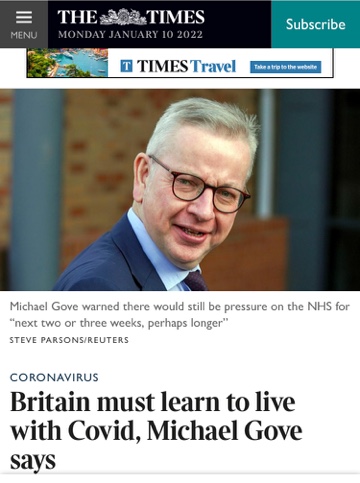
In regards to the future a small bit of politics. Michael Gove Has been one of the most outspoken for strong rules in the UK. A UK Macron. From his interview in the times this week (copy below) he seems to be developing a more nuanced position, so maybe Djokovic will be able to play in the UK as well as France.....
Britain must learn to “live with Covid” after Boris Johnson was proved right on avoiding Christmas restrictions, Michael Gove has argued. The levelling up secretary said that after two or three weeks of pressure on the NHS, “we can look forward to the progressive lifting of restrictions” and start to treat
Covid like other coronaviruses, which can cause the common cold. The prime minister is understood to be preparing a long-term plan for managing Covid without restrictions and other emergency measures as confidence grows in government that the NHS will weather the Omicron wave.Gove has been a leading advocate of Covid restrictions and acknowledged this morning that while he had been on the “more cautious end” of government discussions, Johnson had been right to overrule him.“His judgment has been vindicated,” Gove told
Today on BBC Radio 4. “He argued publicly that we would be able to get through this with the booster campaign.”Gove said that “for the next two or three weeks, perhaps longer”, the focus would be dealing with pressure on the NHS, but said there would be “better times ahead” beyond that.“One of the things that we do need to think about is how we live with this particular type of coronavirus. There are other coronaviruses which are endemic and with which we live. Viruses tend to develop in a way whereby they become less harmful but more widespread,” he said.“So at some point it will have to stop being an emergency but that is likely to be a phase-out rather than an active point in time where somebody can declare the epidemic over.“It’s going to fade out and disappear much more slowly than that, I think.”Medley said ministers would then have to make decisions on free testing and future rounds of booster vaccinations using the same cost-benefit analysis as other non-Covid public health measures.“The decisions that the government makes about vaccinating, for example against measles, are based upon decisions in terms of public health, but also the costs, and I think to some extent that approach will become more and more likely as we go forward,” he said.“We have an annual vaccination programme against influenza, for example, we have childhood vaccination programmes against many other diseases, but we don’t, for example, vaccinate against chickenpox.”He said that making free tests available had been very valuable in managing Covid so far, arguing: “It does allow people to manage their risks. Since July the number of admissions was roughly constant, just under 1,000 a day, up until the beginning of December. “That can really only come about if people are managing their risks and the free diagnostics have enabled that.” Chris Hopson, chief executive of NHS Providers, which represents hospital bosses, said he believed that the health service’s “front line will hold”. In London, where the Omicron outbreak first took off, hospital admissions are now down 17 per cent from the start of the year and the rolling average has fallen for seven days in a row. The capital has 3,867 Covid patients in hospital, the latest figures released on Sunday show - about half last January’s peak.