3d Printing Watch Crystal Gaskets-

Posts
2,212
Likes
2,431
SO: I had a REALLY annoying thing happen. Helping re-set a hand as basically a favor on a tank quartz watch (of a nicer, perhaps french brand). I go to put it back together and notice some crud in the crystal, time under the microscope shows it is filthy under there. SO, I put it flat on my case holder and start to clean it with just rodico/a piece of cloth.

Next thing I know, the crystal gasket has shattered! It is the 'hardest' super-glue-esque gasket I've ever seen: I even mistakened it for that when I first saw it, and it has basically just started flaking apart. I can't in good conscience try to re-use it, so I considered a few options. Replacing it is impossible, nothing of the right size exists.

First, I thought about just UV gluing it back in place. 0.25mm on each side of the crystal between it and the case seems like quite a lot, so I'm less tempted to give it a try. SO, back to the drawing board.

Second option: Can I 3d print a gasket? Based on the dimensions (less than 1mm thick I think, with an I frame-eseque profile), I'm not thrilled. I chatted with buddy who does 3d printing a lot, looked at my options, and any sort of filiment printer is a no-go. Smallest nozzles are 0.1mm, only epensive printers really use them, and they are fiddly.

THIRD option: Can I 3d print a gasket? Turns out, there is this thing called UV-Resin printing that has become affordable lately. It uses a 3d cured resin, an LCD screen, and some automation to cure the material. Material resin choice is going to be a whole adventure, but that is a future step. I went to facebook marketplace, and for $80 picked up an inexpensive 4k model (Mars 3 for those who know what that means). I'm going to try to model the gasket, slice it, and give it a go. I ordered an ABS-like material, which I hope will be cloe enough. I also ordered a 'superflex' material that is supposed to be more rubber-like, just way worse to print.

SO, that is where I am 馃榾 Stick aorund here for the journey !
 
Posts
436
Likes
843
I would still have a go with the UV glass adhesive (think Seiko S-314) worst case you just have to remove it and try again, best case it works and you are good to go.

I have had success with fairly large gaps between the glass and frame and still passing a 3bar test using UV adhesives, it does take some practice to get a clean joint but its definitely doable.

If you do go down this route, my biggest tip after making sure everything is clean before you start trying to glue anything is don't try to clean off the glue till AFTER it has been cured. This sounds counter-intuitive and I fell for this trap at first too, but I was taught during my training at work to do it this way and at least with Seiko S-314 you can clean it up surprisingly well with some alcohol after its cured.
By cleaning up any excess later you aren't moving the glass around and potentially making the glue run underneath the glass and onto the inside of the frame, or introducing any bubbles into the gap when the glass slides to one side and you slide it back which sucks air into the opposite side.

Also be aware that compared to some other glues I've worked with Seiko S-314 does need a longer curing time under the UV lamp.
 
Posts
18,128
Likes
37,827
I mis-read the gap size. If it's 0.25mm then I'd also go for UV glue. I've done a few glass fixes and had no problems.
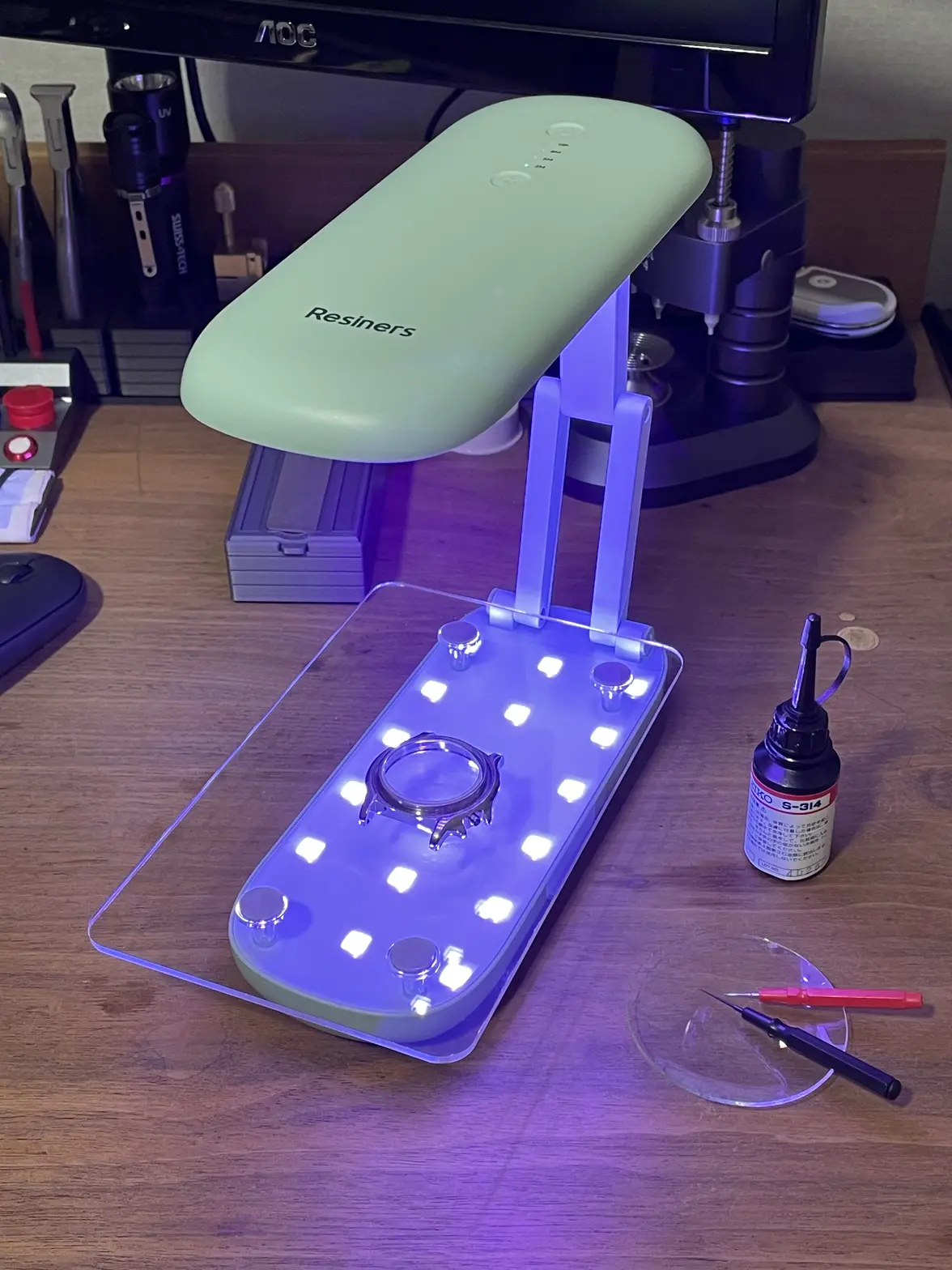
I put a big drop of UV on a small glass plate (old clock glass) and use an oiler to apply the UV. Once the crack soaks up a bit of the UV, use the oiler to tease the "pimple" of UV along the gap. Then repeat until you've gone all round. As @noless noted, cure time should be increased compared to standard UV.

My setup for doing UV crystal setting. You can collapse the top lamp down so that the watch is in a "UV Sandwich".

 
Posts
135
Likes
117
Second option: Can I 3d print a gasket? Based on the dimensions (less than 1mm thick I think, with an I frame-eseque profile), I'm not thrilled. I chatted with buddy who does 3d printing a lot, looked at my options, and any sort of filiment printer is a no-go. Smallest nozzles are 0.1mm, only epensive printers really use them, and they are fiddly.
I don鈥檛 think the nozzle size is really the main issue here. Even with a larger nozzle you can still print very thin layers well below 1 mm. The nozzle diameter mostly affects the line width and how fine the details are in the XY direction.

For this kind of gasket the material is probably more important. A flexible filament like TPU could actually work pretty well for it, especially for a thin sealing profile. You also wouldn鈥檛 need some super expensive printer with a tiny nozzle for that.

It would probably need a bit of tuning and testing, and it obviously won鈥檛 behave exactly like molded rubber, but I wouldn鈥檛 completely rule out 3D printing for this.
 
Posts
2,212
Likes
2,431
I don鈥檛 think the nozzle size is really the main issue here. Even with a larger nozzle you can still print very thin layers well below 1 mm. The nozzle diameter mostly affects the line width and how fine the details are in the XY direction.

For this kind of gasket the material is probably more important. A flexible filament like TPU could actually work pretty well for it, especially for a thin sealing profile. You also wouldn鈥檛 need some super expensive printer with a tiny nozzle for that.

It would probably need a bit of tuning and testing, and it obviously won鈥檛 behave exactly like molded rubber, but I wouldn鈥檛 completely rule out 3D printing for this.
So the gasket is 'I' shaped (at least on the inside), so despite the width being 0.25mm, it gets really thin, as there is a hole cut out of the material. So it gets pretty thin I think?

And yes, I'm aware, I spent a while looking at the materials, I was definitely considering TPU. For the resin printer, I have a flexible resin as well.

I would still have a go with the UV glass adhesive (think Seiko S-314) worst case you just have to remove it and try again, best case it works and you are good to go.

I have had success with fairly large gaps between the glass and frame and still passing a 3bar test using UV adhesives, it does take some practice to get a clean joint but its definitely doable.

If you do go down this route, my biggest tip after making sure everything is clean before you start trying to glue anything is don't try to clean off the glue till AFTER it has been cured. This sounds counter-intuitive and I fell for this trap at first too, but I was taught during my training at work to do it this way and at least with Seiko S-314 you can clean it up surprisingly well with some alcohol after its cured.
By cleaning up any excess later you aren't moving the glass around and potentially making the glue run underneath the glass and onto the inside of the frame, or introducing any bubbles into the gap when the glass slides to one side and you slide it back which sucks air into the opposite side.

Also be aware that compared to some other glues I've worked with Seiko S-314 does need a longer curing time under the UV lamp.
I actually HAVE the UV glue and did one before (actually, the same watch 3 times, but then broke the crystal on the one that was going 'well' because of stupidity). But that one was sub-0.1mm total between both sides (so closer to 0.05mm between the frame/crystal).

I just doubt the ability of it to fill that big of a gap. It seems like the crystal moves A LOT when I put it in.
 
Posts
2,212
Likes
2,431
I just gave the UV glue a chance, I think 0.25mm is too big, it didn't fill the gap, and the 'rattle fit' of the crystal made it basically impossible to get centered with the glue in place. Additionally, the glue started 'leaking' out below the glue. In the end, I was so unhappy with how I was doing, that I just cleaned up instead of curing it.
 
Posts
2,212
Likes
2,431
Welp, you guys ended up being right 馃榾 I fixtured the crystal with rodico and was able to get it UV glued in after a few tries. So, no 3d printing here 馃榾
 
Posts
18,128
Likes
37,827
Beat me to the punch. I was going to suggest setting the crystal in place with Kapton tape, and even using small paper tabs in the sides to keep it centred, then UV "spot weld" each corner and cure the UV. Then seal the back with Rodico and do the sides.

Good outcome 馃憤.

Now start thinking of what you can use your new printer for 馃.