What should I do if I don't have the original case?

Posts
372
Likes
344
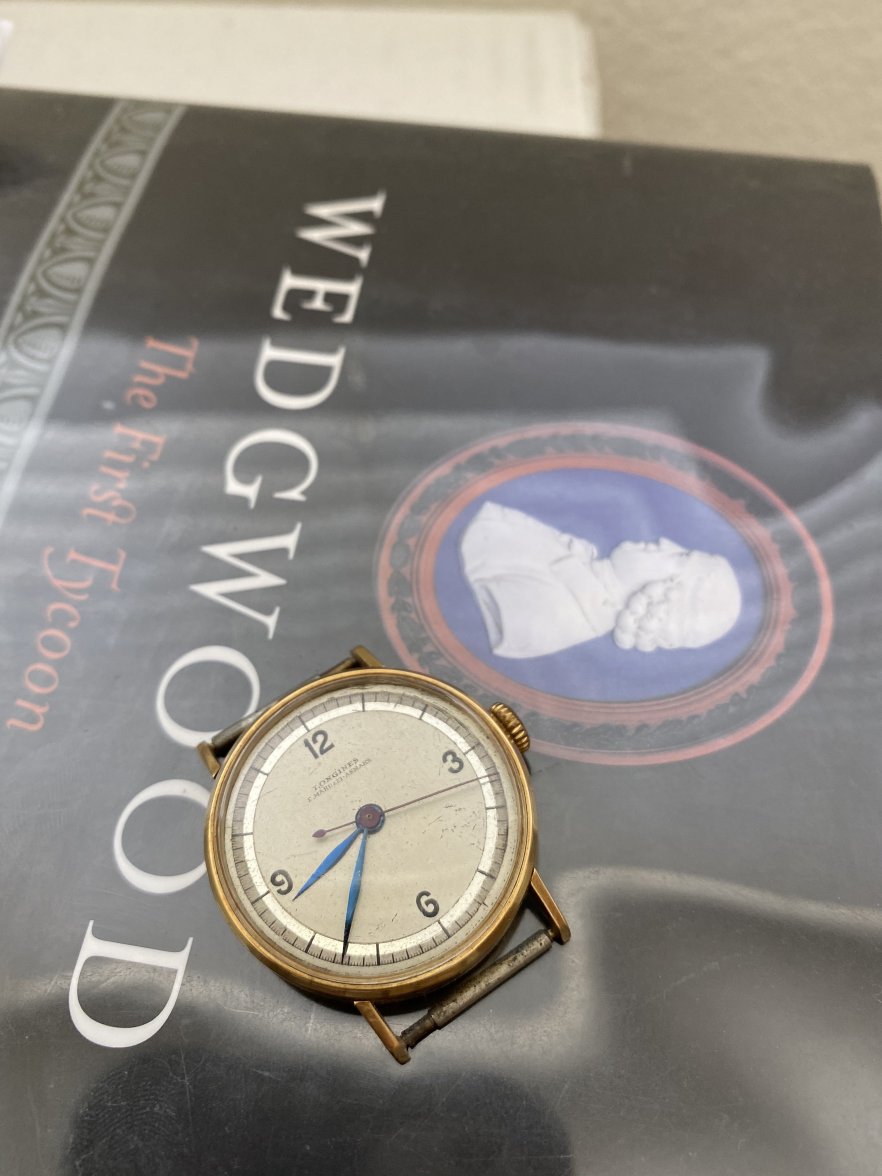
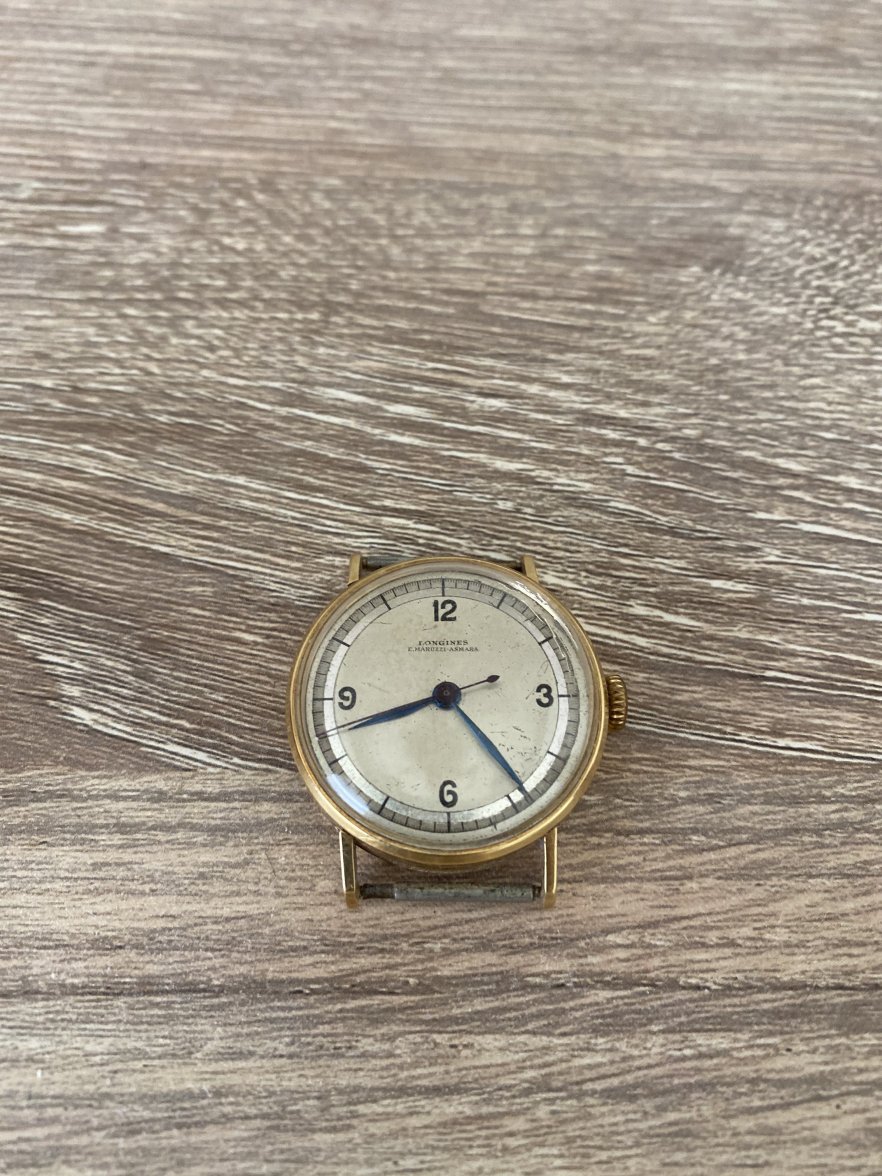
I have a 13.33Z. According to the Longines records, it was sold in Italy. I am not sure why it says Asmara - the capital or Eritrea. For some time until 1941, Eritrea was ruled by the Kingdom of Italy.

It reminds of a flying around in a plane in that region of Africa.

This is one that I don't wear - I just like looking at the dial and the hands going slowly around.

Anyway, the records indicate that it was originally a steel cased watch. It is now in a gold case.

Do you think I should try and find an original case? It seems like 13.33Z (non-chronographs) are rare.
Edited:
 
Posts
2,820
Likes
4,924
Yes, you should definitely find a period correct, steel case for this piece. And redial the two rectangular Longines, as well. 馃檮

It is your choice, what you do with your watches. Few here will advocate for refinishing a dial, or stop you from fitting a more original case. Finding a case, however, will be very difficult. Furthermore, it is possible that the gold case was fitted in period and could be viewed as pseudo-original. This is true of countless Longines that were originally sold in France in the same era.
 
Posts
372
Likes
344
Yes, it sounds like it is really a question of authenticity. If it is not completely authentic then it could have greater value if it is as authentic as possible.
 
Posts
106
Likes
133
I can't really advise on the watch case. Although as @DirtyDozen12 stated, it will probably be quite difficult to find an appropriate case. Although you could try to find a parts watch to scavenge from. More pictures would be helpful, of the movement and case back markings, which I would be interested to see anyway 馃榾

I've been quite impressed with the Longines you have posted and you're a Wedgwood collector (possibly) to boot! I've dabbled in vintage Jasperware over the years.
 
Posts
372
Likes
344
Thank you @SportChief.

I wish that I had saved the pictures of the watch and movement from the source - I don't really remember where I picked it up.

I have been collecting watches in a small way since around the early 2000s. Almost all of them have been Longines - I must have around 40 or so - don't really know. Over the years, I have been able to grab a few pieces that are interesting - many of them in Melbourne.

Thank you for your listening of me as a potential ceramics collector - I have thought about collecting ceramics, perhaps those that come from the Indus Valley Civilization - although I am not sure of whether it has integrity to do so.

The book is an interesting read - I never considered Wedgwood products to be built on the latest science and technology of that time.
 
Posts
106
Likes
133
Thank you @SportChief.

I wish that I had saved the pictures of the watch and movement from the source - I don't really remember where I picked it up.

I have been collecting watches in a small way since around the early 2000s. Almost all of them have been Longines - I must have around 40 or so - don't really know. Over the years, I have been able to grab a few pieces that are interesting - many of them in Melbourne.

Thank you for your listening of me as a potential ceramics collector - I have thought about collecting ceramics, perhaps those that come from the Indus Valley Civilization - although I am not sure of whether it has integrity to do so.

The book is an interesting read - I never considered Wedgwood products to be built on the latest science and technology of that time.

You're very welcome! I don't want to get on a tangent on pottery as this is a watch forum, but I actually knew a man who had a few pieces of pottery from the Indus Valley Civilization in his personal collection. They were quite impressive. I've heard Josiah Wedgwood described as the Steve Jobs of the 18th century. He was a mastermind of self-promotion and advertising, as well as a genius when it came to using the new inventions of the industrial revolution to mass-produce pottery on an industrial scale to the growing middle class. Very similar to how the Swiss and Americans started manufacturing watches with mass-produced, interchangeable parts in the middle of the 19th century.
 
Posts
103
Likes
96
I think it's very attractive in the gold case but I understand the desire to get as close to original as possible.

Any chance we can see the movement and/or the caseback? That might give a better idea of just how close to "period correct" the case might be.

And if you happen to tire of watching that dial and hands going round, I'd be happy to take over!
 
Posts
372
Likes
344
I appreciate how you added a comparison to the watch making industry at the end- just to keep it on topic.

Perhaps I shall look into ceramics - I feel that to keep ceramics you need a place where they will be undisturbed - like a spot you might place an Atmos.

One of the things I remember reading about mechanical wristwatches is that the more that a specialist adjusts it, the more accurate the watch will tend to be over a period of time. This is in contrast to almost all other types of devices - can you imagine a computer company boasting that they put in another 1000 hours after assembly? I think that pottery fits into the category where hand finishing a mass market product makes it nicer. Although I need to finish the book...

Given that there are very few parts around for Longines watches, I do wonder whether it will be possible to produce a single part or a few parts today or in the near future that perform as well as the original part that was mass produced but hand finished. I wonder whether firehouse horology will get into vintage watches.
 
Posts
372
Likes
344
@rondeaux - I wish that I had kept the original pictures of the inside.

I am not that comfortable taking the back off - I have a great appreciation of wristwatches.... but I don't want to mess with the movements.

Let me see if I can open it up.
 
Posts
372
Likes
344
@rondeaux - there are some watches that I am thinking of selling - I am not sure exactly which ones but perhaps not this one yet. However, I need to first get myself up to 200 posts with some actual contribution first.

The paradox is that the more time I spend on the forum posting, the less inclined I am to sell anything....
 
Posts
7,651
Likes
21,952
Hi there, just from the look of it and the design the case looks period correct to me and I would keep the watch as is.
As a matter of fact, please add me to the list of takers if you were to tire of it - although I would not separate the dial from the watch.
 
Posts
106
Likes
133
I appreciate how you added a comparison to the watch making industry at the end- just to keep it on topic.

Perhaps I shall look into ceramics - I feel that to keep ceramics you need a place where they will be undisturbed - like a spot you might place an Atmos.

One of the things I remember reading about mechanical wristwatches is that the more that a specialist adjusts it, the more accurate the watch will tend to be over a period of time. This is in contrast to almost all other types of devices - can you imagine a computer company boasting that they put in another 1000 hours after assembly? I think that pottery fits into the category where hand finishing a mass market product makes it nicer. Although I need to finish the book...

Given that there are very few parts around for Longines watches, I do wonder whether it will be possible to produce a single part or a few parts today or in the near future that perform as well as the original part that was mass produced but hand finished. I wonder whether firehouse horology will get into vintage watches.

A qualified watchmaker should, by the definition of their training, be able to fashion a part if needed to correctly fit a in watch. However, this is typically very expensive as the rate of labor would probably outweigh the value of a watch. Fortunately, most Longines movements were made in large numbers and parts are typically not hard to come by. Also, Longines in Switzerland has a large supply of original parts if you are willing to pay for their service/refurbishment.
 
Posts
103
Likes
96
@rondeaux - I wish that I had kept the original pictures of the inside.

I am not that comfortable taking the back off - I have a great appreciation of wristwatches.... but I don't want to mess with the movements.

Let me see if I can open it up.

I understand the hesitation. That said, it's surprisingly easy to pop open most case backs with a small knife. There are many videos online showing how to do it safely. I've also been surprised at how robust some of these older movements can be.

@rondeaux - there are some watches that I am thinking of selling - I am not sure exactly which ones but perhaps not this one yet. However, I need to first get myself up to 200 posts with some actual contribution first.

The paradox is that the more time I spend on the forum posting, the less inclined I am to sell anything....

Yes - generally the more I learn about each watch, the less likely I am to let it go.
 
Posts
372
Likes
344
@Syrte - thank you- yes, I will keep it as it is.

@SportChief - I remember many years ago Longines (the swatch group) refused to service watches older than around the 2000s - they would just say that it is too old and hand it back to you. I had heard that they had gotten rid of all the spare parts many years ago. I think I still have a NOS dial or two in a box in Melbourne - I don't recall for what movement though. Actually, I think I may have a case too....

@rondeaux - thank you.