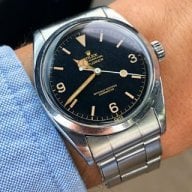
What is "Vintage"?

Posts
248
Likes
184
I also consider vintage to be of an era when industrial production wasn't quite the same as today.

All the charms of vintage -- the frequent iterations, the paint issues leading to tropical, different dial manufactuers, etc etc -- were due to production at scale tech not being where it is today. And while there all anomalies - say, the cream Rolex daytonas in the early 2000s - for the most part those days are over. Do we talk about variations within a run of iPhones? No. The world has changed.

I think the watches of today might be appreciated if they're limited run (some gem set Rolexes) or hark back stylistically to today, but I think vintage as a concept is over.

 
Posts
355
Likes
392
I also consider vintage to be of an era when industrial production wasn't quite the same as today.

All the charms of vintage -- the frequent iterations, the paint issues leading to tropical, different dial manufactuers, etc etc -- were due to production at scale tech not being where it is today. And while there all anomalies - say, the cream Rolex daytonas in the early 2000s - for the most part those days are over. Do we talk about variations within a run of iPhones? No. The world has changed.

I think the watches of today might be appreciated if they're limited run (some gem set Rolexes) or hark back stylistically to today, but I think vintage as a concept is over.

An interesting point. To you vintage has less to do with the passage of time and more to do with the development of new materials and techniques that move the watches away from an era when they were more, for lack of a better word, individual and not cookie cutter perfect. While that is an interesting observation, it forever bars most new watches from ever being "vintage". This is not something that will be accepted by many, and definitely not by those trying to make profits by shrinking the time between production and vintage status.
 
Posts
329
Likes
5,219
“Vintage” is a function of the age of the person making the assessment. The formula is simple: divide your age by 2 and add 7. Anything older than that is vintage... for you.

That's the formula for the correct age of a man/woman to date
 
Posts
242
Likes
2,453
Vintage is more than age. It’s also appearance. For example I have a Rolex 16570 from early nineties with sapphire crystal. I also had (sold now) a Tudor 79090 with plexi, matt dial and painted index at the same age. I consider the Tudor as vintage but not the Rolex.
 
Posts
355
Likes
392
“Vintage” is a function of the age of the person making the assessment. The formula is simple: divide your age by 2 and add 7. Anything older than that is vintage... for you.

Hmm, but the discussion is about watches. Using this premise to a 60 year old a vintage watch would be 37 years old, but to a 20 year old a vintage watch would be 17 years old. The problem arises when the 20 year old tries to sell the 60 year old a 17 year old "vintage" watch at a premium based on the watch's status. The subjective approach doesn't work here.
Edited:
 
Posts
248
Likes
184
An interesting point. To you vintage has less to do with the passage of time and more to do with the development of new materials and techniques that move the watches away from an era when they were more, for lack of a better word, individual and not cookie cutter perfect. While that is an interesting observation, it forever bars most new watches from ever being "vintage". This is not something that will be accepted by many, and definitely not by those trying to make profits by shrinking the time between production and vintage status.

I think this is why vintage is up for debate! It's not just watches of a certain age, or a limited runs, like the omega tin tin will be in 20 years. There are actually fewer variations as we go on here, and consistency of production and materials such that age doesn't impact the watch in the same way.
 
Posts
355
Likes
392
I think this is why vintage is up for debate! It's not just watches of a certain age, or a limited runs, like the omega tin tin will be in 20 years. There are actually fewer variations as we go on here, and consistency of production and materials such that age doesn't impact the watch in the same way.

I completely agree that vintage is up for debate. The problem is that the boundaries for vintage as a concept are so blurred that it is anyone's guess what vintage really is. Just look at the responses to this thread and you will see dozens of different interpretations. Nevertheless, the "vintage" watch market is out there and sellers freely establish their own criteria for what is vintage. Maybe once buyers agree to pay a premium for a particular watch based on its vintage status, that is what ultimately makes it vintage.
 
Posts
1,099
Likes
1,083
i would definitely draw the line at 80's for vintage.

however, there will always be some acceptable overlap to some degree, and of of course some people abusing the term into the 90's and 00. you usually shake your head and lol when people do this
 
Posts
4,645
Likes
31,237
That's the formula for the correct age of a man/woman to date

True, it’s also the the formula to determine whether people are vintage.
 
Posts
230
Likes
140
The term "vintage" started to be used in the 1970s and beginning of the 1980s, the 20 year old watches of the time were from the 1960s or 1950s. True horology in these types of wristwatches ended around 1985 or 1986, because that’s when the computer had really taken-over a large part of the manufacturing process. Patek Philippe stopped manufacturing their most important reference 2499 and the 3450. Rolex had also changed the movement from Valjoux to the automatic Zenith movement.

Also Rolex changed it's case design from the 5513 to the 16610 around this mid to late 80s era. The change in case design between these Submariner models was startling enough to really define the change in the ages IMO.
Edited:
 
Posts
1,232
Likes
5,682
Interesting. So why the cut-off in 1979? What to you would make a 1979 Submariner vintage and a 1980 not?

Rolex is a special case but broadly speaking, by early 80s the whole Swiss watch industry as it had been previously known was defunct, Swatch Group emerged and from then on most watches produced were either Quartz or mechanical ETA.
 
Posts
16,307
Likes
44,994
Hmm, but the discussion is about watches. Using this premise to a 60 year old a vintage watch would be 37 years old, but to a 20 year old a vintage watch would be 17 years old. The problem arises when the 20 year old tries to sell the 60 year old a 17 year old "vintage" watch at a premium based on the watch's status. The subjective approach doesn't work here.
Vintage, like patina, is subjective...is it damage or patina? Is it old or is it vintage?
 
Posts
355
Likes
392
Vintage, like patina, is subjective...is it damage or patina? Is it old or is it vintage?

OK, but that is not an opinion on when a watch becomes vintage. How many years? What is the process? What is your opinion on that?
 
Posts
355
Likes
392
Rolex is a special case but broadly speaking, by early 80s the whole Swiss watch industry as it had been previously known was defunct, Swatch Group emerged and from then on most watches produced were either Quartz or mechanical ETA.

So you are saying that neither quartz watches or mechanical ETA watches can ever be qualified as vintage?
 
Posts
16,862
Likes
47,901
Technically for a customs declaration perspective vintage is 25 years

But a 2013 wine could be a good vintage
 
Posts
1,232
Likes
5,682
So you are saying that neither quartz watches or mechanical ETA watches can ever be qualified as vintage?

No, anyone can qualify as vintage whatever he deems fit. That's just my take on it. As far as I am concerned quartz are not even watches, let alone vintage.
 
Posts
1,162
Likes
6,031
So, how about antique? I have read that 75 years makes a watch antique. Thoughts about that? I have heard the 25 and older is vintage, but I really have trouble calling a 1994 vintage. The tritium cutoff seems to fall into that date range, though. In my mind mid-seventies and older are vintage. 40's and prior are antique. I avoid anything from the '80s, so they are off the radar. For terminology's sake are there any other potential subcategories? There seems to be gap years between vintage, antique and modern. Perhaps I am thinking too much. 😉
 
Posts
16,307
Likes
44,994
OK, but that is not an opinion on when a watch becomes vintage. How many years? What is the process? What is your opinion on that?
I gave my opinion above- I’ll stick with my insurance company and customs (as @STANDY said) that considers 25 years vintage or historic. But vintage is not universally accepted as a mathematical value like a dozen or a bushel.
 
Posts
355
Likes
392
No, anyone can qualify as vintage whatever he deems fit. That's just my take on it. As far as I am concerned quartz are not even watches, let alone vintage.

To each his/her own. I once felt as you do, but I have broadened my opinion. Your take on quartz is like saying that electric cars are not cars because they lack internal combustion engines. There are many owners of Grand Seiko, Omega, Rolex, Patek, and other fine brands of quartz watches that would vehemently disagree with you. Quartz watches are important pieces in the history of horology which encompases not just watch making, but the study of how man has measured time. Everything from sundials and hour glasses to mechanical watches, quartz watches, smart watches, and whatever comes next is part of this unbroken chain.
 
Posts
355
Likes
392
So, how about antique? I have read that 75 years makes a watch antique. Thoughts about that? I have heard the 25 and older is vintage, but I really have trouble calling a 1994 vintage. The tritium cutoff seems to fall into that date range, though. In my mind mid-seventies and older are vintage. 40's and prior are antique. I avoid anything from the '80s, so they are off the radar. For terminology's sake are there any other potential subcategories? There seems to be gap years between vintage, antique and modern. Perhaps I am thinking too much. 😉

Thinking too much is no crime. Thinking too little should be. We have way too much of the latter going on in the world today!

As for your comments on the vintage issue, I agree that "antique" is another category that is completely subjective. My intention for this thread was not to push a specific timeline for vintage and antique status, it was to determine if there is any consensus about when these categories are achieved in terms of watches. I haven't taken a tally, but it sure seems like there are many subjective opinions. It is ironic that there is a vintage watch market out there, but no agreed upon definition about what vintage is.
Edited: