What caused the appearance of this dial?

Posts
9
Likes
3
Hello! My first post. Hopefully in the right place. I dug around and didn't find an answer to this, so I'm hoping some help can be found here. I was surprised to find the depth of general watchmaking expertise that there appears to be in this Omega-specific forum!

A couple of months ago I dove into watch repair, like probably a million other people have. Like them, I started with an ST36 that I took apart and reassembled a bunch of times, a pile of screws that I moved around until I could do so without firing them across the room, then started buying non running watches off the auction sites, mostly with cheap, 17 jewel center-seconds Swiss movements, like the AS 1686, to clean, oil, and regulate. I've had modest success. Recently, I managed to swap the hairspring and balance wheel from one balance cock to another and it actually worked. So now, I, of course, consider myself the obvious heir to Abraham-Louis Breguet's watchmaking legacy, as I'm sure many hobbyists feel after a few months of daily watchmaking (and breaking). So that's me. All joking aside, I have a real question.

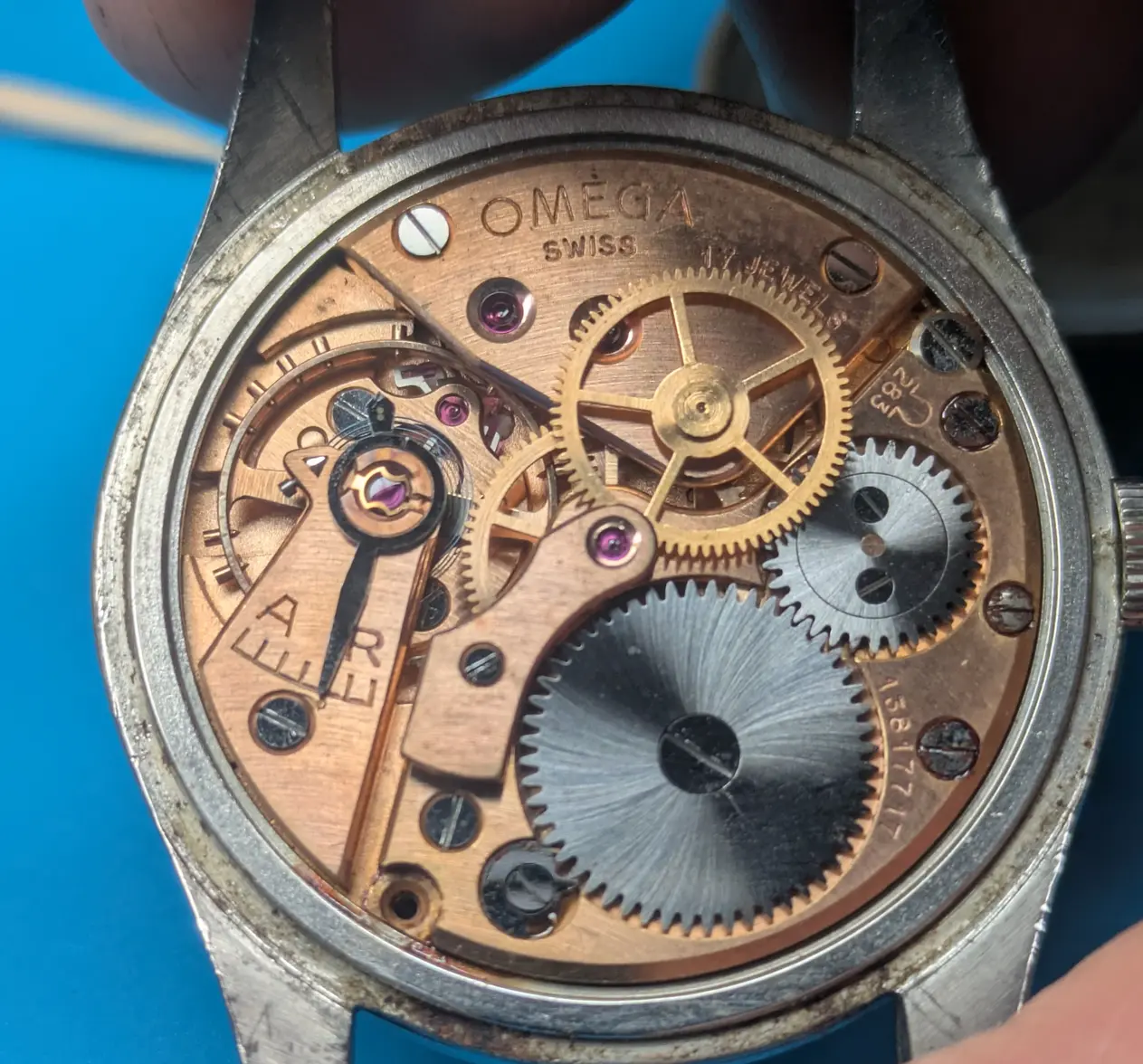
I'm working up the courage to service a sluggish old Omega I bought the other day. I mostly bought it because I'm really curious about what sorts of fine details in the movement will be "better" than the amazingly precise cheap movements I've been working on so far. It's a 283, and looks to be in decent shape inside, though I haven't actually removed the movement yet.

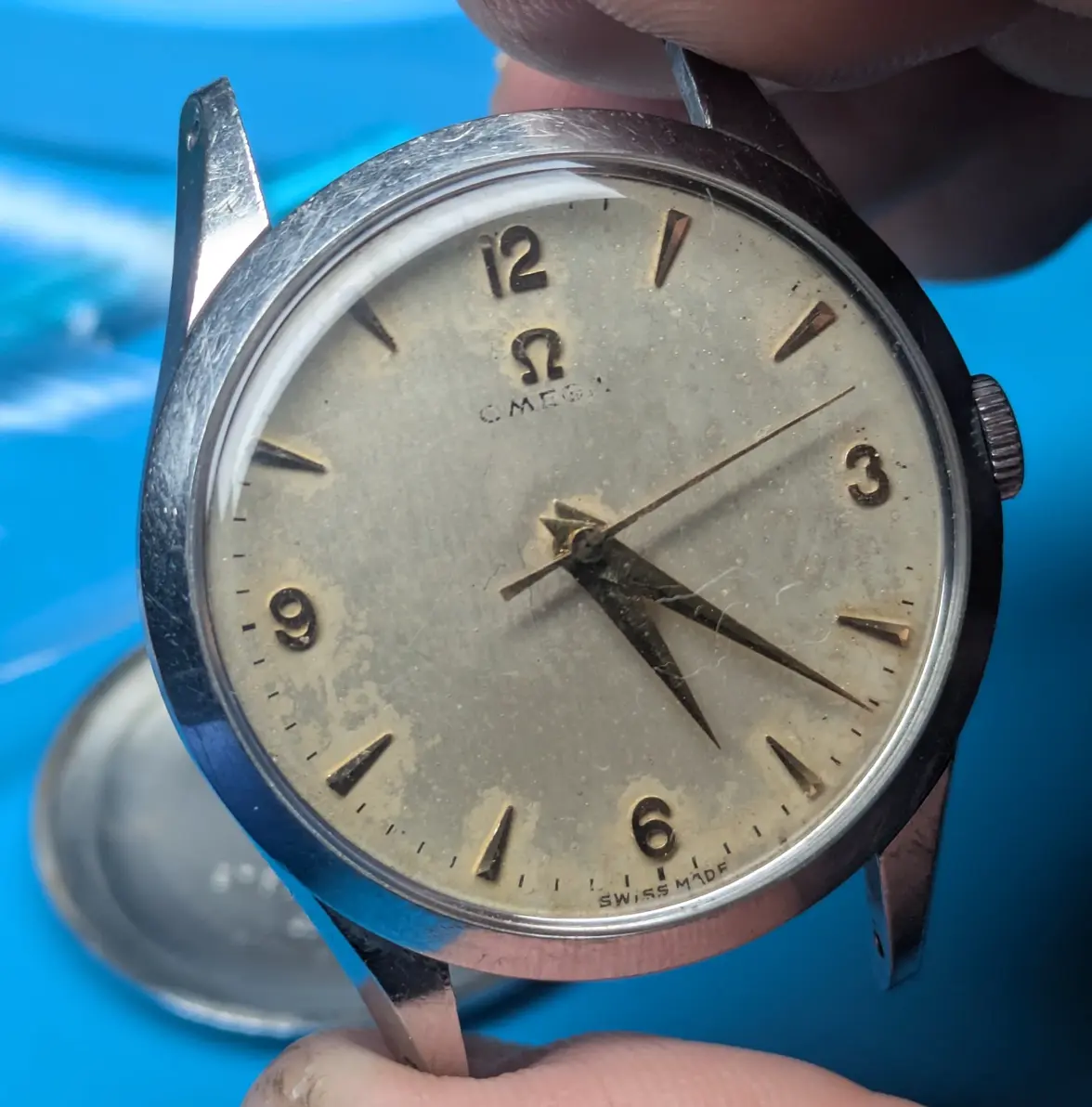
My specific question is about the dial. I don't really care much about it, but would like to do what I can to improve its appearance, though I suspect that's not possible. Mostly, I'm curious about what might have caused it to age as it has, and if its current appearance is due to a botched attempt to clean in in the past. Here's a picture. Sorry that it's through the crystal. Like I said, I haven't taken the movement out yet.
Inside, the only thing I found of concern was a case screw that was quite rusty, removed in this photo (near the bottom).
So that's my really long story that could probably have been better told with a sentence and a photo. I looked around at vintage Omega dials for sale, and was surprised to find a number of them similarly aged. Any thoughts or knowledge from folks here who aren't, like me, looking at their very first Omega, would be greatly appreciated.

 
Posts
13,744
Likes
53,627
Someone tried to clean the dial ….
 
Posts
9
Likes
3
I assumed so. I can't see where the Omega logo could be so obscured without someone actually scrubbing at the dial with something. Same for the minute indices between 12 and 4. I assume there's nothing to be done, correct? Maybe I should grab a q-tip and finish the job! ha! Still surprised that I saw so many similarly-destroyed dials when I looked around on the interwebs for a replacement...
 
Posts
9
Likes
3
Ha! I have lots of q-tips. I'm curious about another feature of this watch. To achieve a center seconds complication, they chose a somewhat janky pressed-in driving wheel for the sweep second pinion. Was this just because the much more common center wheel setup found in most movements from the era hadn't been developed? Omega made like 3 million movements with this style center seconds complication, if the internet is to be believed. Seems odd.
 
Posts
18,123
Likes
37,810
Omega developed this desgn for centre seconds in 1936 with the 23.4SC caliber used for the Omega "Medicus".
It worked, and I suppose Omega thought "if it ain't broke, don't fix it".

The design continued on through many calibers, including the famous 30T (SC) series and many others beyond.
 
Posts
3,107
Likes
9,235
Is this the second to last stage in the natural evolution of Omega dials? The stage before its painted black and the asking price is tripeled.
 
Posts
29,851
Likes
77,247
Ha! I have lots of q-tips. I'm curious about another feature of this watch. To achieve a center seconds complication, they chose a somewhat janky pressed-in driving wheel for the sweep second pinion. Was this just because the much more common center wheel setup found in most movements from the era hadn't been developed? Omega made like 3 million movements with this style center seconds complication, if the internet is to be believed. Seems odd.
Indirectly driven sweep seconds hands were very common in this era. It was the predominant form.

The integrated or directly driven design came much later.
 
Posts
13,420
Likes
18,618
Someone tried to clean the dial ….
More accurately, someone tried to clean the dial with an abrasive chemical that destroyed the lacquer and part of the original printing.
gatorcpa
 
Posts
9
Likes
3
I asked a chatbot when it would be appropriate to redial a watch like this, and it basically said that once a watch dial has been destroyed by an attempted cleaning, you may as well refinish it if you want a nice looking watch, since its value as a collectible is already essentially lost. I don't see myself getting this dial refinished...a good job of it would cost more than I paid for the watch. But I thought the chatbot's assessment was interesting. Refinishing is such a divisive topic that it's probably a great thing to ask a soulless chatbot about.
 
Posts
9
Likes
3
More accurately, someone tried to clean the dial with an abrasive chemical that destroyed the lacquer and part of the original printing.
gatorcpa
for what it's worth, I did an equally horrific job on an old waltham with nothing but distilled water and a q-tip. After seeing a (very popular, but oft derided) watch restorer do the same with great results. For me, the water took away the stains, the varnish, the paint, the logo...pretty much everything but the applied indices! Ha!
 
Posts
9
Likes
3
Indirectly driven sweep seconds hands were very common in this era. It was the predominant form.

The integrated or directly driven design came much later.
Had I done my homework, I would have known this! I just assumed that by the early 50s the direct center seconds train would have pretty much replaced the indirect center seconds. This article has an interesting discussion of it, with mention at the end of an even odder complication...adding a module to support small seconds to a movement designed for direct center seconds. Ha! That seems profoundly silly.
 
Posts
29,851
Likes
77,247
Had I done my homework, I would have known this! I just assumed that by the early 50s the direct center seconds train would have pretty much replaced the indirect center seconds. This article has an interesting discussion of it, with mention at the end of an even odder complication...adding a module to support small seconds to a movement designed for direct center seconds. Ha! That seems profoundly silly.
Silly in what way exactly? Some watch designers prefer a sub-seconds design, so when they need a movement with that design, ETA made the 2895-2 to satisfy that need. Using the 2892A2 as a base movement means that many cases that are already made for the 2892 can be used for the 2895-2. The design is quite reliable - I made a short video of the dial side on the last one I serviced...

 
Posts
9
Likes
3
Silly in what way exactly? Some watch designers prefer a sub-seconds design, so when they need a movement with that design, ETA made the 2895-2 to satisfy that need. Using the 2892A2 as a base movement means that many cases that are already made for the 2892 can be used for the 2895-2. The design is quite reliable - I made a short video of the dial side on the last one I serviced...

Silly in a Rube Goldberg unnecessarily complicated way.

Why take a watch movement design that was made more complicated to put the seconds in the center and make it even more complicated to put the seconds back where they were before the original complication was added?

I'm thinking of the ST36 (similar to the (still-produced?) ETA 6497-1) I started with, or the ETA 1260 in the Wyler Incaflex I serviced yesterday...each of them has a sub-second and a very simple, clean wheel train. No coaxial arrangements, for example.

I guess what you're saying is that ETA doesn't have a movement similar to the 6497 that would fit in the same size case a 2892 would fit in, and it was easier/cheaper/made more sense for ETA to add a sub-second complication to a center-seconds movement than to make a simpler movement from the ground up to get the job done? I'm really new to this, so it's pretty fascinating to think that would be the best solution.
 
Posts
29,851
Likes
77,247
I guess what you're saying is that ETA doesn't have a movement similar to the 6497 that would fit in the same size case a 2892 would fit in, and it was easier/cheaper/made more sense for ETA to add a sub-second complication to a center-seconds movement than to make a simpler movement from the ground up to get the job done? I'm really new to this, so it's pretty fascinating to think that would be the best solution.
Yes, exactly. I think you are assuming a lot about the complexity there - it's a dead simple design that is very reliable. I don't think any professional watchmaker would call this complicated in any way.
 
Posts
9
Likes
3
It's entirely possible that I'm using the word "complication" incorrectly (what I understand to be the horological meaning of "complication"). My assumption is that each change to the movement beyond the most simple design (the basic sub-second design) constitutes a "complication." Like moving the second hand to the center, or adding the date, or the day, etc.

So i guess moving the second hand to the center, then adding wheels and pinions to move it back to a sub-second location seems to use two "complications" to get back to a watch that functions as if it had none. I didn't know that manufacturers did that until I read that article.
 
Posts
29,851
Likes
77,247
It's entirely possible that I'm using the word "complication" incorrectly (what I understand to be the horological meaning of "complication"). My assumption is that each change to the movement beyond the most simple design (the basic sub-second design) constitutes a "complication." Like moving the second hand to the center, or adding the date, or the day, etc.

So i guess moving the second hand to the center, then adding wheels and pinions to move it back to a sub-second location seems to use two "complications" to get back to a watch that functions as if it had none. I didn't know that manufacturers did that until I read that article.
Complication in the way you are now using it is not the same as "complicated" as you were using it previously.

Yes, it's a complication (as are many things added to watches), but it is far from complicated.
 
Posts
9
Likes
3
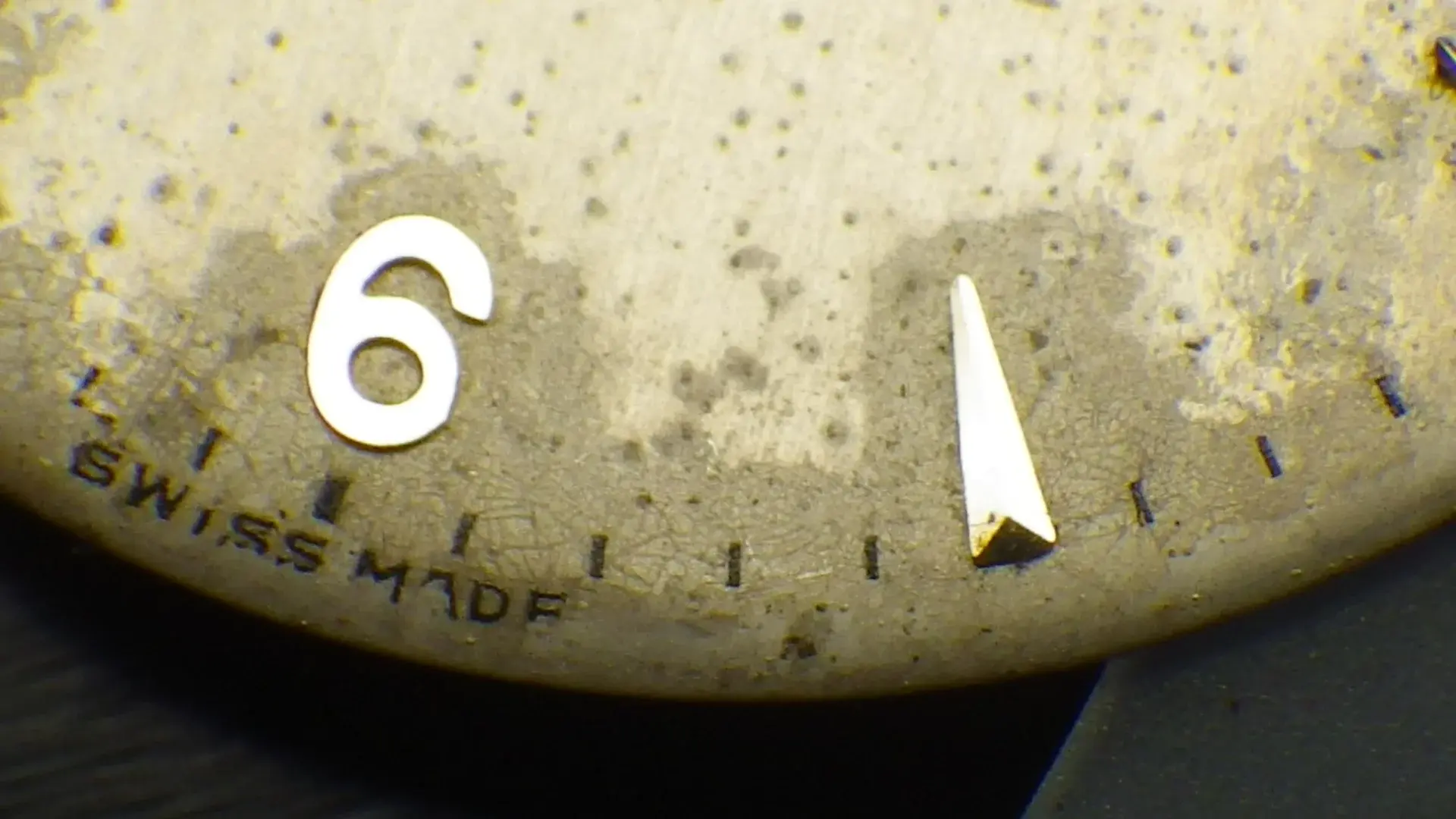
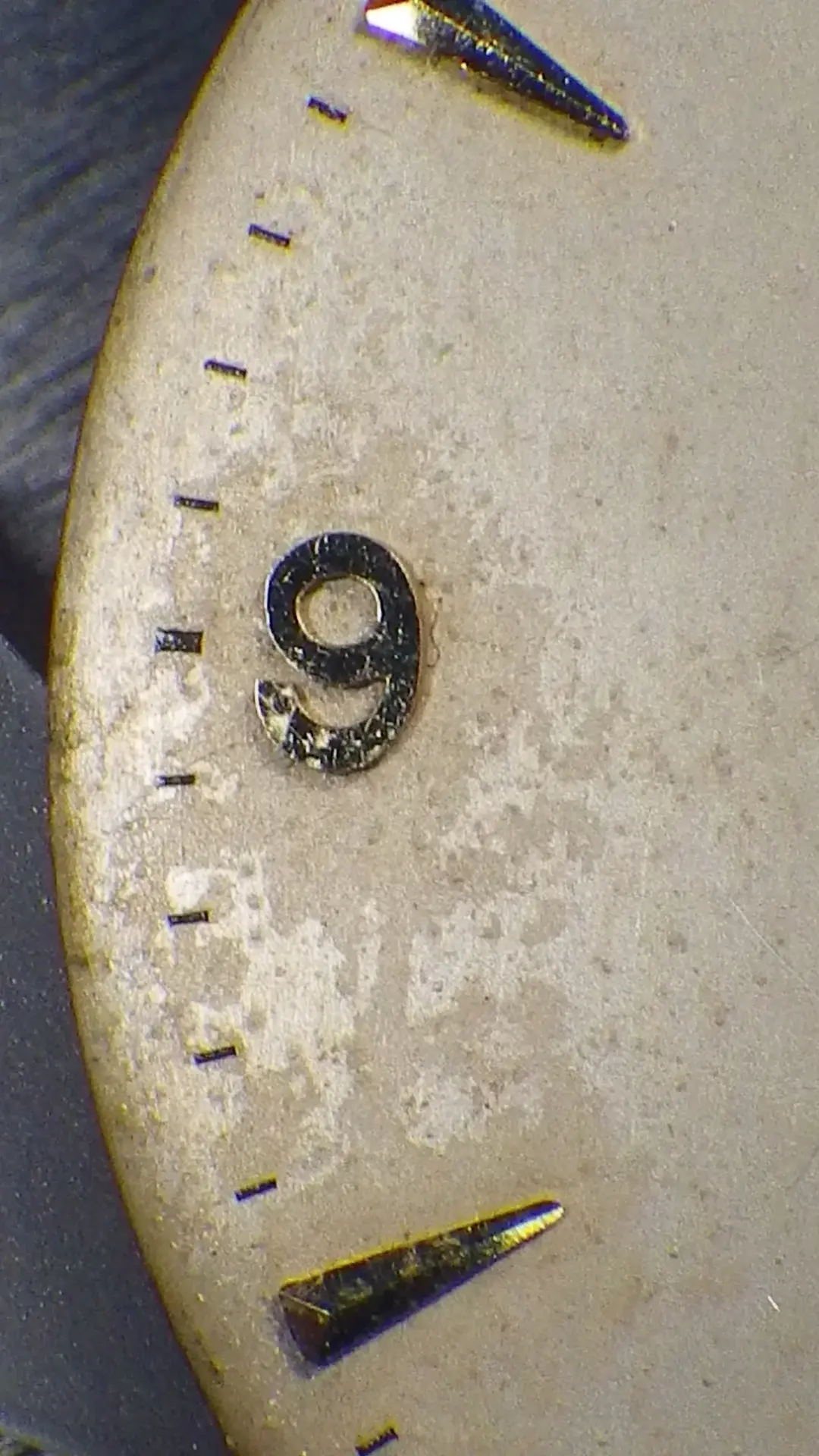
I disassembled the movement yesterday and started cleaning the parts. I set the dial aside, then this morning I took some close-up photos of the dial's surface (with a digital camera, I don't have a microscope). Here's a few of those images that show some surface detail that I hadn't noticed before. Two show the difference between the areas that look less scrubbed around the outside of the dial and the scrubbed area:
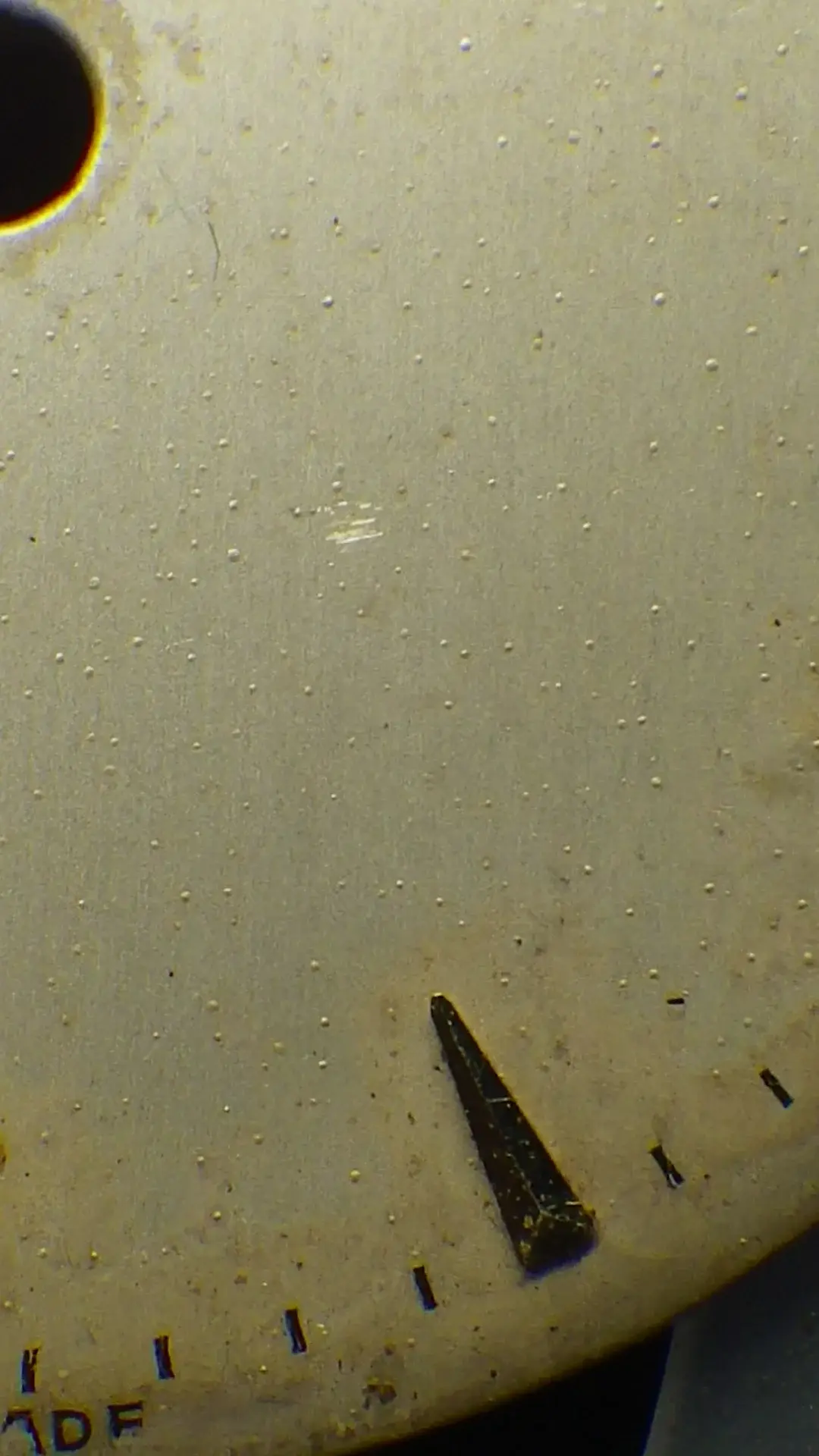
And this one shows a well-lit section of tiny "bubbles" in the finish that are all over the dial, including the area that's been scrubbed and the area that hasn't.

Seems that whatever effort was made to clean the dial was made long enough ago that it's developed new defects on top of both the old patina and the scrubbed surface!

All of which is to say I don't think I'm gonna touch it at all. If those tiny raised pips are more than just the surface varnish, the dial will look like it has chicken pox on top of it's already muddy appearance if they get scrubbed off. I suppose there's a science behind all of this. Anyone have a link to a high-level (or detailed) explanation of dial patina? Thanks!