- Posts
- 598
- Likes
- 376
bill5959
·By halfway I mean respecting the integrity of the watch as a piece of history. Letting the owner decide. They could just charge double for tis and be inundated.
Please consider donating to help offset our high running costs.
Nothing wrong about it really - just a difference in perspective / preference. Different facets of a same passion.
That is a very fair point and the majority of owners would always want it so.
None of this is really the concern of an Omega watchmaker, whose sole purpose is to restore the watch to original specifications and functionality. I deeply respect that. One the other hand, it would be nice if Swatch/Omega would allow you and the customer some leeway to customize the level of restoration to a mutually agreed upon standard before the work is performed. I'm sure most of the OCD collectors here were would gladly sign a damage waiver if replacement of dials, hands, etc. were not undertaken against your advice.
I fully understand the attitude of the original factory when sent a watch is to return it capable of doing the best service they can.
Just look at the astronauts watches, many of which while being historically important, do not carry their original parts, as they were replaced by Omega in order to maintain them at their highest possible performance.
I appreciate Maurice taking the time to shed some light on the protocols of watch repair at Omega.
...Omega and Maurice are Swiss renders...
I think there are different ways to interpret factory specifications. The way Bienne has tended to interpreted the phrase in its service regime is transform an old watch into a new-looking one. This works with restorations of 1970's tool watches because Omega still has an extensive parts supply, but it doesn't work for watches that have entered the true vintage genre.
In all fields of collecting that I can think of, as well as theorists and conservators of our industrial heritage, the practice is to conserve rather than refurbish. In the case of mass-produced timepieces, many of us have made a compromise and opted for practical conservation, aiming for as much factory originality as possible but not at the price of having the watch inoperative. I was hopeful during the Omegamania build-up that perhaps that Omega in Bienne, having invested so much in extolling the value of its own heritage, would adopt a more sophisticated approach when dealing with vintage watches. But instead, we continue to see this clash of values between Omega and the collecting community that supports the brand.
Thank you for participating. It helps to have some inside perspective. I guess I understand the philosophy, and I have just sent a watch off that I approved more intervention than I normally would (dial cleaning, not replacement).
I would appreciate it if the service center let you know what was to be replaced. Many times people get watches from their relatives and start to get into the watch hobby. At first they are excited and quickly send it off for a service which Omega restores to new with new parts. The owner is happy for a quick moment and wears it. Then upon reading more and more on the internet realizes the horrible mistake. Now I'm not saying Omega is at fault because they have a protocol and need to ensure a two year warranty.
I would agree with you if I thought of my watches as merely functional tools, but long gone are the days when mechanical watches were practical. While I do use all of my watches to tell time, they are purely emotional products that are akin to works of art or historical artifacts for me.
I would want replacements that are exactly the same in appearance and materials, even if they are newly manufactured and not NOS from the past. Then you're truly bringing the watch back to factory specs as it left the factory, as opposed to what seems to pass as such now: "it still tells time."
That's a good point, I can't see it being that hard to manufacture such parts.. guess it's a matter of scale maybe? At what cost? If a new dial cost $1000 (instead of $200), would people buy them?
It does seem like with all of the vintage re-editions being made today that the watch companies are aware of the demand for vintage models, but getting the proper infrastructure set up to create older parts might be too much of a gamble to try and convince the likes of Swatch or Richemont. We have to remember that people like us make up a tiny percentage of their customers. I personally dream of the day when they would start using tritium again.
We have to remember that people like us make up a tiny percentage of their customers
We are a small part of the equation.
They dont really want to service our old watches they want to service a watch for 25 years and sell us a new model.
Maurice has been here for a while and, I might be wrong but I think he's Italian.
Maurice and I have had this discussion by PM already, and we have agreed to disagree. While I fully support getting the movement running back within specs when possible, I don't support the automatic replacement of parts that affect the looks of the watch. If the tritium lume in the hands and dial are no longer glowing, that means they are not up to original specifications - I don't agree that this means they should be replaced if the owner of the watch decides not to. Lume can be stabilized if someone wants to take the time to do so, and this eliminates any possible hazard to the watch, but the factory still won't do this. Not sure if it's related to the numbers they have to meet each day to keep their jobs or earn their bonus, but to me it's not doing the job right if you just start replacing parts all over the place.
Again - whoever owns the watch decides what gets done - not sure why the Swiss don't seem to understand this concept. It's not that difficult.
Thanks for comments Maurice. I remember when a full "factory" service added value 😀. It still does except to many of us who have the "vintage" bug. Being mostly a Rolex 50's-70's collector I see no difference than Rolex North America's service as compared to Omega or any other mark. The manufacturer wants the watch to be as close to what's available now with updated parts and specs. and to be able to function with same efficiency as possible.
I think service centers will give you options to replace things or not, and let you decline certain items being replaced. It's the things that they declare "not optional" that are the problem.
Because the service center gives a 2 year warranty. If they are going to honor the warranty, then they want control of the repair.
By halfway I mean respecting the integrity of the watch as a piece of history. Letting the owner decide. They could just charge double for tis and be inundated.

Keep in mind you can always ask Omega in Bienne to keep some "peices" in place. I did that for the dial of my 910 Flightmaster. I asked to keep the vintage dial as is, and to change whatever else was not working. And it came back with what I asked + all the spare parts. If you send your watch to Rolex, you'll never get the spare parts. ,

Gentlemen, thank to you all for sharing your points of view and taking part in this discussion.
I have tried to synthesize your contributions below and I am very sorry if I missed some points (there have been many).
Overall, I believe that this is a reasonably fair representation of both vintage collectors' needs and brand watchmakers' attitudes.
Thank you very much again.
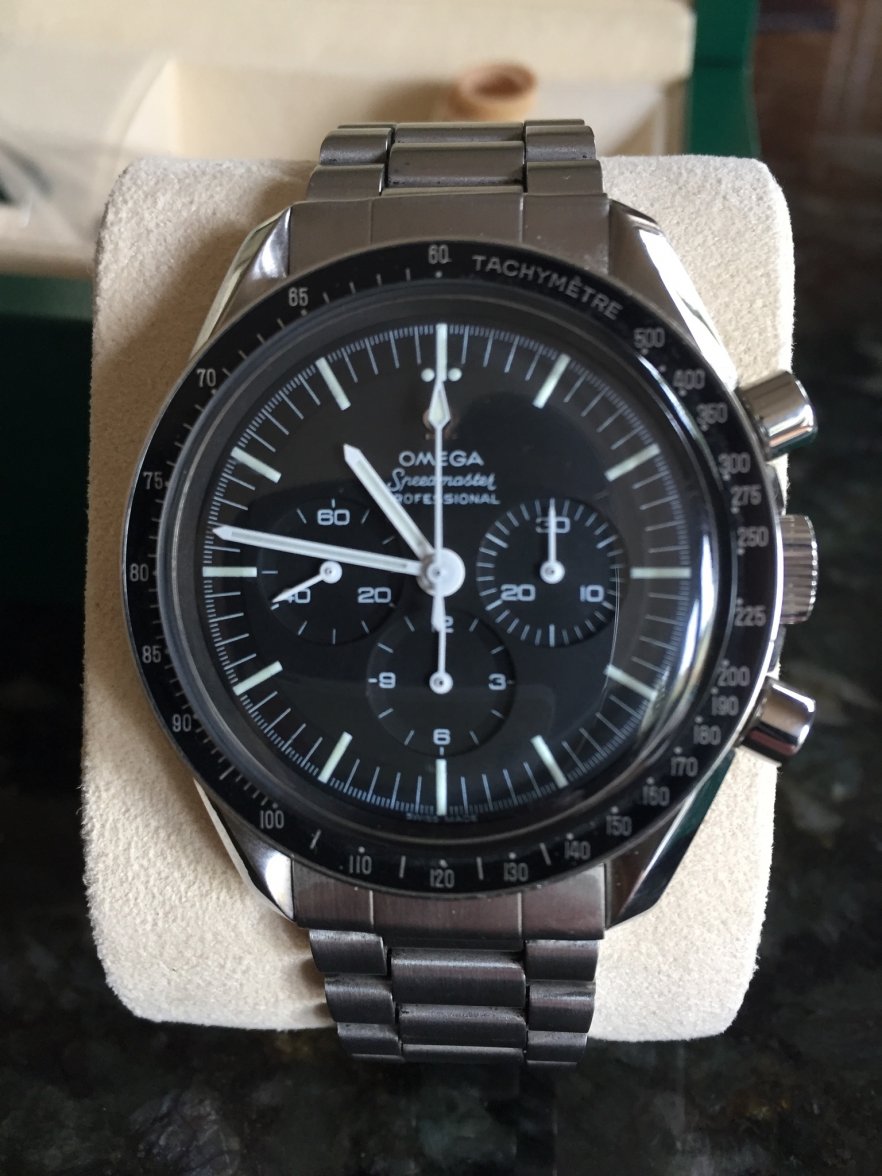
Sorry, as I am new here and late to this discussion. I have a 1965 speedmaster professional, 321 caliber. Wore it since i was about 15 (when big watches were not common - at least from what I saw). After 30 years of wear it was pretty beat up. Eventually it stopped working because moisture got in. Sent it to Omega in Biel-Bienne. for about $1200 they restored it. All replacement parts were returned to me. (Face, case, back, hands, springs, some gears...). I could have refused some of the repairs, but I thought I would like to have the watch restored to look as new and flawless as possible. As time has gone on I wondered if I made a mistake on not keeping it as original as possible in the event I wanted to sell it.
Wondering everyone's opinion. Did I destroy its resale value?
But I am now to the point where I wear it because I like how it looks, and i guess i'll just give it to one of my kids eventually.
Is a 321 from 1965, rebuilt by omega more valuable... or less, than one that is all original?
Apologies in advance if silly question.
Thanks
Thank you for your understanding, but I am Italian and I have been responsible for the Omega service in Italy, also assembling some special editions (Apollo-Suyuz 1975, Speedmaster for Italy, etc.). In fact, De Marchi has been the Omega agent for Italy for many, many years and we had full access to all their stocks and facilities much more than a normal distributor has never been allowed.
It wouldn't cost a lot. In 2007 there was a discussion on how celebrationg the 50th Speedmaster anniversary and a limited production of a CK2915 reissue was briefly taken into consideration. My friend Gino showed me some blueprints made in Bienne at that time and it was clear that the thing was more than feasible (do not forget that Lemania 2320 have been provided to several brands until the Nineties). However, companies do not look back but forward and Swatch Group was very keen, rightfully, to promote the coaxial escapement instead.
I tend to agree with your view.
Correct.
Thank you, Al, for sharing once again your view.
Thank you for pointing out that there was a time when a full "factory" service added value.
This is a good point: we have never used to be directly in contact with the watch owner. The watches were (and are) shipped by the ADs.
This is correct.
For a company it is not easily feasible. Remember that vintage watches are an infinitesimal part of the Swatch Group business. History is very useful for advertising, but today no one would rely on an Apollo computer even in a smartphone!

I’m with @watchtinker on this.
First I do believe that in most things when you take anything to a repair shop and pay premium for it you typically expect it to come back good as new. WE are the exception, and I agree that as owners we have the right to decide which components to preserve, but the default option for repairs and service should be to return good as new or better.
My brother in law has a collection of watches, he keeps them all to date and service and pristine. He hates aged bezels, original crowns that no longer ensure water resistance, scratched cases etc. First thing he said when he saw my 1675 is...” they can fix that for you and it’ll be good as new”. He was amazed when I told him that if I did get a new bezel, and dial etc etc I would loose half it’s value. He just didn’t get it.
Let’s face it. Collector value points are more often than not counter intuitive.
Now, knowing watches should a responsible service center advice on the loss of value a rehaul can cause? Yes. And at least at Rolex and IWC in New York they do, or did for me on more than o e occasion.
Let’s say you’re not a collector and you send your watch for service and pay 1g for it.... and it comes back scratched, with a cracked dial, without water resistance, with faulty Lume.... that’s not good.
The majority of buyers, the majority of customers are NOT collectors. They want a perfect watch. They pay for it.
I’m with @watchtinker on this.
First I do believe that in most things when you take anything to a repair shop and pay premium for it you typically expect it to come back good as new. WE are the exception, and I agree that as owners we have the right to decide which components to preserve, but the default option for repairs and service should be to return good as new or better.
My brother in law has a collection of watches, he keeps them all to date and service and pristine. He hates aged bezels, original crowns that no longer ensure water resistance, scratched cases etc. First thing he said when he saw my 1675 is...” they can fix that for you and it’ll be good as new”. He was amazed when I told him that if I did get a new bezel, and dial etc etc I would loose half it’s value. He just didn’t get it.
Let’s face it. Collector value points are more often than not counter intuitive.
Now, knowing watches should a responsible service center advice on the loss of value a rehaul can cause? Yes. And at least at Rolex and IWC in New York they do, or did for me on more than o e occasion.
Let’s say you’re not a collector and you send your watch for service and pay 1g for it.... and it comes back scratched, with a cracked dial, without water resistance, with faulty Lume.... that’s not good.
The majority of buyers, the majority of customers are NOT collectors. They want a perfect watch. They pay for it.
I’m with @watchtinker on this.
First I do believe that in most things when you take anything to a repair shop and pay premium for it you typically expect it to come back good as new. WE are the exception, and I agree that as owners we have the right to decide which components to preserve, but the default option for repairs and service should be to return good as new or better.
My brother in law has a collection of watches, he keeps them all to date and service and pristine. He hates aged bezels, original crowns that no longer ensure water resistance, scratched cases etc. First thing he said when he saw my 1675 is...” they can fix that for you and it’ll be good as new”. He was amazed when I told him that if I did get a new bezel, and dial etc etc I would loose half it’s value. He just didn’t get it.
Let’s face it. Collector value points are more often than not counter intuitive.
Now, knowing watches should a responsible service center advice on the loss of value a rehaul can cause? Yes. And at least at Rolex and IWC in New York they do, or did for me on more than o e occasion.
Let’s say you’re not a collector and you send your watch for service and pay 1g for it.... and it comes back scratched, with a cracked dial, without water resistance, with faulty Lume.... that’s not good.
The majority of buyers, the majority of customers are NOT collectors. They want a perfect watch. They pay for it.

They should know that replacing everything on a vintage watch will destroy the value, so maybe explaining that in 1 minute to the client before deciding for him what to do wouldn't be too difficult to implement in the servicing process!

They should know that replacing everything on a vintage watch will destroy the value, so maybe explaining that in 1 minute to the client before deciding for him what to do wouldn't be too difficult to implement in the servicing process!

It wouldn't cost a lot. In 2007 there was a discussion on how celebrationg the 50th Speedmaster anniversary and a limited production of a CK2915 reissue was briefly taken into consideration. My friend Gino showed me some blueprints made in Bienne at that time and it was clear that the thing was more than feasible (do not forget that Lemania 2320 have been provided to several brands until the Nineties). However, companies do not look back but forward and Swatch Group was very keen, rightfully, to promote the coaxial escapement instead.
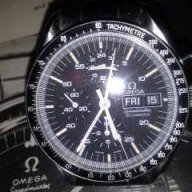
Because the service center gives a 2 year warranty. If they are going to honor the warranty, then they want control of the repair.
It was my Holy Grail.. not a 321, but not a modern watch either. They wanted to replace the dial because some lume on some of the hour markers is gone and the hands because the tritium was gone.
Again - whoever owns the watch decides what gets done - not sure why the Swiss don't seem to understand this concept. It's not that difficult. Cheers, Al


I love it when some of these older threads get revived as it gives us a chance to reconsider them in the light of history. The comment that interested me the most was this:
What a difference 10 years can yield.