Some Cal 56x timegraphing

Posts
2,219
Likes
4,952
Hi Stewart,


Lubricating the escapement can be challenging for a beginner. After using epliame, install the balance and let the watch run dry for say 10 minutes. This will wear away a channel in the coating on the pallet stones, and when you apply your 9415 it should lay right in that area. Apply to the exit stone from the train side - very small drop on the stone. Then cycle the pallet fork back and forth a few times until the oil is gone - should take 4 or 5 teeth or so. Then apply another very small drop, and repeat until you have gone all the way around. Then cycle the pallet so the wheel goes around at least 4 times to spread the oil evenly, then check the amount applied to each tooth. There should be a small wedge or ball of 9415 forming between the tooth and jewel when the heel of the tooth is about 1/2 way across the stone face.


Cheers, Al


Great explanation, thanks. I have not been working from the train side but, the big difference is I never let the watch run and just cycled the escape wheel a few times before applying oil to the exit stone and cycling in quarter turns. I will now add the balance and follow the 10 minute rule. The first few I did were not treated as I understood that was not common practise in the sixties. It seems that Maurice saw a similar thing even later on.

Perhaps this explains my last timegraph above where I think one tooth is dirty/damaged. It may just be that the oil did not adhere sufficiently. Will find out when I look at it again.

Interesting to see both of your comments on oils to use. It seems Cousins have most of them so an order will be sorted soon. As I only buy a few ml at a time, the cost is about £8k per litre so, to fill the car in my avatar about £100k. And I complain about the cost of Castrol GTX!

Thanks

Chris
 
Posts
383
Likes
410
Just want to ask again to clarify since you didn't answer - are you letting the watch run with the escapement dry for 10 minutes before applying the 9415?
Yes, of course. This is the standard procedure suggested in all ETA courses, but it seems to work only for modern calibers.
I'm not sure where you worked (what facility) but if this was a problem recognized by Omega, it puzzles me why all current technical guides for all the low beat movements still call for epilame and 9415. Now many of the old tech guides don't have any lubrication information on them (they are just parts lists), so you have to rely on Work Instructions 27 and 40. In fact these work instructions state that all pallet fork stones for Swiss lever watches are epilame treated, regardless of low or high beat. Every technical guide I have pulled up that has been updated in the last 20 years, and calls out the lubrication for the Swiss lever escapement, calls for 9415.

I worked at F.lli De Marchi (Turin). We were also in charge of assembling some special editions for Italy.
With respect to the guides, you should not miss the point that factory epilamage is somewhat different from what you might apply in your workshop.
This would include 861 and family (1861, 1866 etc.), 2201 just to name a couple off the top of my head, and I certainly don't have any trouble getting 300 degrees of amplitude on these movements using epilame and 9415.


l

To be honest, I would be pleasantly surprised to obtain 300° amplitude from a caliber 321 using both Fixodrop and 9415. But I might well be missing some passage and I am always eager to progress.
As far as I know, the only reference book on calibers 321/861 which deals with these aspects in depth has been written quite recently. Unfortunately, as far as I know, it is available in Italian only.
http://ilmiolibro.kataweb.it/schedalibro.asp?id=995006
 
Posts
29,678
Likes
76,840
Yes, of course. This is the standard procedure suggested in all ETA courses, but it seems to work only for modern calibers.

Well I can't assume anything, because I already assumed that professional watchmakers all use epilame and 9415 on low beat watches, and you say you don't, so I'm just trying to confirm how you are doing this to make sure there is not some procedural difference.

So now you are saying it's not all low beat calibers, but only vintage low beat calibers that have this problem with epilame and 9415?

With respect to the guides, you should not miss the point that factory epilamage is somewhat different from what you might apply in your workshop.

I understand it's applied differently at the factory (I have been through many watch factories in Switzerland, although not Omega), so are you suggesting that it may be because the application is different at the factory that it caused you problems? Of course I am referring to doing this is an after sales service environment only. I have never worked in factory setting - have no desire to actually! 😉

To be honest, I would be pleasantly surprised to obtain 300° amplitude from a caliber 321 using both Fixodrop and 9415. But I might well be missing some passage and I am always eager to progress.
As far as I know, the only reference book on calibers 321/861 which deals with these aspects in depth has been written quite recently. Unfortunately, as far as I know, it is available in Italian only.
http://ilmiolibro.kataweb.it/schedalibro.asp?id=995006

I have most certainly had 321's with 300 degrees. Not all of course, because quite frankly some of them are very beat up, but it's not uncommon.

Are you saying this text specifically talks about problems using epilame and 9415 on Cal. 321 and 861 watches?

Cheers, Al
 
Posts
383
Likes
410
Well I can't assume anything, because I already assumed that professional watchmakers all use epilame and 9415 on low beat watches, and you say you don't, so I'm just trying to confirm how you are doing this to make sure there is not some procedural difference.

So now you are saying it's not all low beat calibers, but only vintage low beat calibers that have this problem with epilame and 9415?

That's correct. At least, this is my experience.


I understand it's applied differently at the factory (I have been through many watch factories in Switzerland, although not Omega), so are you suggesting that it may be because the application is different at the factory that it caused you problems? Of course I am referring to doing this is an after sales service environment only. I have never worked in factory setting - have no desire to actually! 😉

It might be due to some sort of interaction between factory treatment and Fixodrop, but this is a mere hypothesis.


I have most certainly had 321's with 300 degrees. Not all of course, because quite frankly some of them are very beat up, but it's not uncommon.


Are you saying this text specifically talks about problems using epilame and 9415 on Cal. 321 and 861 watches?

Nowadays most 321 are very beat up, but last year I serviced a 321 which had been left untouched in a drawer for over fifty years. I did not apply Fixodrop and the amplitude was easily in the 300° range.
However, I assume that you have recently serviced a 321 with the combination 9415/Fixodrop and obtained an amplitude in the range 300°.
I am pleased to hear this, because it means that the combination 9415/Fixodrop I am fearing is not a real cause of troubles.
The indicated text is the only one which deals - to the best of my knowledge - with the fine tuning of calibers 321/861.

Thanks for your interest in the matter I raised.

Cheers, Maurice
 
Posts
2,219
Likes
4,952
Hi Guys

Resurrecting one part of this thread, the use of fixodrop. I'm using 8941 which is the ready mixed variety.

For the fork, only applied to the jewels.

For the escape wheel, I believe the professional way is to dip the whole wheel but, I have just been applying it to the teeth. It seems a little strange to me to apply an oil repellant to the pivots. Is the logic to oil the pivots after the 10 minute running in period so that the epilame has been worn away?

By the way, I ordered all these synthetic oils from Cousins (as advised above) but they don't have Kluber P125 so, am stuck with 8213 at the moment. Must find a European stockist (Stuart - are you using this?).

Thanks, Chris.
 
Posts
3,070
Likes
3,533
No, I haven't found any either. I am using 8213 for brass barrels and 8212 for steel ones.
 
Posts
3,070
Likes
3,533
Chris. I have found the following contact information on Kluber's web site:

Klüber Lubrication Great Britain Ltd.
Longbow Close
Pennine Business Park
Huddersfield
HD2 1GQ
Managing Director:
Paul Holland
Phone:+44 1422 205115
Fax:+44 1422 206073
Email:[email protected]


Whilst I don't suggest phoning their MD, it might be worth calling them or sending an e-mail to see if anybody stocks P125.
 
Posts
2,219
Likes
4,952
Chris. I have found the following contact information on Kluber's web site:


Klüber Lubrication Great Britain Ltd.

Longbow Close

Pennine Business Park

Huddersfield

HD2 1GQ


Managing Director:

Paul Holland


Phone:+44 1422 205115

Fax:+44 1422 206073

Email:[email protected]


Whilst I don't suggest phoning their MD, it might be worth calling them or sending an e-mail to see if anybody stocks P125.


Thanks Stewart (apologies for my autocorrection earlier)

I will send a mail to their sales department and let you know how I get on.

Cheers, Chris.
 
Posts
29,678
Likes
76,840
Chris - I always clean the pivots of watches in pith wood after they have gone through the cleaning machine, just to be sure they are clean - similar to using peg wood to clean all the jewels and bushings. I clean the pivots of the escape wheel after I use the epilame.

But even if you didn't do this, it would not be a big problem. You are placing a fair bit of oil at the junction between the pivot and the jewel when you oil, so the oil will get in there, so it's nothing to worry about. Much of the movement is treated with epilame at the factory, so it's all over the movement basically when the movement is new.

And yes only the jewels of the fork. Here is why:


If you get it on the inside of the fork horns, it can cause wear in the fork, at least this is the suspected reason for the wear you see in these photos.

Some cautions with using epilame:

1 - Dry the parts immediately after you dip them or use a dropper/syringe to apply the treatment. The solvent used evaporates very quickly, and can cause condensation to form on the steel parts, leading to rust.

2 - Keep the epilame sealed up as much as possible. When the solvent evaporates, it makes the solution stronger, which is not a good thing. So I never work directly out of the original epilame bottle, but I decant some into a bottle that is used for the application, so here are some photos to explain how I do this, which is common practice with professional watchmakers:

The parts to be treated are placed in a small plastic basket as shown here - this is a Rolex so the escape wheel and both reversing wheels are in this basket:


The basket is placed in this necked bottle, the lid is secured, and the bottle is turned upside-down - you don't need to leave it there for long - max. 1 minute, and if it's just the escape wheel 20 seconds is plenty:


I then turn the bottle right side up, let the solution drain from the area where the basket is, and remove the basket, sealing the bottle up immediately. I then use a heat gun (hair dryer would work) to heat the parts in the plastic basket to prevent condensation from forming on the parts as the solvent evaporates. The solution in the bottle should be changed every 3 weeks or so if you are using it every day like I am. Yes that gets very expensive - here I pay nearly $170 for a 100 ml bottle of epilame.

For the pallet fork, I press the fork into a piece of pith wood, and I use a modified syringe (sharp tip stoned off) that I have drawn the epilame solution up into to apply the treatment to the stones.


I used to use a small bottle with a dropper in it, but when treating the pallet fork for a co-axial watch, that method is far too crude and it would get the epilame onto areas of the fork where it should not be, so the syringe gives much finer control for that, and I just started using it for all pallet forks.

I think somewhere I have a diagram that explains how to identify when the epilame solution is too strong - if I can find it I will post it.

Cheers, Al
 
Posts
45
Likes
21
Epilame, from the Alliance Horlogère:

Epilame is a surface treatment for lubrication points in a watch that are prone to have the oil spread away from the area it is intended to lubricate. For instance, the teeth of the escape wheel and the flat contact faces of the pallets. Several manufacturers recommend its use on the reversing wheels of automatic mechanisms. It can additionally be used on the heart cams and reset hammers of chronograph movements, to improve both their performance and their longevity. Some watchmakers also advocate its use on the cap jewels to keep the oil concentrated on the balance staff pivot.

The physical properties of epilame allow it to fill in the micro-crevices in the surfaces of materials, thereby preventing the spread of lubrication via these tiny surface imperfections.

Pseudonyms

▪ Epilam
▪ Epilame
▪ Fixodrop
▪ Moebius 8941
▪ Stearic Acid

History

The use of stearic acid in watchmaking, as a surface treatment to prevent the spread of lubrication, was first proposed by Dr. Woog, of Paris, and Paul Ditisheim. They called the product of their patented method epilame
 
Posts
2,219
Likes
4,952
Thanks Al, for another comprehensive explanation. I am paying the same price for epilame and reasoning that the air in the bottle becomes saturated and no evaporation takes place until you open the cap, I immediately decanted it into four 25ml bottles. Then, I've been working with an eye dropper from one bottle. This should mean the others stay fresh until required. I take your point that it could get too concentrated and as I don't use much of it, I thought this might get me my moneys worth.

I have seen the bottles and will now pick one up. Thanks for putting my mind a rest over the pivots. Much easier to treat the whole wheel (just noticed the price of the bottle, by heck!).

And will now pith all pivots after cleaning.

Thanks François for the link. I have that document and it is most useful. It's been a good thread for me too and has cleared up some slightly out of date advice I was given.

Cheers, Chris.
 
Posts
29,678
Likes
76,840
Yes that bottle is expensive, but many things in watchmaking are priced at seemingly outrageous prices, so you kind of get used to it after a while. 😉

BTW a bit surprised Cousins does not carry the P125. I know most North American suppliers carry it, so if you really get stuck that is an option.

Some time we should talk about application of braking grease also.

Cheers, Al
 
Posts
2,219
Likes
4,952
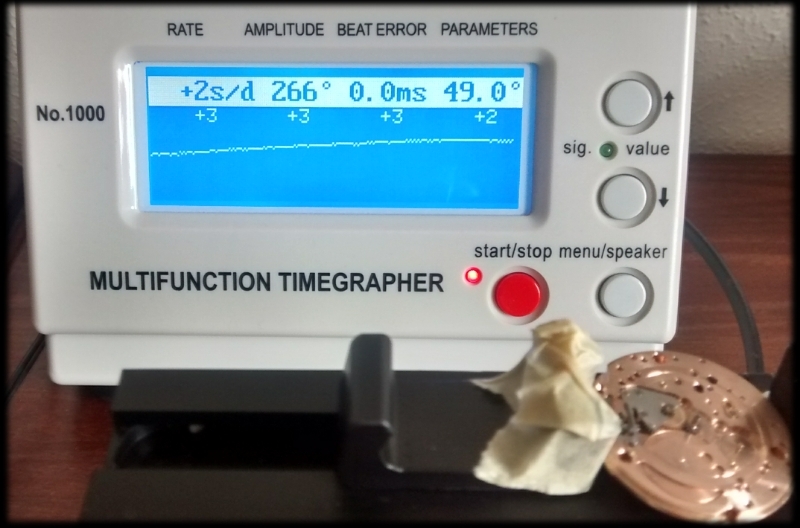
I am still learning how to read these plots and wanted to share something I believe I have worked out. I tested another Connie I have worked on. It's a 561 (chronometer) and is running within spec (perhaps a bit fast) but has this feature on the timegraph:
71757

Either one escape wheel tooth is dirty/badly oiled.
Or
One tooth is damaged and I did not see it.


I'm back to this again after a holiday. This movement had a Max amplitude of 240 degrees fully wound and showed the above problem.
Well, after the great advice on here, I redid this movement with synthetic oils, updated the way I work with the fixodrop and added another new mainspring. It's not cased yet but I have excellent results so, thanks to everyone who contributed here. Special mention to Al.

I'm still not at the 300 degree holy grail but far above the 160 degree requirement. Will running out the full test but this looks very good to me.

Cheers, Chris.

 
Posts
383
Likes
410
I'm back to this again after a holiday. This movement had a Max amplitude of 240 degrees fully wound and showed the above problem.

Well, after the great advice on here, I redid this movement with synthetic oils, updated the way I work with the fixodrop and added another new mainspring. It's not cased yet but I have excellent results so, thanks to everyone who contributed here. Special mention to Al.


I'm still not at the 300 degree holy grail but far above the 160 degree requirement. Will running out the full test but this looks very good to me.


Cheers, Chris.

Hi Chris,
let it run for a couple of weeks before testing again. You might gain some additional 10-15°, notwithstanding fixodrop.
Also, test the movement fully wound and 24 hours later for isocrhonism.
Have you got the specs of the new mainspring?

Cheers,

Maurice
 
Posts
2,219
Likes
4,952
Hi Maurice

I let it run overnight before a quick full wind test so, I shall leave the full 0h/24h test for a week or so and see. I am in no hurry. The new mainspring is an Omega part 5501208 and the only writing on the install ring is 'Generale Ressorts SA'. I tried one or two generic mainsprings but for the small extra cost involved, I have gone back to genuine parts now.

I think the big change for me is using the synthetic oils and letting the movement run for 15 minutes before applying the 9415 to the pallet stones. You really can see this grease between the escape gear and pallet stone very clearly as you cycle the movement (under magnification obviously). Using the lighter oil on the 4th wheel and escape pivots will obviously have helped. The final improvement was to buy a 'jewel picker upper' pen which makes oiling the incabloc 'contre pivot' endstone a trivial task as it is far easier to hold. These synthetic oils do seem to go exactly where you want.

Will let you know the full test results.

Cheers, Chris.
 
Posts
2,219
Likes
4,952
Disimpan


And 'disimpan' to you! 😉 I suppose this is to find again? [Edit - just discovered this is a real word meaning saved. Cunning]

I need one of these search words so, 'Speedmaster'. No hang on, what about ' Edim7 '.
 
Posts
5,753
Likes
2,939
And 'disimpan' to you! 😉 I suppose this is to find again? [Edit - just discovered this is a real word meaning saved. Cunning]

I need one of these search words so, 'Speedmaster'. No hang on, what about ' Edim7 '.

Yeah Dennis and Jim invented this method to make sure we could search our favorite topic quickly.
 
Posts
514
Likes
561
I'm new to this forum and agave a question for Al.

For optimum performance, do you lubricate the centre second arbour, and if so do you use 9010?